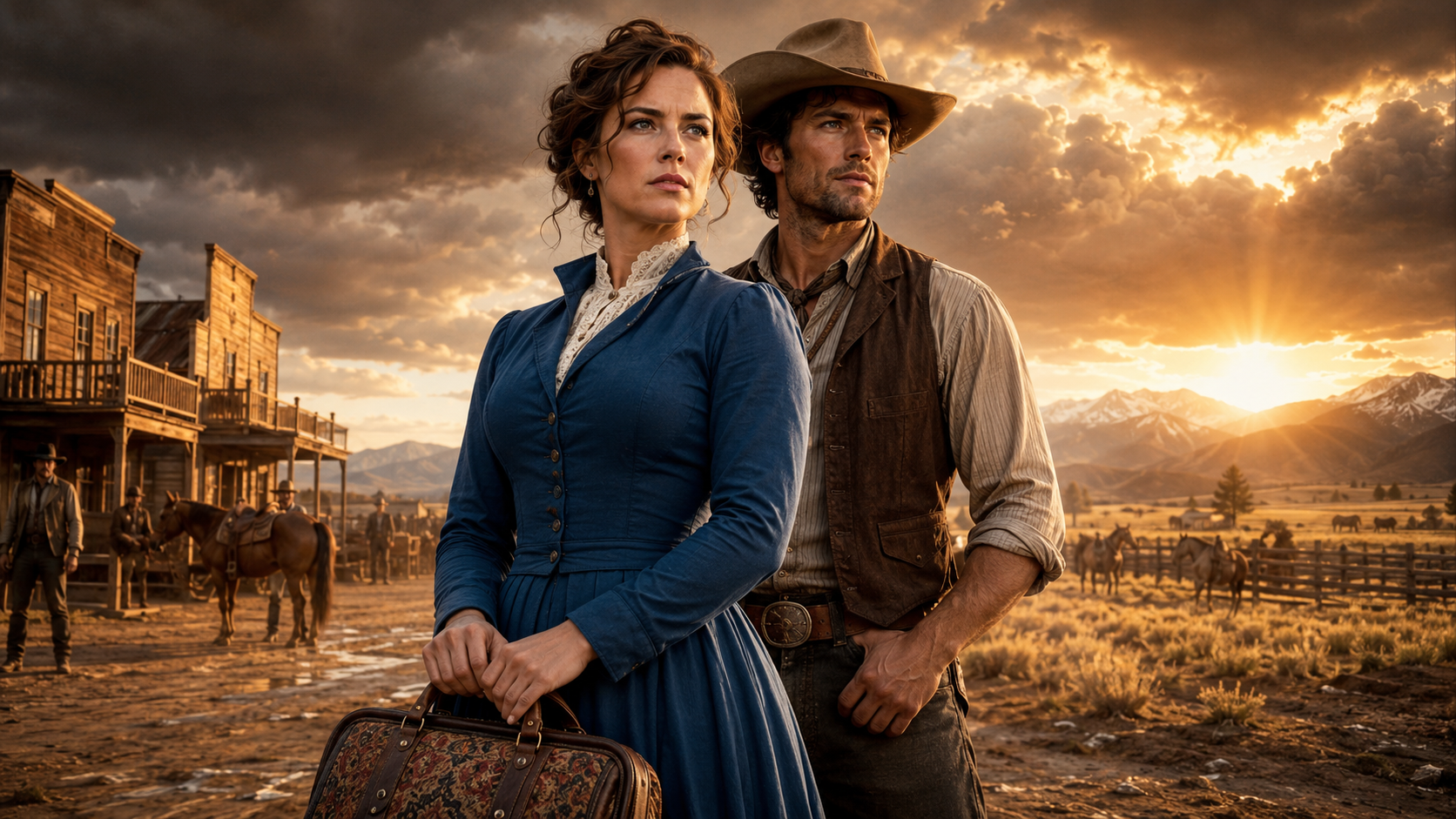
His mouth twisted. “Daniel was soft, but he was blood.”
“He wrote that we were to marry.”
“Wrote a lot of things, I expect.”
“I sold what little I owned to come here.”
“That was your decision.”
Nora felt the boards beneath her shoes, the heat against her neck, the town watching from behind curtains and wagon wheels.
“Mr. Mercer,” she said, “I am not asking for charity. I ask only for the trunk Daniel said he was keeping for me and any letters of mine found among his things.”
Evan leaned against the doorframe. “Nothing here belongs to you.”
“My name may not be on a marriage certificate, but it is on those letters.”
“Letters burn.”
For the first time since stepping off the stage, fear found Nora’s spine.
“What did you say?”
“I said you ought to buy a ticket east while you’ve still got fare.”
“I do not.”
“Then find work. Or find another fool.”
The door shut.
For a while, Nora did not move.
She had come west to become a wife. By sunset, she was no one’s bride, no one’s widow, no one’s family, and no one’s concern.
Behind her, the old woman in the black bonnet spoke.
“You can cry later. Not in front of that door.”
Nora turned.
The woman stood at the gate, holding a basket covered with a white cloth. Up close, she smelled faintly of cloves and woodsmoke.
“My name is Beatrice Kane,” she said. “I own the Lantern Star boardinghouse. Can you cook?”
“Yes.”
“Can you scrub?”
“Yes.”
“Can you keep your tongue when men deserve losing ears?”
Nora glanced toward the closed door. “Not always.”
The old woman smiled. “Good. I dislike saints. They faint too much.”
“I have no money for a room.”
“I did not ask if you had money. I asked if you could work.”
Nora looked past her toward town. A few faces vanished from windows.
“I can work,” she said.
“Then come.”
The Lantern Star was not much to look at. Its porch sagged on the left, its sign had lost most of its paint, and the kitchen smelled of onions, yeast, coffee, and old arguments. But the sheets were clean. The back room had a lock. And Beatrice Kane, for all her snapping, placed a bowl of stew in Nora’s hands before asking another question.
By supper, everyone knew the dead man’s intended bride was serving biscuits.
Deke Malloy came in with six others and took the center table as if it belonged to him. He waited until Nora approached with a platter before raising his voice.
“Say, Miss Ashford, you charging extra for wedding cake, seeing as the groom skipped out by dying?”
Forks paused.
Chairs creaked.
Nora set the platter down.
“I would charge you extra for manners,” she said, “but I doubt you could afford even a sample.”
A ranch hand near the stove choked on his coffee.
Deke’s face darkened. “You think you’re clever?”
“No. I think I am tired. Clever would require more energy than you deserve.”
Beatrice shouted from the kitchen, “Deke Malloy, either eat your supper or wear it.”
That ended the matter for the evening.
But cruelty, Nora learned, was like dust in Mercy Bend. Sweep it from one corner and it settled in another.
Men watched her carry water as if strength in a woman were a circus trick. Women looked at her worn cuffs and whispered that Daniel Mercer must have been desperate. Children repeated things they had heard at home.
The bride with no groom.
The woman too stubborn to leave.
The eastern spinster who had come chasing a husband and found a grave.
Nora did not answer every insult. She could not afford the time. Work began before dawn and did not end until Beatrice blew out the kitchen lamps. Nora kneaded bread, peeled potatoes, mended sheets, hauled ash, washed cups, swept floors, and learned the names of men who could laugh at her in the evening and ask for more coffee in the morning.
At night, in her small room, she read Daniel’s letters.
Not because she loved him. That would have been too grand a word for a man she had never touched.
But she had loved the door he seemed to open.
And now the door had shut on her fingers.
One week after Nora arrived, the storm came.
It built all afternoon beyond the western ridge, stacking black clouds over the open range. By dusk, thunder rolled so low that the windows shook in their frames. Men crowded into the Lantern Star early, hungry and restless. Rain began as a whisper. Then it became a roar.
Nora was carrying a tray of tin cups when the front door burst open.
Wind slammed through the dining room, blowing out two lamps.
A young cowboy stumbled inside, soaked and wild-eyed.
“Help!” he shouted. “Rider down by Miller’s Cut! Horse came in bloody!”
The room erupted.
Beatrice seized a lantern. “Who?”
“Caleb Hawthorne.”
A silence heavier than the storm fell over the room.