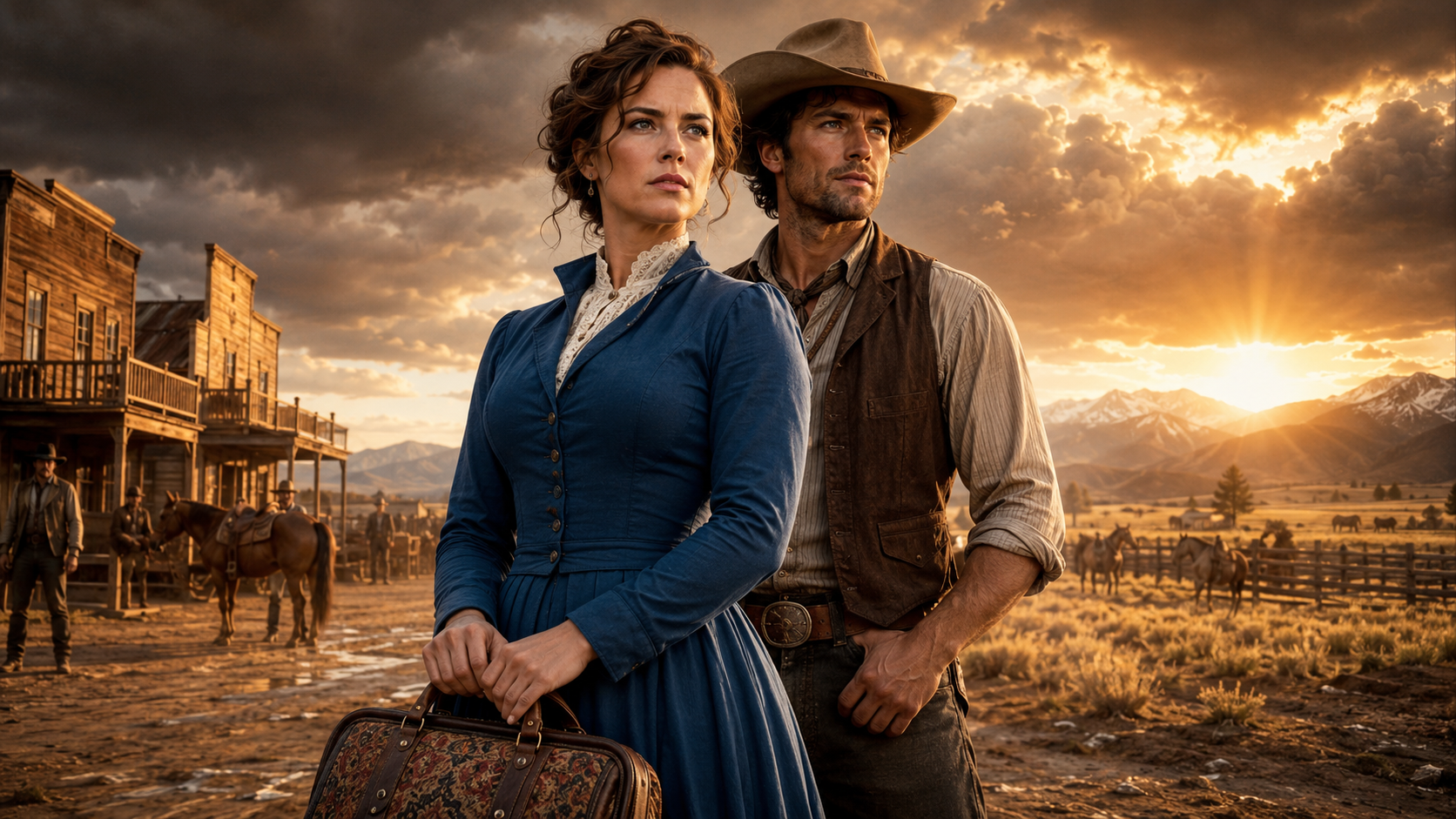
When Nora Ashford stepped down from the eastbound stage in Mercy Bend, the first thing she noticed was not the heat, though it struck her face like an opened oven. It was not the dust either, though it lifted from the street in pale sheets and clung to the hem of her blue traveling dress. It was the silence.
A small town should have had noise. Wagons. Horses. Men shouting over freight. Women calling children back from muddy ditches. Doors swinging. Spurs scraping. Somebody laughing too loudly outside a saloon.
Mercy Bend had all those things, but the moment Nora appeared with her carpetbag in one hand and a wooden hatbox in the other, every sound seemed to thin.
She knew that kind of silence.
She had heard it in Boston when her employer’s wife discovered Nora reading in the parlor instead of polishing silver. She had heard it in a church basement when charitable ladies decided a woman without family must also be without pride. She had heard it from men who answered matrimonial advertisements and then went quiet when they learned she was not young enough to be foolish, not pretty enough to be displayed, and not meek enough to be purchased.
So Nora did what she always did.
She lifted her chin, adjusted the glove on her left hand, and walked straight toward the station office.
The station agent was a thin man with a fox-colored mustache and a habit of blinking too fast. He looked at her name written on the folded letter she placed on the counter.
“Nora Ashford,” he read.
“Yes.”
“Come for Daniel Mercer?”
“Yes. He was to meet me here.”
The man’s blinking worsened.
Behind her, someone coughed. Not the kind of cough that cleared a throat. The kind that warned other people to listen.
Nora turned halfway. Three men stood near the freight platform, pretending to be interested in sacks of flour.
The station agent removed his hat.
That was when Nora knew.
“Miss Ashford,” he said carefully, “I’m sorry to tell you. Mr. Mercer passed four days ago.”
The words did not strike her all at once. They arrived like stones dropped one by one into a deep well.
Passed.
Four days.
Mr. Mercer.
Her fingers tightened around the handle of the carpetbag.
“How?” she asked.
“Horse threw him near Blackthorn Wash. Broke his neck, they say. Buried him Sunday.”
Sunday.
On Sunday, Nora had been two hundred miles away, sitting upright in a hard seat, reading Daniel Mercer’s last letter until the creases nearly tore. He had written that the house needed curtains. He had written that the west was harsh but honest. He had written that he was not a romantic man, but he believed kindness could be built the same way a fence was built: post by post, day by day, until something stood between a person and the wilderness.
Nora had believed him.
For six months, she had believed him.
A voice from the freight platform said, “Well, ain’t that mercy? Poor Daniel got spared the wedding.”
The other men laughed.
Not loudly. Worse than loudly. They laughed as if they had expected to.
Nora turned fully.
The man who had spoken was broad in the belly, narrow in the eyes, and pleased with himself in the way only cruel fools ever are.
He swept his hat from his head in a mock bow. “No offense, miss. Just saying, a man ought to know what he’s ordering before the package arrives.”
The station agent muttered, “Deke, hush.”
But Deke only grinned.
Nora looked at him for one long moment.
Then she said, “Sir, if your wit were a horse, it would have been shot for mercy before reaching town.”
The laugh that followed came from somewhere unexpected.
An old woman in a black bonnet stood outside the dry goods store, one gloved hand pressed to her mouth. Her eyes were sharp as sewing needles.
Deke’s grin collapsed.
Nora turned back to the station agent. “Where did Mr. Mercer live?”
“North edge. Little white house. But his brother took possession yesterday.”
“His brother?”
“Evan Mercer. Runs cattle out toward the salt flats.”
“Then I will speak to Mr. Evan Mercer.”
The agent looked as if he wanted to advise against it. He did not. Men rarely warned women in time to be useful.
The white house on the north edge of town had no curtains.
Nora stood outside the gate and stared at the windows. Daniel had mentioned the windows in his letters. Morning light in the kitchen. A narrow view of the church steeple. A place where he imagined her keeping basil in cracked cups because he had heard eastern women liked green things.
The gate creaked under her hand.
Before she reached the porch, the door opened.
Evan Mercer was broader than his dead brother had looked in the photograph. His beard was blond, his face red from sun, and his eyes traveled over Nora with open disappointment.
“You’re the woman.”
“I am Nora Ashford.”
He did not invite her in.
“I’m sorry for your loss,” she said.
His mouth twisted. “Daniel was soft, but he was blood.”
“He wrote that we were to marry.”
“Wrote a lot of things, I expect.”
“I sold what little I owned to come here.”
“That was your decision.”
Nora felt the boards beneath her shoes, the heat against her neck, the town watching from behind curtains and wagon wheels.
“Mr. Mercer,” she said, “I am not asking for charity. I ask only for the trunk Daniel said he was keeping for me and any letters of mine found among his things.”
Evan leaned against the doorframe. “Nothing here belongs to you.”
“My name may not be on a marriage certificate, but it is on those letters.”
“Letters burn.”
For the first time since stepping off the stage, fear found Nora’s spine.
“What did you say?”
“I said you ought to buy a ticket east while you’ve still got fare.”
“I do not.”
“Then find work. Or find another fool.”
The door shut.
For a while, Nora did not move.
She had come west to become a wife. By sunset, she was no one’s bride, no one’s widow, no one’s family, and no one’s concern.
Behind her, the old woman in the black bonnet spoke.
“You can cry later. Not in front of that door.”
Nora turned.
The woman stood at the gate, holding a basket covered with a white cloth. Up close, she smelled faintly of cloves and woodsmoke.
“My name is Beatrice Kane,” she said. “I own the Lantern Star boardinghouse. Can you cook?”
“Yes.”
“Can you scrub?”
“Yes.”
“Can you keep your tongue when men deserve losing ears?”
Nora glanced toward the closed door. “Not always.”
The old woman smiled. “Good. I dislike saints. They faint too much.”
“I have no money for a room.”
“I did not ask if you had money. I asked if you could work.”
Nora looked past her toward town. A few faces vanished from windows.
“I can work,” she said.
“Then come.”
The Lantern Star was not much to look at. Its porch sagged on the left, its sign had lost most of its paint, and the kitchen smelled of onions, yeast, coffee, and old arguments. But the sheets were clean. The back room had a lock. And Beatrice Kane, for all her snapping, placed a bowl of stew in Nora’s hands before asking another question.
By supper, everyone knew the dead man’s intended bride was serving biscuits.
Deke Malloy came in with six others and took the center table as if it belonged to him. He waited until Nora approached with a platter before raising his voice.
“Say, Miss Ashford, you charging extra for wedding cake, seeing as the groom skipped out by dying?”
Forks paused.
Chairs creaked.
Nora set the platter down.
“I would charge you extra for manners,” she said, “but I doubt you could afford even a sample.”
A ranch hand near the stove choked on his coffee.
Deke’s face darkened. “You think you’re clever?”
“No. I think I am tired. Clever would require more energy than you deserve.”
Beatrice shouted from the kitchen, “Deke Malloy, either eat your supper or wear it.”
That ended the matter for the evening.
But cruelty, Nora learned, was like dust in Mercy Bend. Sweep it from one corner and it settled in another.
Men watched her carry water as if strength in a woman were a circus trick. Women looked at her worn cuffs and whispered that Daniel Mercer must have been desperate. Children repeated things they had heard at home.
The bride with no groom.
The woman too stubborn to leave.
The eastern spinster who had come chasing a husband and found a grave.
Nora did not answer every insult. She could not afford the time. Work began before dawn and did not end until Beatrice blew out the kitchen lamps. Nora kneaded bread, peeled potatoes, mended sheets, hauled ash, washed cups, swept floors, and learned the names of men who could laugh at her in the evening and ask for more coffee in the morning.
At night, in her small room, she read Daniel’s letters.
Not because she loved him. That would have been too grand a word for a man she had never touched.
But she had loved the door he seemed to open.
And now the door had shut on her fingers.
One week after Nora arrived, the storm came.
It built all afternoon beyond the western ridge, stacking black clouds over the open range. By dusk, thunder rolled so low that the windows shook in their frames. Men crowded into the Lantern Star early, hungry and restless. Rain began as a whisper. Then it became a roar.
Nora was carrying a tray of tin cups when the front door burst open.
Wind slammed through the dining room, blowing out two lamps.
A young cowboy stumbled inside, soaked and wild-eyed.
“Help!” he shouted. “Rider down by Miller’s Cut! Horse came in bloody!”
The room erupted.
Beatrice seized a lantern. “Who?”
“Caleb Hawthorne.”
A silence heavier than the storm fell over the room.
Nora knew the name. Everyone knew the name, even those who pretended not to care about powerful men. Caleb Hawthorne owned the north pasture, the south pasture, the river bend, the old orchard, two hay meadows, a timber claim, and grazing rights that ran so far across the valley people joked the sun had to ask his permission before setting.
He was thirty-four, unmarried, rarely seen in town, and spoken of with either envy or anger.
Deke Malloy stood. “If Hawthorne’s down, half the valley just got interesting.”
Beatrice snapped, “And if you had a soul, Deke, that would be interesting too.”
She turned to Nora. “Boil water. Tear clean linen. Bring my medicine chest.”
“You’re going out?” Nora asked.
“He may not survive the ride here.”
“I have steadier hands,” Nora said.
Beatrice stared.
Nora swallowed. “During the fever years in Boston, I assisted Dr. Vale at the charity ward. I have cleaned wounds, set splints, stitched cuts, and held men down while they cursed God and their mothers.”
Another crack of thunder shook the house.
Beatrice handed her the lantern. “Then move.”
They found Caleb Hawthorne at Miller’s Cut, half under a fallen cottonwood, rain washing blood from his face into the mud.
His horse stood nearby, trembling. Two ranch hands were trying to lift the tree branch pinning his leg, but every movement made Caleb groan through clenched teeth. A dark stain spread beneath his coat near the ribs.
Nora knelt in the mud.
“Mr. Hawthorne,” she said sharply. “Can you hear me?”
His eyes opened.
They were not the cold blue she expected from a rich man in a story. They were brown, almost black, and unfocused with pain.
“Who are you?” he rasped.
“The woman keeping you alive if you cooperate.”
One corner of his mouth moved. It might have been a smile. It might have been agony.
“Bossy angel,” he muttered.
“Not an angel. Hold the lantern higher!”
The last command was for Beatrice, who obeyed without complaint.
Nora cut Caleb’s coat open. The rib wound was ugly but not immediately fatal if the bleeding stopped. The leg worried her more. The branch had trapped him hard, and the angle of his boot was wrong.
“On three,” she told the ranch hands. “Lift only enough to free him. Not a hair more. If you jerk, I will haunt you while living.”
They stared.
“Now!”
They lifted.
Caleb roared.
Nora dragged his leg clear, packed cloth hard against his side, and tied it down with a strip torn from her own petticoat.
He nearly passed out.
“Stay with me,” she said, leaning close.
His eyes found hers.
“What’s your name?”
“Nora.”
“Nora,” he repeated, as though fixing it somewhere inside himself. “If I die, tell my foreman he’s fired.”
“You may fire him yourself tomorrow.”
“That a promise?”
“That is a professional opinion.”
It took four men and a wagon to bring Caleb back to the Lantern Star. Nora worked through the night. She cleaned mud from the wound, picked splinters from torn skin, stitched by lamplight, wrapped the broken leg as best she could, and argued with every man who tried to crowd the room.
When Caleb thrashed from pain, she spoke close to his ear.
“Breathe. In. Out. You are not dying on my table. I have had enough men abandon appointments this month.”
His fever came near dawn.
He muttered names Nora did not know. He cursed someone called Silas. Once he caught her wrist with surprising strength.
“Don’t sell the water,” he whispered.
“I won’t.”
His grip loosened.
By morning, Mercy Bend had a new story.
The bride they mocked had saved Caleb Hawthorne.
That did not make them kind, but it made them careful.
Caleb woke properly two days later.
Nora was changing the cloth at his ribs when his eyes opened and focused.
“You,” he said.
“Yes. Try not to sound disappointed.”
His gaze moved over her face. “I remember rain.”
“There was rain.”
“A tree.”
“That too.”
“You ordering men around like a general.”
“I was polite at first.”
“No, you weren’t.”
Nora smiled despite herself.
Caleb watched the smile as if it surprised him. “How bad?”
“Your ribs are stitched. Your leg is broken. You lost blood. You gained a reputation for being difficult even while unconscious.”
“That all?”
“For now.”
He looked toward the window. “My horse?”
“Alive.”
“My men?”
“Terrified of me.”
“Good.”
He closed his eyes, then opened them again. “Thank you, Nora.”
No one in Mercy Bend had said her name that way. Not as a joke. Not as a label. Not as Daniel Mercer’s failed bride.
Just Nora.
She busied herself with the bandage. “Do not thank me until you survive my cooking.”
“I own cattle, Miss Ashford. I have survived worse.”
Over the next week, Caleb healed slowly and badly, which was to say he complained less than most men but attempted too much too soon. Nora caught him trying to stand on the third day and threatened to tie him to the bed frame.
“You would not,” he said.
“I have torn linen, curtain rope, and the moral support of Mrs. Kane.”
Beatrice appeared in the doorway. “I’ll fetch knots from the stable.”
Caleb sat back down.
A strange companionship grew in the sickroom.
He learned she liked coffee strong enough to frighten weak men. She learned he read old newspapers from back to front. He learned she had crossed half a country to marry Daniel Mercer. She learned he had known Daniel, though not well.
“He was careful,” Caleb said one afternoon while rain tapped softly against the glass. “Quiet. Asked questions others avoided.”
“What kind of questions?”
Caleb’s face changed.
“The kind that get men disliked.”
Nora folded a clean cloth. “He wrote that Mercy Bend needed honesty.”
“It does.”
“Did someone kill him?”
Caleb was silent long enough to answer.
“I don’t know.”
“But you suspect.”
“I suspect many things. Proving them is where the ground falls away.”
Before Nora could ask more, boots sounded in the hall.
A man entered without knocking.
He was dressed too finely for mud, with silver at his cuffs and a smile polished thin. His hair was black, his beard trimmed sharp, and his eyes moved around the room as if pricing everything in it.
“Caleb,” he said. “Still breathing. How inconvenient.”
Caleb’s expression hardened. “Silas Crowley.”
Nora remembered the fever whisper.
Do not sell the water.
Silas looked at her. “And this must be the famous nurse-bride.”
Nora did not answer.
“I hear you arrived for one man and attached yourself to another with admirable speed.”
Caleb’s hand tightened on the sheet.
Nora stepped between them before he could move.
“Mr. Hawthorne is not well enough for visitors.”
“How fortunate that I am not here socially.” Silas removed papers from inside his coat. “The railroad offer expires Friday. Your signature is required. Given your condition, I thought it merciful to bring the agreement here.”
“I told you no.”
“Before your accident, yes. Accidents change a man’s view.”
Caleb’s voice dropped. “Especially when they are arranged.”
Silas laughed softly. “Fever has made you poetic.”
Nora saw it then. Not proof, but shape. The way Silas stood too comfortably in a room where he was hated. The way his eyes kept moving to Caleb’s bandaged leg. The way he had expected weakness and found witnesses.
“What is being sold?” she asked.
Silas’s smile turned toward her. “Nothing that concerns you.”
“Then you will not mind saying.”
Caleb answered. “Water rights along Copper Run.”
Nora looked at him. “The river that feeds the small farms east of town?”
His brows lifted. “You learn quickly.”
“I listen while carrying plates.”
Silas slid the papers back into his coat. “How charming. A serving woman with opinions.”
“A dangerous thing,” Nora said. “We are often near knives.”
Beatrice laughed from the hallway.
Silas’s smile vanished.
“You should be careful, Miss Ashford. Mercy Bend has already buried one man who involved himself in matters above his station.”
The room went still.
Nora felt Caleb’s attention sharpen.
“What did Daniel Mercer know?” she asked.
Silas tilted his head. “I have no idea.”
“You knew I meant Daniel.”
His eyes cooled.
Nora’s pulse beat hard in her throat, but she did not step back.
Silas left with a promise to return.
That night, Nora took Daniel’s letters from beneath her mattress.
She had read them in grief. Then anger. Then habit.
Now she read them as evidence.
Daniel had been plain in most things. His handwriting was square. His sentences were practical. But there were oddities. Phrases that had seemed sentimental now felt placed.
Bring the green ribbon if you still have it. I always trust a woman who can keep small things safe.
The west hides its truths in hems and seams.
A house is only yours when the water reaches it honestly.
Nora opened her carpetbag and removed the green ribbon Daniel had mailed with his first photograph. She had thought it an awkward gift. Too simple. Too narrow. She had tied it around her letters and carried it west because throwing away kindness, even strange kindness, had felt wrong.
Under the lamplight, she examined the ribbon.
At first she saw nothing.
Then she noticed the stitches.
They were not decorative. Some were long, some short, arranged in uneven groups along the edge. Nora fetched paper and copied the pattern. Long, short, short. Long, long. Short. Break. More groupings.
She worked until her candle guttered.
At dawn, she understood.
Numbers.
Coordinates.
Not a love token. A map.
She took the ribbon to Caleb.
He listened without interrupting, his face growing still.
“Copper Run,” he said when she finished. “Those coordinates mark the original spring.”
“What spring?”
“The first water claim in the valley. My father filed it before there was a town. If Daniel had proof the spring belongs to my land, Silas cannot sell the water to the railroad without me.”
“But he needs your signature.”
“Or my death.”
Nora’s hand closed around the ribbon. “Daniel hid this with me.”
“Yes.”
“He brought me here for proof, not marriage.”
Caleb’s expression softened. “Maybe both.”
She looked away.
It should have humiliated her, being used by a dead man. Yet beneath the sting was something stronger.
Daniel had chosen her because she would come. Because she would keep small things safe. Because she was exactly what Mercy Bend had mocked: a woman desperate enough to cross the country, stubborn enough to stay, and invisible enough to carry a secret past men who thought her unworthy of notice.
Nora stood. “Where would Daniel keep the rest?”
Caleb did not hesitate. “Church bell tower.”
“Why?”
“He repaired the bell last winter. Said no one looks up unless something is burning.”
By sunset, Nora had climbed the church stairs in her work dress while Beatrice kept watch below with a shotgun hidden beneath her shawl.
In the bell tower, behind a loose board, Nora found an oilcloth packet.
Inside were copies of land claims, survey drawings, and a signed statement accusing Silas Crowley of bribing the county clerk, altering water records, and arranging Daniel Mercer’s murder after Daniel refused to destroy the originals.
At the bottom was one final note.
Miss Ashford, forgive me. I needed courage and could not find enough in myself. So I sent for someone who had already proved she owned it.
Nora folded the note with shaking hands.
Below, a horse screamed.
Then came Beatrice’s shout.
Nora rushed down to find Silas Crowley in the churchyard with two armed men. Beatrice stood between them and the door, shotgun raised.
Silas looked up at Nora.
“You have something of mine.”
Nora tucked the packet beneath her bodice. “No. I have something Daniel died for.”
His face hardened. “Give it to me.”
“No.”
One of the armed men moved.
Beatrice cocked the shotgun. “Take another step and meet your maker with an untidy chest.”
For a moment, everyone froze.
Then a gunshot cracked from the street.
Not Beatrice’s.
One of Silas’s men dropped his pistol and cried out, clutching his hand.
Caleb Hawthorne sat on a horse at the end of the church path, pale as bone, one leg strapped stiff, a revolver in his hand.
Behind him rode six Hawthorne ranch hands.
Nora stared. “You should be in bed!”
Caleb swayed slightly in the saddle. “I was losing the argument.”
“You rode with a broken leg?”
“Badly.”
Silas drew his pistol.
Nora did not think. She grabbed the church rope and pulled with both hands.
The bell exploded overhead.
The horse beneath Silas reared. His shot went wild, shattering a church window. Caleb’s men surged forward. Beatrice fired into the dirt near Silas’s boots, and that ended his courage. Within seconds, he was disarmed, cursing, and pinned against the fence.
The whole town came running.
For once, they arrived in time to see the truth instead of inventing it afterward.
The trial lasted three days.
The evidence in Daniel’s packet brought down Silas Crowley, the county clerk, and two hired riders who confessed before the judge finished reading the charges. Evan Mercer, who had burned Nora’s letters and tried to take Daniel’s house, claimed ignorance until one of Silas’s men named him as the person paid to search Daniel’s belongings.
Mercy Bend became very polite to Nora Ashford.
Deke Malloy even removed his hat when she passed.
She looked at him once and said, “Careful. Sudden manners may cause dizziness.”
Two weeks later, Caleb was well enough to sit on the Lantern Star porch with his leg propped on a crate and his temper mostly restored.
Nora brought him coffee.
“You are supposed to be resting,” she said.
“I am sitting.”
“You are planning.”
“That too.”
She handed him the cup. “Planning what?”
He looked across the street toward Daniel Mercer’s little white house. Its windows were still bare.
“I bought the house from the court sale.”
Nora went still.
Caleb added quickly, “Not for myself.”
“For whom?”
“For you.”
Her face closed before she could stop it.
He saw it and cursed softly. “No. I said that badly.”
“Yes, you did.”
“I meant I bought it before Evan could steal it back. The deed is in your name if you want it. If you do not, we sell it and the money is yours. Daniel owed you that much. So does this town.”
Nora stared at him.
“You put it in my name?”
“Yes.”
“Without asking?”
His mouth tightened. “I was afraid asking would give someone time to interfere.”
“That is not an answer I dislike, which annoys me.”
A smile touched his face.
Nora sat beside him.
For a while, they watched wagons move through the dust.
Then Caleb said, “I have another offer. This one I am asking before doing.”
“Wise.”
“I want to build a clinic near Copper Run. The valley needs one. Beatrice says you could run it.”
“Beatrice says many things.”
“She also says I am in love with you and too slow to mention it.”
Nora nearly dropped her cup.
Caleb looked at her directly, no teasing in his face now.
“I know you did not come here for me,” he said. “I know the last man who wrote you promises buried secrets inside them. I will not offer rescue. You have rescued yourself more than once. But if you ever wanted a partner, Nora Ashford, I would consider it the honor of my life to be chosen.”
The porch boards creaked in the wind.
Nora thought of Boston. Of silence. Of laughter at the station. Of Daniel’s letters. Of rain and blood and a man whispering her name as if it mattered.
She looked at Caleb Hawthorne, owner of half the valley, sitting helplessly with a broken leg and offering her not shelter, not pity, not purchase, but choice.
“I will not be chosen because I saved you,” she said.
“No.”
“And not because Mercy Bend feels guilty.”
“No.”
“And not because you think a woman who can stitch a wound can mend everything broken in you.”
His eyes lowered. “No.”
She softened. “Then ask me again when you can stand without wobbling.”
Caleb’s smile came slowly. “That may be a month.”
“I have crossed farther distances.”
He laughed then, and the sound moved through Nora like sunlight after a hard winter.
By autumn, the little white house had curtains.
Green ones.
The clinic opened with two rooms, a cabinet of medicines, a clean table, and a bell Nora rang whenever men argued with her instructions. Beatrice became its unofficial guard. Caleb donated land and money but learned quickly not to call it his clinic unless he wished to be corrected in public.
Mercy Bend changed because towns do change, though never as quickly as they claim. Some people remained foolish. Some remained cruel. But now, when a stranger stepped off the stage with hope in one hand and fear in the other, fewer people laughed.
Nora saw to that.
One bright morning, Deke Malloy came in with a nail through his palm and tears standing in his eyes.
Nora examined the wound.
“Will I lose the hand?” he asked.
“Not if you follow instructions.”
“I hate instructions.”
“I know. That is why you are here with a nail in your hand.”
Caleb, leaning in the doorway with a cane, turned his face away to hide a smile.
Later, when the clinic emptied, he walked with Nora to the porch.
He no longer wobbled.
Not much.
He stood before her, hat in his hands.
“Nora Ashford,” he said, “will you marry me?”
She pretended to consider.
“Do you promise never to make decisions about my house without telling me?”
“Yes.”
“Do you promise that if I say no, you will still fund the clinic roof repairs?”
“Yes.”
“Do you promise not to ride through a thunderstorm with broken bones again?”
He hesitated.
“Caleb.”
“I promise to make a sincere effort.”
“That is the best I will get, I suppose.”
He stepped closer. “Is that a yes?”
Nora looked down the street where she had once arrived unwanted, unclaimed, and laughed at. She looked at the house with green curtains, the clinic with its open door, the valley beyond town where water ran honestly again.
Then she looked at the man waiting for her answer.
“Yes,” she said. “But I am not marrying the owner of half the valley.”
“No?”
“No. I am marrying the man who finally learned to ask.”
Caleb laughed and drew her carefully into his arms.
Across the street, Beatrice Kane shouted, “About time!”
The whole town heard.
This time, when Mercy Bend laughed, Nora laughed with it.
And years later, when people told the story, they always began the same way:
A mail-order bride came west to marry a dead man, and fools said the groom was lucky to have escaped her.
But the fools were wrong.
Because the bride they mocked saved the richest cowboy in the valley, uncovered the crime that nearly stole the river, built a clinic where there had only been dust, and proved that a woman rejected at the station could still become the reason a whole town learned shame, courage, and grace.

