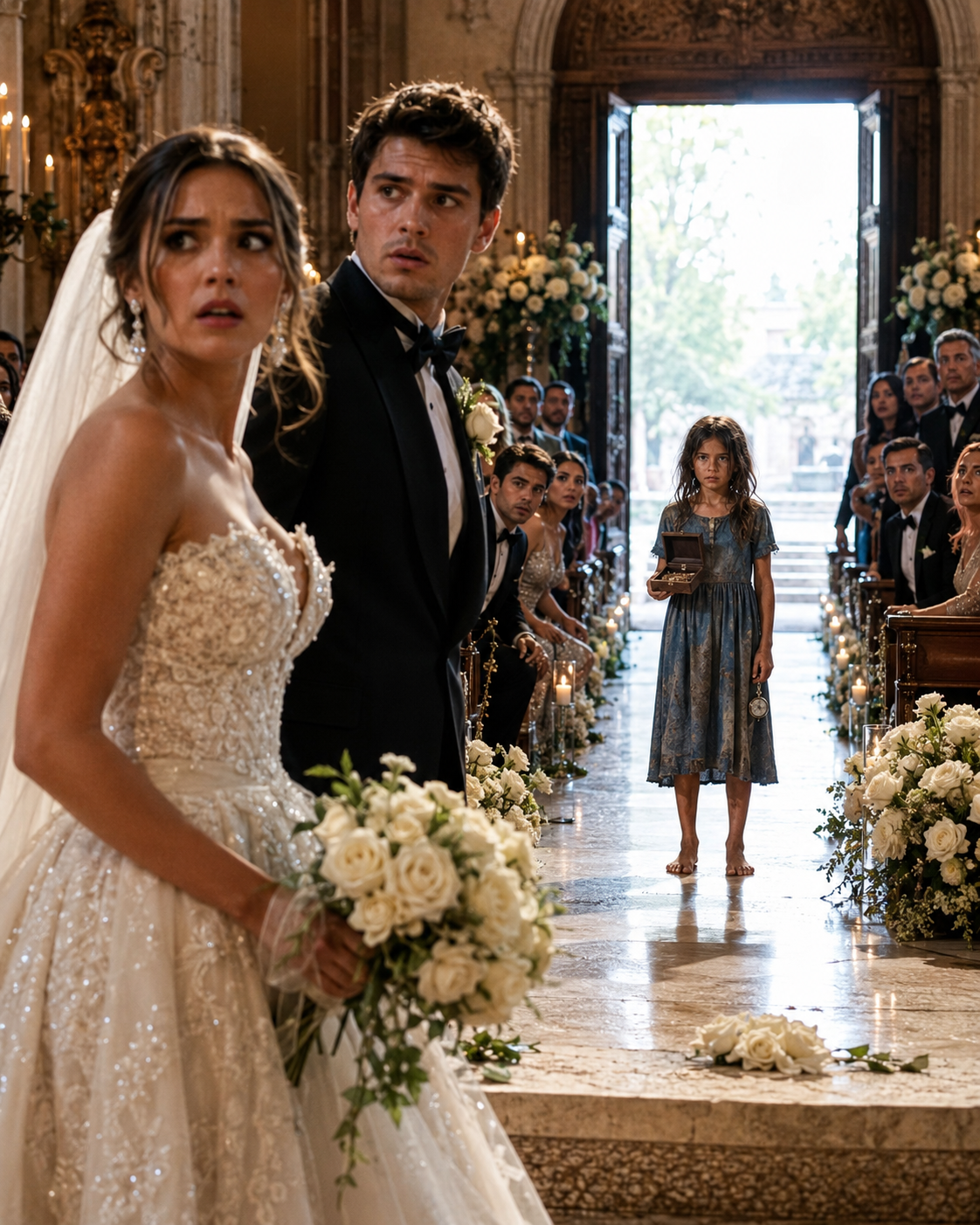
Julian removed his jacket and knelt in front of Ruby.
She took one cautious step backward.
“I’m not going to touch you,” he said. “I only want to ask whether you are hurt.”
“My feet hurt.”
“Did you come here alone?”
Ruby nodded.
“I took a bus. Then I walked because the driver said the street was closed for the wedding.”
Julian looked toward the enormous floral arrangements, the musicians, the diamonds, and the hundreds of people who had arrived in private cars.
A nine-year-old girl had crossed the city barefoot to reach them.
“Where were you staying after your mother died?”
“At our apartment.”
“Alone?”
Ruby nodded again.
Something inside Julian broke.
Eleanor came forward and removed the pale shawl from her shoulders. She wrapped it gently around Ruby without embracing her.
Ruby looked up at the old woman.
“Are you Nathan’s mother?”
Eleanor’s lips trembled.
“Yes.”
“My mother said he laughed whenever he burned toast.”
Eleanor gave a sound that was half laugh, half sob.
“He burned everything.”
For the first time, Ruby’s expression softened.
Julian stood.
He looked at his assistant, Daniel Mercer, who was waiting near the front row.
“Contact child services and our family attorney. Make sure Ruby has somewhere safe tonight. Arrange for a doctor to examine her feet. No reporters. No photographs.”
Ruby immediately tightened her grip on the music box.
“Are you sending me away?”
“No,” Julian said. “I am making sure nobody can ever hide you again.”
She searched his face as if trying to decide whether promises from wealthy men were worth anything.
“My mother said promises are easy when people are watching.”
Julian nodded.
“She was right.”
He held out the brass key.
“Then we won’t make promises. We’ll begin with the truth.”
North Station had been closed for nearly twenty years.
By evening, rain hammered its cracked glass roof. Julian arrived with Eleanor, Ruby, Daniel, an independent attorney, and a representative from child services.
Cabinet number two hundred and fourteen stood behind a rusted luggage counter.
Ruby inserted the brass key.
Inside they found a sealed metal case.
It contained copies of Nathan’s letters to Elise, medical records documenting Ruby’s birth, photographs, financial statements, and a handwritten journal belonging to Julian’s father.
There was also a maintenance invoice for Nathan’s boat dated the day before his death.
The invoice bore Marcus Arden’s authorization.
It did not prove that Marcus had caused the accident. It did, however, prove that he had ordered an unqualified contractor to repair a damaged fuel line and then pressured an employee to change the inspection date after Nathan died.
Nathan’s death had not been planned.
It had been concealed.
Marcus had protected his career by burying the negligence. When Elise later appeared with Nathan’s child, he had feared she would uncover everything. He forged documents, altered records, and convinced Julian’s grieving father that paying Elise to disappear was the only way to save the family.
Camille had eventually discovered the truth.
Instead of exposing her father, she had helped him maintain the lie.
The following morning, Julian convened an emergency meeting of the Crosshaven board.
Marcus Arden was removed from every company position. The development agreement between Crosshaven and the Arden family was suspended. All relevant files were turned over to independent investigators.
Camille asked to speak with Julian privately.
They met in a quiet conference room overlooking the harbor.
She no longer wore her wedding dress. Her hair was tied back, and her eyes were swollen from crying.
“I know you hate me,” she said.
Julian stood near the window.
“I don’t know what I feel.”
“I did not know about the boat until last year.”
“But you knew about Ruby.”
“Yes.”
“You went to Elise’s home.”
Camille looked down.
“I believed I could persuade her to remain silent until after the merger.”
“You threatened a dying woman.”
“I never threatened to hurt her.”
“You told her no one would believe her. You told her that speaking would destroy her daughter’s future.”
Camille pressed both hands against the table.
“My father had controlled every decision in my life since I was a child. He convinced me that if the truth came out, both families would collapse.”
“And marrying me would save them?”
“I loved you.”
Julian finally looked at her.
“Perhaps part of you did. But you loved the future you had arranged more.”
Camille began to cry again.
“Is there any way to repair this?”
“You cannot repair eleven stolen years by apologizing after the truth walks barefoot into a church.”
She closed her eyes.
Julian placed a folder on the table.
It contained the name of an independent attorney.
“You need your own legal counsel. Not your father’s.”