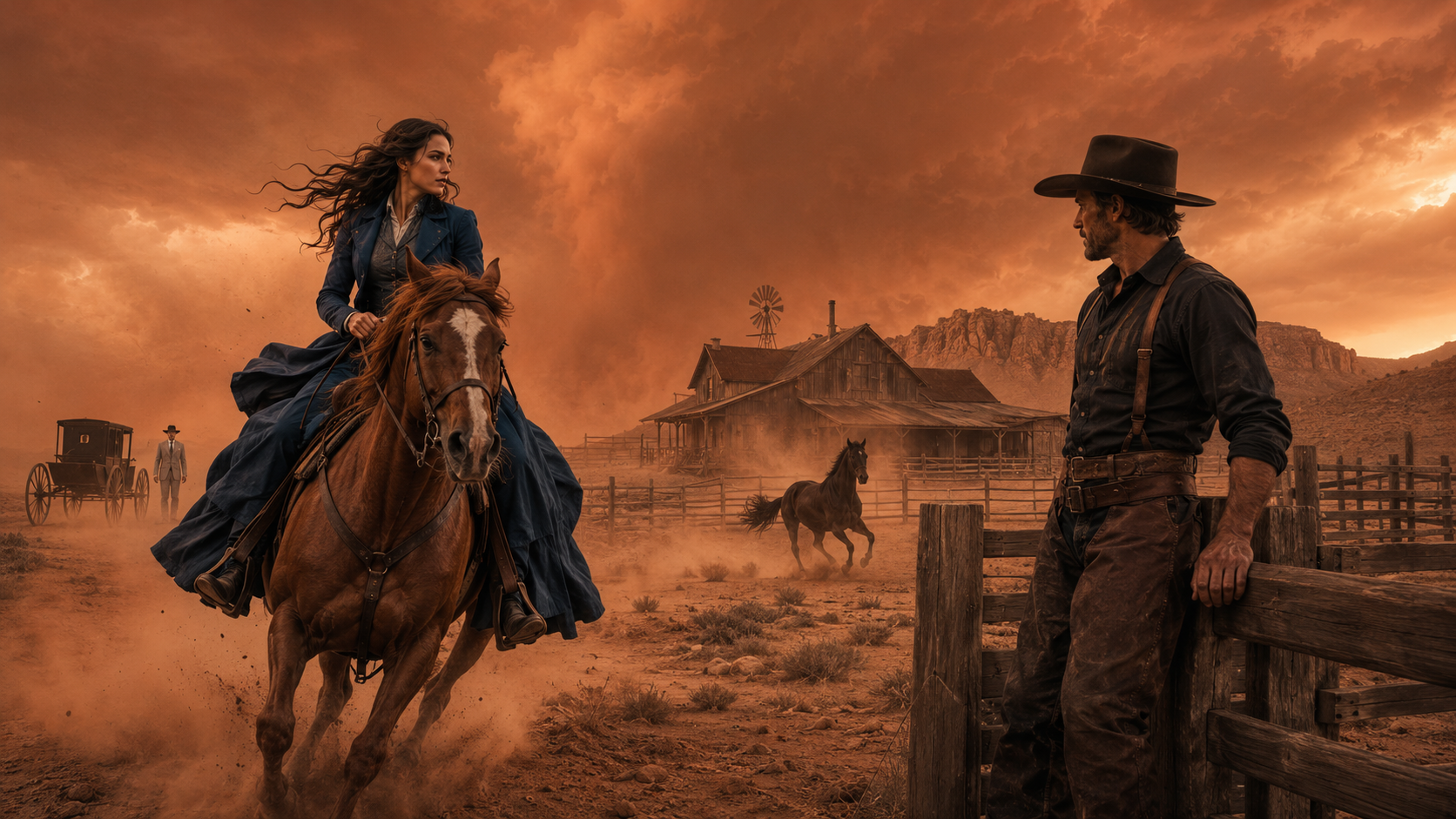
Elias stared at her.
“You intend to lower a wounded surveyor from a second-floor window using curtains.”
“Do you have a better idea?”
“Yes.”
Gunfire struck the window frame.
Elias fired again.
“My idea has become less practical.”
They tied two curtains together. Elias lowered Pike while Clara steadied the knot. The old man landed badly but remained conscious.
Clara climbed next.
Elias followed after overturning the wardrobe across the door.
They escaped through the alley as armed men entered the pharmacy.
Pike directed them to an abandoned rail shed outside town.
There, by the light of a single match, he drew the symbols used in Rusk’s coded shipping manifests.
A circle meant reliable water.
A broken circle meant a false deficiency report had been prepared.
A cross indicated a family judged unlikely to resist.
A black square meant acquisition completed.
Beside Clara Wynn’s name, the Rain Table would show a broken circle and a cross.
She did not need to see the record to know it.
Chapter Six
The Marriage Becomes Real in Small Ways
They returned to Red Mesa with Pike hidden beneath blankets in a supply wagon.
Miriam placed him under guard in a room above the inn. Sheriff Vale sent two deputies he trusted to watch the street. Lenora brought soup and threatened to strike Pike with a spoon if he attempted to die before testifying.
For three days, Clara and Elias barely slept.
They examined freight records from the previous six years. Miriam obtained them through a territorial subpoena delivered before Rusk’s local judge could interfere.
At first, the pages showed nothing except grain, wire, medicine, tools, and rail schedules.
Then Pike identified the code.
Black squares appeared beside twelve family names.
Broken circles appeared beside seventeen.
Clara found Rosa Medina.
The Bellamys.
The Ortegas.
The Vales.
The Calder family.
The Wynns.
Twelve properties had already been taken.
Five more were marked for future action.
The scale of the scheme altered everything.
“This was never only about our inn,” Clara said.
Elias stood behind her chair, one hand resting on the table.
“No.”
“If we save ourselves and keep the evidence private, he continues.”
“Yes.”
“You say that as though you already know what I intend.”
“I know what you will refuse to do.”
“What is that?”
“Close the door after escaping a burning house while other people remain inside.”
She turned toward him.
“You make me sound reckless.”
“You rode into a dust storm to propose to a stranger.”
“You accepted.”
“I have never claimed superior judgment.”
Exhaustion softened her laughter.
Elias looked down at her.
For weeks, they had performed marriage before other people. In public, he placed a hand lightly against her back. At hearings, she sat close enough for their sleeves to touch. They used each other’s names with practiced familiarity.
In private, they had been careful.
Perhaps too careful.
That night, after the others left, Clara found him asleep at the dining-room table with his head resting on folded arms.
The lamplight revealed strands of silver beginning near his temples. A healed burn crossed the back of his right hand. He looked less guarded in sleep, but not peaceful.
She covered his shoulders with a blanket.
His hand closed around her wrist.
He woke immediately.
“It is only me.”
His grip loosened.
“Sorry.”
“You were dreaming.”
“No.”
“You drew a revolver on the sugar bowl.”
“It behaved suspiciously.”
She sat opposite him.
“Was it San Perdido Canyon?”
He looked toward the dark window.
“Sometimes.”
“You never told me what happened after Daniel died.”
“There was nothing worth telling.”
“There was you.”
“That was the problem.”
Clara waited.
Elias had learned that she could wait longer than most people. She did not fill silence to rescue him from it. She simply remained.
“At sunset,” he said, “I found Daniel near the creek. He was still conscious. He asked whether the others were safe.”
“Were they?”
“No.”
“What did you tell him?”
“I said yes.”
Clara’s expression did not change.
“He knew I was lying. He smiled anyway. Then he told me the ranch papers were beneath the chapel.”
“The mission vault.”
“I thought he was confused. I never looked.”
“You were grieving.”
“I was avoiding.”
“Both can be true.”
Elias rubbed one hand over his face.
“If I had opened those letters from the marshal’s office, I might have discovered the canyon information came from Rusk.”
“You might have.”
“If I had asked why Daniel insisted on joining the posse—”
“You might have learned about the investigation.”
“I wasted seven years.”
“No.”
His eyes lifted.
“You survived seven years badly. That is not the same as wasting them.”
“You have a generous interpretation.”