A freight wagon rolled into town beneath a new company emblem belonging to the cooperative.
Clara leaned against Elias’s shoulder.
“Do you ever regret saying yes?”
“Sometimes.”
She sat upright.
“When?”
“When you move my invoices.”
“That is not regret. That is confusion adjusting to order.”
“When you invite twelve people to supper without warning.”
“The inn always has food.”
“When your mother asks about grandchildren during breakfast.”
“She asks during every meal.”
“Exactly.”
Clara smiled.
“And the rest of the time?”
“The rest of the time, I regret that you waited until a dust storm.”
“Why?”
“I would have preferred to remember seeing you clearly.”
She rested her hand over his.
“I remember you clearly.”
“What did you see?”
“A lonely man pretending peace and emptiness were the same thing.”
“That is severe.”
“You married me for honesty.”
“What do you see now?”
She looked across the town.
“A man who offered his hand to an enemy hanging over a canyon.”
“I nearly reconsidered.”
“No, you did not.”
“No.”
“What do you see when you look at me?”
Elias considered the question.
“The woman who saved her father’s name.”
Clara’s expression softened.
“The woman who turned a town’s shame into anger and its anger into courage. The woman who proposed before saying good morning.”
“It was afternoon.”
“The sun was hidden. Time had become uncertain.”
“That is a weak defense.”
“I am not defending myself.”
He lifted her hand and kissed her fingers.
“I am answering.”
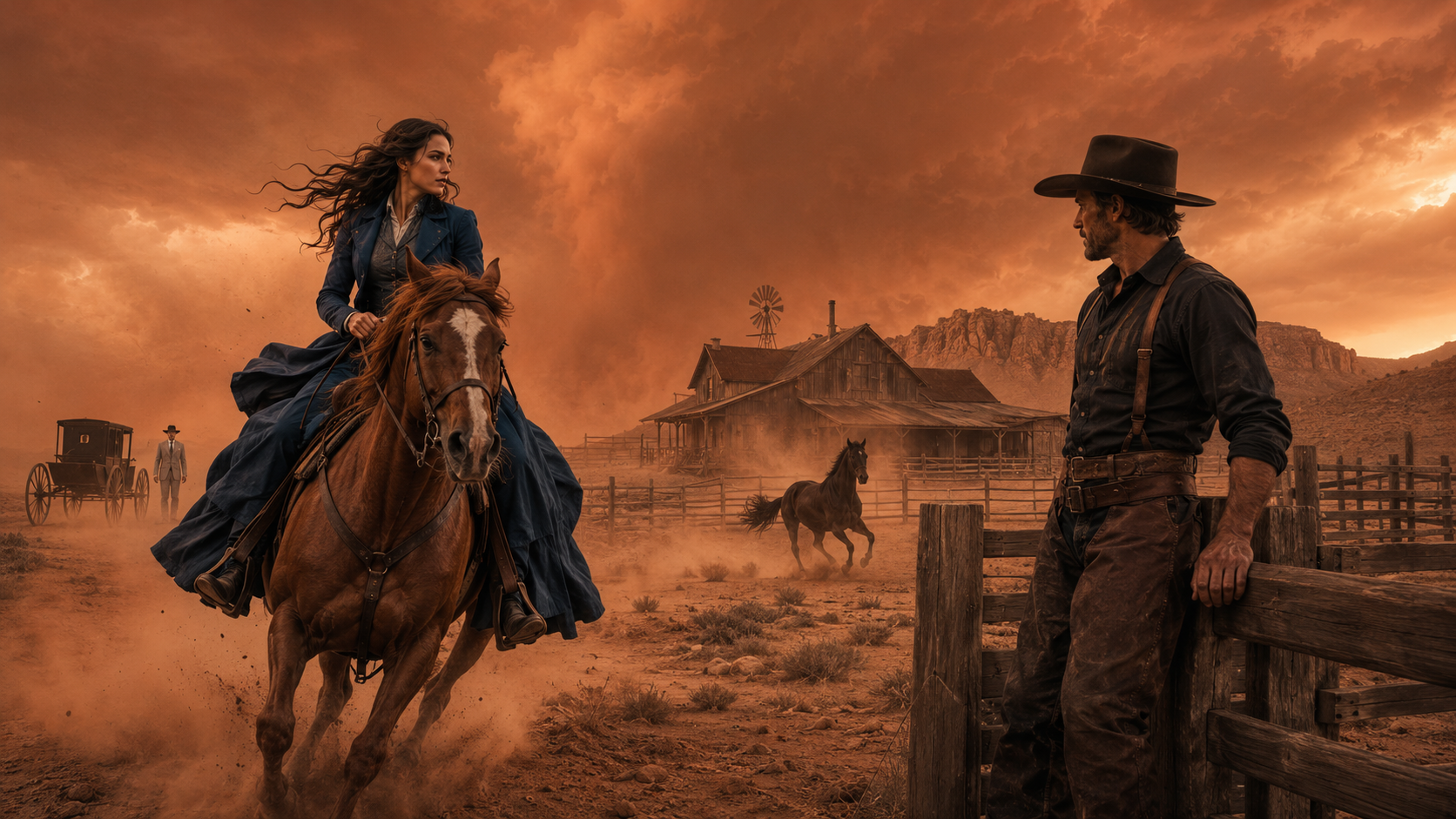
Years later, Red Mesa told many versions of their story.
Some claimed Clara Wynn had been the most beautiful woman in the territory and that Elias Boone agreed to marry her the moment she removed her veil.
She had worn no veil.
Others said Elias defeated Gideon Rusk in a gunfight at sunset.
There had been gunfire, but no clean duel and no sunset.
A few versions transformed Clara into a helpless innkeeper rescued by a fearless horseman.
Those were the least accurate.
Clara was never helpless.
Elias was never fearless.
Gideon Rusk had not controlled the territory because he was braver, wiser, or stronger than everyone around him. He controlled it because fear arrived separately at each door.
One family was ashamed of a failed farm.
Another feared a forged debt.
A sheriff feared losing his position.
A surveyor feared for his wife.
A mother feared for her daughter.
A widower feared needing anyone again.
Rusk understood how to purchase isolated fear.
He did not understand what happened when frightened people spoke to one another.
Rosa testified.
Pike confessed.
Julian opened the metal case.
Vale chose the town over his office.
Lenora revealed the secret she had carried.
Miriam followed the records.
Elias returned to the fight he had abandoned.
And Clara learned that asking another person to stand beside her did not surrender her independence.
It gave independence an ally.
The Broken Spur Ranch expanded across the eastern ridge. The Copper Bell became a gathering place for travelers, ranchers, lawyers, surveyors, and families seeking help before signing dangerous papers.
In winter, Clara and Elias worked at the same table.
Her inn accounts occupied one side.
His ranch records occupied the other.
Between them lay the Arroyo Verde Cooperative ledger, bound in new leather but containing the original signatures of the families who had first agreed that water should not become a weapon.
Sometimes their hands touched while reaching for the same document.
Sometimes one of them left the final cup of coffee for the other.
Sometimes they argued until Lenora threatened to charge them for disturbing the guests.
Their marriage had begun as a legal barrier.
It survived because they stopped measuring it by the danger that had created it.
It became real in ordinary places: beside an injured horse, across a cluttered desk, inside a smoke-filled inn, knee-deep in a reopened channel, and under a stable roof they never finished repairing that afternoon.
Clara had ridden nine miles looking for a husband whose name could protect her property.
She found a man who did something more difficult.
He respected her strength without demanding that she hide her need.
Elias had agreed to a temporary marriage because a determined woman still believed he was honorable.
He discovered that honor did not require a life without mistakes.
It required returning when the next person needed him.
On windy nights, dust still crossed Red Mesa and pressed against the walls of the Copper Bell.
The shutters rattled.
The horses shifted in the stable.
The desert searched for every unguarded opening.
But the house held.
Not because one person was strong enough to seal every crack.
Because many hands had rebuilt it.
And because two people who had once lived behind separate doors had finally learned to leave one open.
THE END