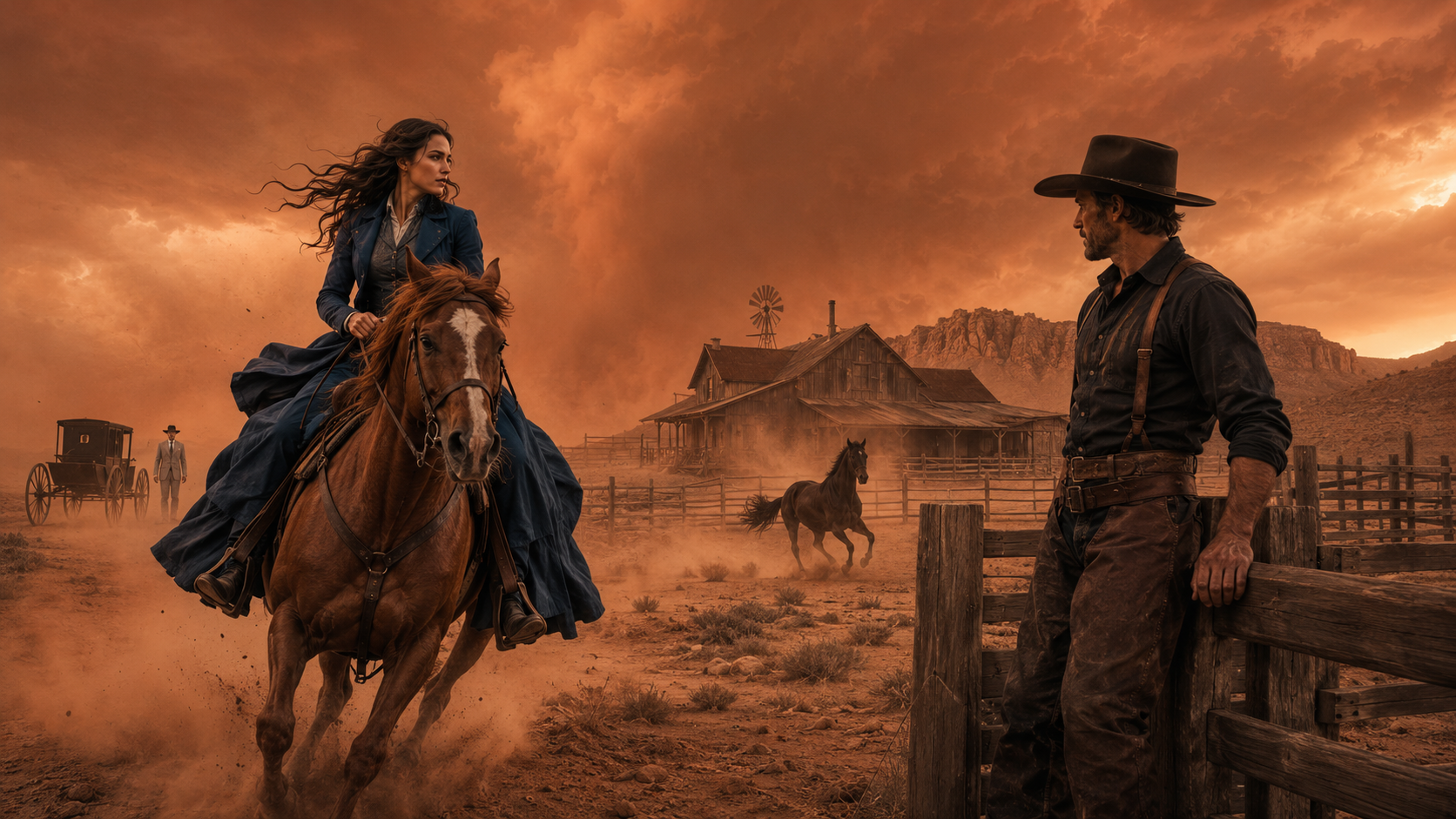
THE BRIDE OF RED MESA

Chapter One

A Proposal in the Dust

The dust storm followed Clara Wynn out of Red Mesa like a living thing.

It rolled across the Arizona Territory in a copper-colored wall, swallowing the road behind her and turning the afternoon sun into a dim red coin. Her mare, Juniper, fought the wind with her head lowered and her ears pinned back. Sand rattled against Clara’s riding coat, found its way beneath her collar, and stung the narrow strip of skin between her gloves and sleeves.

Every sensible instinct told her to turn around.

She had ignored sensible instincts since breakfast.

Nine miles beyond town, where the road narrowed between black volcanic ridges, the first fence posts of the Broken Spur Ranch appeared through the dust. Most of the posts stood straight. A few leaned where floodwater had loosened the earth. Beyond them lay a weathered barn, a stone well, two corrals, and a low adobe house facing the western hills.

Elias Boone was in the near pasture trying to calm a frightened colt.

He stood with one hand extended, his hat pulled low against the wind. The colt circled him, trembling and wild-eyed. Elias did not grab for the halter. He waited, speaking in a voice Clara could not hear above the storm.

The horse finally stopped.

Elias touched its nose.

Only then did he turn toward the road.

Clara had seen him in town perhaps twenty times. He bought coffee, nails, lamp oil, veterinary powder, and almost nothing else. He spoke when necessary and listened when it was not. People described him as unfriendly because they did not know what to do with a man who refused to decorate silence for their comfort.

He was taller than Clara remembered. His face was lean, sun-darkened, and marked by a pale scar that ran from the edge of his left eyebrow toward his temple. The wind pressed his shirt against broad shoulders made strong by work rather than display.

His eyes moved from Clara to the storm behind her.

“You picked a poor afternoon for visiting.”

“I did not come to visit.”

“That makes the weather seem even worse.”

She dismounted, though her knees had stiffened during the ride. Elias took Juniper’s reins before the mare could jerk free and tied her beside the barn.

“You need shelter,” he said.

“I need an answer.”

He looked at her more closely.

Clara had rehearsed an orderly explanation: the Copper Bell Inn, the debt certificate, the water claim, the family-protection statute, and the notice that had arrived from Gideon Rusk’s bank that morning.

But the storm was tearing branches from the mesquite trees. Her hair had escaped its pins. Elias Boone was watching her with the patient caution of a man approaching an injured animal.

An orderly explanation suddenly seemed dishonest.

“I came to ask you to marry me.”

The colt bolted to the far end of the pasture.

Elias remained where he was.

The wind pulled at his hat brim.

“Say that again.”

“I would rather not.”

“I need to know whether the storm carried away part of the sentence.”

“It did not.”

“You rode nine miles to ask a man you barely know to marry you.”

“Yes.”

“In a dust storm.”

“The weather changed after I left town.”

“That is the least troubling part.”

Clara folded her gloved hands to keep them from shaking.

“I am not asking for romance. I am asking for a legal partnership.”

“That improves the proposal only slightly.”

“I own the Copper Bell Inn and the springhouse behind it. My father borrowed money during the influenza winter to keep the inn open and pay the medical bills of six families who could not afford a doctor. He believed the debt was secured against the business income.”

“And it was not?”

“The original note was. The replacement certificate is secured against the inn, the spring, and every water claim attached to my family’s name.”

Elias’s expression sharpened.

“Replacement certificate?”

“Gideon Rusk purchased the original loan through the Desert Prosperity Bank. His attorney says Father agreed to new terms before he died.”

“Did he?”

“No.”

“You are certain?”

“My father could barely lift his head during his final week. The certificate was supposedly signed two days before his death and witnessed in Arroyo Junction, forty miles away.”

Elias looked toward the advancing dust, then back at her.

“Come inside.”

The house was plain, cool, and cleaner than Clara had expected. A rifle hung above the door. A saddle rested on a wooden stand near the back wall. On the kitchen table lay a veterinary book, a tin cup, a whetstone, and three envelopes that had never been opened.

Elias lit a lamp although it was not yet evening. The dust storm darkened the windows until the room appeared surrounded by rust-colored smoke.

He poured water into two cups.

Clara drank too quickly.

“Start at the beginning,” he said.

She removed the folded notice from inside her coat and placed it on the table.

Elias read without moving his lips. When he reached the final page, his jaw tightened.

“This says the debt becomes payable in full if the annual flow of the Wynn spring falls below the bank’s stability standard.”

“Yes.”

“Who determines the flow?”

“A private surveyor employed by Rusk.”

“And the latest survey?”

“Claims the spring has weakened by thirty-one percent.”

“Has it?”

“No. The spring is stronger than it was last summer.”

Elias read the page again.

“Then the survey is false.”

“False surveys still become dangerous when the judge drinks whiskey in Rusk’s private room every Thursday.”

“What does marriage change?”

Clara had reached the part she feared most.

“My father and your brother were original partners in the Arroyo Verde Water Compact.”

Elias’s eyes lifted.

“My brother has been dead for seven years.”

“His share passed to you.”

“I have never claimed it.”

“You never surrendered it either. According to the compact, if two founding shares become part of one household, no creditor may seize either property until the territorial water commission reviews every connected survey.”

Elias leaned back.

“So marrying me would delay the foreclosure.”

“It would also grant us access to the compact records. Those records disappeared from the county office three months after your brother died.”

“You think Rusk took them.”

“I think Gideon Rusk has spent eight years buying distressed loans, ordering suspicious water surveys, and acquiring the same properties after the owners defaulted.”

“How many?”

“I have confirmed five. I suspect more.”

“And you believe the missing compact records prove it?”

“They may prove the water assessments were never legal.”

Elias’s gaze moved to the false certificate.

“Why come to me? There are men in Red Mesa who would marry you before you finished asking.”

“Most would expect the inn in return.”

“You could write a contract.”

“Men who intend to break promises are rarely frightened by ink.”

“And you believe I am?”

“Frightened by ink?”

“Trustworthy.”

Clara met his eyes.

“When the Calder boy was injured in your corral, you paid the doctor although the accident was not your fault. When Noah Bell lost his horses in the canyon fire, you lent him two mares and refused payment. When Rusk offered to purchase your northern pasture, you rejected three times its value because the sale would have blocked the Ortega family’s road to their grazing land.”

“You have studied me.”

“I study anyone whose name I intend to share.”

The corner of his mouth moved, although it did not become a smile.

“What terms are you offering?”

“Separate property. Equal decisions concerning the water claim. Separate rooms. No personal obligations beyond public cooperation and basic respect. Once the debt is defeated, either of us may end the marriage.”

“And if the debt is not defeated?”

“We remain married until we find another solution.”

“And if the marriage becomes something neither of us wants to end?”

The question entered the room softly.

Clara looked toward the lamp.

“That possibility is not part of my current plan.”

“Plans have never been particularly respectful of people.”

“Will you do it?”

“I have not said no.”

“You have not said yes.”

“No.”

Outside, the storm hammered the house.

Elias gathered the pages and placed them in order.

“You may sleep in the spare room. I will take you back to town after the storm.”

“I need an answer tonight. Rusk’s men arrive tomorrow to inventory the inn.”

“You need the right answer, not the fastest one.”

“I do not have the luxury of time.”

“And I do not marry during the first hour of a conversation.”

Clara stood.

“Then I have made a mistake.”

Elias stood as well.

“Probably.”

Her face warmed.

“You could have expressed that with greater kindness.”

“You could have proposed after saying good afternoon.”

“I rode here through a storm.”

“I noticed.”

“Because I thought you would help.”

“I have not refused.”

“You are determined to make every sentence difficult.”

“I have had little practice with proposals.”

Thunder rolled beyond the ridge.

Clara looked at the unread envelopes on his table.

“Have you had practice with being alone?”

Something changed behind his eyes.

Only for a second.

Then the wall returned.

“Yes,” he said. “More than enough.”

She immediately regretted the question.

“I am sorry.”

“Do not be. It was honest.”

He opened the spare-room door.

“You will have my answer at sunrise.”

Clara wanted to argue, but exhaustion had begun to weigh down her limbs. She entered the small room and found a narrow bed, a wooden chair, and a window facing the mountains.

As she closed the door, she heard Elias move around the kitchen.

He did not open the three envelopes.


Elias remained at the table long after the storm passed.

The house had been built for a family.

That fact became most noticeable at night.

The kitchen held six chairs, although five had not been used in years. The spare room had belonged to his brother Daniel. The second bedroom had been prepared for Daniel’s bride, who had returned east after his death and never answered Elias’s letters.

The three envelopes on the table were from the territorial marshal’s office.

Elias knew what they contained.

Requests to return.

Offers of work.

Reminders of a life he had abandoned after leading a posse into San Perdido Canyon seven years earlier.

They had been pursuing cattle thieves. The information had been wrong. Daniel had ridden beside him. Gunfire had broken out before Elias understood that the supposed thieves were displaced ranch hands protecting their camp.

Daniel died before sunset.

Two innocent men died beside him.

The actual thieves escaped.

Elias resigned and came home to the Broken Spur, where animals made no speeches about justice and silence could not accuse him of choosing the wrong trail.

Now Clara Wynn had ridden into that silence and asked him to enter another fight built from papers, influence, and men who believed the law belonged to whoever could afford it.

He should refuse.

Her plan endangered his ranch. Gideon Rusk owned the bank, the freight company, the largest cattle operation in the county, and enough of the local government to make elections resemble private appointments.

A false marriage might delay him.

It would also make Elias a target.

He looked toward the spare-room door.

Clara had not asked him to rescue her. She had brought evidence, a legal theory, and terms that protected them both. Even frightened and exhausted, she had not pretended helplessness.

She had selected him because she believed his name meant something.

Elias could not remember the last time he had believed that himself.

At sunrise, Clara entered the kitchen wearing yesterday’s dress and an expression prepared for disappointment.

Elias had already saddled both horses.

“You are taking me home.”

“Yes.”

“I understand.”

“We will stop at the chapel first.”

She stared at him.

“The chapel?”

“Reverend Cole opens it at six.”

Clara’s lips parted.

Elias lifted the marriage certificate form he had found in Daniel’s old desk.

“If you still intend to ask me, my answer is yes.”

For once, Clara Wynn had nothing to say.

Chapter Two

The Wedding Gideon Rusk Laughed At

Red Mesa learned of the marriage before Clara and Elias reached the chapel.

The baker’s daughter saw them on the east road. The daughter told the stable boy. The stable boy told the barber, who abandoned a customer with shaving cream across half his face and hurried outside.

By the time Reverend Cole opened the chapel doors, fourteen people had gathered across the street pretending to have business near the hitching rail.

Clara’s mother arrived wearing one buttoned boot and one unbuttoned boot.

Lenora Wynn climbed down from a borrowed wagon, marched toward Elias, and struck him in the chest with her closed fan.

“You married my daughter without speaking to me?”

“Not yet.”

She struck him again.

“You planned to marry my daughter without speaking to me?”

“Your daughter did most of the planning.”

Clara took her mother’s arm.

“I intended to tell you after I knew he would agree.”

“You left town in a dust storm.”

“I was in a hurry.”

“You returned with a husband.”

“Technically, he is still only a possibility.”

Lenora looked Elias up and down.

“Do you drink?”

“Coffee.”

“Gamble?”

“No.”

“Hit women?”

“No.”

“Expect obedience?”

“No.”

Clara glanced at him.

“That answer came suspiciously quickly.”

Elias ignored her.

Lenora lowered the fan.

“Have you ever been arrested?”

“Not successfully.”

Clara closed her eyes.

Her mother studied him for another moment.

“Good enough. Reverend!”

They married before seven in the morning.

Clara wore a dust-stained riding dress. Elias wore his work shirt. Juniper remained tied outside beside his gray gelding. Reverend Cole’s wife served as witness, Lenora cried into a flour sack someone had given her as a handkerchief, and the barber watched from the doorway with shaving cream still drying on his customer’s face.

Elias spoke his vows in the same calm voice he used with frightened horses.

Clara’s voice trembled only once.

When Reverend Cole announced them as husband and wife, Elias looked at her as though waiting for instructions.

“You may kiss her,” the reverend said.

“That was not included in our agreement,” Clara whispered.

“People are watching.”

“They watched us arrive covered in dirt. Their expectations should already be low.”

Elias leaned closer.

“May I?”

The question surprised her.

She nodded.

He kissed her forehead.

It was brief, respectful, and somehow more intimate than a dramatic embrace would have been.

A few witnesses sighed.

The barber’s customer sneezed.

Then someone began clapping from the street.

Slowly.

Mockingly.

Gideon Rusk stood beside a polished black carriage.

He was a handsome man in the manner of an expensive knife: bright, balanced, and made for harm. His silver-gray suit was untouched by dust. A black pearl gleamed in his tie. Two bank officers stood behind him, and Sheriff Vale waited near the carriage with the uncomfortable posture of a man pretending not to belong to the group.

Rusk smiled.

“What a touching solution.”

Clara walked down the chapel steps beside Elias.

“Good morning, Mr. Rusk.”

“I had no idea desperation could arrange a wedding before breakfast.”

“I had no idea theft required such fine tailoring.”

The crowd went silent.

Rusk’s smile remained.

“You misunderstand an ordinary financial process.”

“I understand that you intend to take my property using a certificate my father never signed.”

“Your accusations are emotional.”

“My evidence is not.”

Rusk looked at Elias.

“And you must be the fortunate groom.”

Elias said nothing.

Rusk waited.

When the silence became uncomfortable, he continued.

“Mrs. Boone has married you because she believes your forgotten water share can prevent lawful foreclosure.”

“I know why she married me.”

“Does that not trouble you?”

“No.”

“Most men prefer affection.”

“Most men prefer speaking when they have nothing to say. I have survived without both.”

Several people in the crowd hid smiles.

Rusk’s expression cooled.

“A marriage certificate cannot create water that does not exist.”

“The spring exists,” Clara said.

“The official survey disagrees.”

“Your surveyor disagrees.”

“The distinction will not impress a judge.”

Elias stepped down one stair.

“Then we will find a judge capable of making it.”

Sheriff Vale shifted his weight.

Rusk glanced toward him, then returned his attention to Clara.

“My officers will still conduct the inventory.”

“They will not enter the inn,” Elias said.

“Mr. Boone, the bank possesses a legal order.”

“The order names Clara Wynn as the sole property holder. Clara Wynn no longer exists.”

Clara raised an eyebrow.

“I still exist.”

“Legally, the name changed.”

“You could phrase that less alarmingly.”

Rusk’s gaze sharpened.

Elias continued.

“The property now forms part of a household containing two original shares in the Arroyo Verde Water Compact. Territorial Statute Forty-Two requires a commission review before seizure.”

One of the bank officers leaned toward Rusk and whispered.

Rusk did not look pleased.

“You prepared this carefully,” he said.

“Clara did.”

“Then perhaps your bride is more dangerous than she appears.”

“I never doubted it.”

Rusk walked toward his carriage.

Before climbing inside, he looked back at them.

“Enjoy the wedding. By winter, I will own the inn, the spring, and the Broken Spur Ranch.”

Elias rested one hand on the chapel railing.

“You should buy a warmer coat.”

Rusk paused.

“For winter?”

“For the day you discover you own none of them.”

The carriage pulled away.

Only after it vanished did Clara release the breath she had been holding.

“You made him angry,” she said.

“He arrived that way.”

“He threatened your ranch.”

“He threatened our ranch.”

The word our caught them both by surprise.

Lenora stepped between them and placed one arm around each.

“Now that you have challenged the most powerful man in the county before breakfast, perhaps we could find something to eat.”

Chapter Three

A House With Two Doors

Clara returned to the Copper Bell Inn expecting disorder.

Instead, she found Rusk’s inventory officers standing on the street while twenty-three townspeople occupied every chair in the dining room.

No one had ordered food.

Mrs. Alvarez knitted beside the fireplace. Noah Bell read the same newspaper page repeatedly. The barber had finally cleaned his customer’s face and brought him to the inn as a witness. Three ranch wives sat at a table with empty cups. Reverend Cole played checkers against himself.

When Clara entered, Mrs. Alvarez looked up.

“We heard the bank wished to count the furniture.”

“They do.”

“We decided to sit on it.”

One of the officers cleared his throat.

“This is obstruction.”

“This is breakfast,” Lenora said. “Order eggs or leave.”

The officers left.

It was Clara’s first lesson in how quickly private fear could become public resistance once someone refused to hide it.

Her second lesson came that evening.

Elias moved into the small room at the back of the inn without argument. Clara occupied her old bedroom upstairs. They agreed he would spend three days each week at the Broken Spur and four nights in town until the commission hearing.

The arrangement appeared simple.

Living together did not.

Elias rose before dawn. Clara worked past midnight. He left boots in places she considered unreasonable. She reorganized his ranch invoices without permission. He drank coffee strong enough to damage metal. She opened windows even when the desert night turned cold.

On the fourth evening, Elias entered the office and discovered three piles of documents arranged across the desk.

“What happened here?”

“I created order.”

“There was order.”

“There were feed receipts beneath a horseshoe catalogue.”

“I knew where they were.”

“You spent forty minutes searching for them yesterday.”

“I eventually succeeded.”

“That is not a filing system. That is a rescue operation.”

He picked up a labeled folder.

“You wrote dates on everything.”

“Dates are useful.”

“Not if a man remembers.”

“You forgot your own wedding breakfast.”

“There were complications.”

“You ate half my biscuit.”

“I believed it was mine.”

“It was on my plate.”

“You had left the table.”

“To bring my mother tea.”

“I did not know the biscuit’s history.”

Clara tried not to smile.

Elias saw the attempt.

“You find this amusing.”

“Not at all.”

“You are a poor liar.”

“So I have been told.”

“By whom?”

“My husband, apparently.”

For a moment, neither moved.

The word still felt borrowed.

Elias set the folder down.

“What have you found?”

Clara opened the false debt certificate.

“The survey report lists the flow of our spring as eleven gallons per minute.”

“What is the actual rate?”

“Sixteen.”

“Measured when?”

“Yesterday morning. Noah Bell and Mrs. Alvarez witnessed it.”

“Rusk will claim the flow changes.”

“I measured again this afternoon. Sixteen.”

Elias examined the surveyor’s signature.

“Who is Orson Pike?”

“He conducts nearly every water assessment for Rusk’s bank.”

“Where does he live?”

“San Espera.”

“That is two days south.”

“According to the hotel register, he has not visited Red Mesa in eleven months.”

Elias looked up.

“Then how did he measure the spring last week?”

“He did not.”

They checked the remaining pages.

Each contained a small round seal beside the surveyor’s signature. Under magnification, the seal showed a mountain, a river, and the words SOUTHWESTERN HYDROGRAPHIC OFFICE.

Clara went to a cabinet and removed her father’s old correspondence.

“The territorial office changed its seal three years ago. The new version includes a star above the mountain.”

“This seal has no star.”

“The certificate was supposedly prepared four months ago.”

Elias sat beside her.

“Rusk used an old stamp.”

“Or someone copied an older survey.”

They searched until nearly midnight.

At last, Clara found a letter written to her father eight years earlier. It concerned a disputed irrigation channel on the Ortega property. The page carried Orson Pike’s signature and the old seal.

The signature matched the one on Clara’s certificate perfectly.

Not similarly.

Perfectly.

Even the ink blot beneath the final letter was identical.

“It was reproduced,” she said.

Elias held both pages near the lamp.

“Someone copied the signature and seal from this letter.”

Clara’s heart began to pound.

“Which means the entire survey is manufactured.”

A floorboard creaked in the hallway.

Elias extinguished the lamp.

The office fell dark.

Someone moved near the rear door.

Elias drew his revolver without sound. He opened the office door and crossed the kitchen.

The rear latch lifted.

A shadow slipped inside.

Elias seized the intruder, drove him against the wall, and pressed the revolver beneath his jaw.

The man made a frightened choking sound.

Clara relit the lamp.

Sheriff Amos Vale stood frozen against the wall.

His hat had fallen to the floor.

“An ordinary visitor uses the front entrance,” Elias said.

“I did not want Rusk’s men to see me.”

“You chose a method likely to get you shot.”

“I see that now.”

Clara closed the curtains.

“What do you want?”

Sheriff Vale looked toward the dark windows.

“I came to warn you. Rusk knows you requested a water commission hearing. He has sent men to the county archive.”

“For what?”

“The Arroyo Verde Compact records.”

“They disappeared years ago.”

“Not all of them.”

The sheriff removed a small brass key from his pocket.

“Your father stored a duplicate ledger in the old mission vault.”

Clara stared at him.

“How do you know?”

“I helped him move it.”

“Why did you never tell me?”

“Because he made me promise to keep it hidden unless Rusk challenged the compact directly.”

“He has been challenging it for years.”

“Not openly. Until now, he purchased individual debts. Your marriage connected the original shares and forced him to attack the compact itself.”

Elias lowered the revolver.

“What is in the ledger?”

“Maps, founding signatures, spring measurements, maintenance payments, and amendments. Enough to prove which properties possess permanent water rights.”

“Then why has Rusk not taken it?”

“He did not know where it was.”

“And now?”

Vale looked ashamed.

“He suspects I know.”

Clara took the key.

“Why help us?”

The sheriff’s face tightened.

“My wife’s family owned a peach farm north of San Espera. Six years ago, Rusk’s bank called their loan after a water survey declared their well unstable. They sold the farm for one quarter of its value.”

“Who purchased it?” Elias asked.

“A company called Morning Star Agricultural.”

Clara recognized the name.

“Rusk owns Morning Star.”

“I learned that last year.”

“And you remained his sheriff.”

“I told myself I could protect the town by staying close to him.”

“Did you?”

Vale looked toward the floor.

“Not enough.”

Elias holstered the revolver.

“Where is the mission vault?”

“Beneath the ruined chapel at Santa Lucía.”

“I know it.”

“Rusk’s men leave at sunrise.”

“Then we leave now,” Clara said.

Elias turned toward her.

“You are staying here.”

“No.”

“This may be dangerous.”

“It concerns my property.”

“It also concerns men willing to enter an archive at night.”

“Which is why I should trust the decision entirely to a former marshal who nearly shot the current sheriff?”

Vale raised a hand.

“She makes a reasonable point.”

Elias gave him a flat look.

Clara put on her coat.

“We agreed to equal authority.”

“We also agreed to basic respect.”

“I am respecting your ability to disagree while I prepare my horse.”

“You are impossible.”

“You accepted before sunrise.”

“I had not slept.”

“That does not invalidate a marriage.”

“We will see what the judge says.”

Chapter Four

The Ledger Under the Chapel

Santa Lucía Mission stood in a dry valley thirty miles west of Red Mesa.

The roof had collapsed during a summer storm. Wind and sun had erased most of the painted saints from the walls, leaving fragments of hands, halos, and sorrowful eyes. A dead bell hung in a wooden frame beside the chapel.

Clara, Elias, and Sheriff Vale arrived shortly before dawn.

The vault entrance lay beneath a cracked stone altar.

Vale inserted the brass key into an iron lock hidden behind a loose panel. The mechanism resisted, then opened with a groan that echoed through the ruins.

Stone steps descended into darkness.

Clara carried the lamp.

The air below smelled of dust, old leather, and dry wood. Shelves lined the narrow chamber. Most were empty, but a cedar box rested beneath a canvas sheet at the rear.

Her father’s initials were burned into the lid.

C.W.

Clara knelt.

For almost a year, every document connected to Charles Wynn had arrived in the form of a burden: unpaid accounts, disputed signatures, unexplained clauses, and letters written by men who spoke of his death as a useful administrative event.

Seeing his initials in the wood felt different.

It felt like his hand reaching through the dark.

Elias crouched beside her.

“You open it.”

Inside lay a thick leather ledger, rolled maps, payment receipts, and a small notebook tied with blue thread.

Clara opened the ledger.

The first page contained the founding statement of the Arroyo Verde Water Compact. Twelve families had signed it, including the Wynns and the Boones. The compact granted each family permanent access to springs and channels maintained collectively.

No private creditor could reduce those rights.

No survey could be conducted without two independent observers.

No property could be declared water-deficient unless the entire compact was inspected.

Every assessment Rusk had used was invalid.

Vale released a slow breath.

“This could destroy him.”

“No,” Clara said. “This can stop one foreclosure. We still need proof that he acted knowingly.”

She opened the smaller notebook.

It belonged to Daniel Boone.

Elias went still when he saw the name.

The early pages recorded channel repairs, spring measurements, and supply purchases. Later entries became less orderly.

Daniel had noticed strangers measuring land near compact properties. He had traced payments from Desert Prosperity Bank to Orson Pike. He had written the names of seven families beside dates and property values.

On the final written page, Daniel had drawn a line connecting them all to Gideon Rusk.

Beneath it were five words:

HE CREATES THE DROUGHT FIRST.

Elias took the notebook.

His face emptied.

“Daniel was investigating him.”

Clara touched the page.

“What happened before your brother died?”

“We were told cattle thieves were operating in San Perdido Canyon. Daniel insisted on joining the posse because he believed they were connected to stolen compact livestock.”

“Who provided the information?”

Elias looked toward Sheriff Vale.

Vale’s face had gone pale.

“Gideon Rusk.”

A sound came from the chapel above.

Boots against stone.

Elias extinguished the lamp.

A man’s voice drifted down the stairs.

“The vault is open.”

Another voice answered.

“Rusk said burn whatever you find.”

Elias handed the notebook to Clara.

“Behind the shelves.”

“There is no exit.”

“Move.”

Clara and Vale slipped into a narrow space behind the cedar cabinet. Elias remained near the stairs.

The first man descended carrying a lantern and a shotgun.

The second followed with a can of kerosene.

Elias waited until both reached the floor.

Then he struck.

He kicked the lantern from the first man’s hand and drove his shoulder into the second. The shotgun fired into the ceiling. Stone chips rained down.

Clara saw the kerosene can roll toward the fallen lantern.

Flame spread across the floor.

Vale lunged from hiding and dragged the can away.

The shotgun man swung the barrel toward Elias.

Clara seized a rolled map and struck the man’s wrist. It did little damage, but the surprise caused him to turn. Elias knocked him unconscious with one blow.

The second man fled up the stairs.

Vale followed.

Clara stamped at the fire with the canvas sheet while Elias gathered the ledger and notebooks.

“Go,” he ordered.

“What about the maps?”

“Take what you can.”

Smoke filled the chamber.

Clara stuffed three rolls beneath her arm. Elias lifted the cedar box. They climbed into the chapel as flames reached the lower shelves.

Outside, Sheriff Vale had caught the fleeing man near the bell frame.

The man struggled until Elias approached.

Then he stopped.

His name was Frank Darlow, a freight guard employed by Rusk.

Vale tied his hands.

“You are under arrest for attempted murder and destruction of territorial records.”

Darlow laughed breathlessly.

“You arrest me, Rusk replaces you before supper.”

“Perhaps.”

“He owns the judge.”

“Perhaps.”

“He owns half the county.”

Vale tightened the knot.

“He does not own this morning.”

They loaded the records onto the horses.

As the sun rose, Clara stood among the ruined mission stones and watched smoke drift from the vault entrance.

Elias examined Daniel’s notebook again.

“For seven years, I believed my mistake killed him.”

“You followed false information.”

“I chose to trust it.”

“Trusting a lie is not the same as creating it.”

“Dead men rarely benefit from the distinction.”

Clara moved closer.

“Daniel knew Rusk was stealing land. If Rusk sent you into that canyon, your brother may have been the intended target.”

Elias’s eyes lifted toward hers.

The possibility was worse than guilt because it gave his grief a direction.

“I should have seen it.”

“You were his brother, not his jailer.”

“I was the marshal.”

“You were a man surrounded by people who believed Gideon Rusk’s respectability was evidence of innocence.”

Elias looked across the valley.

“I spent seven years punishing myself while the man responsible continued doing exactly what Daniel tried to stop.”

“Then stop punishing yourself.”

He gave a humorless laugh.

“You make it sound simple.”

“No. I make it sound necessary.”

She held out her hand.

“Come home.”

He looked at her hand for several seconds before taking it.

Chapter Five

The Man Who Manufactured Drought

Attorney Miriam Shaw arrived from Prescott four days later.

She was forty-three, sharp-eyed, and unimpressed by nearly everything. She wore a brown traveling suit, carried two leather cases, and dismissed Rusk’s local judge as “a decorative criminal with sideburns.”

After reading the compact ledger, she ordered the dining room cleared and covered the tables with maps.

“This proves the surveys violated the compact,” she said. “It may delay foreclosure permanently. It does not yet prove conspiracy.”

“What about Daniel’s notebook?” Clara asked.

“It shows suspicion, not admissible evidence.”

“Frank Darlow confessed that Rusk ordered the records burned,” Sheriff Vale said.

“Did he name Rusk directly?”

“He said Rusk’s foreman gave the order.”

“Will he testify?”

Vale hesitated.

“He changed his statement after spending one night in jail.”

“Why?”

“His wife received a parcel containing their daughter’s blue dress.”

Miriam’s expression hardened.

“That is not a warning. It is an announcement of capacity.”

Elias stood near the window.

“We need Orson Pike.”

“The surveyor?” Miriam asked.

“He is either creating false reports or allowing Rusk to use his name.”

“Where is he?”

Clara pointed to San Espera on the map.

“Two days south.”

“Then someone should speak to him before Rusk does.”

“I will go,” Elias said.

“So will I,” Clara replied.

“No.”

Miriam looked between them.

“Is this how your marriage generally functions?”

“Yes,” they said together.

“Excellent. Argue while packing.”

They departed the following morning.

For two days, Clara and Elias rode through dry country carved by wind. They passed abandoned homesteads, sunken wells, and orchards where dead trees stood in rows like blackened ribs.

At the remains of a farm called Esperanza Grove, Clara stopped beside a collapsed irrigation wheel.

A woman was gathering firewood from the empty house.

Her name was Rosa Medina.

Her family had lost the farm three years earlier.

“The bank said our well was failing,” Rosa told them. “We knew it was not. My husband measured it every morning.”

“Was Orson Pike the surveyor?” Clara asked.

“The paper carried his name.”

“Did you see him?”

“No. Two men from the bank came. They lowered a rope into the well and left after ten minutes.”

“What happened next?”

“The bank demanded the full loan. Gideon Rusk offered to purchase the farm before the court hearing.”

“Who owns it now?”

Rosa pointed toward a sign half-buried in sand.

SUN CREST PRODUCE COMPANY.

Clara had seen the company name in Daniel’s notebook.

“Would you testify?”

Rosa looked toward the abandoned house.

“My husband died believing we lost this place because he failed.”

“He did not fail,” Clara said.

“You do not know that.”

“I know the survey method violated the Arroyo Verde Compact. I know the signature may have been copied. And I know the same thing happened to other families.”

Rosa’s grip tightened around the firewood.

“How many?”

“We do not know yet.”

For years, shame had isolated her more effectively than distance.

Now anger entered the space where shame had lived.

“Find out,” Rosa said. “Then return.”

They reached San Espera after dark.

Orson Pike lived above a closed pharmacy. His door stood open.

Inside, furniture had been overturned. Papers covered the floor. A chair lay broken beside the window.

Elias drew his revolver.

Clara found blood on the edge of a desk.

“Someone reached him first.”

A faint sound came from the rear room.

They discovered Pike inside a wardrobe, bleeding from a cut above his ear. He was a small, elderly man with thick spectacles and hands stained by drafting ink.

“They took my case,” he whispered.

“Who?” Elias asked.

“I did not see their faces.”

“Did Gideon Rusk employ you?”

Pike closed his eyes.

“Once.”

Clara knelt beside him.

“Your signature appears on surveys you never conducted.”

“I know.”

“Did you authorize them?”

“No.”

“Then help us prove it.”

Pike began to shake.

“My wife is in a care home outside Tucson. Rusk pays the fees.”

“Why?”

“Because eight years ago I falsified one report for him.”

The room went quiet.

Pike pressed a cloth against his wound.

“There had been a drought. A real one. The Bellamy ranch was failing, but its deep well remained strong. Rusk wanted the land because a railroad survey was expected nearby. He paid me to report that the well could not support livestock.”

“And after the Bellamys lost the ranch?” Clara asked.

“He kept the report. My signature. My seal. Examples of my handwriting. He said I would conduct future assessments whenever asked.”

“Did you?”

“Three. Then I refused.”

“But the reports continued,” Elias said.

“He did not need me anymore. His clerk copied the old signatures.”

“How many properties?”

“I cannot say.”

“Try.”

Pike looked at Clara.

“The bank created an internal list called the Rain Table. It ranked properties by debt, water access, resale value, and owner vulnerability.”

Clara felt cold despite the heat trapped in the room.

“Owner vulnerability?”

“Recent deaths. Illness. Disputed inheritance. Widows. Families with children. Immigrants unlikely to receive a fair hearing.”

Elias’s voice lowered.

“Where is the Rain Table?”

“Rusk’s freight office receives an updated copy each month. The code is hidden inside ordinary shipping records.”

“What code?”

Pike reached for a pencil.

A fist-sized rock crashed through the window.

A second later, gunfire exploded from the roof across the street.

Elias dragged Clara and Pike to the floor.

The lamp shattered.

Darkness swallowed the room.

Another bullet struck the wall.

Elias fired toward the rooftop flash.

Clara crawled to the rear window and looked into the alley. A wagon loaded with empty medicine crates stood beneath it.

“We can get Pike out the back.”

“He cannot climb.”

“We lower him.”

“With what?”

She pulled a curtain from its rod.

Elias stared at her.

“You intend to lower a wounded surveyor from a second-floor window using curtains.”

“Do you have a better idea?”

“Yes.”

Gunfire struck the window frame.

Elias fired again.

“My idea has become less practical.”

They tied two curtains together. Elias lowered Pike while Clara steadied the knot. The old man landed badly but remained conscious.

Clara climbed next.

Elias followed after overturning the wardrobe across the door.

They escaped through the alley as armed men entered the pharmacy.

Pike directed them to an abandoned rail shed outside town.

There, by the light of a single match, he drew the symbols used in Rusk’s coded shipping manifests.

A circle meant reliable water.

A broken circle meant a false deficiency report had been prepared.

A cross indicated a family judged unlikely to resist.

A black square meant acquisition completed.

Beside Clara Wynn’s name, the Rain Table would show a broken circle and a cross.

She did not need to see the record to know it.

Chapter Six

The Marriage Becomes Real in Small Ways

They returned to Red Mesa with Pike hidden beneath blankets in a supply wagon.

Miriam placed him under guard in a room above the inn. Sheriff Vale sent two deputies he trusted to watch the street. Lenora brought soup and threatened to strike Pike with a spoon if he attempted to die before testifying.

For three days, Clara and Elias barely slept.

They examined freight records from the previous six years. Miriam obtained them through a territorial subpoena delivered before Rusk’s local judge could interfere.

At first, the pages showed nothing except grain, wire, medicine, tools, and rail schedules.

Then Pike identified the code.

Black squares appeared beside twelve family names.

Broken circles appeared beside seventeen.

Clara found Rosa Medina.

The Bellamys.

The Ortegas.

The Vales.

The Calder family.

The Wynns.

Twelve properties had already been taken.

Five more were marked for future action.

The scale of the scheme altered everything.

“This was never only about our inn,” Clara said.

Elias stood behind her chair, one hand resting on the table.

“No.”

“If we save ourselves and keep the evidence private, he continues.”

“Yes.”

“You say that as though you already know what I intend.”

“I know what you will refuse to do.”

“What is that?”

“Close the door after escaping a burning house while other people remain inside.”

She turned toward him.

“You make me sound reckless.”

“You rode into a dust storm to propose to a stranger.”

“You accepted.”

“I have never claimed superior judgment.”

Exhaustion softened her laughter.

Elias looked down at her.

For weeks, they had performed marriage before other people. In public, he placed a hand lightly against her back. At hearings, she sat close enough for their sleeves to touch. They used each other’s names with practiced familiarity.

In private, they had been careful.

Perhaps too careful.

That night, after the others left, Clara found him asleep at the dining-room table with his head resting on folded arms.

The lamplight revealed strands of silver beginning near his temples. A healed burn crossed the back of his right hand. He looked less guarded in sleep, but not peaceful.

She covered his shoulders with a blanket.

His hand closed around her wrist.

He woke immediately.

“It is only me.”

His grip loosened.

“Sorry.”

“You were dreaming.”

“No.”

“You drew a revolver on the sugar bowl.”

“It behaved suspiciously.”

She sat opposite him.

“Was it San Perdido Canyon?”

He looked toward the dark window.

“Sometimes.”

“You never told me what happened after Daniel died.”

“There was nothing worth telling.”

“There was you.”

“That was the problem.”

Clara waited.

Elias had learned that she could wait longer than most people. She did not fill silence to rescue him from it. She simply remained.

“At sunset,” he said, “I found Daniel near the creek. He was still conscious. He asked whether the others were safe.”

“Were they?”

“No.”

“What did you tell him?”

“I said yes.”

Clara’s expression did not change.

“He knew I was lying. He smiled anyway. Then he told me the ranch papers were beneath the chapel.”

“The mission vault.”

“I thought he was confused. I never looked.”

“You were grieving.”

“I was avoiding.”

“Both can be true.”

Elias rubbed one hand over his face.

“If I had opened those letters from the marshal’s office, I might have discovered the canyon information came from Rusk.”

“You might have.”

“If I had asked why Daniel insisted on joining the posse—”

“You might have learned about the investigation.”

“I wasted seven years.”

“No.”

His eyes lifted.

“You survived seven years badly. That is not the same as wasting them.”

“You have a generous interpretation.”

“I watched my father die while I argued with him about calling a doctor. For months, I believed that if I had been kinder, quieter, faster, or more obedient, he might have lived.”

“Was that true?”

“No. Influenza does not negotiate with daughters.”

“Neither does a bullet.”

“Then perhaps we should both stop treating grief as evidence of guilt.”

Elias looked at her for a long time.

“You make difficult things sound reasonable.”

“I run an inn. Most disasters become less impressive after breakfast.”

He turned his hand palm upward on the table.

Clara placed hers in it.

Neither spoke.

The moment contained no grand declaration. No promise. No kiss.

Only two exhausted people sitting beneath a lamp while the desert wind moved against the windows.

Yet when Clara went upstairs, the house no longer felt divided into his space and hers.

Chapter Seven

Gideon Rusk Makes an Offer

Gideon Rusk arrived at the Copper Bell at noon wearing a cream-colored coat.

The dining room fell silent.

He had come alone, which made him seem more dangerous rather than less. Men like Rusk rarely needed visible protection. Their safety existed in the consequences attached to touching them.

Clara stood behind the front desk.

Elias emerged from the office.

Rusk removed his gloves.

“I wish to speak privately.”

“Then speak quietly,” Clara said.

His gaze moved around the occupied dining room.

“You have become theatrical.”

“I operate an inn. There is always an audience.”

“This concerns your mother.”

Clara’s expression changed.

Rusk noticed.

“Where is she?”

“Safe.”

The office door opened, and Lenora leaned out.

“I am also capable of hearing threats for myself.”

Rusk gave a small bow.

“Mrs. Wynn.”

“Mr. Rusk. Your coat makes you look like a dishonest wedding cake.”

A rancher coughed to hide a laugh.

Rusk placed an envelope on the desk.

“I am offering a settlement.”

Miriam Shaw stepped from the staircase.

“You will address all offers to counsel.”

“I wondered where Prescott’s most unpleasant attorney had gone.”

“I have been called worse by men who later lost property.”

Rusk’s eyes cooled.

“The bank will release the Copper Bell debt. Mrs. Boone will retain the inn and spring. Mr. Boone’s ranch will be excluded from all future claims.”

“In exchange for what?” Clara asked.

“The return of documents stolen from my freight office.”

“The records were obtained by subpoena,” Miriam said.

“A subpoena issued through a territorial commissioner who misunderstood their commercial nature.”

“The commissioner reads surprisingly well.”

Rusk ignored her.

“In addition, Orson Pike will withdraw his accusations. Sheriff Vale will resign. All parties will sign an agreement prohibiting public discussion of internal bank records.”

“And the twelve families whose land you stole?” Clara asked.

“Strong language does not strengthen a weak claim.”

“What happens to them?”

“They are not part of this settlement.”

“Then there is no settlement.”

Rusk’s patience thinned.

“You should consult your husband before rejecting security on his behalf.”

Clara looked at Elias.

“What do you think?”

“No.”

She returned her attention to Rusk.

“We consulted.”

Rusk stepped closer.

“You believe this town will stand beside you when the cost becomes real. It will not. These people enjoy courage as a public performance. Wait until freight stops arriving. Wait until the bank calls their loans. Wait until ranchers discover no buyer will take their cattle.”

A few customers shifted uncomfortably.

Rusk saw it.

He continued.

“I do not need to defeat all of you. I need only make each person wonder which neighbor will surrender first.”

Elias approached the desk.

“That method worked because they did not know about one another.”

“And now they do?”

“Yes.”

Rusk smiled without humor.

“Knowledge is not unity.”

“No,” Elias said. “But it is where unity begins.”

Rusk put on his gloves.

“You have mistaken a temporary marriage and a room full of frightened farmers for power.”

Clara took the settlement envelope and tore it in half.

“No. We have mistaken nothing.”

He turned toward the door, then stopped.

“There is one thing you should understand, Mrs. Boone. Your father was offered the same choice.”

Clara froze.

Rusk looked over his shoulder.

“He could have protected the inn. He refused.”

“What choice?”

“Ask your mother.”

He left.

Clara turned toward Lenora.

Her mother’s face had lost all color.

“Mother?”

Lenora closed the office door.

The crowd outside began speaking in low voices.

Inside, she sat at the desk.

“Your father discovered the Rain Table two months before he became ill.”

Clara felt the room tilt.

“You knew?”

“Only part of it.”

“Why did you say nothing?”

“Because Rusk came here at night. He offered to erase the debt if Charles surrendered the compact ledger and sold him the spring.”

“And Father refused.”

“Yes.”

“What did Rusk do?”

“He said the inn would pass to you after Charles died. He said a daughter without brothers would be easy to isolate.”

Elias’s jaw hardened.

Lenora continued.

“Your father moved the ledger to Santa Lucía. He began sending letters to the families whose names he remembered. Then the influenza came.”

“Did Rusk make him ill?”

“No. The illness was real. But while Charles was dying, someone entered the office and removed his loan papers.”

“The replacement certificate,” Clara whispered.

“I was afraid, Clara. After the funeral, Rusk showed me a copy of the new debt. He said if I challenged it, he would accuse your father of fraud and have the inn seized immediately.”

“You should have told me.”

“I wanted you safe.”

“You allowed me to believe Father had signed away everything.”

“I thought anger at him would be easier for you than fear of Rusk.”

Clara stepped back.

“You let me blame a dying man.”

Lenora’s eyes filled.

“Yes.”

The word contained no defense.

Clara left the office.

Elias followed her to the stable but did not speak until she reached Juniper’s stall.

“She was wrong,” he said.

“I know.”

“She was afraid.”

“I know.”

“Knowing does not remove the injury.”

“No.”

Clara gripped the stall gate.

“My father died while I was angry with him. Our last conversation was an argument about the debt. I told him he had treated the inn like a charity house. I told him his generosity would leave Mother and me homeless.”

“He knew you loved him.”

“You cannot know that.”

“I know what frightened people sound like when they are trying to protect what they love.”

She turned.

“How?”

“Because you sounded the same when you proposed to me.”

Her anger broke.

Not completely.

Enough to reveal grief beneath it.

Elias opened his arms uncertainly, as though offering shelter to a wild animal.

Clara stepped into them.

He held her carefully at first.

Then she clutched the back of his shirt, and his arms tightened.

She cried against his chest for the last conversation she could not change, for the truth her mother had hidden, and for a father whose apparent failure had been an act of resistance.

Elias did not tell her to forgive.

He did not tell her to stop.

He simply remained.

Chapter Eight

The Town Goes Dry

Rusk acted three days later.

The freight company suspended deliveries to Red Mesa because of “route instability.” The bank demanded early payment from nine ranchers. A cattle buyer canceled his contracts. The telegraph line failed north of town, although no storm had passed through the area.

By Friday, flour had doubled in price.

By Saturday, fear entered every conversation.

Rusk’s prediction began to come true.

People who had cheered at the chapel now avoided Clara’s eyes. Ranchers whispered that the Water Compact case should be settled before the entire town collapsed. The baker asked whether she might return the Rain Table records in exchange for reopened freight service.

Then the main irrigation channel stopped flowing.

Elias rode upstream with Noah Bell and discovered the gate at Coyote Narrows buried beneath an artificial rockslide. Someone had used blasting powder to collapse the canyon wall.

Without that channel, the southern farms would lose their late-season crops.

Rusk owned the only alternate reservoir.

His price for water was five times the usual rate.

At an emergency town meeting, anger turned toward Clara.

A farmer named Otis Crane stood near the chapel door.

“My children cannot eat a court case.”

“No one is asking them to,” Clara said.

“You rejected a settlement.”

“The settlement protected only my property.”

“Your property started this.”

“No. Gideon Rusk started it when he manufactured false debts.”

“And now he is starving the town because you will not bend.”

Elias stepped forward.

Clara stopped him with one hand.

She faced the room.

“If I surrender the records, freight may return. The bank may delay your loans. Water may flow again.”

“Then surrender them,” someone said.

Other voices joined.

Clara waited until the room quieted.

“And when the next widow inherits land Rusk wants?”

No one answered.

“When the next well is declared dry despite being full? When the next family receives a debt signed by a dying man? When the next sheriff is frightened into silence?”

Otis looked away.

“Every person here must decide what price is acceptable,” Clara continued. “I cannot decide for you. But do not call surrender peace. It is only permission purchased with someone else’s future.”

The meeting ended without agreement.

Outside, Elias found Miriam studying the dark sky.

“How long until the channel can be cleared?” she asked.

“Three weeks by hand.”

“The crops have one.”

“We could divert water from the Broken Spur spring.”

Clara turned toward him.

“That would empty your winter reserve.”

“Our reserve.”

“The ranch may lose half the herd.”

“It may.”

“You cannot risk everything.”

“I thought partnership meant both people remained in the danger.”

She recognized her own argument.

“That was unfair.”

“It was accurate.”

Miriam watched them.

“I dislike interrupting marital philosophy, but there may be another solution. The original compact map shows an abandoned emergency channel north of Coyote Narrows.”

Elias examined it.

“That route crosses Rusk’s lower pasture.”

“Does he own the water right?” Clara asked.

“No. Only the land.”

“Can he stop us from repairing the channel?”

“He can try.”

By sunrise, forty-three townspeople had gathered with shovels, picks, wagons, and teams of horses.

Otis Crane arrived last.

He stood before Clara, ashamed.

“I spoke badly yesterday.”

“You spoke while afraid.”

“That does not make it right.”

“No.”

He lifted his shovel.

“Where do you need me?”

They worked beneath the desert sun.

Rusk’s foremen appeared before noon and ordered them off the pasture. Sheriff Vale produced the compact map and informed them that obstruction of an emergency water route carried a territorial prison sentence.

The foremen left.

By evening, the old channel was open.

Water flowed across Rusk’s land toward the farms he had tried to starve.

Children ran beside it.

Farmers cheered.

Clara stood ankle-deep in the muddy current while Elias watched from the bank.

She splashed water toward him.

It struck his boots.

“You did that intentionally.”

“Yes.”

He stepped into the channel.

“Elias.”

He splashed her with both hands.

The front of her dress became soaked.

For one shocked second, Clara stared at him.

Then she laughed.

It was not the polite laugh she used with guests or the dry laugh she gave when correcting his paperwork.

It was loud, breathless, and free.

Elias smiled.

The expression changed his entire face.

Clara forgot the people around them.

She forgot the court case, the false debts, and Gideon Rusk.

She saw only the man standing in the water with sunlight behind him.

Then Noah Bell shouted that married people should behave with dignity, and the entire work crew began laughing.

The moment passed.

But not entirely.

Chapter Nine

Fire at the Copper Bell

The territorial hearing was scheduled for November 18.

Two nights before it, Clara woke to the smell of smoke.

She opened her bedroom door and found the hallway filled with black air.

“Fire!”

The flames had begun in the office.

They climbed the curtains, crossed the ceiling, and spread toward the stairs. Guests stumbled from their rooms. Lenora appeared in her nightdress carrying the inn’s cashbox.

Elias ran from the rear room.

“Everyone outside!”

“The records!” Clara shouted.

“Miriam moved them to the jail.”

“My father’s letters are in the desk.”

“Leave them.”

She ran toward the office.

Elias caught her around the waist.

“Clara!”

“The blue box!”

Flames rolled across the doorway.

Elias covered his mouth with his sleeve, forced her toward the courtyard, then turned back.

“No!”

He disappeared into the smoke.

Clara tried to follow, but Sheriff Vale dragged her outside.

The roof above the office cracked.

A second later, Elias emerged through the kitchen window carrying the blue document box beneath one arm.

His sleeve was burning.

Clara threw a blanket around him and forced him to the ground.

Townspeople formed a line from the well. Buckets passed from hand to hand. Men broke windows. Women carried furniture into the street. Children led frightened horses away from the stable.

The fire burned for three hours.

At dawn, the eastern half of the inn remained standing. The office and kitchen had been destroyed. The roof above Clara’s room had collapsed.

No one had died.

Elias sat on an overturned water trough while Clara wrapped his burned forearm.

“You went back,” she said.

“You tried first.”

“That does not answer me.”

“You said the box mattered.”

“Not more than you.”

He looked at her.

The street around them seemed to fade.

Clara tied the bandage too tightly.

He winced.

“Sorry.”

“You are angry.”

“Yes.”

“At the person who set the fire?”

“At you.”

“That seems misdirected.”

“You could have died.”

“So could you.”

“I was frightened.”

“So was I.”

She stared at him.

Elias’s voice softened.

“I saw you run toward the office, and for one second I understood what my life would become if that ceiling fell.”

Clara stopped breathing.

He looked down at the bandage.

“I did not like it.”

“That is a remarkably poor declaration.”

“I have had little practice.”

“With declarations or feelings?”

“Both.”

She touched the unburned side of his face.

“You should practice.”

His hand covered hers.

They leaned toward one another.

A deputy ran from the alley.

“Sheriff! We found something.”

The moment broke.

Behind the inn, Vale had discovered a broken kerosene bottle wrapped in cloth. The cloth carried the emblem of Rusk’s freight company.

It was evidence.

Too obvious, Miriam warned.

“Rusk does not make obvious mistakes.”

“Then someone wants us to believe he ordered it,” Clara said.

“Or someone beneath him is becoming careless.”

Elias examined the bottle.

A fragment of paper remained caught beneath the cloth.

It bore a handwritten number.

47-B.

Pike recognized it immediately.

“It is a Rain Table property code.”

“Whose?” Clara asked.

Pike consulted the copied freight ledger.

His finger stopped on a name.

AMOS VALE.

Everyone turned toward the sheriff.

Vale stared at the page.

“My wife’s family farm.”

The code beside it showed the property had been acquired six years earlier.

Another notation had been added last month.

WITNESS LIABILITY—REMOVE.

The fire had not been intended only to destroy the inn.

It was a message to Sheriff Vale.

Rusk’s system was beginning to consume the people who had once protected it.

Chapter Ten

The Hearing

The territorial water commission convened in the Red Mesa courthouse because no hall in Prescott could accommodate the witnesses who arrived.

Rosa Medina came from San Espera.

The Bellamy brothers traveled from New Mexico.

Three Ortega families filled an entire row.

Former bank clerks, freight drivers, ranch hands, survey assistants, and displaced landowners stood along the walls.

Gideon Rusk entered with four attorneys.

He no longer smiled.

The hearing began with the validity of Clara and Elias’s marriage.

Rusk’s lead attorney, Horace Flint, described it as a fraudulent arrangement created solely to obstruct lawful collection.

“Mrs. Boone proposed marriage one day after receiving a foreclosure notice,” he said. “Mr. Boone accepted without courtship. Their union combined dormant water shares and triggered a procedural delay. The purpose could not be clearer.”

Commissioner Ada Marlowe looked toward Miriam.

“Do you dispute the timeline?”

“No,” Miriam said.

A murmur moved through the room.

Miriam called Clara first.

“Why did you marry Elias Boone?”

“To prevent Gideon Rusk from seizing my inn through a forged debt certificate.”

Flint almost smiled.

Miriam continued.

“Did you love Mr. Boone on your wedding day?”

“No.”

“Did he claim to love you?”

“No.”

“Did either of you conceal the practical purpose of the marriage?”

“No.”

“What terms did you establish?”

“Equal authority. Separate property. Separate rooms. No personal obligation without consent.”

Flint rose.

“Then you admit the marriage was a business device.”

“I admit it began as an agreement.”

“What is the difference?”

“An agreement states what two people owe. A device is something one person uses.”

“And your husband was not used?”

Clara looked toward Elias.

“He was informed, stubborn, and entirely capable of refusing.”

Several people laughed.

Commissioner Marlowe struck the table for silence.

Flint approached the witness chair.

“Do you share a bedroom?”

Miriam stood.

“Private intimacy has no relevance to the validity of the water claim.”

“It has relevance to the authenticity of the marriage.”

Clara answered before the commissioner could rule.

“No.”

Flint turned toward the audience.

“There it is.”

Clara continued.

“We share work. We share financial risk. We share meals when neither of us forgets to eat. We share responsibility for my mother, his ranch hands, the inn employees, and every decision concerning the properties. He knows I put cinnamon in coffee when I cannot sleep. I know he walks the eastern fence after nightmares because movement is easier for him than memory.”

Elias lowered his eyes.

Clara’s voice remained steady.

“He rescued my father’s letters from a burning building after I was foolish enough to try. He gave the town his winter water reserve before anyone promised to repay him. When I am angry, he does not silence me. When I am afraid, he does not call me weak. Our marriage began because I needed legal protection. It became real because neither of us treated protection as ownership.”

Flint waited.

“Do you love him?”

The question filled the courtroom.

Clara looked at Elias.

She had not spoken the words to him.

Not in the inn.

Not in the channel.

Not after the fire.

Yet the truth did not become less true because it had arrived without ceremony.

“Yes.”

Elias’s head lifted.

Flint returned to his table.

“No further questions.”

Elias testified next.

Flint asked whether Clara had fulfilled the duties he expected of a wife.

“I expected honesty.”

“Has she provided it?”

“Relentlessly.”

“Did you marry her out of pity?”

“No.”

“For financial gain?”

“No.”

“For access to the Copper Bell property?”

“I owned land before the marriage.”

“Then why accept?”

Elias looked toward the spectators.

“Seven years ago, my brother died while investigating the same land scheme we are discussing today. I did not know it then. I believed his death was the result of my failure, and I built a life in which no one could depend on me enough to be harmed by my mistakes.”

Flint shifted impatiently.

“The question concerned Mrs. Boone.”

“It still does. Clara rode into that life and asked me to stand beside her. She believed my name still represented something honorable when I had stopped believing it myself.”

“Gratitude is not marriage.”

“No.”

“Pity is not marriage.”

“No.”

“Shared opposition to Mr. Rusk is not marriage.”

“No.”

Flint leaned closer.

“Then what makes your marriage genuine?”

Elias glanced at Clara.

“The fact that I would remain her husband if every debt vanished today.”

Flint paused.

Elias continued.

“I would remain if the inn burned completely. I would remain if the ranch failed. I would remain if the water commission ruled against us and we had to begin again with nothing but two horses and her mother’s opinions.”

Lenora whispered loudly that her opinions had substantial value.

Laughter passed through the room.

Even Commissioner Marlowe hid a smile.

Elias’s gaze stayed on Clara.

“I married her because she needed my name. I stay because she has become my home.”

Clara’s eyes filled.

Flint sat down.

Miriam then called Orson Pike.

The surveyor confessed to falsifying the first Bellamy assessment. He identified his copied signature on seventeen later documents and explained the Rain Table code.

Rosa Medina described losing Esperanza Grove.

The Bellamy brothers described finding strong water beneath a well Rusk had declared dead.

Sheriff Vale admitted accepting Rusk’s political support and remaining silent after learning his wife’s family had been targeted.

“I believed compromise gave me influence,” Vale said. “It only taught him the price of my obedience.”

Miriam presented the Arroyo Verde Compact.

Then the coded freight records.

Then Daniel Boone’s notebook.

Finally, she placed the false certificate attributed to Charles Wynn beside the original survey letter from which Pike’s signature and seal had been copied.

Horace Flint objected.

Commissioner Marlowe overruled him.

Rusk sat perfectly still.

Miriam approached the commissioners.

“The evidence shows a repeated method. First, Desert Prosperity Bank identifies land with reliable water and owners under personal or financial pressure. Second, a false survey declares the water unstable. Third, a hidden deficiency clause accelerates the debt. Fourth, a company controlled by Mr. Rusk acquires the property below value.”

She placed the Rain Table on the evidence stand.

“Twelve completed acquisitions. Five planned. Seventeen families selected not because their land was weak, but because their circumstances made them easier to frighten.”

Flint rose.

“No record proves Mr. Rusk personally ordered these actions.”

A voice came from the rear of the courtroom.

“I can prove it.”

Everyone turned.

A young man stood near the doors.

Clara recognized him as Julian Rusk, Gideon’s nephew and chief accounting clerk.

Gideon Rusk’s composure broke.

“Sit down.”

Julian walked forward carrying a locked metal case.

His hands shook.

“My uncle ordered the Copper Bell fire.”

The room erupted.

Commissioner Marlowe demanded silence.

Julian placed the case before Miriam.

“It contains the original Rain Tables, payment instructions, company ownership records, and letters to Orson Pike.”

Rusk rose.

“You stole private records.”

Julian faced him.

“I copied records after you told Darlow to burn Santa Lucía. I took the originals after you ordered the inn destroyed.”

“You ungrateful coward.”

“You raised me to believe mercy was weakness. I believed you until I saw the property codes beside children’s names.”

Flint whispered urgently to Rusk.

Rusk ignored him.

“You will leave this courthouse with nothing.”

Julian looked toward the families seated behind Clara.

“That is more than you intended to leave them.”

The commissioners recessed to examine the case.

Rusk’s attorneys surrounded him.

Miriam approached Clara and Elias.

“If those records are genuine, this is no longer merely a water dispute.”

“What is it?” Clara asked.

“A territorial conspiracy case.”

Across the courtroom, Gideon Rusk looked at them.

The confidence had not vanished from his face.

It had become desperation wearing the same clothes.

Chapter Eleven

The Dam at Black Canyon

During the recess, a deputy entered through the side door and spoke urgently to Sheriff Vale.

Vale’s face changed.

“What happened?” Elias asked.

“The Black Canyon dam keeper is missing.”

The dam held the reservoir above Red Mesa.

If its gates opened fully, water would rush through the lower channel and destroy the farms, the freight bridge, and half the town.

Elias looked toward Rusk.

His chair was empty.

They ran outside.

Rusk’s black carriage had vanished.

Elias mounted the nearest horse. Clara climbed behind him before he could object.

“This is not a discussion,” she said.

“For once, I agree.”

Sheriff Vale and six riders followed.

They reached Black Canyon under a sky darkened by an approaching winter storm.

The reservoir gate mechanism stood inside a wooden control house above the gorge. Rusk’s carriage waited near the entrance. One horse had broken loose.

Elias dismounted.

“You stay behind the stone wall.”

“No.”

“Clara.”

“He may have Julian’s records duplicated at the dam.”

“He may also have a rifle.”

“So do you.”

“That argument is not comforting.”

They entered together.

Inside the control house, Gideon Rusk stood beside the gate wheel. The dam keeper lay unconscious near the wall.

A lantern burned beside three open kerosene cans.

Rusk held a revolver.

“You should have accepted the settlement,” he said.

Elias moved slightly in front of Clara.

Rusk laughed.

“There is the heroic husband.”

“He is not here to rescue me,” Clara said.

“No?”

“No. He is here because you threatened his town.”

“His town? These people distrusted him for years. They gossiped about his brother. They called him a killer behind his back.”

Elias’s face did not change.

Rusk continued.

“And now he risks his life for them because a beautiful woman offered him a counterfeit marriage.”

Clara stepped beside Elias.

“You still do not understand what defeated you.”

“I have not been defeated.”

“You believed every relationship was a transaction. You purchased judges, clerks, witnesses, surveyors, and frightened relatives. When people obeyed, you thought they belonged to you.”

Rusk touched the gate wheel.

“Belonging is merely obedience described sentimentally.”

“No,” Elias said. “That is why no one remains loyal when your money stops.”

Thunder rolled above the canyon.

Rusk’s revolver shifted toward Clara.

Elias fired first.

His bullet struck the gate wheel beside Rusk’s hand. Rusk fired toward them, then kicked the lantern into the kerosene.

Flames spread across the floor.

He turned the wheel.

Deep inside the dam, gears began to move.

The main gate opened.

Water thundered into the canyon.

Elias tackled Rusk before he could turn the wheel farther. They struck the floor hard. The revolver slid beneath a burning table.

Clara ran to the mechanism.

The wheel would not move.

A locking pin had been driven into the gear.

She seized an iron bar and struck it.

Nothing.

Behind her, Elias and Rusk fought near the open doorway. Rusk was older but driven by panic. He struck Elias’s burned arm and reached for a knife hidden in his boot.

Clara struck the pin again.

It shifted.

Flames climbed the wall.

The roof began to crack.

Sheriff Vale appeared outside but could not fire without risking Elias.

Rusk drove the knife toward Elias’s chest.

Elias caught his wrist.

The two men staggered toward the edge of the platform.

Clara hit the pin a third time.

It fell free.

She threw her weight against the wheel.

It turned half an inch.

Water pressure resisted from inside the dam.

Vale and two deputies rushed to help her.

Together, they forced the wheel backward.

The gate began closing.

Rusk heard the gears.

“No!”

He broke free from Elias and lunged toward Clara.

Elias caught him around the waist.

The burning roof beam collapsed between them and the wheel.

Rusk fell against the railing.

The wood broke.

For one second, he hung above the gorge, one hand gripping a splintered post.

Elias reached down.

Rusk stared at the offered hand.

“You would save me?”

“Yes.”

“Why?”

“Because I am not you.”

Rusk hesitated.

Pride and survival fought across his face.

Survival won.

He grabbed Elias’s wrist.

Elias pulled him onto the platform as Sheriff Vale closed iron shackles around his hands.

The gate sealed.

The river below remained high, but the flood did not reach the town.

They escaped moments before the control-house roof collapsed.

Rain began to fall.

Rusk stood in the mud between two deputies, his cream-colored coat blackened by smoke.

He looked at Clara.

“You believe this makes you powerful.”

“No,” she said. “It proves you never were.”

Chapter Twelve

What the Court Returned

The territorial investigation lasted five months.

Julian Rusk’s records connected Gideon to seventeen false surveys, twelve completed land acquisitions, four bribed officials, two cases of witness intimidation, the Santa Lucía attack, the Copper Bell fire, and the attempted destruction of Black Canyon dam.

Desert Prosperity Bank was placed under receivership.

The shell companies were dissolved.

The local judge resigned before he could be removed.

Orson Pike pleaded guilty to falsifying the first survey and received a reduced sentence because of his cooperation. His wife’s care was paid from a public fund rather than Rusk’s money.

Sheriff Vale resigned voluntarily.

Red Mesa elected him again the following spring.

Not every property could be returned.

Some had been divided, damaged, or resold. Compensation never restored orchards that had died or houses where children had grown up.

But Esperanza Grove returned to Rosa Medina.

The Bellamy family recovered its well.

The Ortega road became protected public access.

A cooperative purchased three properties whose former owners no longer wished to return.

The Wynn debt was declared fraudulent.

The Copper Bell Inn and spring belonged to Clara without restriction.

The Broken Spur Ranch’s compact share was formally recognized.

On the morning the final ruling arrived, Clara found Elias repairing the stable roof.

She stood below with the letter.

“The debt is gone.”

He looked down.

“All of it?”

“All of it.”

He climbed from the roof.

She handed him the ruling.

He read each page carefully.

“The marriage review is closed,” he said.

“Yes.”

“The original purpose of our agreement has ended.”

“Yes.”

Neither spoke.

A horse shifted inside the stable.

Elias folded the ruling.

“You may request an annulment.”

“So may you.”

“I am aware.”

“Do you want one?”

“No.”

The answer came before she finished asking.

Clara’s heart struck hard against her ribs.

“You might consider the question.”

“I have considered it since San Espera.”

“That was months ago.”

“I am thorough.”

“Your filing system suggests otherwise.”

He stepped closer.

“Do you want to leave?”

“No.”

“Do you want separate property?”

“The inn should remain legally mine. The ranch should remain legally yours.”

“Agreed.”

“Equal authority over shared decisions?”

“Yes.”

“Honesty?”

“Even when inconvenient.”

“That will be often.”

“I know.”

She looked at the scar near his temple.

“We never discussed affection in the original agreement.”

“No.”

“We should correct the omission.”

“How?”

Clara placed her hands against his chest.

“Perhaps with clearer language than you used after the fire.”

“I said losing you would damage my life.”

“You said you would not like it.”

“I was injured.”

“Your arm was injured. Your vocabulary was unharmed.”

He lowered his head.

“I love you.”

The words were simple.

His voice was not.

It carried seven years of silence, one dust-storm proposal, a burned inn, a reopened channel, and every morning in which he had chosen not to retreat into the life he knew before her.

Clara smiled.

“That is clearer.”

“You have not answered.”

“I testified under oath.”

“I would prefer to hear it without opposing counsel.”

“I love you, Elias Boone.”

He kissed her.

There was nothing cautious about it.

The stable roof remained unfinished.

Neither cared.

Chapter Thirteen

A Different Kind of Contract

The Copper Bell reopened before summer.

The town rebuilt the burned office with stone walls and wider windows. Lenora insisted on a larger kitchen. Clara added a meeting room where the Arroyo Verde Cooperative gathered each month.

Its first charter contained three principles:

Water assessments required independent witnesses.

Debt terms had to be written in plain language.

No family facing foreclosure would meet a creditor alone.

Elias served on the cooperative board despite claiming to dislike meetings. Clara served as chair despite claiming she had enough work.

They continued dividing their time between the inn and ranch.

Their differences did not disappear.

Clara still rearranged his papers.

Elias still placed tools on any available surface.

She considered six in the morning a reasonable time for conversation.

He considered any conversation before coffee an act of aggression.

They argued about fence repairs, room prices, horse feed, and whether Lenora’s new rooster should be allowed inside the kitchen.

The rooster won.

One evening, nearly a year after the dust-storm proposal, Elias found Clara sitting on the inn roof.

Red Mesa glowed beneath the sunset. The restored irrigation channel reflected the orange sky. Beyond town, fields once declared dry had become green again.

He climbed beside her.

“You are supposed to use the stairs.”

“I did.”

“The interior stairs.”

“You should have specified.”

He handed her a cup of coffee.

She tasted it.

“There is cinnamon in this.”

“You could not sleep last night.”

“You noticed.”

“I occasionally do.”

Below them, Lenora stood in the courtyard scolding the rooster.

Children played near the stable.

A freight wagon rolled into town beneath a new company emblem belonging to the cooperative.

Clara leaned against Elias’s shoulder.

“Do you ever regret saying yes?”

“Sometimes.”

She sat upright.

“When?”

“When you move my invoices.”

“That is not regret. That is confusion adjusting to order.”

“When you invite twelve people to supper without warning.”

“The inn always has food.”

“When your mother asks about grandchildren during breakfast.”

“She asks during every meal.”

“Exactly.”

Clara smiled.

“And the rest of the time?”

“The rest of the time, I regret that you waited until a dust storm.”

“Why?”

“I would have preferred to remember seeing you clearly.”

She rested her hand over his.

“I remember you clearly.”

“What did you see?”

“A lonely man pretending peace and emptiness were the same thing.”

“That is severe.”

“You married me for honesty.”

“What do you see now?”

She looked across the town.

“A man who offered his hand to an enemy hanging over a canyon.”

“I nearly reconsidered.”

“No, you did not.”

“No.”

“What do you see when you look at me?”

Elias considered the question.

“The woman who saved her father’s name.”

Clara’s expression softened.

“The woman who turned a town’s shame into anger and its anger into courage. The woman who proposed before saying good morning.”

“It was afternoon.”

“The sun was hidden. Time had become uncertain.”

“That is a weak defense.”

“I am not defending myself.”

He lifted her hand and kissed her fingers.

“I am answering.”

Years later, Red Mesa told many versions of their story.

Some claimed Clara Wynn had been the most beautiful woman in the territory and that Elias Boone agreed to marry her the moment she removed her veil.

She had worn no veil.

Others said Elias defeated Gideon Rusk in a gunfight at sunset.

There had been gunfire, but no clean duel and no sunset.

A few versions transformed Clara into a helpless innkeeper rescued by a fearless horseman.

Those were the least accurate.

Clara was never helpless.

Elias was never fearless.

Gideon Rusk had not controlled the territory because he was braver, wiser, or stronger than everyone around him. He controlled it because fear arrived separately at each door.

One family was ashamed of a failed farm.

Another feared a forged debt.

A sheriff feared losing his position.

A surveyor feared for his wife.

A mother feared for her daughter.

A widower feared needing anyone again.

Rusk understood how to purchase isolated fear.

He did not understand what happened when frightened people spoke to one another.

Rosa testified.

Pike confessed.

Julian opened the metal case.

Vale chose the town over his office.

Lenora revealed the secret she had carried.

Miriam followed the records.

Elias returned to the fight he had abandoned.

And Clara learned that asking another person to stand beside her did not surrender her independence.

It gave independence an ally.

The Broken Spur Ranch expanded across the eastern ridge. The Copper Bell became a gathering place for travelers, ranchers, lawyers, surveyors, and families seeking help before signing dangerous papers.

In winter, Clara and Elias worked at the same table.

Her inn accounts occupied one side.

His ranch records occupied the other.

Between them lay the Arroyo Verde Cooperative ledger, bound in new leather but containing the original signatures of the families who had first agreed that water should not become a weapon.

Sometimes their hands touched while reaching for the same document.

Sometimes one of them left the final cup of coffee for the other.

Sometimes they argued until Lenora threatened to charge them for disturbing the guests.

Their marriage had begun as a legal barrier.

It survived because they stopped measuring it by the danger that had created it.

It became real in ordinary places: beside an injured horse, across a cluttered desk, inside a smoke-filled inn, knee-deep in a reopened channel, and under a stable roof they never finished repairing that afternoon.

Clara had ridden nine miles looking for a husband whose name could protect her property.

She found a man who did something more difficult.

He respected her strength without demanding that she hide her need.

Elias had agreed to a temporary marriage because a determined woman still believed he was honorable.

He discovered that honor did not require a life without mistakes.

It required returning when the next person needed him.

On windy nights, dust still crossed Red Mesa and pressed against the walls of the Copper Bell.

The shutters rattled.

The horses shifted in the stable.

The desert searched for every unguarded opening.

But the house held.

Not because one person was strong enough to seal every crack.

Because many hands had rebuilt it.

And because two people who had once lived behind separate doors had finally learned to leave one open.

THE END

THE BRIDE OF RED MESA
Finally, Roberts has finally shown off her handsome heirs