Paper mattered. Law mattered. Money mattered.
But not as much as a town that had finally grown tired of being privately afraid.
Silas Creed left Cinder Creek in irons three days later.
Justice did not arrive like a hymn. It arrived tired, dusty, argued over, and incomplete. Creed still had friends. He still had money. He still had lawyers who would polish his crimes until they looked like mistakes.
But he also had letters in a marshal’s bag, testimony from half a town, and Mara Hart alive to speak.
By October, Rowan still owed the bank.
But now the bank had become humble.
The penalty disappeared after Etta Crowe threatened to examine every note it had written since the war. The cattle contract came through. Neighbors helped raise a new barn and argued loudly that it was not charity, merely repayment for future favors. June sold eggs in town and kept a ledger so severe that grown men paid exact change out of fear.
Mara did not marry Rowan in a rush.
That surprised everyone.
Especially Rowan.
One evening, after the new barn roof went on, he found her by the spring. The water moved clear over stones beneath the cottonwoods. She sat on a flat rock with her bad ankle stretched in front of her and one of June’s schoolbooks in her lap.
“You are hiding,” he said.
“I am resting.”
“You hide with better posture than most people rest.”
She looked at him. “You are learning.”
He sat beside her, leaving space.
For a while, they listened to the spring.
Then Rowan said, “When I wrote that advertisement, I thought I was asking for a wife.”
“You were.”
“No. I was asking for someone to step into a room still full of ghosts and pretend not to see them.”
Mara closed the book.
“I saw them.”
“I know.”
“I also saw you trying to make room.”
Rowan looked at the water. “I loved Clara.”
“June’s mother.”
“Yes.”
“I know.”
“I still love her. Not like a man waiting for the dead to return. But like a man grateful for a house she helped build inside him.”
Mara’s eyes softened.
“That is not a betrayal,” she said.
“I used to think any new happiness would be.”
“And now?”
He reached into his coat and took out a folded paper.
Not a proposal.
A deed.
Mara frowned.
“What is that?”
“Half the spring rights.”
She stared at him.
He placed the paper on the rock between them.
“Not as payment,” he said. “Not as rescue. Not as a trap. Whether you marry me or not, this ranch is standing because you carried truth through mud, blood, smoke, and every stubborn man in Cinder Creek. Your name belongs on what you saved.”
For once, Mara had no immediate answer.
The silence stretched.
Rowan began to worry he had done the wrong thing.
Then she touched the paper with one finger.
“You are offering me water.”
“I suppose I am.”
“That is very practical.”
“You like practical.”
“I do.”
She looked at him then, and all the sharpness did not leave her face, but something warmer came through it.
“I will not marry you because you need me,” she said.
“I know.”
“I will not marry you because June loves me.”
“She does.”
“I know. I am trying not to be smug.”
“You are failing.”
A smile broke through before she could stop it.
Rowan forgot, for one second, how to breathe.
Mara looked back at the spring.
“I might marry you,” she said, “because when you are afraid, you eventually tell the truth.”
“That is not the prettiest reason a man has ever heard.”
“It may be the safest.”
He nodded.
“That is enough for me.”
They were married two weeks later beneath the cottonwoods near the spring.
June insisted on flowers, then chose bean blossoms because her mother would have approved of useful beauty. Etta Crowe signed as witness and warned the preacher not to mumble. The blacksmith cried and blamed smoke from a forge nowhere nearby.
When the preacher asked Mara if she took Rowan Vale as her husband, she looked at Rowan and said, “I do, with both eyes open.”
When he asked Rowan, Rowan’s voice broke on the first word.
“I do.”
June stood between them afterward, holding both their hands.
“Are we finished becoming a family now?” she asked.
Mara considered this seriously.
“No.”
June’s face fell.
Rowan squeezed her hand.
Mara continued, “Families are not finished. They are practiced.”
June thought about that.
“Every day?”
“Usually.”
“What if we are bad at it?”
“Then we apologize and practice again.”
June nodded. “That is acceptable.”
Years later, people in Cinder Creek still told the story of the bride who missed the train.
Some said Rowan Vale found her dying in a ditch.
June corrected them every time.
“She was not dying,” June would say. “She was furious.”
Others said Mara saved Three Pines Ranch.
Rowan corrected them too.
“She saved more than land.”
And Mara, when asked what truly happened, never began with the courthouse or the fire or Silas Creed leaving town in chains.
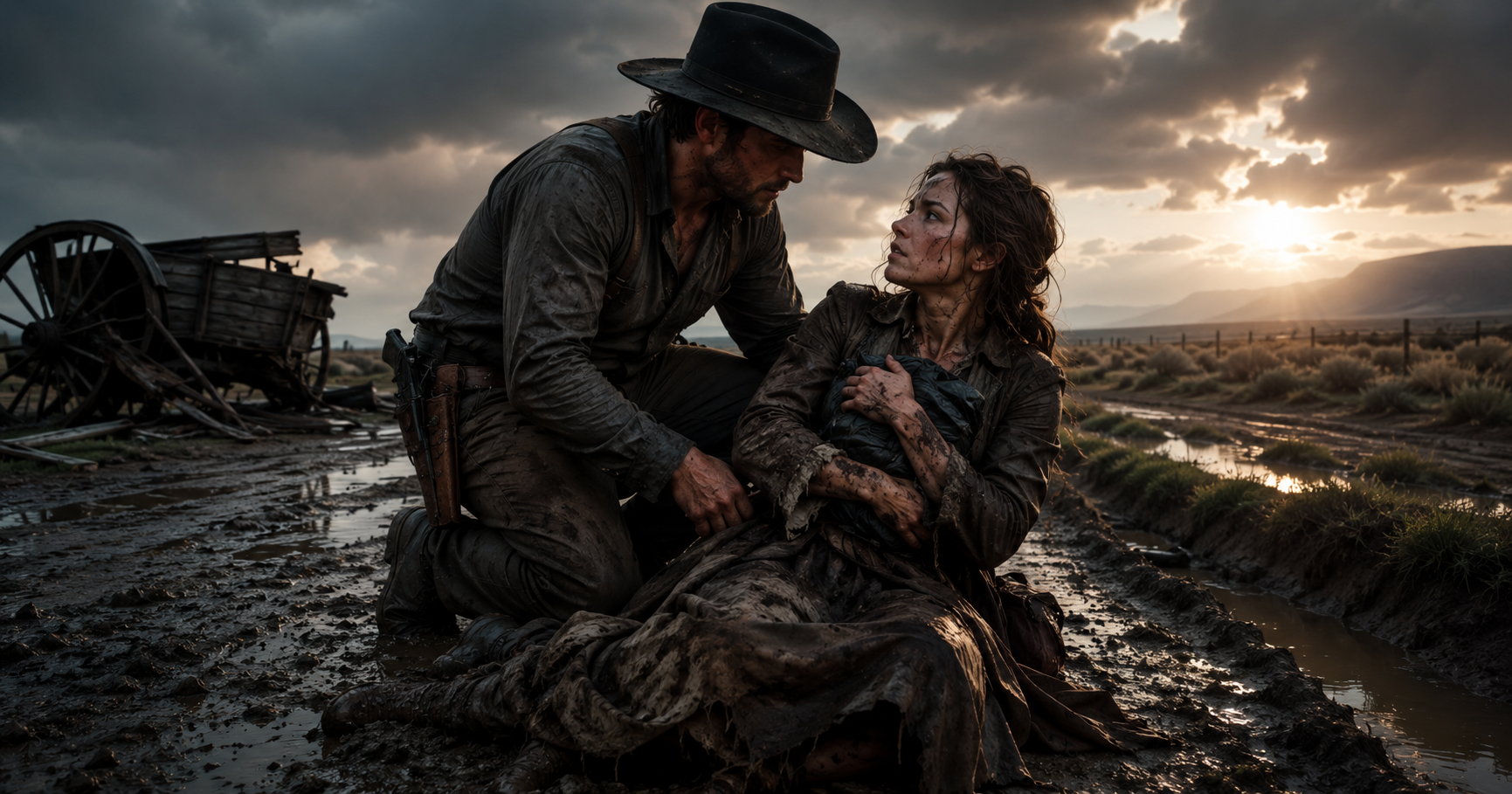
She began with the mud.
“I was not waiting to be rescued,” she would say. “I was waiting until I could stand.”
Then she would smile, just a little.
“And when Rowan found me, I had already decided I would.”