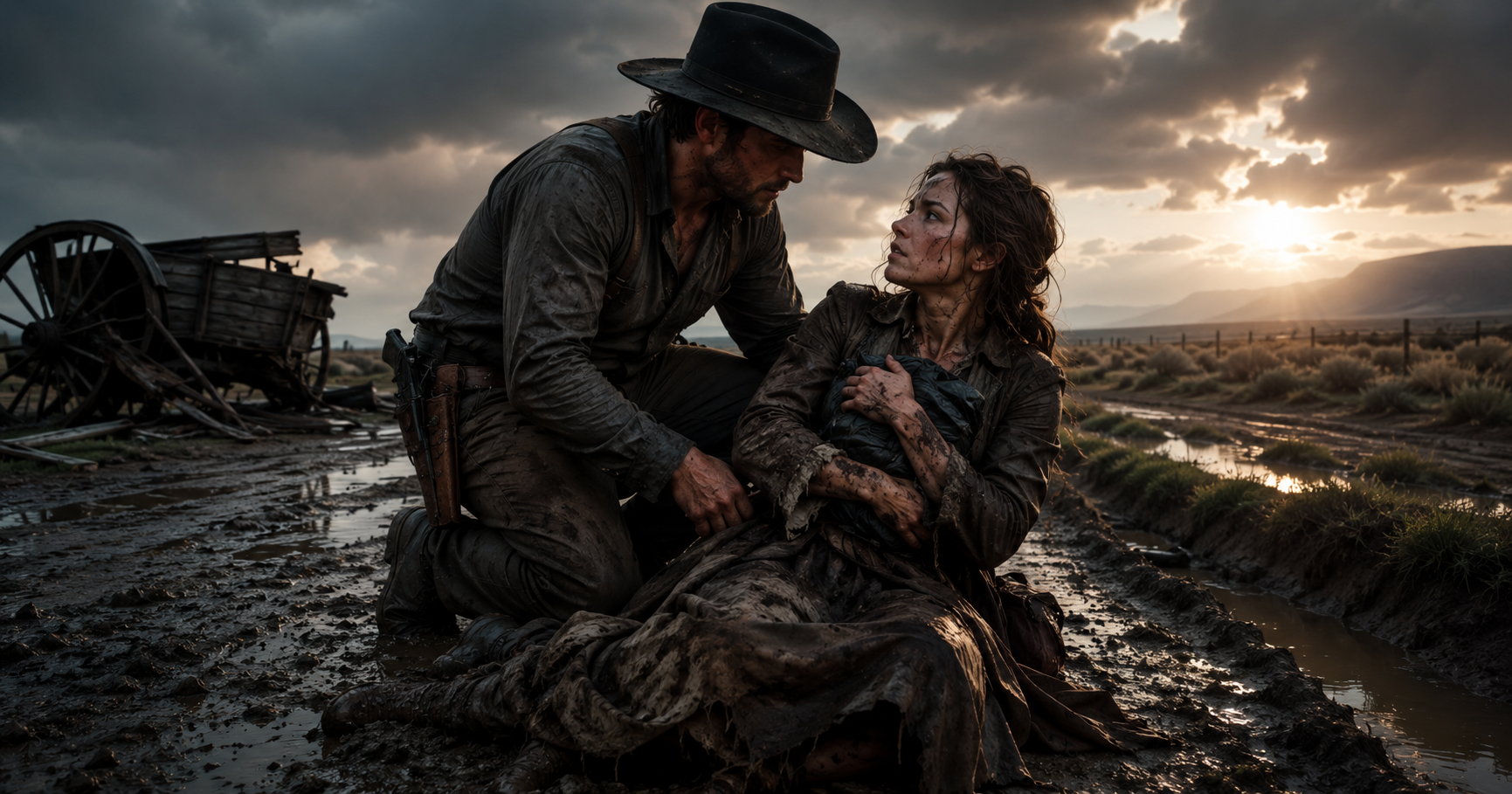
“The one who asked whether dictionaries contain every word or only the obedient ones.”
“That’s her.”
Despite the mud and pain, Mara’s voice softened by a single thread. “A sensible question.”
“She has many.”
“Then she is dangerous.”
“She is lonely.”
The word settled between them.
Rowan had not meant to say it. Not so plainly. But the road was empty, the sky low, and the woman in front of him had nearly died before becoming anything he had hoped she might become. It made lying feel wasteful.
Mara looked over the road ahead. “Lonely children hear more truth than adults intend.”
Rowan said nothing.
The horse picked its way toward Cinder Creek. The town lay in a shallow valley where the church steeple, the grain office, the bank, and the hotel all seemed to lean toward one another as if exchanging secrets.
But Rowan did not take her to town.
He took her home.
Three Pines Ranch sat beyond the last line of cottonwoods, tucked against low hills the color of wet iron. Two barns, one cabin, a smokehouse, a corral, and a porch that sagged on one side because Rowan had meant to fix it for three years and grief had taught him the terrible art of leaving things almost done.
June Vale stood on that porch in a blue dress and boots too big for her.
She ran when she saw them.
Then she stopped.
Her eyes went wide.
“You are very muddy,” June said.
“June,” Rowan warned.
Mara looked down at the child. “That is an accurate assessment.”
June stepped closer. “Are you going to die?”
“Not if I can help it.”
“That is not a promise.”
“No,” Mara said. “It is a position.”
June seemed to consider this and approve.
Then her gaze fell on the oilskin packet.
“Is that a present?”
Mara tightened her grip.
“No.”
June nodded gravely. “Then it must be important.”
“It is.”
“More important than your boot?”
Mara looked down at her bare, muddy stocking.
“For the moment, yes.”
June turned to Rowan. “Papa, she needs the doctor.”
“I know.”
“And soup.”
“I know.”
“And a blanket that isn’t the scratchy brown one, because injured people should not also be insulted.”
For the first time, Mara almost smiled.
Rowan saw it, and something in his chest moved in a place he had believed had gone still.
By nightfall, Doc Bell had cleaned the cut on Mara’s head, wrapped her ankle, scolded everyone in the room, and declared that nothing was broken except perhaps the patience of the patient. June had brought water, soup, three blankets, and one question every six minutes until Rowan sent her to wash.
Mara sat at the kitchen table with her injured foot propped on a chair. The oilskin packet lay in front of her. Her hand never strayed far from it.
Rowan stood by the stove.
Mara watched him for a while.
“Do you intend to hover all evening?”
“This is my kitchen.”
“That does not answer my question.”
He pulled out the chair across from her and sat.
The cabin suddenly felt smaller.
There were too many things in it. The smell of rain. The doctor’s liniment. June humming in the next room. The empty hook where Rowan’s first wife’s shawl used to hang. The woman at the table who had answered his advertisement for a wife, arrived wounded instead of veiled, and brought trouble wrapped in oilskin.
Mara touched the packet.
“Before anyone speaks of marriage,” she said, “there are things you should know.”
Rowan’s hands tightened on the table.
June appeared in the doorway with wet hair and bare feet.
“Am I allowed to hear?”
“No,” Rowan said.
“Yes,” Mara said at the same time.
Rowan looked at her.
Mara did not look away. “She lives here. Whatever danger followed me has already reached this house. Children should not be forced to learn fear by listening through walls.”
June stepped fully into the room.
Rowan shut his eyes for a second.
Then he nodded.
June climbed into the chair beside Mara.
Mara untied the red cord.
Inside the oilskin were folded papers, a small account book, three letters, and a map marked in blue ink.
“I worked for a freight office in Denver,” Mara said. “Not as a clerk, though that is what they called me when visitors came. I kept the books. I balanced contracts. I copied bills of sale. I learned which men smiled while stealing.”
Rowan’s gaze dropped to the papers.
“A man named Silas Creed owns half the freight lines between Denver and the western rail camps,” Mara continued. “He is rich enough to be called respectable and cruel enough to deserve it. He offered me a private arrangement. I refused.”
June frowned. “What does private arrangement mean?”
“It means he wanted something he had no right to ask for,” Mara said carefully. “And when I said no, he tried to ruin me.”
Rowan’s jaw hardened.
Mara saw it.
“No,” she said.
He looked at her.
“Do not become angry before you understand.”
“I can do both.”
“Men often think so.”