The Bride Missed the Train—Then the Rancher Found Her in the Mud Carrying a Secret That Could Burn the Whole Town Down

For one long, airless moment, Rowan Vale thought the woman was dead.

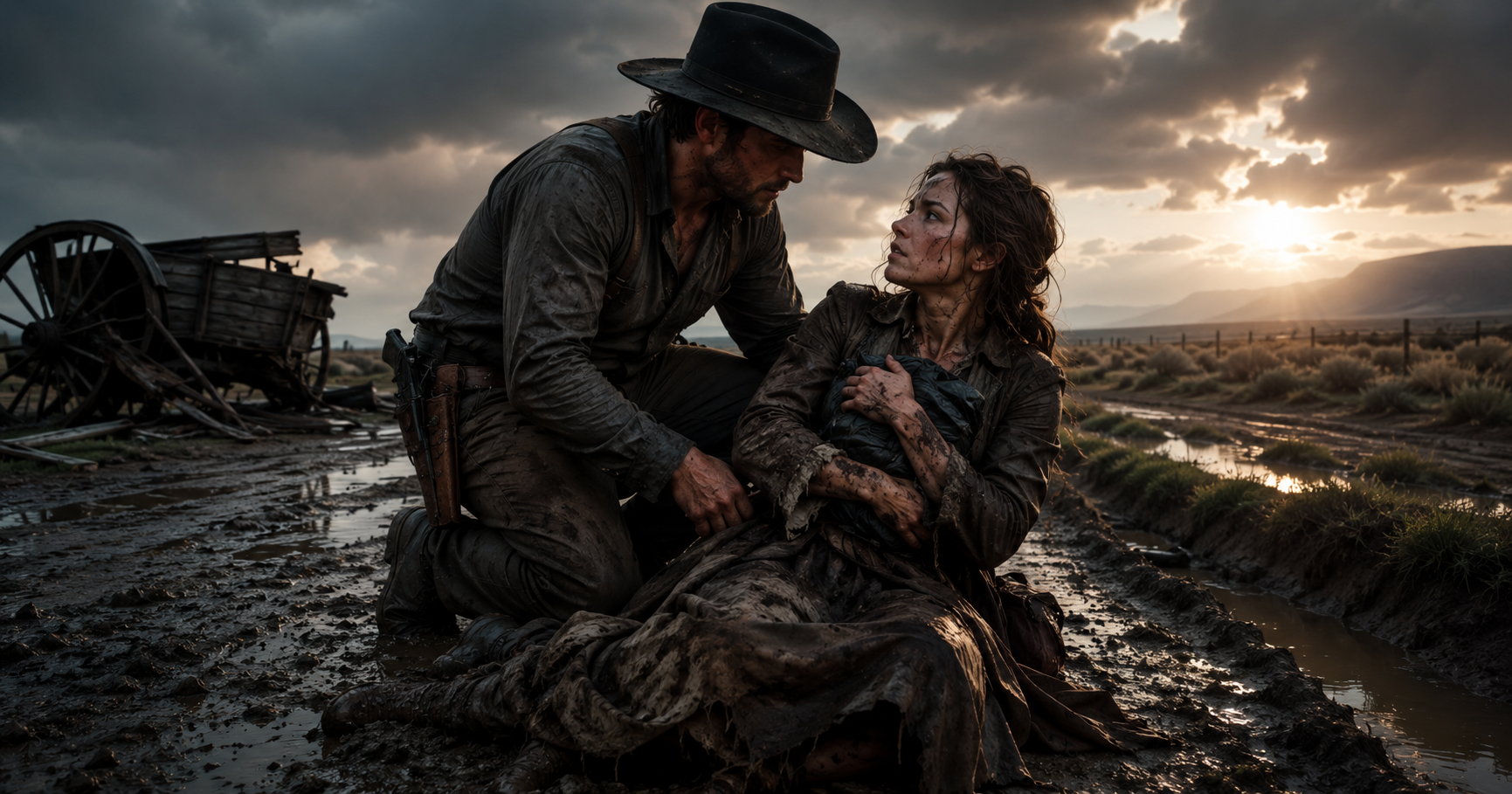
The rain had stopped, but the earth still remembered it. Mud sucked at his boots as he slid down the bank toward the ditch where the freight road bent around a stand of black cottonwoods. Broken wheel tracks carved deep scars into the road above. A trunk lay split open beside the creek, its contents dragged through the muck like someone had searched it in a fury.

Then he saw the hand.

A woman’s hand, pale beneath a glove torn at the wrist, clutched a flat oilskin packet against her chest so tightly her fingers had cramped around it.

Rowan dropped to one knee.

“Miss Hart?”

The woman did not answer.

Her dark traveling coat was ripped across one shoulder. Wet hair covered half her face. Blood had dried near her temple and fresh mud streaked her cheek. One boot was missing. The other foot lay at a wrong, painful angle that made Rowan’s stomach tighten.

He reached toward her.

Her eyes snapped open.

In the same breath, she drove the heel of her hand into his chest and tried to crawl backward.

“Don’t.”

Her voice was raw. Not weak. Raw.

Rowan raised both hands. “Easy. I’m not here to hurt you.”

“That is what men say when they want a woman to stop fighting.”

The words came out in pieces, but they came out sharp.

Rowan studied her face. Even hurt, even soaked, even half buried in a ditch, she looked at him as if he were a problem she intended to solve.

“My name is Rowan Vale,” he said. “Three Pines Ranch. You were supposed to arrive in Cinder Creek by noon.”

Her eyes narrowed.

“You are late,” she whispered.

“I’m late?”

“The train was late. The wagon driver was drunk. The road washed out. Then someone tried to kill me.” She blinked slowly, fighting dizziness. “So yes, Mr. Vale. Everyone is late.”

Against his will, Rowan let out one stunned breath that was nearly a laugh.

The woman in the mud glared at him.

“I apologize,” he said. “That was not amusement.”

“It sounded like amusement.”

“It was surprise.”

“Surprise is often rude.”

“So is bleeding in my drainage ditch when I was expecting a bride at the depot.”

That made her still.

Not softer. Just still.

“I am not your bride yet,” she said.

“No,” Rowan answered. “You are not.”

Something in her expression shifted, as if she had expected either offense or possession and found neither. She drew one shallow breath, then another.

“Can you tell me how badly you’re hurt?” he asked.

She closed her eyes. “Head wound. Not deep. Left ankle badly twisted, possibly broken. Shoulder strained. Two ribs bruised. Cold. Thirsty. Furious.”

“Furious made the list?”

“Furious is currently doing most of the work.”

Rowan looked at the packet in her arms. Oilskin. Tied with red cord. No bigger than a ledger book, but she held it like a heart.

“You’ll need both hands to climb.”

“I will manage with one.”

“You may not.”

“Then you may drag my corpse uphill and complain about my judgment afterward.”

Rowan stared at her for a second.

“Mara Hart,” he said quietly, “you are the most difficult woman I have ever found unconscious.”

“I was not unconscious.”

“You did not answer when I spoke.”

“I was deciding whether you were real.”

“And?”

“The jury is still out.”

The corner of his mouth twitched. He stood, then bent enough to offer his arm.

“Keep your packet,” he said. “But hold on to me with the other hand.”

“I dislike needing help.”

“That’s fortunate. This is not about what you like.”

She looked at him then, really looked. The rain had made his hat limp, had soaked through his shirt, had turned dust and sweat into dark streaks across his jaw. He was broad, sun-browned, and tired around the eyes. Not old, but marked by work and loss.

“You wrote shorter sentences in your letters,” she said.

“You wrote kinder ones.”

“I had more ink and less pain then.”

He waited.

At last, with visible hatred for the necessity, she put one muddy hand on his forearm.

Getting her up the bank took almost half an hour.

Mara did not cry out. Not when her injured ankle slipped. Not when her bad shoulder struck the dirt. Not when Rowan finally had no choice but to lift her the last few feet and set her on the road beside his horse.

She only said, through clenched teeth, “If you tell anyone I fainted, I will deny it.”

“You did not faint.”

“I know.”

“You nearly did.”

“Nearly is a country where many useless things live.”

Rowan helped her into the saddle. She went rigid when he mounted behind her, so he kept his arms careful and his hands visible on the reins.

“My daughter’s name is June,” he said, because he could feel fear tighten every muscle in her back. “She is eight. She has been waiting on the porch since breakfast and pretending she is not.”

Mara’s breathing changed.

“The girl from your letters.”

“Yes.”

“The one who asked whether dictionaries contain every word or only the obedient ones.”

“That’s her.”

Despite the mud and pain, Mara’s voice softened by a single thread. “A sensible question.”

“She has many.”

“Then she is dangerous.”

“She is lonely.”

The word settled between them.

Rowan had not meant to say it. Not so plainly. But the road was empty, the sky low, and the woman in front of him had nearly died before becoming anything he had hoped she might become. It made lying feel wasteful.

Mara looked over the road ahead. “Lonely children hear more truth than adults intend.”

Rowan said nothing.

The horse picked its way toward Cinder Creek. The town lay in a shallow valley where the church steeple, the grain office, the bank, and the hotel all seemed to lean toward one another as if exchanging secrets.

But Rowan did not take her to town.

He took her home.

Three Pines Ranch sat beyond the last line of cottonwoods, tucked against low hills the color of wet iron. Two barns, one cabin, a smokehouse, a corral, and a porch that sagged on one side because Rowan had meant to fix it for three years and grief had taught him the terrible art of leaving things almost done.

June Vale stood on that porch in a blue dress and boots too big for her.

She ran when she saw them.

Then she stopped.

Her eyes went wide.

“You are very muddy,” June said.

“June,” Rowan warned.

Mara looked down at the child. “That is an accurate assessment.”

June stepped closer. “Are you going to die?”

“Not if I can help it.”

“That is not a promise.”

“No,” Mara said. “It is a position.”

June seemed to consider this and approve.

Then her gaze fell on the oilskin packet.

“Is that a present?”

Mara tightened her grip.

“No.”

June nodded gravely. “Then it must be important.”

“It is.”

“More important than your boot?”

Mara looked down at her bare, muddy stocking.

“For the moment, yes.”

June turned to Rowan. “Papa, she needs the doctor.”

“I know.”

“And soup.”

“I know.”

“And a blanket that isn’t the scratchy brown one, because injured people should not also be insulted.”

For the first time, Mara almost smiled.

Rowan saw it, and something in his chest moved in a place he had believed had gone still.

By nightfall, Doc Bell had cleaned the cut on Mara’s head, wrapped her ankle, scolded everyone in the room, and declared that nothing was broken except perhaps the patience of the patient. June had brought water, soup, three blankets, and one question every six minutes until Rowan sent her to wash.

Mara sat at the kitchen table with her injured foot propped on a chair. The oilskin packet lay in front of her. Her hand never strayed far from it.

Rowan stood by the stove.

Mara watched him for a while.

“Do you intend to hover all evening?”

“This is my kitchen.”

“That does not answer my question.”

He pulled out the chair across from her and sat.

The cabin suddenly felt smaller.

There were too many things in it. The smell of rain. The doctor’s liniment. June humming in the next room. The empty hook where Rowan’s first wife’s shawl used to hang. The woman at the table who had answered his advertisement for a wife, arrived wounded instead of veiled, and brought trouble wrapped in oilskin.

Mara touched the packet.

“Before anyone speaks of marriage,” she said, “there are things you should know.”

Rowan’s hands tightened on the table.

June appeared in the doorway with wet hair and bare feet.

“Am I allowed to hear?”

“No,” Rowan said.

“Yes,” Mara said at the same time.

Rowan looked at her.

Mara did not look away. “She lives here. Whatever danger followed me has already reached this house. Children should not be forced to learn fear by listening through walls.”

June stepped fully into the room.

Rowan shut his eyes for a second.

Then he nodded.

June climbed into the chair beside Mara.

Mara untied the red cord.

Inside the oilskin were folded papers, a small account book, three letters, and a map marked in blue ink.

“I worked for a freight office in Denver,” Mara said. “Not as a clerk, though that is what they called me when visitors came. I kept the books. I balanced contracts. I copied bills of sale. I learned which men smiled while stealing.”

Rowan’s gaze dropped to the papers.

“A man named Silas Creed owns half the freight lines between Denver and the western rail camps,” Mara continued. “He is rich enough to be called respectable and cruel enough to deserve it. He offered me a private arrangement. I refused.”

June frowned. “What does private arrangement mean?”

“It means he wanted something he had no right to ask for,” Mara said carefully. “And when I said no, he tried to ruin me.”

Rowan’s jaw hardened.

Mara saw it.

“No,” she said.

He looked at her.

“Do not become angry before you understand.”

“I can do both.”

“Men often think so.”

June glanced between them and whispered, “She may be right.”

Mara went on. “After I refused him, my position disappeared. Then boarding houses would not rent to me. Then a letter went to my brother claiming I had stolen money. I had not. I had proof I had not. But proof is a small candle when a rich man owns the wind.”

Rowan’s voice was low. “So you ran.”

“No,” Mara said. “I investigated.”

June sat up straighter.

Mara spread the map on the table.

“These are ranches and farms between Cinder Creek and Halewater Pass. Sixteen properties. All carrying notes through the same bank. All near springs or creek rights the railroad will need when it lays the northern spur.”

Rowan stared at the map.

His ranch was circled.

Three Pines.

A red mark sat over his well.

His mouth went dry.

Mara looked at him. “That is why I answered your advertisement.”

The words landed hard.

Rowan pushed back from the table and stood.

June’s face changed. “Papa?”

He walked to the window. Outside, rainwater dripped from the porch roof into a barrel with a slow, hollow sound.

Mara’s voice followed him.

“At first, I wrote because your ranch was on the map. I thought I could warn you. But then you wrote back about June. About how she read the same page of a book twice when she was worried. About how your late wife planted beans along the fence because she said flowers were pretty but food was prettier. About how the house had grown too quiet.”

Rowan gripped the window frame.

“I should have told you,” he said.

Mara was silent.

He turned.

“I should have told you the bank holds a note on this ranch. I should have told you I’m two months from losing it if the cattle contract fails.”

“Yes,” Mara said.

No anger.

That was worse.

“I was afraid you wouldn’t come.”

“You took away my chance to decide with both eyes open.”

June looked down at her hands.

Rowan swallowed. “I know.”

Mara studied him for a long moment.

A worse man would have defended himself. A weaker one would have blamed sorrow. Rowan did neither. He stood with the truth in the room and let it judge him.

Finally, Mara said, “Then we begin with the unpleasant advantage of knowing neither of us arrived honestly.”

June lifted her head. “Does that mean you are leaving?”

Mara’s expression changed.

Very slightly.

“No.”

June tried not to show relief and failed.

Mara folded one hand over the map. “It means I need help. And so do you.”

The next morning, Silas Creed came to Cinder Creek.

He did not come dusty, as honest travelers did. He came polished. His black carriage rolled down the main street with two matched horses and a driver in a coat finer than the mayor’s Sunday suit. By noon, everyone knew a Denver gentleman had taken the largest room at the hotel and asked after Miss Mara Hart.

By one o’clock, Rowan was riding hard for Three Pines.

Mara was at the table teaching June fractions with dried beans.

“He is here,” she said before Rowan spoke.

June’s hand froze over the beans. “The man with the wind?”

Mara nodded.

Rowan shut the door. “Pack what you need. I’ll take you both to the east line cabin.”

“No.”

“Mara.”

“If I hide, he controls the story.”

“If you stay, he controls the danger.”

She rose carefully, one hand braced on the table, her wrapped ankle stiff beneath her skirt.

“Danger is already here.”

The knock came before sunset.

Three calm taps.

A man certain the world had hinges for his convenience.

Rowan opened the door and filled it.

Silas Creed stood on the porch in a dark coat, silver watch chain gleaming against his vest. He was handsome in the way expensive knives were handsome: polished, cold, and made for harm.

“Mr. Vale,” he said. “I believe you have something that concerns me.”

“No.”

Creed smiled. “That was quick.”

“I understood the question.”

His eyes flicked past Rowan toward the room. “Mara. I know you are inside.”

Mara’s voice answered from behind Rowan. “Then you also know you are not welcome.”

Creed’s smile tightened.

She stepped into view. Pale from pain, hair braided loosely, wearing one of Rowan’s late wife’s gray shawls because June had insisted it was the softest thing in the house.

Creed’s gaze moved over the shawl, then her face.

“You look unwell.”

“I was thrown from a wagon and left in the mud.”

“How unfortunate.”

“Your man thought so too. He searched my trunk before he rode away.”

For the first time, Creed’s expression slipped.

Only a crack.

But Rowan saw the darkness behind it.

“I had no man on that road,” Creed said.

Mara tilted her head. “I did not say you did.”

The silence was clean and sharp.

June peeked from behind the pantry curtain.

Creed saw her and rearranged his face into gentleness.

“You must be June.”

June stepped out. “You smile like the banker when he lies.”

“June,” Rowan said.

But Creed’s eyes had hardened.

Mara put a steadying hand on the girl’s shoulder.

Creed looked at Rowan. “You are in debt, Mr. Vale. Men in debt should be careful about the company they keep.”

Rowan’s voice turned flat. “Men who threaten children should be careful about standing on my porch.”

Creed lifted both hands as if wounded by the accusation. “Threaten? I came to prevent a scandal. Miss Hart stole private documents from my office.”

“I copied records of fraud,” Mara said. “There is a difference.”

“A judge may not see it that way.”

“Then let us ask one.”

Creed stepped closer to the threshold.

Rowan did not move.

The two men stood close enough that the air between them felt like a wire pulled tight.

Creed spoke softly. “Your ranch is already slipping. I can buy the note. I can make the bank impatient. I can make every feed merchant in town remember what you owe. Do not mistake one stubborn woman for salvation.”

Mara’s voice cut through the room.

“And do not mistake one frightened town for silence.”

Creed looked at her.

Something ugly moved across his face and vanished.

“You always did overestimate truth,” he said. “Truth is only useful when someone powerful repeats it.”

Mara reached for the packet on the table.

“No,” she said. “Truth is useful when someone afraid says it first.”

Creed left without another word.

But before he stepped down from the porch, he turned to Rowan.

“Thirty days,” he said. “By then, you will wish you had never answered an advertisement.”

Rowan shut the door.

For a moment, the cabin held no sound at all.

Then June whispered, “I hate him.”

Mara exhaled slowly. “That is reasonable.”

Rowan turned to the packet. “Who can read those papers and do something about them?”

Mara looked toward town.

“There is one woman,” she said. “If she is still alive, still sober, and still angry.”

Etta Crowe was alive.

Sober was debatable.

Angry was beyond question.

She lived behind the old livery in a two-room house full of law books, tobacco smoke, and cats with judicial expressions. She had once been the best land attorney in the territory until she told a railroad baron in open court that his argument had “the moral spine of boiled cabbage.” After that, men stopped hiring her. Women, widows, and desperate ranchers did not.

Etta read Mara’s papers until the lamp burned low.

She read Rowan’s loan note.

Then she read the old deed to Three Pines.

At midnight, she laughed.

It was not a warm sound.

It was the sound of a trap recognizing another trap.

“There,” she said, tapping the deed with one crooked finger.

Rowan leaned forward. “What?”

“Your father bought grazing land, yes. But your mother registered the spring rights separately after the drought of ’69.” Etta looked at Mara. “Did Creed’s map mark the water?”

“Yes.”

“Of course it did. Railroads do not thirst politely.” Etta turned the deed toward Rowan. “The bank can threaten the house, the pasture, the barn. But it cannot touch the spring without a separate lien. There is none.”

Rowan stared at the paper.

Mara closed her eyes.

June whispered, “Does that mean we win?”

Etta snorted. “Child, never use the word win near a lawyer. It makes God suspicious.”

But the next morning, Cinder Creek learned to listen.

Judge Abel Thorne agreed to hear the matter because half the town had gathered outside his office before breakfast and because Etta Crowe had arrived carrying three law books and an expression that promised public embarrassment.

Silas Creed stood on the courthouse steps, elegant and calm.

Mara walked beside Rowan with June between them.

Creed smiled. “Miss Hart. Surely you do not intend to turn private confusion into a street performance.”

Mara looked at the crowd.

The banker stood near the hitching post. The hotel owner stood in her doorway. Two ranch wives watched from a wagon. The blacksmith came out with a hammer still in his hand.

“I think Cinder Creek has suffered too much private confusion,” Mara said. “A little public clarity may do it good.”

Creed’s smile vanished.

Inside, Etta laid out the papers.

Not all of them.

Only enough.

Copies of false assignments. Freight payments tied to dummy buyers. Ranch notes quietly shifted toward Creed’s companies. A map of water rights and rail lines. And Rowan’s deed, showing the spring beyond the bank’s reach.

Judge Thorne read in silence.

Creed argued beautifully. He spoke of misunderstanding, commercial necessity, clerical error, and malicious female resentment.

Etta let him talk.

Then she said, “Judge, when a man builds a fence across land he does not own, we call it trespass. When he does it with paper instead of posts, gentlemen call it business. I ask the court to remember the difference.”

The judge rubbed his eyes.

By noon, the bank’s claim over the spring was denied.

By one, Judge Thorne ordered Creed’s companies to produce all purchase records connected to Cinder Creek ranch notes.

By two, Silas Creed stopped smiling.

But Mara knew men like him did not become harmless because one door shut.

They looked for fire.

That night, the barn burned.

June saw it first.

She screamed from the porch, and Rowan ran before the second breath left her body. Flames crawled up the hayloft wall, orange and hungry, throwing sparks into the dark. Horses kicked and shrieked inside.

Rowan plunged through the smoke.

Mara caught June around the waist before the girl could follow.

“Papa!” June screamed.

“He knows the horses,” Mara said, holding her tight. “He knows the way.”

“I have to help!”

“You will help by breathing.”

Inside the barn, wood cracked like gunshots.

Neighbors came running. Buckets passed hand to hand. Someone shouted that a man had been seen riding east. Someone else shouted that the back door had been chained from outside.

Mara’s blood went cold.

Creed had not come for paper.

He had come for punishment.

Rowan emerged through smoke with one horse loose beside him, then turned back.

“No!” June screamed.

He disappeared again.

The roof beam groaned.

Mara limped forward, grabbed an axe from the chopping block, and dragged herself toward the chained back door.

Pain shot up her injured leg so sharply the night went white at the edges.

She kept moving.

At the back of the barn, the chain burned hot against the door handles. Mara wrapped her skirt around one hand and swung the axe with the other.

Once.

Twice.

The third swing split the latch.

The door burst open.

Smoke rolled out.

Rowan stumbled through with the last horse’s reins in one hand and his sleeve on fire.

Mara threw herself against him, beating at the flames with her shawl until the cloth smoked and tore.

He caught her before she fell.

“You shouldn’t be walking.”

“You shouldn’t be burning.”

The absurdity of it struck them both at once. Not laughter. Something too close to it and too shaken to name.

Then June slammed into Rowan, sobbing.

He dropped to his knees and wrapped his arms around her.

“I’m here,” he whispered. “I’m here.”

Mara stood beside them with smoke in her lungs and the ruined shawl in her hands.

For the first time since the ditch, her own strength failed.

Rowan looked up and saw it.

He reached for her.

She let him.

By dawn, half the barn was gone.

But all the horses lived.

And Silas Creed had made his mistake.

The man seen riding east was Creed’s driver. The chain came from the hotel stable. The blacksmith identified the cut links because he had sold them himself. The hotel owner admitted Creed had left after midnight and returned with soot on one cuff.

By sunrise, the sheriff had enough to search Creed’s room.

They found nothing.

Of course they found nothing.

Creed was too careful for that.

Then June spoke.

“He put something in the church stove.”

Everyone turned.

The girl stood in the courthouse hall, pale but steady.

“I saw him yesterday. Before court. He went into the church when no one was there. He had a packet under his coat. I thought it was papers.”

Mara knelt carefully in front of her. “Why didn’t you say?”

June’s mouth trembled. “Because I followed him when you told me not to follow danger.”

Rowan closed his eyes.

Mara took June’s hands.

“Then today we will be grateful you disobeyed and discuss consequences later.”

Etta Crowe barked a laugh from behind them. “That is the most useful parenting I have heard in years.”

They found the packet wedged behind a loose brick near the church stove.

Inside were letters.

Not copies. Originals.

Instructions to pressure banks. Payments to false buyers. Orders to acquire water rights by any means necessary. And one letter that named the man who had attacked Mara’s wagon and searched her trunk.

Creed had hidden the papers in the church because no one ever looked for sin beside the stove.

When the sheriff brought Silas Creed to the courthouse, he no longer looked polished.

He looked cornered.

Mara stood in front of him.

Her ankle throbbed. Her head ached. Smoke had roughened her voice. But her hands were steady.

Creed looked past her at Rowan. “Control your woman.”

The room went silent.

Rowan stepped forward.

Mara lifted one hand, stopping him.

Then she looked Creed in the eye.

“That is where you have always been confused,” she said. “No one controls me. That is why you are afraid.”

Creed laughed once, sharp and ugly. “You think this ends me?”

“No,” Mara said. “Men like you rarely end cleanly. But it begins something you cannot buy.”

“What?”

“Witnesses.”

She turned.

The whole town stood behind her.

Ranchers. Widows. Merchants. Children. The banker who had looked away too many times. The judge who had preferred quiet. The blacksmith. The hotel owner. June, holding Rowan’s hand.

Creed saw them.

For the first time, he understood.

Paper mattered. Law mattered. Money mattered.

But not as much as a town that had finally grown tired of being privately afraid.

Silas Creed left Cinder Creek in irons three days later.

Justice did not arrive like a hymn. It arrived tired, dusty, argued over, and incomplete. Creed still had friends. He still had money. He still had lawyers who would polish his crimes until they looked like mistakes.

But he also had letters in a marshal’s bag, testimony from half a town, and Mara Hart alive to speak.

By October, Rowan still owed the bank.

But now the bank had become humble.

The penalty disappeared after Etta Crowe threatened to examine every note it had written since the war. The cattle contract came through. Neighbors helped raise a new barn and argued loudly that it was not charity, merely repayment for future favors. June sold eggs in town and kept a ledger so severe that grown men paid exact change out of fear.

Mara did not marry Rowan in a rush.

That surprised everyone.

Especially Rowan.

One evening, after the new barn roof went on, he found her by the spring. The water moved clear over stones beneath the cottonwoods. She sat on a flat rock with her bad ankle stretched in front of her and one of June’s schoolbooks in her lap.

“You are hiding,” he said.

“I am resting.”

“You hide with better posture than most people rest.”

She looked at him. “You are learning.”

He sat beside her, leaving space.

For a while, they listened to the spring.

Then Rowan said, “When I wrote that advertisement, I thought I was asking for a wife.”

“You were.”

“No. I was asking for someone to step into a room still full of ghosts and pretend not to see them.”

Mara closed the book.

“I saw them.”

“I know.”

“I also saw you trying to make room.”

Rowan looked at the water. “I loved Clara.”

“June’s mother.”

“Yes.”

“I know.”

“I still love her. Not like a man waiting for the dead to return. But like a man grateful for a house she helped build inside him.”

Mara’s eyes softened.

“That is not a betrayal,” she said.

“I used to think any new happiness would be.”

“And now?”

He reached into his coat and took out a folded paper.

Not a proposal.

A deed.

Mara frowned.

“What is that?”

“Half the spring rights.”

She stared at him.

He placed the paper on the rock between them.

“Not as payment,” he said. “Not as rescue. Not as a trap. Whether you marry me or not, this ranch is standing because you carried truth through mud, blood, smoke, and every stubborn man in Cinder Creek. Your name belongs on what you saved.”

For once, Mara had no immediate answer.

The silence stretched.

Rowan began to worry he had done the wrong thing.

Then she touched the paper with one finger.

“You are offering me water.”

“I suppose I am.”

“That is very practical.”

“You like practical.”

“I do.”

She looked at him then, and all the sharpness did not leave her face, but something warmer came through it.

“I will not marry you because you need me,” she said.

“I know.”

“I will not marry you because June loves me.”

“She does.”

“I know. I am trying not to be smug.”

“You are failing.”

A smile broke through before she could stop it.

Rowan forgot, for one second, how to breathe.

Mara looked back at the spring.

“I might marry you,” she said, “because when you are afraid, you eventually tell the truth.”

“That is not the prettiest reason a man has ever heard.”

“It may be the safest.”

He nodded.

“That is enough for me.”

They were married two weeks later beneath the cottonwoods near the spring.

June insisted on flowers, then chose bean blossoms because her mother would have approved of useful beauty. Etta Crowe signed as witness and warned the preacher not to mumble. The blacksmith cried and blamed smoke from a forge nowhere nearby.

When the preacher asked Mara if she took Rowan Vale as her husband, she looked at Rowan and said, “I do, with both eyes open.”

When he asked Rowan, Rowan’s voice broke on the first word.

“I do.”

June stood between them afterward, holding both their hands.

“Are we finished becoming a family now?” she asked.

Mara considered this seriously.

“No.”

June’s face fell.

Rowan squeezed her hand.

Mara continued, “Families are not finished. They are practiced.”

June thought about that.

“Every day?”

“Usually.”

“What if we are bad at it?”

“Then we apologize and practice again.”

June nodded. “That is acceptable.”

Years later, people in Cinder Creek still told the story of the bride who missed the train.

Some said Rowan Vale found her dying in a ditch.

June corrected them every time.

“She was not dying,” June would say. “She was furious.”

Others said Mara saved Three Pines Ranch.

Rowan corrected them too.

“She saved more than land.”

And Mara, when asked what truly happened, never began with the courthouse or the fire or Silas Creed leaving town in chains.

She began with the mud.

“I was not waiting to be rescued,” she would say. “I was waiting until I could stand.”

Then she would smile, just a little.

“And when Rowan found me, I had already decided I would.”

The Bride Missed the Train—Then the Rancher Found Her in the Mud Carrying a Secret That Could Burn the Whole Town Down
Do you remember Valya Isaeva, who became a mum at the age of 10? How is her life now?