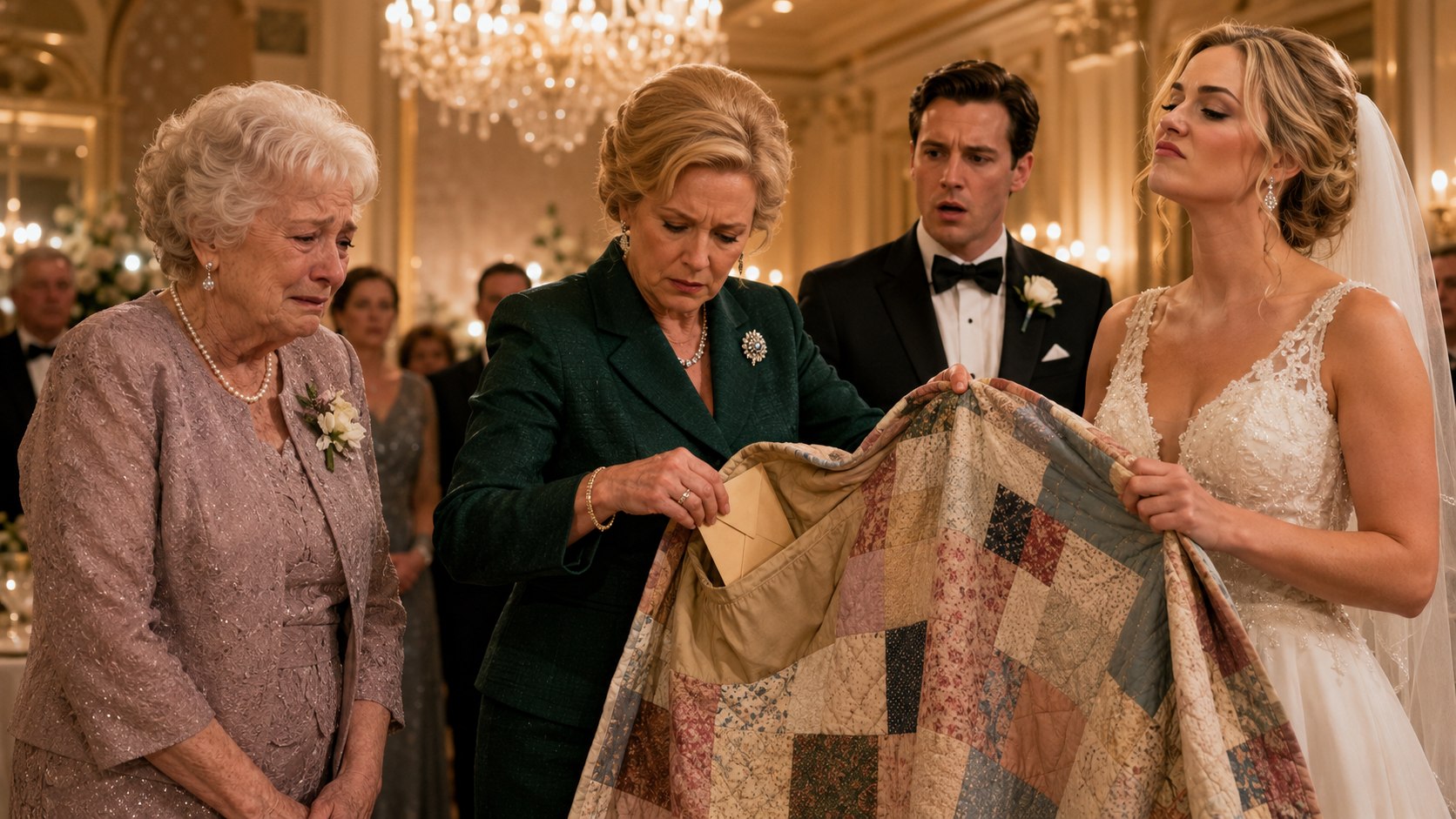
He sat at your table and read it twice.
The second time, he cried silently.
You did not stop him.
Some tears are overdue, and interrupting them is like closing a window in a house full of smoke.
When Eleanor finally left, she gave you her personal card.
“Call me tomorrow,” she said. “Not as charity. As a curator. That quilt deserves care.”
You shook your head.
“I don’t want money for it.”
“I didn’t offer money.”
She smiled.
“I offered respect.”
You kept the card.
After she left, Noah stayed.
He slept on your couch, still wearing his dress shirt, the quilt folded over his chest. At dawn, you found him awake, staring at the ceiling. He looked younger without the tuxedo jacket and the weight of Isabelle’s world around him.
“I don’t know what happens now,” he said.
You sat in the old armchair across from him.
“That’s all right.”
“My marriage might be over before it started.”
“Yes.”
“My phone has hundreds of messages.”
“Leave it off.”
“Dad’s letter is going to be everywhere.”
“Then let it remind people to be kinder.”
He turned his head toward you.
“Are you angry at me?”
You considered lying.
Old love makes lying tempting.
But Samuel’s letter had filled the house with courage, and you did not want to waste it.
“Yes,” you said.
Noah closed his eyes.
“I deserve that.”
“I’m not angry because you loved Isabelle. People can love badly before they learn. I’m angry because you let me become small in front of you.”
His jaw trembled.
“I know.”
“I am old, Noah. I don’t have endless years left to wait outside your life until you remember me.”
He sat up slowly.
“I don’t want you outside my life.”
“Then open the door.”
He nodded.
“I will.”
Over the next few days, the world discovered your quilt.
The video went viral before lunch. People wrote about their grandmothers, handmade gifts, old recipes, and things they had thrown away before understanding their value. Strangers said they called elderly relatives after watching Noah read the letter.
Isabelle posted a statement.
It was beautifully written and completely empty.
She said her words were taken out of context. She said weddings were stressful. She said she respected family traditions and regretted that some people had interpreted the moment negatively.
Eleanor Ashford responded with one sentence.
The context was cruelty.
That sentence went viral too.
Noah did not respond online.
Instead, he came to your house every morning that week.
At first, you thought guilt was driving him, and maybe it was. But guilt can pass like weather, or it can become a tool in the hands of someone willing to change.
Noah repaired the porch railing without asking for praise.
He fixed the kitchen window.
Properly this time.
He replaced the porch light, cleaned the gutters, and sat with you at lunch while you told him stories about his father he had been too young to remember. Some stories made him laugh. Some made him cry.
All of them brought Samuel back into the room for a little while.
One afternoon, Noah found an old box of fabric beneath your sewing table.
“What are these?”
“Pieces I saved.”
“From what?”
“Everything.”
There was a square from Samuel’s baseball jersey. A piece from Noah’s first Halloween costume. A strip from the curtains in the first apartment you and Harold rented.
Fabric looked useless to some people.
But you had always known it could hold a life.
Noah touched a faded yellow square.
“Can you teach me?”
You looked at him.
“To sew?”
“Yes.”
You almost laughed.
Then you saw he meant it.
So you taught him how to thread a needle.
His stitches were terrible.
Crooked, uneven, too tight in some places and loose in others. He frowned at them as if they had personally betrayed him.
You smiled.
“Now you know how my hands felt making your gift.”
He looked up.
“I’m sorry.”
“I know.”
This time, you believed him.
A month later, the legal news came.
Noah filed for annulment.
Isabelle’s family tried to fight it quietly, but the public damage had already been done. Stories surfaced from former friends, assistants, bridesmaids, and planners who admitted Isabelle had mocked people for years when she thought there would be no consequences.
People love calling a single cruel moment a mistake.
But sometimes one moment is only the window.
The house behind it has been ugly for years.
Noah struggled with that truth.
You watched him grieve not only the woman he had married, but the version of himself who had wanted her approval so badly. He had mistaken being accepted by glamorous people for becoming worthy.
That was not rare.
You had seen many lonely people do it.
One evening, he sat at your table and said, “I think I was embarrassed by where I came from.”
You stirred honey into your tea.
“I know.”
He looked wounded, then nodded.