Even at eighty-one, you knew the sound of a door painted onto a wall.
Noah knew it too.
“Her name is Clara,” he said.
Isabelle blinked.
“What?”
“My grandmother’s name is Clara. You’ve had two years to learn it.”
The guests shifted.
Two years.
Two years of dinners, cards, engagement photos, bridal showers, family calls, wedding plans. Two years in which Isabelle had smiled at you as if you were furniture and called you “Grandma” only when she wanted Noah to hear it.
You had told yourself it was enough.
Young people were busy.
You should not expect too much.
You should be grateful to be included.
But Noah had pulled the truth into the light.
She had never seen you as a person.
Isabelle’s tears dried quickly, anger burning through the performance.
“Are you seriously doing this in front of everyone? Over a blanket?”
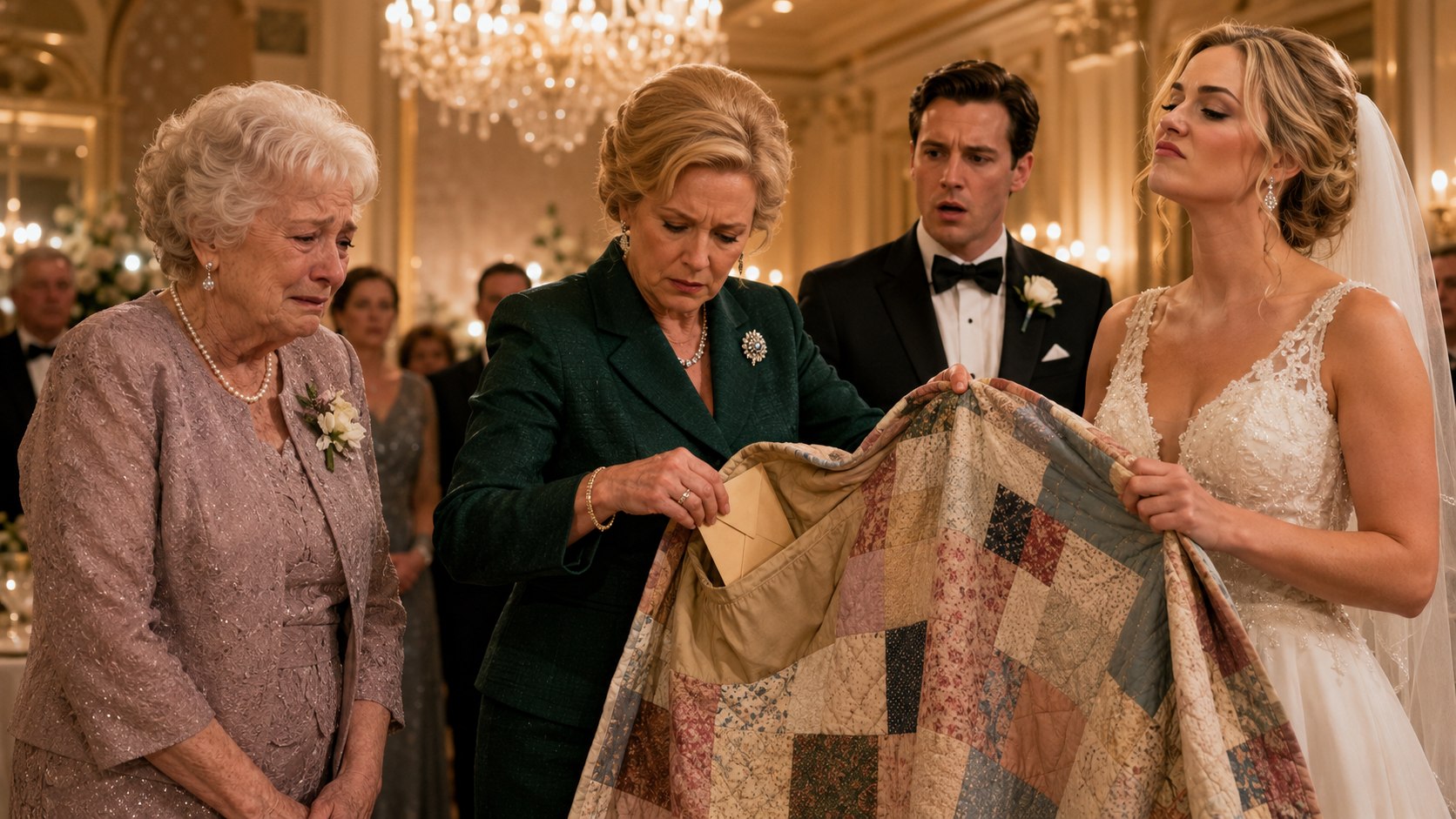
Noah lifted the letter.
“Over my father. Over my grandmother. Over the woman who raised me when no one else could.”
Your heart ached.
Not because of Isabelle anymore.
Because for the first time in years, Noah sounded like yours again.
Eleanor folded the quilt carefully and placed it in your arms.
“Mrs. Bennett,” she said, “this belongs with someone who understands its value.”
You held it tightly.
Then Noah came toward you.
“Grandma,” he said, “may I?”
You looked at him.
He was crying openly now, no longer caring who saw. Beneath the expensive tuxedo and polished wedding photographs, you saw the little boy who used to fall asleep against your shoulder.
You handed him the quilt.
Noah lifted it gently.
Nothing like Isabelle had done.
He wrapped it around his shoulders.
A murmur moved through the room.
He looked at the guests.
Then at Isabelle.
“My grandmother spent six months making this. She stitched in my baby blanket, my father’s shirt, my grandfather’s jacket, and part of her wedding veil. She gave us the only kind of wealth that cannot be bought.”
Isabelle’s face twisted.
“Noah, please stop.”
He shook his head.
“No. I should have stopped you.”
That was the sentence that finally broke you.
Because he was not pretending he had no part in your pain.
He knew silence had been its own betrayal.
Noah turned to you.
“I’m sorry, Grandma. I saw your face, and I still didn’t speak fast enough.”
You could not answer.
So you did what old women do when words become too heavy.
You opened your arms.
Noah came to you like he was ten years old again. He bent down because he was taller now, and you held him while the ballroom watched. You felt his shoulders shake. For a moment, the chandeliers, cameras, flowers, rich guests, and ruined wedding disappeared.
There was only your grandson.
Your last thread.
Not broken.
Frayed, perhaps.
But still in your hands.
Then Isabelle said the worst possible thing.
“So what?” she snapped. “Are you choosing her over me?”
The room froze.
Noah slowly released you.
He turned around.
Isabelle stood in the center of the ballroom, beautiful and furious, her gown glittering beneath the lights. She no longer looked like a bride. She looked like someone angry that the script had been taken from her.
Noah stared at her.
“I should never have had to choose.”
“But you are,” she said.
“No,” he answered. “You made the choice visible.”
Vivian rushed forward.
“Noah, think carefully. There are contracts, deposits, reputations. Do you understand what canceling this reception would look like?”
Noah gave a sad laugh.
“Better than living with a woman who thinks kindness is embarrassing.”
Charles’s voice went cold.
“You are making a mistake.”
Noah looked him straight in the eye.
“No. I made the mistake when I let your family teach me to treat my own like an accessory.”
Several guests were crying now.
Not politely.
Truly crying.
Older women. Servers near the kitchen doors. Men who looked away because Samuel’s letter had found something in them they had buried years ago.
The laughter from earlier had become collective shame.
Eleanor stepped beside Noah.
“As the owner of this hotel,” she said, “I can confirm that the remaining charges for tonight will be billed according to contract. I will also personally cover Mrs. Bennett’s transportation home, security if she wants it, and the preservation cost of that quilt.”
Vivian stared.
“Preservation cost?”
Eleanor’s smile was sharp.
“Yes. The Ashford Textile Foundation would be honored to document it as an example of contemporary family memory quilting. With Mrs. Bennett’s permission, of course.”
Isabelle looked as though she might faint.
The “cheap” quilt had just become museum-worthy in front of every person she had wanted to impress.
But you were not thinking about museums.
You were thinking about Samuel.
The letter.
The promise.
Noah held the paper and looked at it as if he could touch his father through ink.