You wished your husband were alive. Just for one minute. Just long enough to stand beside you and place his warm, work-worn hand over yours. Harold would have known what to say. Or maybe he would have said nothing at all. He had always been the kind of man whose silence could hold you steady.
But Harold was gone.
Your son Samuel was gone.
And Noah, your grandson, the little boy you had raised after grief split your family open, stood in front of everyone and looked as though he had forgotten how to be yours.
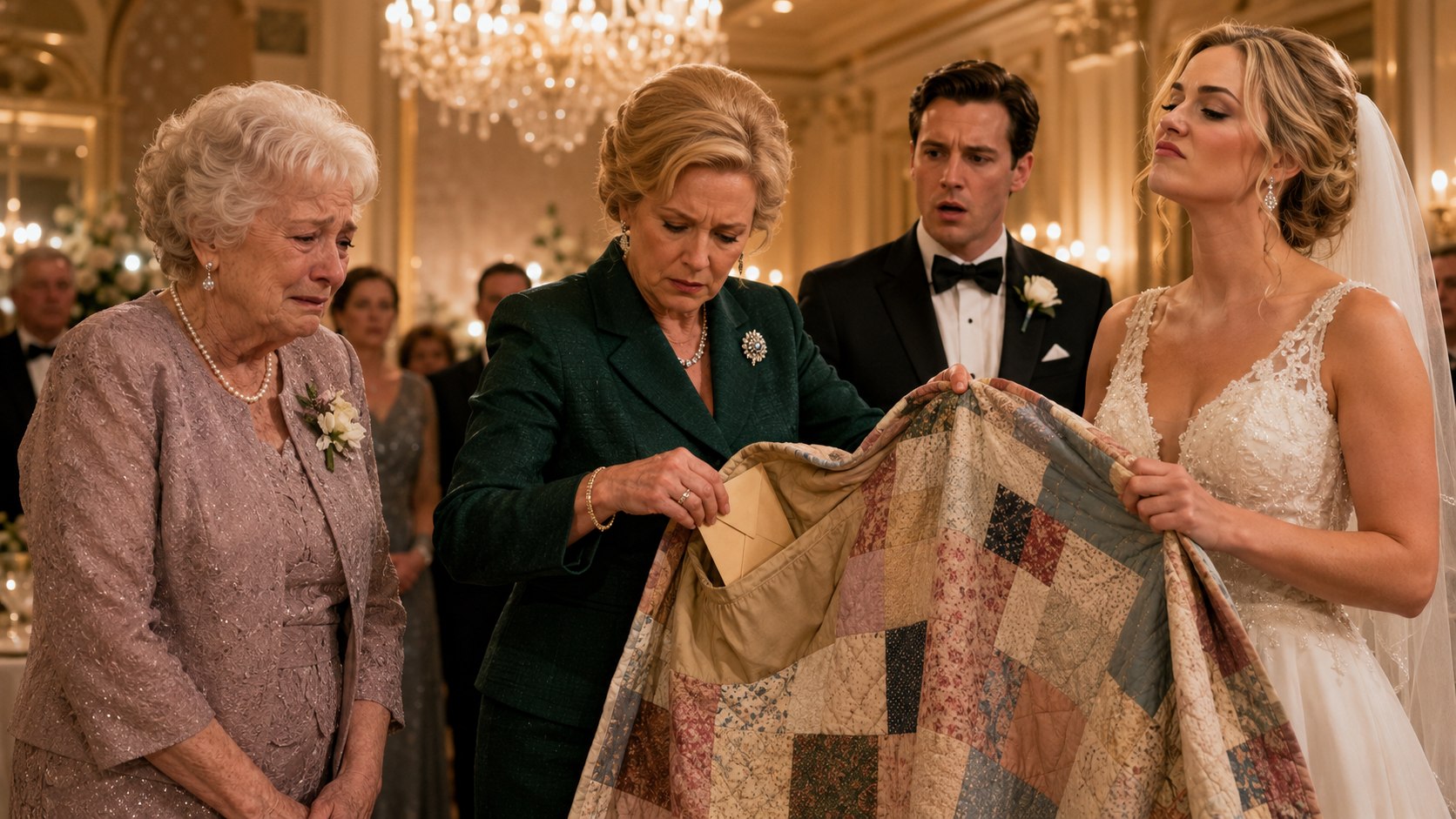
Eleanor spread the quilt across the gift table.
She did not toss it.
She did not shake it open roughly.
She laid it down as carefully as if it were a flag from a fallen battlefield.
Her fingers moved over the first square.
“This fabric,” she said. “Where did it come from?”
Your throat tightened.
“My son’s shirt,” you whispered. “Samuel’s. Noah’s father.”
Noah lifted his head.
For the first time that night, he truly looked at the quilt.
Eleanor touched another square, faded cream with tiny stars.
“And this?”
“That was Noah’s baby blanket,” you said. “He wouldn’t sleep without it. My husband used to walk him around the kitchen with that blanket over his shoulder, singing old church songs until the baby stopped crying.”
The ballroom remained silent.
Eleanor moved to a dark brown patch near the border.
“My husband’s jacket,” you said. “Harold wore it when he built the back porch on my house. Noah used to follow him with a plastic hammer.”
Something moved across Noah’s face.
Not enough for everyone to notice.
But you noticed.
You had known that boy when his hands were sticky with jam, when he cried over scraped knees, when he slept on your couch because thunder scared him. You knew the difference between embarrassment and guilt.
What you saw now was guilt.
Deep guilt.
The kind that hurts because it arrives late.
Isabelle crossed her arms.
“That’s very touching,” she said, trying to recover her smile. “But I don’t think we needed a whole museum lecture during the reception.”
Eleanor looked at her.
“Apparently, you did.”
A murmur passed through the guests.
Then Eleanor turned to the room.
“Many of you know I serve on the board of the Ashford Textile Foundation. For forty years, we have preserved quilts made by women who had no fortune, no platform, no portrait in a gallery, and yet left behind the truest records of their families. Births. Deaths. Migrations. Marriages. Wars. Poverty. Survival.”
Her hand rested on the quilt.
“This is not a cheap blanket. This is a family archive.”
You lowered your eyes.
Kindness can hurt when it arrives after humiliation.
Eleanor continued, “Some families display love in diamonds. Better families preserve it in labor.”
At the head table, Noah stood slowly.
“Grandma,” he said.
Your heart stumbled.
Not because he spoke.
Because his voice sounded like the boy who used to run through your screen door shouting your name.
But before he could say more, Vivian Vale rose fully from her chair.
“Noah, sit down. This has gone far enough. Everyone is uncomfortable.”
“Good,” Eleanor said without looking away from the quilt. “Discomfort is often the first honest guest in a room like this.”
Noah did not sit.
Isabelle turned toward him with a tight smile.
“Baby, don’t make this weird. I was joking.”
A joke.
People always called cruelty a joke when they wanted the wounded person to carry the blame.
They cut you in public, then acted shocked when you bled where others could see.
Noah looked at his bride.
“You called my grandmother’s gift cheap.”
Isabelle rolled her eyes.
“Because it looked cheap, Noah. I didn’t know we were supposed to pretend it was sacred.”
The words landed hard.
Several guests looked away.
Eleanor’s fingers moved along the lower border of the quilt. Suddenly, she paused near the corner where you had stitched Noah and Isabelle’s names in blue thread.
She leaned closer.
“Mrs. Bennett,” she said slowly, “did you sew a pocket here?”
Your breath caught.
For a second, the room tilted.
You had nearly forgotten.
No.
Not forgotten.
Buried.
The memory had been folded beneath grief, beneath nerves, beneath the shame of standing in a ballroom that smelled of roses and money while holding something made from old cloth and old love.
“Yes,” you whispered.
Noah turned toward you.
“What pocket?”
You pressed a hand to your chest.
“Your father asked me to make it.”
The room changed.
It was not merely quiet now.
It was waiting.
Noah’s face went still.
“My father?”
You nodded, and the lights blurred through your tears.
“Before Samuel died, he wrote you a letter. He told me not to give it to you when you were young. He said grief would swallow the words. He wanted you to have it on the day you became a husband.”
Noah stepped toward the table.
Isabelle went pale.