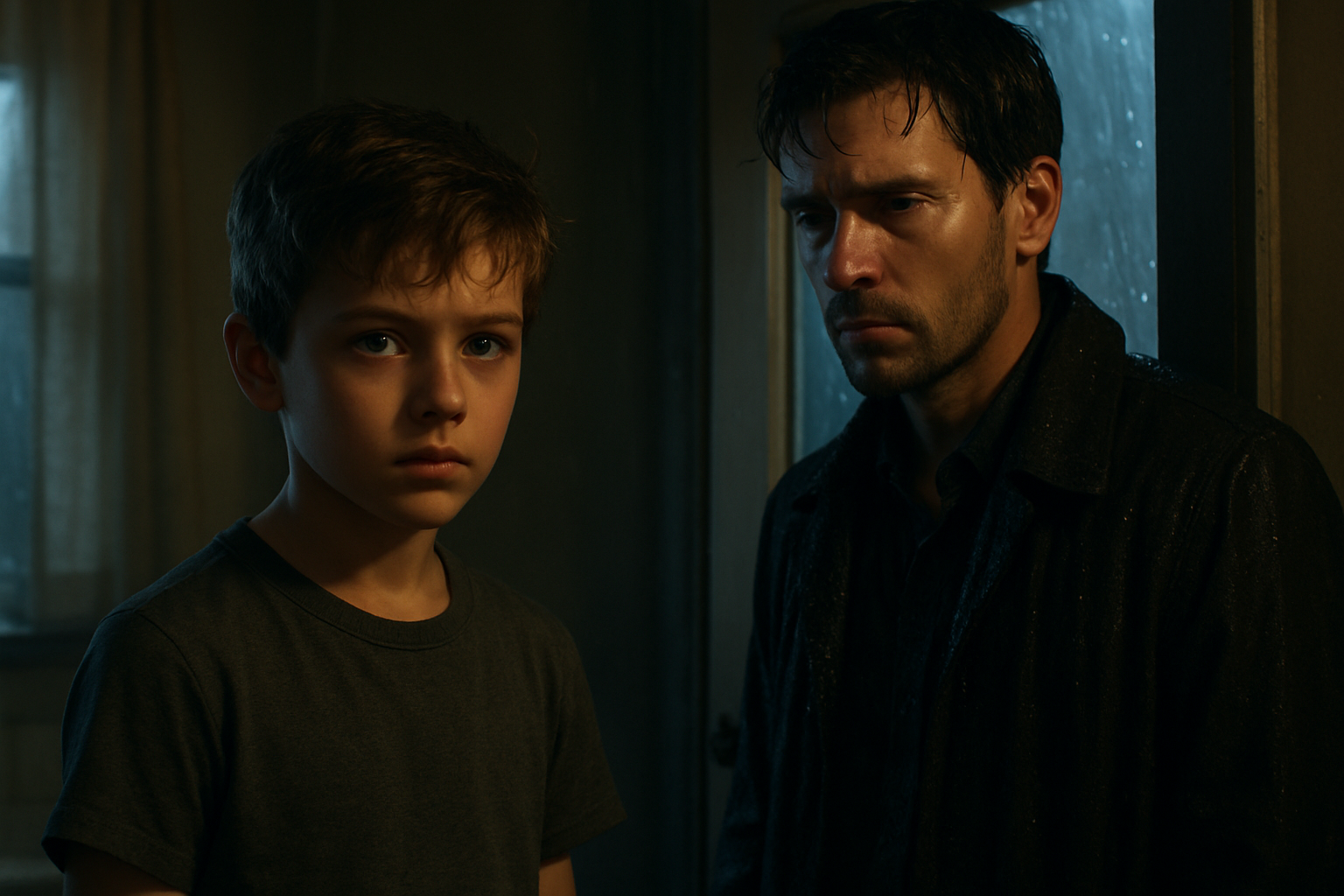
It was the tenderness.
It filled the small bedroom like sunlight under a door. It lay across his chest with a weight he had no language for. Nolan had known how to flirt, how to impress, how to make a room laugh. He had known how to reach for Tessa in the dark with the desperate certainty of a boy pretending to be a man.
But this—waking beside her, knowing the hours were almost gone, feeling the words rise up from some honest place he had spent years avoiding—this terrified him.
I love you.
The words came so clearly that he almost turned toward her and said them.
Almost.
Instead, because humor was the only armor he had ever trusted, because he had never learned how to stand in front of anyone unarmed, he cleared his throat and said, “You steal blankets like a criminal.”
Tessa’s eyes opened slowly.
For a moment, she only stared at him. Sleep softened her face, but not her understanding. She had always seen too much.
“That’s what you want to say?” she asked.
Nolan forced a crooked smile. “I’m just reporting facts.”
She sat up, drawing the sheet around herself. The movement was quiet, but something shifted in the room. The tenderness did not vanish. It cooled. It retreated to the corners like a thing embarrassed to have been seen.
The look on Tessa’s face was not anger.
Anger would have been easier. Anger would have given him something to push against, something to charm his way around. But this was worse. This was disappointment settling into a locked place he would never be able to reach again.
He wanted to touch her hand.
He did not.
By the time they reached the airport, the morning had turned brittle and gray. Cars slid past the curb in restless lines. Suitcases rattled over concrete. Announcements crackled overhead, flattening goodbyes into instructions.
Nolan promised to call when he landed.
Tessa said, “Okay.”
His mother waved from security, impatient and polished, already speaking into her phone as if his life were a schedule she could bully into submission. His new manager stood beside her, one hand clamped around a leather portfolio, shouting that they were late, that the Seoul connection would be tight, that opportunities did not wait for boys who got sentimental in terminals.
Nolan walked away from Tessa.
Three steps.
Five.
Then he turned back.
His heart hammered so violently he felt it in his throat. The words were there again, fierce and ready, crowding behind his teeth.
I love you.
Tessa stood by the barrier with her hands wrapped around the strap of her bag. She looked very young in that airport light and somehow older than him. She looked at him as if she knew exactly what he was failing to say.
Nolan opened his mouth.
Nothing came out.
Something in her eyes dimmed, but she smiled anyway, a small brave thing that hurt him more than tears would have.
“Go become famous,” she said.
So he did.
Nine years later, lying awake on Tessa Monroe’s couch while the storm weakened into a cold Baltimore drizzle against the windows, Nolan understood with brutal clarity that fame had been the least impressive thing he had ever achieved.
It had dazzled from a distance, of course. Fame always did. It came with magazine covers and private jets, women with impossible cheekbones, men who laughed too loudly at mediocre jokes, parties above cities where no one admitted they were lonely. It came with impossible money. It came with assistants who knew his preferences before he did, with rooms prepared before his arrival, with applause so constant it became indistinguishable from weather.
But it had not taught him how to be brave in the only ways that mattered.
It had not taught him to say stay.
It had not taught him to say I was wrong.
It had not taught him to say I love you before the door closed.
Morning came wearing the smell of coffee and judgment.
Nolan opened his eyes to find a child sitting at the kitchen table.
Caleb Monroe wore a navy school uniform sweater over a pale blue shirt, his tie slightly crooked, his dark hair combed with the uneven dedication of someone who had done it himself. A cereal bowl sat in front of him. Beside it lay a thick book about deep-space observation, full of diagrams and star fields and words Nolan suspected most adults would pronounce with caution.
The boy looked up without surprise.
“You snore,” Caleb said.
Nolan pushed himself upright carefully, his back protesting from the couch. “Good morning to you too.”
“It was informational,” Caleb replied. “Not rude.”
At the counter, Tessa stood with her hair pulled into a knot, wearing faded jeans and a sweater too soft to be new. She lifted her mug to her mouth, but not quickly enough to hide her smile.
Nolan saw it.
Then he looked back at Caleb and the impossible math returned, merciless as daylight.
Eight years old.
Storm-gray eyes that were not quite blue and not quite silver.
That stubborn crescent-shaped birthmark near his collarbone, glimpsed the night before when Caleb had reached for a glass and his pajama shirt slipped sideways.