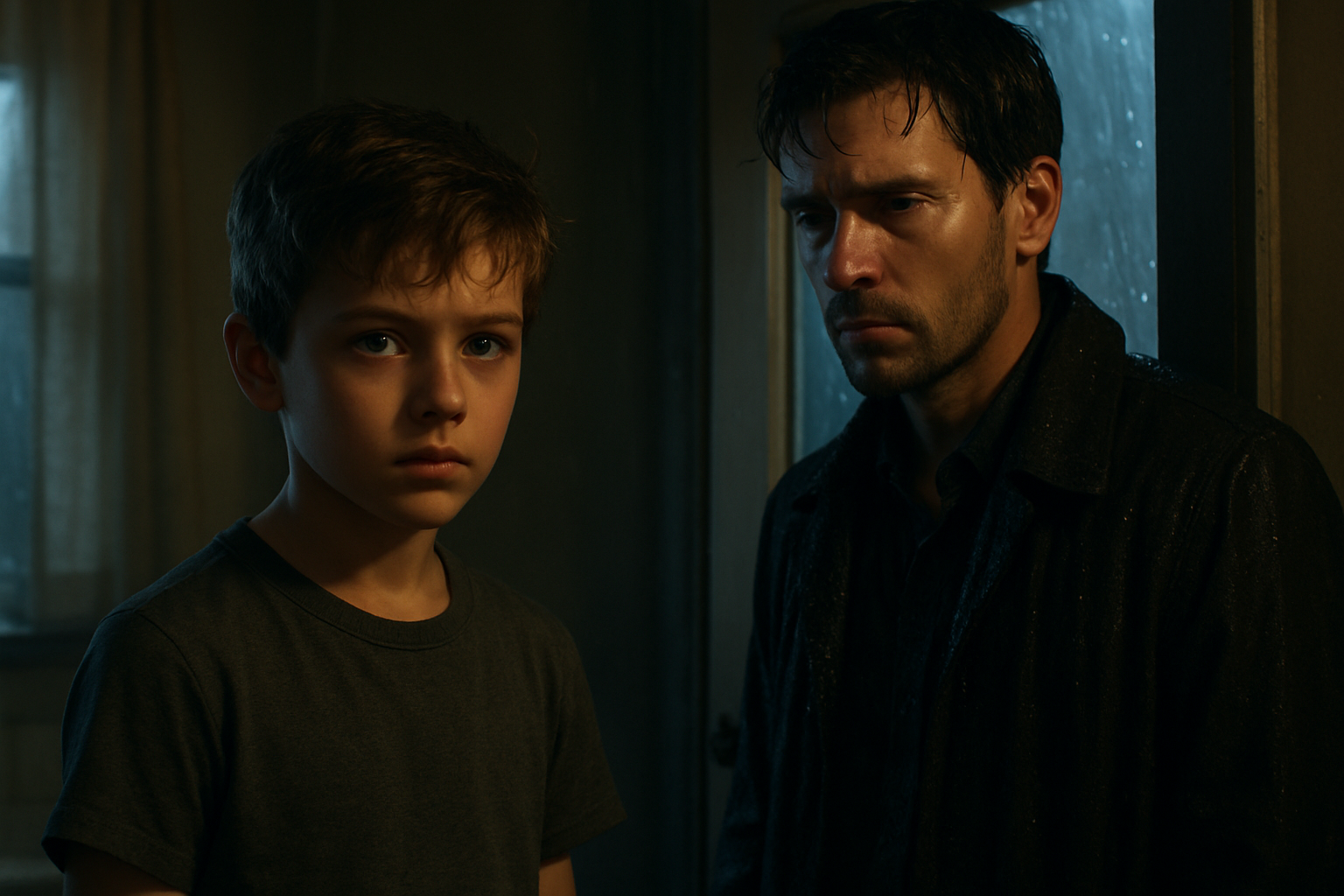
“No,” he said. “Not for Caldwell. Not for London. Not for a board. Not for anything that asks me to be the man I was before I knew you.”
Caleb’s brow furrowed. He wanted to believe. Tessa could see it, and because she could see it, she feared it.
“Promises are data only after they are kept,” Caleb said.
A faint, broken smile touched Nolan’s mouth.
“You’re right,” he said. “Then I’ll keep giving you data.”
They went home after midnight.
Caleb fell asleep in the car before they had driven ten blocks, his head resting against the window, one hand curled around the strap of his backpack as if he did not quite trust the world not to take it. Streetlights slid over his sleeping face in pale gold bands.
Nolan sat in the back beside him, silent. Not touching at first. Then, when the car turned and Caleb’s head dipped sharply, Nolan lifted one hand and carefully cushioned him from the glass.
Tessa saw it in the rearview mirror.
Her throat tightened.
When they reached the apartment, Nolan carried Caleb inside without asking permission. Ordinarily, Tessa might have stopped him. Caleb was too old to be carried, and Nolan too new to be granted such tenderness without question.
But Caleb did not wake. His face rested against Nolan’s shoulder. His fingers curled once into the fabric of Nolan’s coat, then relaxed.
And Nolan held him as if he were something sacred.
So Tessa let him.
The hallway outside Caleb’s room was dim and quiet after the door closed. For a long moment, neither of them moved.
Tessa leaned back against the wall. The adrenaline was draining out of her now, leaving behind only the shaking aftermath.
“I can’t do this if you’re temporary,” she said.
“I know.”
“I can’t survive loving the version of you that only appears during emergencies.”
“I know.”
“You keep saying that.”
“Because I’m done arguing with the truth.”
The words should not have affected her as deeply as they did.
He did not step closer. He did not reach for her hand. He did not kiss her.
That mattered.
The old Nolan would have reached for romance to soften accountability. He would have used touch like a bridge and charm like a rope, pulling her across before she could decide whether she wanted to move.
This Nolan stood in the hallway and let the moment remain painful.
“I’m going to fix what I can,” he said. “And I’m going to live with what I can’t.”
Tessa looked at him for a long time.
Then she nodded once and went into her room alone.
The next morning, Vale Meridian’s board received a three-sentence email from Nolan.
He declined the European acquisition tour.
He postponed all comeback appearances.
And he removed himself from negotiations involving Caldwell Global until an independent review could examine conflicts of interest dating back to Meridian’s seed round.
By noon, the business channels were calling it career suicide.
By two, analysts were speculating about mental instability, personal distraction, and whether the paternity scandal had impaired Nolan’s judgment.
By dinner, Maren arrived at the apartment with legal counsel, two crisis advisors, three phones, and the expression of a woman trying very hard not to murder her most valuable client in front of witnesses.
“You cannot simply walk away from a billion-dollar transaction,” she said.
Nolan sat at the dining table beside Caleb, who was doing math homework and pretending not to listen with the obvious intensity of a child absorbing every adult word in the room.
“I didn’t walk away,” Nolan said. “I paused it.”
“You paused it by publicly accusing your founding investor of misconduct.”
“I requested an independent review.”
“With the subtlety of a brick through a stained-glass window.”
From the kitchen, where she was making tea mostly to have something to do with her hands, Tessa said, “He’s always been dramatic.”
Nolan glanced at her. “Thank you?”
“It wasn’t praise.”
Caleb’s pencil paused over his notebook.
Maren rubbed her forehead. “Nolan, Caldwell is already leaking that you’re unstable because of the paternity scandal.”
“Good,” Nolan said. “Then he’ll underestimate me.”
The room stilled.
Tessa turned from the kettle.
That was when she understood.
Nolan had not acted purely out of guilt or panic. He had not thrown himself onto a corporate sword because the night had been emotional and he needed to prove something grand enough to be believed.
He had started thinking.
Truly thinking.
Not about optics. Not about escape. Not about how to make himself look wounded, heroic, desirable, or wronged.
He was thinking about cause and consequence.
About Caldwell.
About the architecture of power that had kept him obedient for years and had cost all of them more than money.
Maren saw it too. Her irritation sharpened into reluctant attention.
“What do you know?” she asked.
“Not enough,” Nolan replied. “Yet.”
The answer came three days later in the form of a file delivered by a woman named June Ellis.