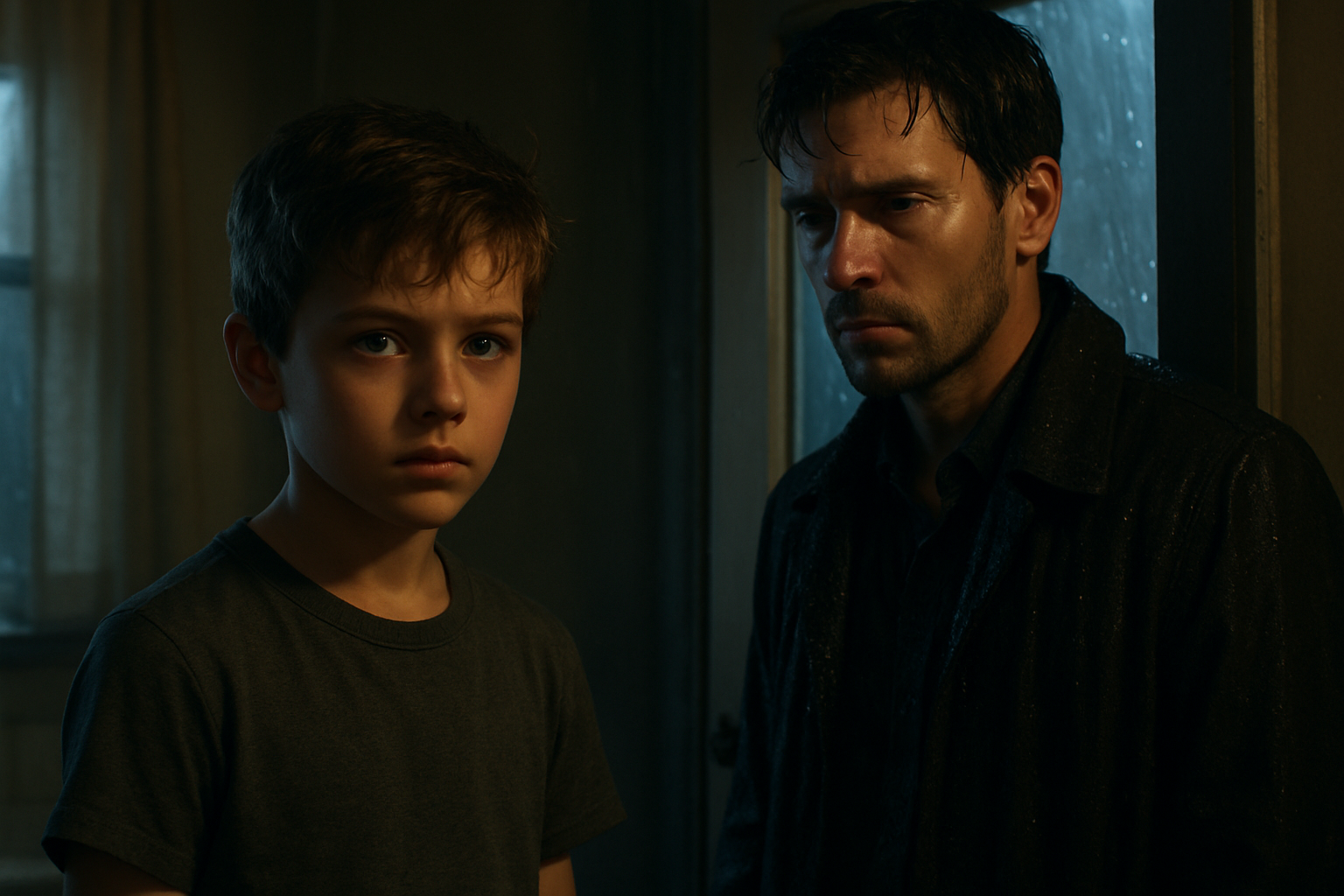
“You wanted honesty?” she said. “Then here it is. I did not keep Caleb from you because I was cruel. I kept him from you because every piece of evidence I had said you would choose the bigger room, the bigger check, the brighter camera, the more important man.”
Nolan stood across from her in the dim living room, rain dragging silver lines down the windows behind him. The city beyond the glass was blurred and indifferent, all wet lights and distant sirens, but inside the apartment everything felt painfully clear.
Tessa’s hands trembled at her sides. She hated that. She curled them into fists.
“You chose Caldwell over Aaron,” she said. “You chose fame over my calls. You chose jokes over love on our last morning. You chose a future where I was an inconvenience you could remember fondly later.”
Nolan’s jaw tightened, but he did not interrupt.
That should have comforted her. It didn’t. His silence only gave her anger more space to move.
“So when I found out I was pregnant,” she continued, each word scraped raw, “I chose Caleb over the hope that you might suddenly become brave.”
The sentence landed between them with the weight of something final.
Nolan looked as though she had struck him, but he did not defend himself. No speech. No clever explanation. No desperate rearranging of facts until he could stand in the center of them looking wounded but innocent.
Somehow, that made her even angrier.
Because part of her had been prepared for the old Nolan—the polished one, the brilliant one, the one who could turn guilt into charm and cowardice into a misunderstanding. She had sharpened herself for that version of him. She knew how to survive him.
She did not know what to do with this man who simply stood there and let her accusation enter him.
“So what now?” she asked, her breath hitching despite herself. “Do we destroy each other forever because we happen to love each other?”
Nolan’s gaze moved past her, toward the narrow hallway and Caleb’s closed bedroom door.
“No,” he said.
The single word was steady, but Tessa was too tired to trust steadiness.
“How do you know?”
He looked back at her, and for the first time that night, he had no answer.
The silence swelled.
Then it broke.
Twenty minutes later, Caleb was gone.
At first, Tessa could not understand what she was seeing. His bedroom was too neat in the wrong places. The blanket on his bed was kicked aside, but his backpack was missing from the chair. His sneakers were gone from beneath the desk. The telescope notebook—the black one with silver corners, the one he carried everywhere and guarded like a state secret—was not beside his lamp.
The window seat where he liked to read stood empty.
The curtain moved faintly, stirred by the air-conditioning vent, fluttering like a small white flag.
Tessa’s mind went completely blank.
Not calm. Not focused.
White.
A terrible, soundless white.
“Caleb?” she called.
Nothing.
She crossed the room too quickly and nearly hit her hip on the edge of the desk. “Caleb?”
Nolan appeared in the doorway behind her.
One glance was enough.
The man who had stood under studio lights, before shareholders, before judges of public opinion and hostile cameras, vanished. Every layer of performance fell away from him so suddenly that what remained looked younger and more frightened than Tessa had ever seen him.
“He heard us,” she whispered.
Nolan was already reaching for his jacket.
They searched for four hours in cold rain.
The city became a maze of reflected lights and wet pavement, of bus stops and locked gates and shadows that looked, for one heart-stopping second, like a boy with storm-gray eyes.
Nolan called building security first. Then Maren. Then every doorman, desk attendant, maintenance worker, driver, and off-duty security contact connected to his life. After that came police contacts who answered because billionaires possessed phone numbers ordinary mothers did not. That fact filled Tessa with an ugly, unreasonable fury even as she listened to him use it for their son.
Their son.
The words hit her again and again as she drove with both hands locked around the steering wheel.
Their son was missing.
Tessa forced her mind to build maps instead of panic. Caleb was not reckless. Caleb made patterns. Caleb chose places with meaning, places with information, places where he could feel less helpless because facts existed there.
The science museum.
The library branch near Pratt Street.
The little park where Aaron used to take him when he was still small enough to call pigeons “ground birds.”
The school courtyard.
The waterfront promenade, where Caleb liked to count the lights of boats and tell Tessa which ones were probably commercial, which ones were private, and which ones were pretending to be one while being the other.
Rain slapped against the windshield. Tires hissed over black streets. Every red light felt like an insult from God.
Tessa refused to cry.
If she cried, the streetlights would blur.
If the streetlights blurred, she might miss him.