Elias got new shoes but kept the old ones in the closet.
When Victor asked why, the boy shrugged.
“To remember.”
Victor did not tell him to throw them away.
He understood.
Some things hurt too much to keep, but too much happened in them to let go.
The scandal broke a month later.
The papers called it The Hargrove Heir Cover-Up.
They printed Harold Creed’s name.
They printed the forged documents.
They printed the old photo.
They wrote about Victor’s father, dead but not spared.
They wrote about Liana Vale, the woman erased by a dynasty.
They wrote about the boy with the violin.
For days, reporters camped outside gates and sidewalks, shouting questions.
Victor gave only one statement.
“My son was not missing. He was hidden from me. His mother was not forgotten. She was betrayed. The people responsible will face everything the law can give them. As for the years we lost, those belong to my family, and the world is not invited to them.”
After that, he said nothing.
Privately, he did what he promised.
He showed up.
At first, Elias resisted him in small ways.
He refused expensive gifts.
He called him Mr. Hargrove.
He answered questions with one word.
He watched Victor carefully, waiting for the rich man to grow bored.
But Victor did not disappear.
He came every morning with coffee for Liana and hot chocolate for Elias.
He learned which medicines went with food.
He sat through school meetings.
He burned toast.
He stood awkwardly in grocery aisles while Elias explained which cereal was good and which only looked good because of the box.
He listened when Liana spoke of the years he missed, even when every sentence made him hate himself and his father all over again.
One evening, winter settled softly over the city.
Snow began to fall beyond the windows of the little house near the park.
Liana sat wrapped in a blanket on the sofa, stronger than before, watching Elias tune his violin. Victor sat at the piano across the room, fingers resting uncertainly on the keys.
“You’re late,” Elias said.
Victor glanced at the clock. “By two minutes.”
“Music doesn’t forgive rich people.”
Liana laughed.
The sound filled the room.
Victor looked at her.
For a second, they were young again.
Not because the years had vanished.
They had not.
But because the love had survived the lie, even damaged, even changed, even limping back through the door after eleven years in the cold.
Elias lifted the violin.
Victor found the first chord.
“Ready?” the boy asked.
Victor looked at Liana.
She nodded.
This time, when the song began, it did not sound like grief.
It sounded like a family learning how to breathe in the same room.
The melody rose through the house, no longer trapped in a tin box, no longer played for coins on a sidewalk, no longer used as proof of pain.
It became what Liana had meant it to be from the beginning.
A promise.
For our little song.
And for the eleven years stolen from them, there would never be enough justice.
But there would be mornings.
There would be dinners where no child stood unwanted at the door.
There would be birthdays with candles.
There would be photographs taken openly, placed in frames instead of hidden in cases.
There would be a father learning the shape of his son’s laughter.
There would be a mother watching the truth return, late but alive.
And one day, when Elias was older, he would understand something Victor had only just begun to learn:
Some lies steal years.
But the truth, when it finally arrives, can still open the door.
Even after eleven winters.
Even after silence.
Even after everyone says it is too late.
Because love does not always return the way we prayed it would.
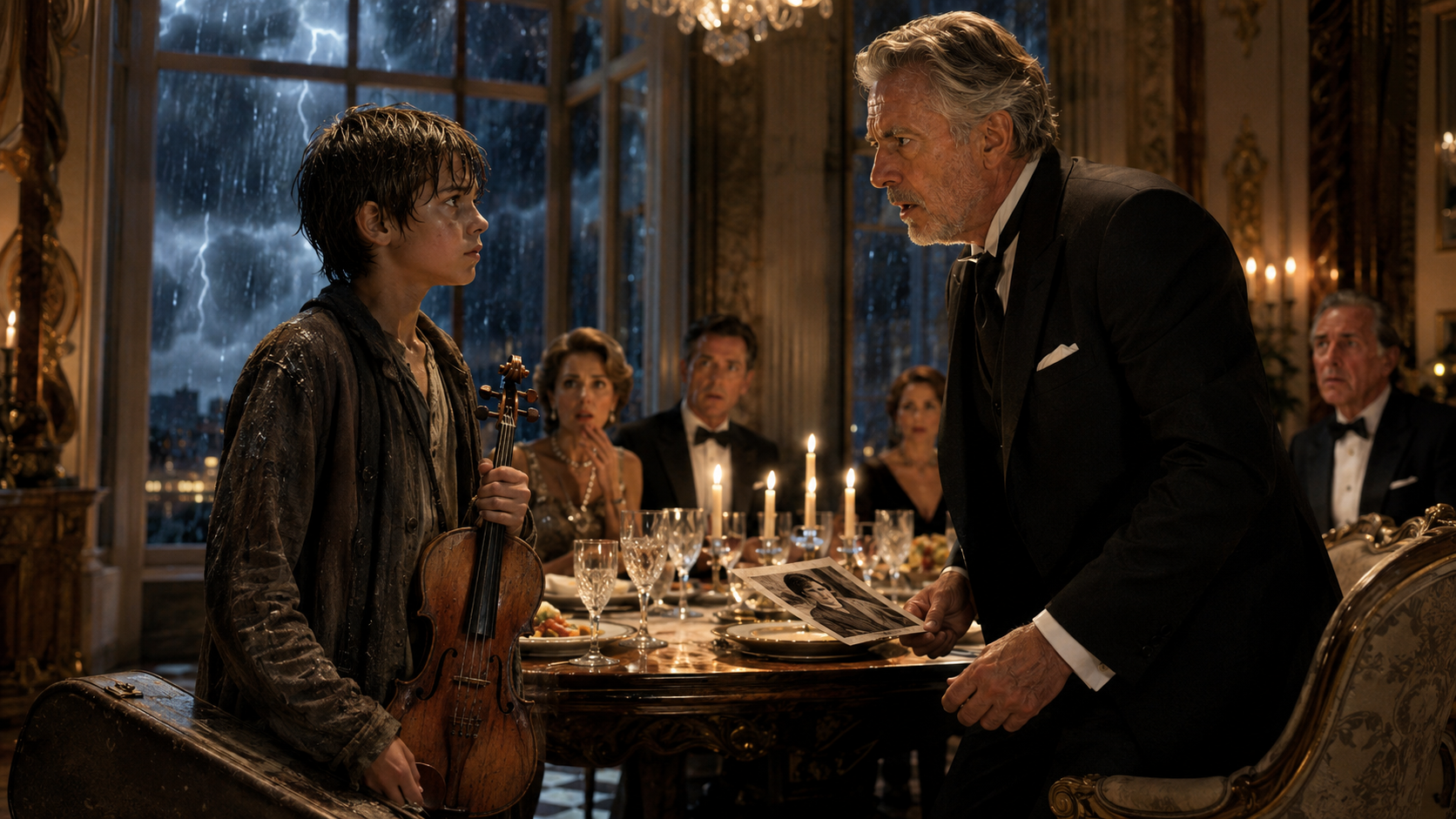
Sometimes it comes back soaked in rain, carrying a cracked violin, standing in a room where it does not belong —
and plays one song that makes the whole world confess.