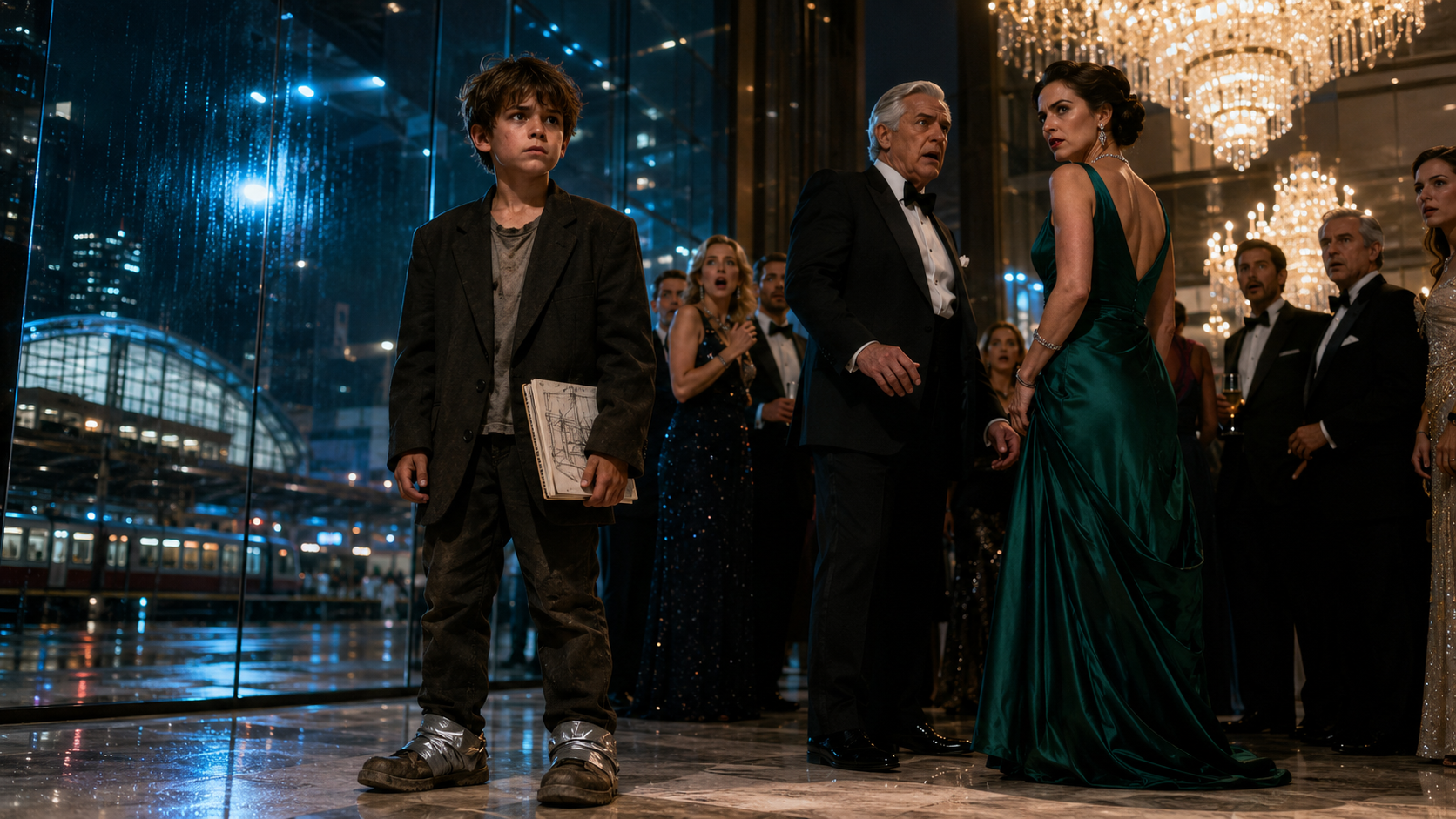
The room went silent.
Eli looked down at his shoes.
The tape was peeling near the toe.
He remembered the woman’s face under the arch.
Not the newspaper face.
The real one.
Wet hair. Torn sleeve. Proud fear. Eyes that had found him because there had been no one else.
Remember me.
Eli closed his notebook.
“I’ll do it.”
Mrs. Bell covered her mouth.
Malcolm lowered his head, not in victory, but in respect.
“Then we do it right,” Inez said. “No heroics without exits. No child alone in a room full of wolves.”
The next evening, Malcolm requested a private meeting with Adrian Cross.
Adrian refused twice.
The third time, Malcolm sent one sentence through Adrian’s assistant.
Ask your wife which hand she wore your ring on when you proposed.
Twenty minutes later, Adrian agreed to see him.
The meeting took place in a conference room at the top of Cross Tower, where the windows overlooked the river and the city looked small enough to rearrange.
Adrian Cross was forty-eight years old, tall, silver at the temples, and famous for making other powerful men nervous. He entered the room with no entourage, no lawyer, and no expression.
“You have five minutes,” he said.
Malcolm placed Eli’s drawing on the table.
Adrian looked at it.
Something passed through his face and disappeared.
Malcolm placed the newspaper photograph beside it.
Then the clinic records.
Then the forged control agreement.
Then the flight diversion.
Then the photograph of Mira Lane.
Then the sealed court record showing Selene Ward’s real family name.
Adrian read everything.
Once.
Twice.
His hands remained still until he reached the drawing again.
He touched the little crescent scar near the woman’s jaw.
His voice, when it came, was almost nothing.
“She got that scar in Venice,” he said. “A glass lantern broke during a storm.”
Malcolm said nothing.
Adrian touched the right hand in the drawing.
“She hated explaining the ring. Said left hands were overrated.”
He stood suddenly and walked to the window.
For a moment, Malcolm saw not a billionaire, not a man whose name was carved into buildings, but a husband staring down at a city that had helped hide his wife.
“I knew,” Adrian whispered.
Malcolm waited.
“The woman in my house drinks black coffee. Liora takes cream. The woman in my house sleeps with the windows closed. Liora always needed air. The woman in my house called the gardenias beautiful. Liora is allergic to gardenias.”
His voice broke.
“I told myself illness changed her.”
“Grief makes cowards of honest men,” Malcolm said gently.
Adrian turned.
“Where is my wife?”
“We believe she was taken through France. We believe she is alive.”
“Believe?”
“It is the strongest word I have without lying to you.”
Adrian closed his eyes.
When he opened them, the polished emptiness was gone.
“What do you need?”
“Tomorrow night,” Malcolm said, “let the boy speak.”
The Glass Gala glittered like a dream built for people who had never been cold.
Eli entered through the service corridor with six children from the St. Bartholomew’s youth art program. Mrs. Bell had found him a navy blazer, a white shirt, and dress pants with a hem she fixed herself. His shoes were still the taped ones. She had offered him a better pair from the donation closet, but Eli refused.
“I want her to know it’s me,” he said.
Mrs. Bell did not argue.
Before they reached the atrium, she knelt and straightened his collar.
“You listen to me,” she said. “Those people in there are not bigger than you. They just take up more space.”
Eli tried to smile.
“I’m scared.”
“Good,” Mrs. Bell said. “Fear means your body knows the truth is heavy. Courage means you carry it anyway.”
She kissed his forehead.
Then Eli walked into the light.
The atrium was enormous.
Glass rose on every side. Music floated from a balcony. Waiters moved like ghosts carrying silver trays. Women shone in diamonds. Men laughed with white teeth and dead eyes. Cameras waited near the stage. Above everything, the crystal ceiling caught the city and shattered it into stars.
Eli felt suddenly dirty.
Not because he was.
Because the room wanted him to.
He touched the notebook inside his blazer.
At nine o’clock, Adrian Cross stepped onto the stage.
The woman beside him wore emerald silk.
Mira Lane looked exactly like the photograph.
In person, she was better.
Her smile trembled with practiced vulnerability. Her voice was soft and warm. She thanked the city for respecting her privacy during her recovery. She placed a hand on Adrian’s sleeve at precisely the right moments. She spoke about healing, gratitude, children, and second chances.
The room adored her.
Eli’s stomach turned.
Then Mira said, “And because recovery has taught me the value of trusting others, I am proud to announce that Selene Ward will guide the Horizon Foundation into its next chapter.”