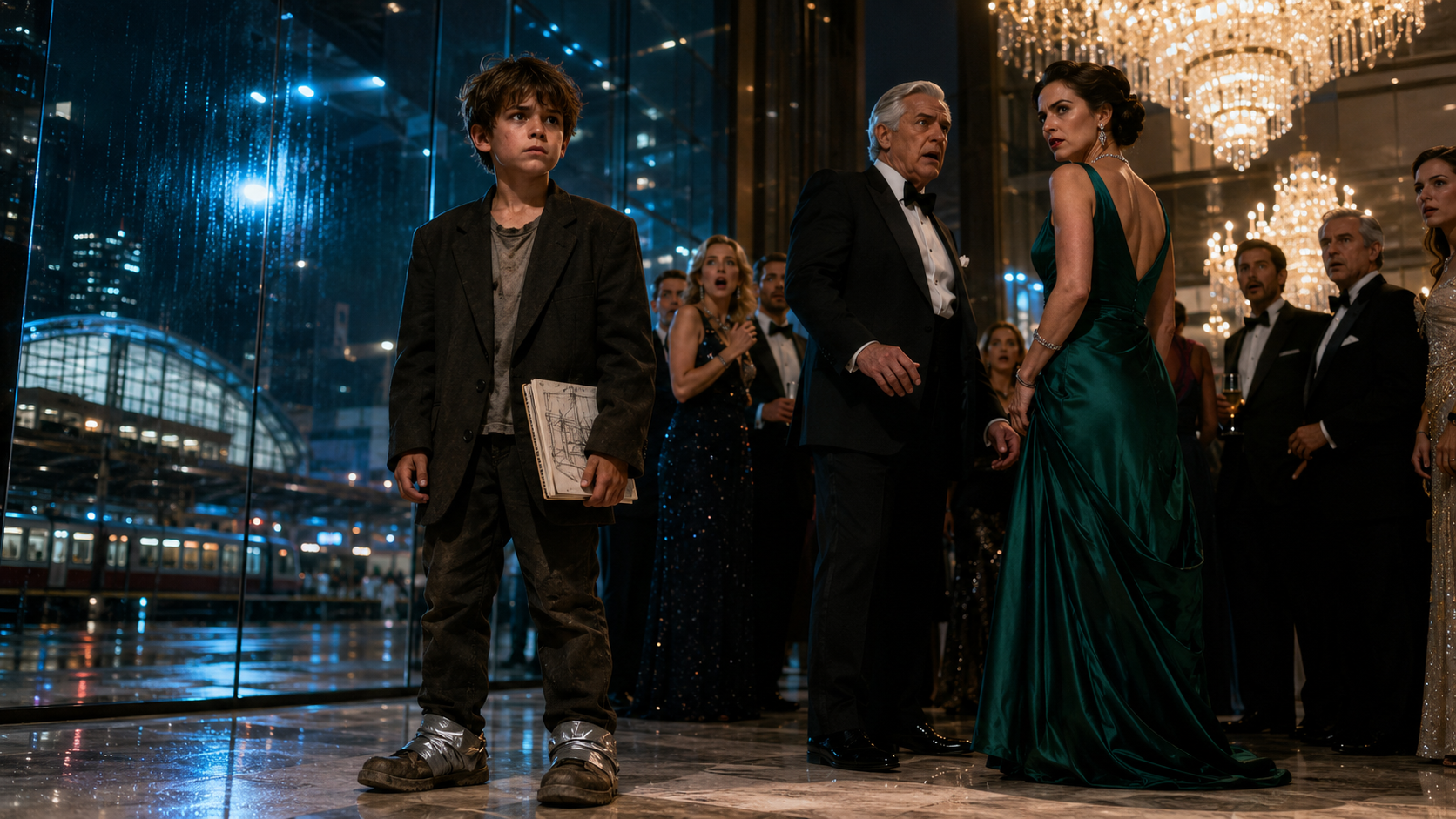
The Boy with Taped Shoes Who Interrupted the Glass Gala

The first thing Eli Marrow noticed about the woman was not that she was rich.

Rich people passed him every day.

They stepped around his cardboard bed beneath the east side of Grayson Terminal, eyes fixed on their phones, shoulders lifted against the smell of rain, diesel, and old pavement. Their coats were soft enough to sleep inside. Their shoes were polished enough to reflect the city lights. Their umbrellas opened like black flowers over their heads, and every one of them moved as though the world had been built with doors waiting for them.

Eli had learned not to stare.

Staring invited questions.

Questions invited police.

Police invited the shelter van, and the shelter van meant locked doors, fluorescent lights, and men who took your blanket when they thought you were asleep.

So Eli usually kept his head down.

But that night, the woman made a sound.

Not a scream. Not even a sob.

It was smaller than that.

A broken little breath, like someone trying to swallow pain before anyone heard it.

Eli looked up.

She stood beneath the stone arch of the terminal, half hidden by the rain. Her dark hair was pinned badly, as if someone else had done it in a hurry. She wore a cream-colored coat that probably cost more than every meal Eli had eaten that year, but the sleeve was torn at the wrist. One heel of her shoe was snapped. Her left hand gripped the wall, and her right hand clutched a silk scarf against her throat.

A black car waited at the curb with its engine running.

The woman stared at it as though it were a cage.

Then she looked at Eli.

For one second, they were the only two people in the city.

“Please,” she whispered.

Eli did not move.

He was twelve years old, though hunger and winter had narrowed him into something smaller. His shoes were too big and wrapped in silver duct tape because the soles had split open in March. He wore three shirts, two of them stolen from donation bins, and a wool cap that smelled faintly of smoke.

The woman took one step toward him.

A man’s voice called from the car. “Mrs. Cross? We need to go.”

The woman flinched.

Eli saw it.

He saw everything. That was the one gift the street had given him. Adults missed details because they believed the world owed them explanations. Eli did not. He noticed what hands did, where eyes went, which people lied with their smiles and which ones lied by standing too still.

The woman’s left cheek had a tiny crescent scar near the jaw.

There was a birthmark below her collarbone, barely visible where the scarf had slipped.

On her right hand, not her left, she wore a thin gold wedding band.

And beneath her breath, so softly he almost missed it, she said, “Tell Adrian I didn’t leave.”

Then a second man stepped out of the black car.

He had a gray umbrella and leather gloves.

He did not run. He did not panic. He simply walked toward her with the calm of a person who knew money could erase witnesses.

“Ma’am,” he said smoothly, “you’re confused again.”

The woman’s face changed.

Not because she believed him.

Because she knew no one else would believe her.

The man took her arm.

Eli slid backward into the shadow of the arch.

The woman’s eyes found him one last time.

“Remember me,” she mouthed.

Then the car door closed, and the black sedan disappeared into the rain.

Eli sat very still for a long time.

The city moved around him. Buses sighed. Brakes hissed. A drunk man cursed at a parking meter. Somewhere, a saxophone played under a bridge.

Eli pulled a pencil stub from his pocket.

He had no phone. No camera. No adult who would come running if he called. But he had paper, because paper was warmer than nothing when tucked beneath a jacket, and he had taught himself to draw the faces of people who gave him bread.

He opened his notebook to a clean page and drew the woman before the rain washed her out of his memory.

The scar.

The birthmark.

The torn sleeve.

The gold ring on the right hand.

The way fear looked when it still had pride inside it.

When he finished, he wrote the only words he knew mattered.

Tell Adrian I didn’t leave.

Then he closed the notebook and tucked it beneath his shirt.

On the street, remembering too much could get you hurt.

But forgetting the wrong thing could get someone killed.

Three weeks later, Eli saw her again.

Or he saw the shape of her.

The newspaper had been shoved into a trash bin outside the library. Eli pulled it free because newsprint was good insulation, especially if you folded it flat under your sweater. The front page was damp around the edges, but the society section was dry.

That was where he saw the photograph.

Liora Cross Returns to Public Life Beside Billionaire Husband at Foundation Preview

Eli did not know much about billionaires. He knew they owned towers with lights that stayed on all night and cars that smelled like leather and rain. He knew adults said the name Adrian Cross the way they said storm warnings, with awe and discomfort. He owned hospitals, research labs, shipping docks, and half the new skyline.

The woman in the photograph stood beside him on the marble steps of the Cross Museum of Modern Design. She wore a silver dress and smiled with her teeth. The caption said she had been away on a private medical retreat after exhaustion.

Eli stared.

Her hair was right.

Her height was right.

The elegant angle of her face was almost right.

Almost.

He sat down on the library steps and opened his notebook. He placed his drawing beside the newspaper.

The woman in the photograph had no crescent scar.

No birthmark at the collarbone.

Her gold wedding ring sat on her left hand.

Her sleeve was perfect.

Her smile was perfect.

Everything about her was perfect in the way expensive lies are perfect.

Eli did not know the word impostor.

But he knew wrong.

So he went to Mrs. Bell.

Mrs. Junie Bell ran the evening meal program in the basement of St. Bartholomew’s, though she said “program” was a fancy word for soup, coffee, and refusing to let fools die in the cold. She was sixty-nine years old, round as a teapot, sharp as broken glass, and famous for telling judges, priests, and drug dealers to wait their turn in the same voice.

Eli waited until the last tray had been washed.

Then he slid the newspaper and notebook across the table.

Mrs. Bell adjusted her glasses.

“What am I looking at, baby?”

“A lady,” Eli said. “But not the same lady.”

Mrs. Bell looked at the newspaper.

Then at the drawing.

Then back at the newspaper.

She did not smile.

Eli had expected her to smile.

Adults often smiled before they dismissed children. It made the dismissal seem kind.

Mrs. Bell did not dismiss him.

She touched the edge of the drawing with one finger.

“Where did you see this woman?”

“Grayson Terminal. Under the east arch. It was raining. Men put her in a car.”

“When?”

Eli told her.

The color left Mrs. Bell’s face slowly, as if someone had opened a drain beneath her skin.

“Eli,” she said, “Liora Cross was supposed to be in a private recovery clinic in Switzerland that week.”

“She wasn’t.”

“No,” Mrs. Bell whispered. “Maybe she wasn’t.”

Eli leaned forward. “She said to tell Adrian she didn’t leave.”

Mrs. Bell closed her eyes.

For a long moment, the only sound was the old refrigerator humming in the corner.

Then she stood.

“Eat something,” she said.

“I already ate.”

“You ate soup. Soup is a rumor. Sit down.”

“Where are you going?”

“To call someone who still believes truth matters.”

The man she called was named Malcolm Vey.

He had once been the city’s most feared prosecutor. Now he lived above a closed tailor shop, wore linen suits in November, and walked with a cane carved from black walnut. He had retired twenty years earlier after accusing three powerful families of buying verdicts, and half the city called him bitter while the other half called him correct.

Malcolm arrived at St. Bartholomew’s forty minutes later.

He listened without interrupting.

That alone made Eli trust him a little.

Most adults interrupted children because they believed childhood was a condition that made facts smaller.

Malcolm asked to see the drawing.

Eli handed it over.

The old prosecutor’s eyes moved across the page.

“You drew this from memory?”

Eli nodded.

“You saw the scar?”

“Yes.”

“The birthmark?”

“Yes.”

“The ring on the right hand?”

“She kept touching it.”

Malcolm placed the drawing beside the newspaper photograph.

“Hm,” he said.

Mrs. Bell folded her arms. “That is not a hm. That is a thundercloud wearing a hat. Say what you mean.”

Malcolm looked at Eli.

“I mean this boy may have seen a kidnapped woman.”

Eli’s stomach tightened.

Kidnapped.

The word made the room smaller.

Malcolm tapped the newspaper photograph. “And this woman may be pretending to be her.”

“Why?” Eli asked.

“Money,” Malcolm said. “Power. Inheritance. Revenge. Those are the old reasons. The costumes change.”

By morning, Malcolm had made three calls.

By noon, he had learned that Liora Cross had never arrived at the clinic in Switzerland.

By evening, he had learned that Adrian Cross’s private jet had filed a flight plan for Geneva, then diverted to a small airfield near the southern coast of France.

By midnight, he had found a document filed by Adrian’s legal office: a temporary control agreement granting expanded authority over the Cross Horizon Foundation to Liora’s new chief of staff, Selene Ward, in the event Liora remained medically unavailable.

The signature looked like Liora Cross’s.

Almost.

Malcolm had spent forty-five years reading the handwriting of liars.

This signature had been copied from a holiday card.

He could feel it.

The next day, Mrs. Bell brought in a woman named Inez Calder.

Inez was a private investigator with short silver hair, a motorcycle jacket, and the flat stare of someone who had never once believed a man simply because he wore a tie. She asked Eli to describe the black car, the driver, the second man, the woman’s voice, the rain, the position of the streetlights, the smell of the terminal, the broken heel.

Eli answered everything.

Inez did not praise him.

She only wrote faster.

By the third day, she had a name.

Mira Lane.

An actress.

Not a famous one. Not the kind on billboards or magazine covers. Mira had done perfume commercials, hospital dramas, luxury hotel ads, and one canceled streaming show about a missing heiress. Her face was close enough to Liora Cross’s to fool a camera if the angle was kind and the lighting expensive.

But no actress could fake a scar she did not know existed.

No actress could invent a birthmark hidden beneath a collar.

No actress would know that Liora wore her wedding ring on the right hand because her left ring finger had been injured in a childhood riding accident.

Small things.

The world always forgot small things.

Eli never did.

The plan they uncovered was bigger than a missing woman.

Selene Ward was not merely an employee.

Her real name was Selene Crosswell.

She was Adrian Cross’s cousin, though the family had buried that truth in sealed records and old scandals. Her father had been disowned after accusing Adrian’s father of stealing patents that built the Cross fortune. Selene had grown up watching the Cross name rise in glass and steel while her mother cleaned hotel rooms three blocks from the company headquarters.

She did not want a salary.

She wanted the throne.

Liora Cross had been the obstacle. Liora controlled the Cross Horizon Foundation, a charitable empire worth billions, built to fund children’s hospitals, legal aid clinics, arts programs, and housing for displaced families. Adrian had money, but Liora had the trust of the public.

So Selene found a look-alike.

She found corrupt doctors.

She found a private facility willing to file false records.

She found men who could move a woman across borders without leaving a clean trail.

And she found Adrian Cross’s weakness.

He loved his wife so desperately that he could not bear to question the woman who came home wearing her face.

“He must know,” Eli said when Malcolm explained it.

Mrs. Bell looked at him sadly. “Sometimes grown people know something in their bones and spend all their strength teaching their minds not to hear it.”

“But she’s his wife.”

“Yes,” Malcolm said. “And that is why the lie worked.”

The Glass Gala was four days away.

Every year, Adrian and Liora Cross hosted the event inside the atrium of the Cross Museum, beneath a ceiling of suspended crystal panels that turned city lights into broken stars. It was the richest charity night in the state. Politicians came. Actors came. Judges came. Camera crews came. People who ignored hunger all year came to applaud themselves for funding soup programs in December.

This year, the gala would announce the future of the Horizon Foundation.

Selene Ward was expected to be named interim executive director.

Mira Lane, pretending to be Liora, would endorse it.

Three hundred witnesses. Twelve news cameras. One polished lie.

After that, Selene would control the foundation, the staff, the accounts, the legal channels, and possibly Liora’s fate.

“We go to the police,” Mrs. Bell said.

“With what?” Malcolm replied. “A boy’s drawing, an old woman’s suspicion, a private investigator’s notes, and flight data we cannot legally explain yet?”

“With the truth.”

“The truth without proof is just noise to people in power.”

Mrs. Bell’s eyes hardened. “Careful, Malcolm.”

“I am being careful.” He looked toward Eli. “That is the problem.”

Eli sat on an overturned crate, his notebook against his knees.

Inez leaned against the wall. “If we move too early, Selene disappears. Mira disappears. Liora disappears. We need the lie to stand in the light long enough for everyone to see it crack.”

Mrs. Bell shook her head. “No.”

No one had asked the question yet.

But Eli heard it waiting.

He looked at Malcolm.

“You want me to say it there,” he said.

Mrs. Bell spun around. “Absolutely not.”

Eli kept looking at Malcolm. “At the gala.”

Malcolm’s jaw tightened. “Only if you choose to.”

“He is a child,” Mrs. Bell snapped.

“He is also the witness Selene does not know exists.”

“He sleeps under a bridge, Malcolm. He owns one pair of taped shoes and a pencil smaller than my thumb. You want to put him in front of billionaires and cameras and ask him to accuse a powerful woman of a crime?”

“No,” Malcolm said quietly. “I want to ask him whether he is willing to help a woman who asked him not to forget her.”

The room went silent.

Eli looked down at his shoes.

The tape was peeling near the toe.

He remembered the woman’s face under the arch.

Not the newspaper face.

The real one.

Wet hair. Torn sleeve. Proud fear. Eyes that had found him because there had been no one else.

Remember me.

Eli closed his notebook.

“I’ll do it.”

Mrs. Bell covered her mouth.

Malcolm lowered his head, not in victory, but in respect.

“Then we do it right,” Inez said. “No heroics without exits. No child alone in a room full of wolves.”

The next evening, Malcolm requested a private meeting with Adrian Cross.

Adrian refused twice.

The third time, Malcolm sent one sentence through Adrian’s assistant.

Ask your wife which hand she wore your ring on when you proposed.

Twenty minutes later, Adrian agreed to see him.

The meeting took place in a conference room at the top of Cross Tower, where the windows overlooked the river and the city looked small enough to rearrange.

Adrian Cross was forty-eight years old, tall, silver at the temples, and famous for making other powerful men nervous. He entered the room with no entourage, no lawyer, and no expression.

“You have five minutes,” he said.

Malcolm placed Eli’s drawing on the table.

Adrian looked at it.

Something passed through his face and disappeared.

Malcolm placed the newspaper photograph beside it.

Then the clinic records.

Then the forged control agreement.

Then the flight diversion.

Then the photograph of Mira Lane.

Then the sealed court record showing Selene Ward’s real family name.

Adrian read everything.

Once.

Twice.

His hands remained still until he reached the drawing again.

He touched the little crescent scar near the woman’s jaw.

His voice, when it came, was almost nothing.

“She got that scar in Venice,” he said. “A glass lantern broke during a storm.”

Malcolm said nothing.

Adrian touched the right hand in the drawing.

“She hated explaining the ring. Said left hands were overrated.”

He stood suddenly and walked to the window.

For a moment, Malcolm saw not a billionaire, not a man whose name was carved into buildings, but a husband staring down at a city that had helped hide his wife.

“I knew,” Adrian whispered.

Malcolm waited.

“The woman in my house drinks black coffee. Liora takes cream. The woman in my house sleeps with the windows closed. Liora always needed air. The woman in my house called the gardenias beautiful. Liora is allergic to gardenias.”

His voice broke.

“I told myself illness changed her.”

“Grief makes cowards of honest men,” Malcolm said gently.

Adrian turned.

“Where is my wife?”

“We believe she was taken through France. We believe she is alive.”

“Believe?”

“It is the strongest word I have without lying to you.”

Adrian closed his eyes.

When he opened them, the polished emptiness was gone.

“What do you need?”

“Tomorrow night,” Malcolm said, “let the boy speak.”

The Glass Gala glittered like a dream built for people who had never been cold.

Eli entered through the service corridor with six children from the St. Bartholomew’s youth art program. Mrs. Bell had found him a navy blazer, a white shirt, and dress pants with a hem she fixed herself. His shoes were still the taped ones. She had offered him a better pair from the donation closet, but Eli refused.

“I want her to know it’s me,” he said.

Mrs. Bell did not argue.

Before they reached the atrium, she knelt and straightened his collar.

“You listen to me,” she said. “Those people in there are not bigger than you. They just take up more space.”

Eli tried to smile.

“I’m scared.”

“Good,” Mrs. Bell said. “Fear means your body knows the truth is heavy. Courage means you carry it anyway.”

She kissed his forehead.

Then Eli walked into the light.

The atrium was enormous.

Glass rose on every side. Music floated from a balcony. Waiters moved like ghosts carrying silver trays. Women shone in diamonds. Men laughed with white teeth and dead eyes. Cameras waited near the stage. Above everything, the crystal ceiling caught the city and shattered it into stars.

Eli felt suddenly dirty.

Not because he was.

Because the room wanted him to.

He touched the notebook inside his blazer.

At nine o’clock, Adrian Cross stepped onto the stage.

The woman beside him wore emerald silk.

Mira Lane looked exactly like the photograph.

In person, she was better.

Her smile trembled with practiced vulnerability. Her voice was soft and warm. She thanked the city for respecting her privacy during her recovery. She placed a hand on Adrian’s sleeve at precisely the right moments. She spoke about healing, gratitude, children, and second chances.

The room adored her.

Eli’s stomach turned.

Then Mira said, “And because recovery has taught me the value of trusting others, I am proud to announce that Selene Ward will guide the Horizon Foundation into its next chapter.”

Applause rose like a wave.

Selene stood at the front table.

She bowed her head with the humility of a knife hiding in silk.

Eli looked at Adrian.

Adrian’s face was unreadable.

Then the children were called to the stage.

One by one, they stepped forward to receive framed prints of their artwork. Cameras flashed. Donors smiled. Mira bent to each child and said something kind enough for the microphones to catch.

Finally, Eli’s name was announced.

“Eli Marrow.”

The applause thinned slightly.

People looked at his shoes.

He felt it.

The little pause.

The little calculation.

The room deciding what kind of child he was.

Mira picked up his framed sketch.

It was not the drawing of Liora.

That was still inside his blazer.

“This is beautiful,” Mira said, loud enough for the cameras. “You have a remarkable gift.”

Eli did not take the frame.

Mira’s smile held.

“Eli?”

He turned to Adrian Cross.

His voice almost failed.

Then he remembered the arch. The rain. The torn sleeve. The woman who had asked a boy with taped shoes to carry the truth because no one else was there.

Eli reached for Adrian’s sleeve.

“Sir,” he said.

The room quieted.

Adrian looked down.

“Yes?”

Eli pulled the folded page from his blazer.

“That woman is not your wife.”

The silence was instant.

Not gradual.

Not confused.

Instant.

As if someone had cut the music with a blade.

Mira stopped breathing.

Selene’s hand tightened around her champagne glass.

Eli held up the drawing.

“I saw your real wife at Grayson Terminal. She was scared. Two men put her in a black car. She had a scar here.” He touched his jaw. “A birthmark here.” He touched below his collarbone. “And she wore her wedding ring on the right hand.”

Cameras flashed.

Someone gasped.

Mira whispered, “This is absurd.”

But her voice had changed.

Only a little.

Enough.

Adrian took the drawing from Eli.

He did not look at Mira first.

He looked at the page.

Then he turned to the woman beside him.

“Tell me where Liora is.”

Mira’s mouth opened.

No sound came.

Adrian stepped closer.

“My wife,” he said, each word colder than the last, “does not wear emerald. She says it makes her look like a jealous statue.”

A nervous laugh escaped someone in the audience and died immediately.

Mira’s face went pale.

“She does not call me Adrian when she is frightened. She calls me Cross because she says it reminds me not to become one.”

Selene stood.

That was her mistake.

Every camera turned toward her.

Adrian looked over the crowd.

“Sit down, Selene Crosswell.”

The name struck the room like a thrown glass.

Not Ward.

Crosswell.

Selene’s expression changed.

For the first time all evening, the mask broke.

“You self-righteous bastard,” she said.

A hundred phones rose.

Adrian’s security chief moved toward the exits. Police officers entered from the side doors, quiet but unmistakable. Malcolm Vey stepped from the wings with Inez Calder beside him.

Mira began to cry.

Not gracefully.

Not like an actress.

Like a terrified woman who had discovered the lie she was paid to perform now had teeth.

“She said Liora was already gone,” Mira sobbed. “She said no one would get hurt. She said it was just signatures and appearances.”

Adrian did not look at her.

He looked only at Selene.

“Where is she?”

Selene laughed.

It was an ugly sound.

“You built hospitals with money your father stole from my family. You built museums. You bought mercy. You married a saint so the world would clap for you. And now you ask where she is?”

Adrian’s face did not move.

“Yes.”

“She is where all Cross women go when they become inconvenient.”

Inez stepped forward. “Careful.”

Selene smiled. “You won’t reach her in time.”

But Mira was already breaking.

“There’s a clinic,” she said. “Not listed as a clinic. A private house on the coast near Saint-Rémy. I heard the name. La Maison Bleue. Blue shutters. Stone gates. She was alive when I left. I swear she was alive.”

Adrian turned toward Inez.

Inez was already on the phone.

The gala became chaos.

Reporters shouted. Donors fled. Selene screamed that the Cross family had created her before it condemned her. Mira collapsed into a chair, sobbing into her hands. Police moved through the crystal light. The orchestra sat frozen with instruments in their laps.

Eli stood in the middle of it all, suddenly unable to feel his fingers.

Mrs. Bell pushed through the crowd and wrapped both arms around him.

“You did it,” she whispered.

Eli looked toward Adrian Cross.

The billionaire stood beneath the lights, holding the drawing like it was the only real thing in the room.

“No,” Eli said. “Not yet.”

Liora Cross was found nine days later.

French authorities entered the house before dawn. It had blue shutters, stone gates, and medical equipment hidden behind locked interior doors. Liora was in an upstairs bedroom with covered windows and a nurse who claimed she had believed the patient was mentally unstable.

Liora was thin.

Weak.

Furious.

Alive.

When her plane landed back in the city, Adrian waited on the tarmac without flowers.

He had remembered.

Liora hated cut flowers. She said they were beautiful things already dying.

He brought instead the old leather jacket she had worn the night he proposed, because she once told him it made her feel like herself.

She came down the steps slowly, one hand on the railing.

For one terrible second, she looked afraid.

Afraid that even now, after everything, he might hesitate.

Adrian crossed the tarmac and stopped in front of her.

He did not touch her until she reached for him.

“Liora,” he said.

Just her name.

Nothing else could carry enough.

She pressed her shaking hand against his face.

“You knew me?”

He broke then.

The kind of breaking no camera should film.

“I forgot how to trust what I knew,” he said. “But someone else didn’t.”

Her eyes moved past him.

Eli stood beside Mrs. Bell, half hidden behind her coat.

He wore the taped shoes.

Liora saw them.

Then she saw his face.

For a moment, the terminal came back: rain, stone, terror, a boy in the shadows.

“You remembered,” she whispered.

Eli nodded.

“You told me to.”

Liora walked to him carefully.

Everyone moved as if to help her.

She waved them away.

When she reached Eli, she knelt despite her weakness and took both his hands.

“I am sorry,” she said.

Eli frowned. “For what?”

“For giving a child a burden no child should have had to carry.”

Eli looked down.

Then he said, “I was already carrying things.”

Liora closed her eyes.

Mrs. Bell wiped her face with the back of her hand and pretended she was not crying.

After that, Eli did not return to sleeping beneath Grayson Terminal.

At first, he hated the bed Liora gave him.

It was too soft.

The room was too quiet.

The window locked too securely.

He hid crackers in the drawer of the nightstand. He slept with his shoes on the floor beside him, toes pointed toward the door. He woke at every footstep. He apologized for using too much soap. He folded towels no one asked him to fold.

Adrian tried to buy him things.

Liora stopped him.

“Trust is not a purchase,” she said.

So Adrian learned another way.

Every morning, he sat at the kitchen table with Eli and asked, “What did you notice today?”

At first, Eli shrugged.

Then he answered.

A sparrow with one white feather.

A driver who smiled only when people looked.

A woman in the bakery who gave the burned pastries to the old men outside and charged them nothing.

A guard at Cross Tower who limped more on rainy days but refused to sit.

Adrian listened to each detail like it mattered.

Because now he understood that details were not small.

They were where truth hid when power entered the room.

Selene Crosswell was convicted of kidnapping, fraud, conspiracy, and attempted theft of charitable assets. Mira Lane testified in exchange for a reduced sentence. The false control agreement was voided. The corrupt doctor lost his license. The men from the black car turned on each other before trial.

The Cross Horizon Foundation survived.

But Liora changed it completely.

The next year, there was no Glass Gala.

No chandeliers.

No champagne tower.

No society photographers pretending generosity was a costume.

Instead, Liora opened the Marrow House for Runaway and Homeless Children in the renovated wing of an old school near the river. It had beds without numbers, lockers with keys, hot meals at any hour, counselors who understood silence, legal advocates, showers with doors that locked, and an art room that smelled of paper, paint, and safety.

Above the entrance hung a framed copy of Eli’s drawing.

Not because it was perfect.

It wasn’t.

The proportions were rough. The shading was uneven. The rain looked like scratches.

But it had saved a woman’s life.

On opening day, a reporter asked Eli how he knew the woman at the gala was fake.

He was thirteen by then.

His new shoes were clean, but the taped ones sat in a box under his bed because he did not want comfort to make him forget what hunger had taught him.

He thought carefully before answering.

“She was too perfect,” he said.

The reporter smiled. “Perfect is suspicious?”

“Sometimes.” Eli looked toward Liora, who stood beside Adrian in a plain blue coat with her gold ring back on her right hand. “Real people have things that don’t match. Scars. Habits. Old pain. Favorite mistakes. If someone copies the face but misses the hurt, they copied the wrong thing.”

The reporter lowered her microphone.

No one laughed.

Years later, Eli Marrow became an artist.

His portraits did not flatter people.

That was why they mattered.

He painted judges with tired eyes, nurses with cracked hands, children who looked ready to run, old women who had survived men with money, fathers waiting outside prison gates, girls laughing with missing teeth, janitors under museum lights, billionaires without armor, and mothers who looked as if they had carried the whole weather of the world.

Critics said his gift was honesty.

Eli disagreed.

Honesty sounded too clean.

His gift was remembering.

At his first major exhibition, Liora stood in front of a painting called The East Arch and cried without hiding it.

The painting showed a woman beneath a terminal arch in the rain, her coat torn, her hand at her throat, her face turned toward the shadows.

In those shadows sat a boy with a notebook and taped shoes.

Not rescuing her yet.

Not understanding everything yet.

Only watching.

Only believing that a frightened woman was still a person even when powerful men called her confused.

Adrian stood beside Liora and held her hand.

Mrs. Bell, older now but no less dangerous, looked at the painting and sniffed.

“You made my basement look too clean in the other one,” she told Eli.

Eli smiled.

“I was being kind.”

“Be accurate.”

“Yes, ma’am.”

A young journalist asked Eli why he painted that night so often.

He looked at the canvas for a long time.

Then he said, “Because the world teaches people like me to be invisible. But invisible people still see. Sometimes we see what everyone else has trained themselves to ignore.”

“And what did you see that night?”

Eli looked across the gallery.

Liora was laughing through tears. Adrian was watching her the way a man watches sunrise after years underground. Mrs. Bell was arguing with a waiter about the size of the sandwiches.

Eli thought of rain.

A black car.

A torn sleeve.

A woman’s mouth forming two silent words.

Remember me.

“I saw that truth doesn’t always arrive with a badge or a camera,” he said. “Sometimes it arrives hungry. Sometimes it is scared. Sometimes its shoes are held together with tape.”

The journalist waited.

Eli added, “And sometimes the smallest person in the room is the only one brave enough to say what everyone powerful is afraid to hear.”

At the far end of the gallery, the taped shoes rested inside a glass case.

Not as a symbol of poverty.

Not as decoration.

As proof.

Proof that a boy had walked into a palace of glass with nothing but a drawing, a memory, and a sentence sharp enough to cut through a billion-dollar lie.

That sentence followed him for the rest of his life.

People repeated it in interviews. In documentaries. In classrooms. In courtrooms. They made it sound grander than it had been.

But Eli remembered the truth.

His voice had shaken.

His hands had gone cold.

His knees had nearly failed.

He had not felt brave.

He had felt terrified.

Still, he had reached for Adrian Cross’s sleeve, looked up at the man everyone feared, and spoken for the woman everyone else had failed.

“Sir,” he had said, “that is not your wife.”

And because he said it, the glass room cracked.

Because he said it, a woman came home.

Because he said it, a foundation became a shelter.

Because he said it, a boy who had once slept under newspapers learned that being unseen was not the same as being powerless.

And somewhere in the city, whenever rain struck the stone arches of Grayson Terminal, Eli remembered the night he almost looked away.

He never did again.

The Boy with Taped Shoes Who Interrupted the Glass Gala
An orthopedist from the United States has already saved more than 20,000 animals. A real superhero!