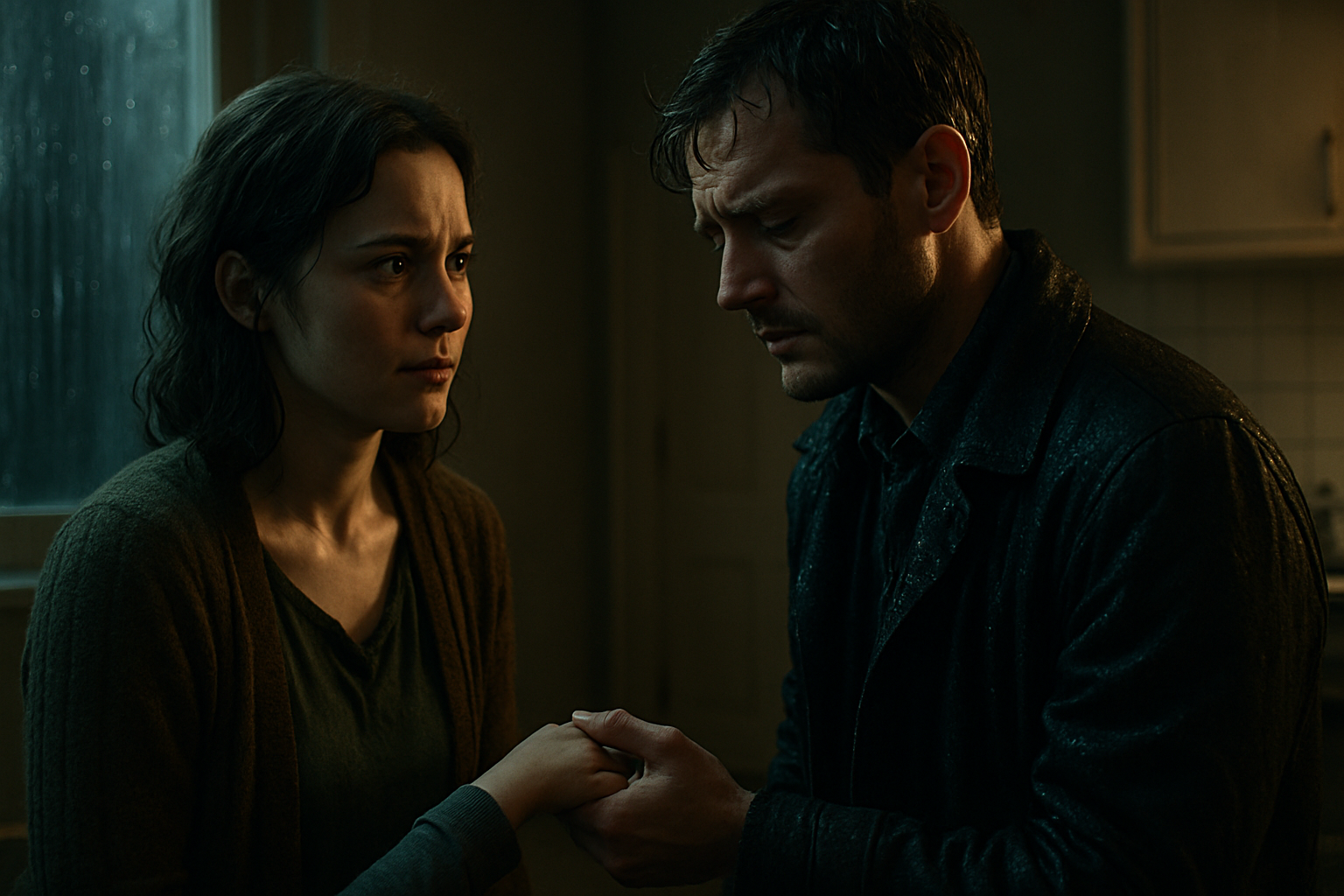
When he woke at six to help Miles finish a science fair model and never mentioned he had slept three hours.
When he listened to her talk about Jonah without trying to rescue the conversation.
When he admitted he feared Miles might one day decide he had arrived too late, and said he would love him anyway.
The word Dad came by accident on a rainy Tuesday.
Miles’s backpack zipper broke while they were rushing for school. Books slid across the floor. His telescope notebook fell open.
Elise bent to gather papers.
Graham tried to help and got in the way, because some skills resist billionaires.
“Move your foot,” Elise said.
“I’m helping.”
“You’re creating obstacles near the math homework.”
Miles grabbed the notebook, frustrated.
“Dad, can you hold this without bending the pages?”
Everything stopped.
Miles’s face went red.
“I mean—”
“I can,” Graham said, voice rough.
He took the notebook as if it were made of glass.
Elise looked at the wall because she needed a second to put herself back together.
Miles cleared his throat.
“We are still late.”
“Yes,” Graham said softly. “Extremely late.”
After they left, Elise stood in the entryway and cried.
For the girl she had been.
For the boy Graham had been.
For Jonah, who should have been there to tease them both.
And for Miles, who had carried everyone’s silence without becoming cruel.
That evening, Graham found Elise on the back steps of her South Baltimore row house. She had insisted they spend weekends there until the place felt like theirs again, not like a crime scene fame had invaded.
He sat beside her, close enough to comfort, not so close that he assumed he had earned it.
“I heard him,” she said.
“I know.”
“You looked like you might pass out.”
“I almost did.”
She laughed softly.
Graham looked at the patched fence, the wet grass, the string lights Miles had called “inefficient but acceptable.”
“I need to say something properly.”
“You practiced?”
“Four times.”
“Then proceed.”
His smile faded.
“I’m sorry for Jonah. Not because I caused what happened in some simple way. Not because guilt makes me noble. I’m sorry because you called me when you were afraid, and I let people convince me my future mattered more than your emergency.”
Elise stared at the grass.
“I’m sorry you learned not to trust me from evidence I provided,” he continued. “I’m sorry you raised Miles alone because the version of me you knew was too dangerous to depend on. And I’m grateful you protected him, even from me.”
For years, forgiveness had felt to Elise like lowering a weapon while the enemy still stood armed.
But Graham was not standing across from her anymore.
He was sitting beside her.
Unarmed at last.
“I forgive you,” she said.
His breath caught.
“I don’t forgive you because you fixed it. You can’t. I forgive you because I’m tired of holding pain like it proves I loved Jonah properly. I loved him. I miss him. I hate what happened. None of that requires me to keep hating you.”
Graham bowed his head.
Elise nudged his shoulder.
“Also, Jonah would haunt me for being this dramatic.”
“He would haunt me first.”
“He probably already has. That explains your cooking.”
Graham laughed then.
A real laugh.
And Elise leaned against him.
They did not become perfect.
Perfect was for press releases, not families.
They argued about discipline, screen time, money, privacy, and whether Graham’s idea of a “small educational gift” needed federal regulation.
Elise refused to marry him quickly just because the internet wanted a wedding.
Graham accepted that love was not a merger.
Miles adjusted slowly. Sometimes with trust. Sometimes with caution.
Always with data.
One year after the storm, the Jonah Rowan Community Observatory opened on a renovated rooftop above a youth center in East Baltimore.
The first night was cloudy, which Miles called “statistically rude,” but families came anyway. Children lined up for telescopes. Counselors staffed a crisis room downstairs.
Mae cried when Graham unveiled a small plaque with Jonah’s name and no self-congratulatory donor nonsense beneath it, because Elise had threatened to remove the entire wall if he made the memorial about himself.
Later, after the crowd thinned, Miles stood at the largest telescope with Graham beside him.
Elise watched as her son adjusted the eyepiece and corrected Graham’s hand position.
“You’re turning it too hard,” Miles said.
“I’m being gentle.”
“You’re being rich. Rich people think pressure solves mechanisms.”
Elise laughed.
Graham gave her a wounded look.
Miles stepped back.
“Look now.”
Graham bent to the eyepiece.
The clouds had broken just enough for the moon to appear.
Bright.
Scarred.
Whole, despite everything that had struck it.
He stayed there a long moment.
Then he looked at Miles.
“It’s beautiful.”
“I know,” Miles said. “But I like hearing you say it.”
Elise moved closer.
Miles, who once guarded every feeling like evidence in a trial, slipped one hand into hers without looking.
His other hand reached for Graham.
For a while, the three of them stood under the clearing Baltimore sky.
Their matching crescent birthmarks were hidden and visible at the same time.
Their shadows touched on the rooftop floor.
Miles looked up at them.
“I have a hypothesis.”
Elise smiled. “Of course you do.”
“That some families don’t start when people do everything right.” He glanced at Graham, then at her. “Some start when people stop running from what they did wrong.”
Graham swallowed.
“That’s a strong hypothesis.”
“It has supporting evidence,” Miles said.
Elise squeezed his hand.
“Then we’ll keep collecting more.”
Graham looked at her over their son’s head.
This time, there was no airport.
No investor dinner.
No camera.
No mother.
No fear standing between what he felt and what he said.
“I love you,” he told her.
Elise’s eyes filled, but her smile held.
“I know.”
Miles sighed.
“That was emotionally predictable.”
Graham laughed.
Elise laughed too.
And somewhere in that sound was Jonah, and Mae’s warm kitchen, and the old rooftop where everything had almost begun right the first time.
The past did not disappear.
It stayed.
But it no longer stood at the door like a storm demanding to be let in.
They had opened that door once.
This time, they knew what to keep.
What to forgive.
And what never to abandon again.