His backpack was missing. His shoes were gone. His telescope notebook was not on the desk.
Elise’s mind went white.
“He heard us,” she whispered.
Graham was already reaching for his jacket.
They searched for four hours in cold rain.
Graham called security, building staff, police contacts, everyone who answered because billionaires have numbers ordinary mothers do not. Elise drove with both hands locked on the wheel, checking the science museum, the library, the park Jonah once took Miles to, the school courtyard, the waterfront.
She refused to cry. Crying would blur the streetlights, and she needed to see.
The fifth place was the Patterson Observatory, a small public dome attached to an old science center. Miles had once mentioned the side gate latch was broken. Elise had reported it twice.
The city had done nothing.
That night, she was furious and grateful.
She found him inside the locked perimeter, sitting on a bench, backpack between his feet, face turned toward the clouded sky.
She called Graham.
“He’s here.”
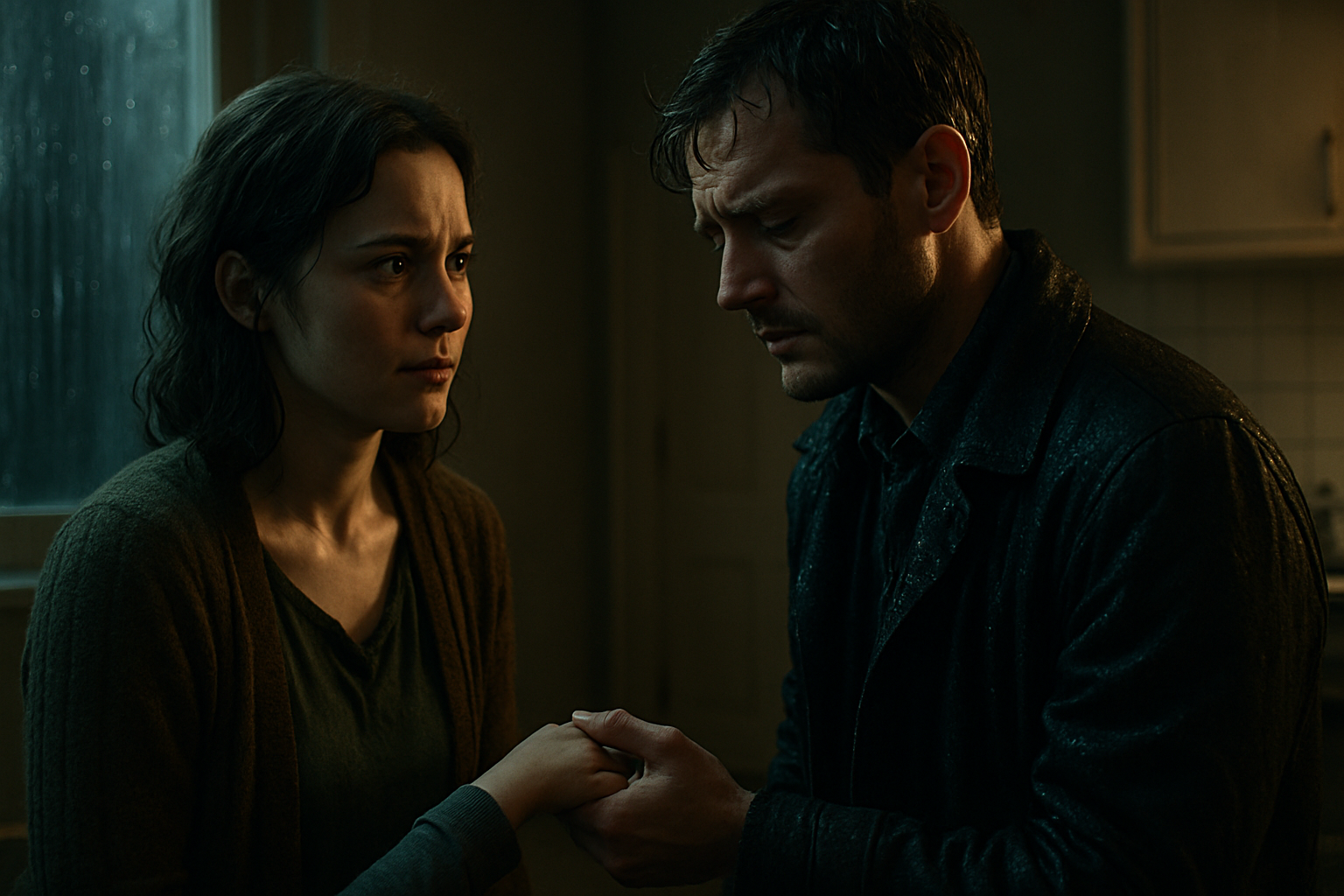
Graham arrived seven minutes later, soaked and breathless. No driver. No umbrella. No security. Just a man terrified enough to run.
Miles did not look surprised.
“I calculated you’d check here eventually.”
Elise sat beside him and wrapped an arm around his shoulders.
“You scared me so badly I forgot how to breathe.”
“I’m sorry.”
“Don’t apologize yet. I’m still too mad to accept it properly.”
Miles nodded.
Then, in a small voice, he asked, “Am I the reason you fight?”
“No,” Elise said instantly. “Never.”
“If I wasn’t here,” Miles said, looking at Graham, “maybe you wouldn’t have to keep trying.”
Graham crouched in front of him, rain dripping from his hair.
“Miles, listen to me. You are not the problem. You are not the wound. We were broken before you existed. None of that belongs to you.”
Miles searched his face.
“Are you going to leave?”
Graham looked at Elise.
She looked back, exhausted beyond anger.
“No,” he said. “Not for Lionel. Not for London. Not for a board. Not for anything that asks me to be the man I was before I knew you.”
Miles considered this.
“Promises are data only after they are kept.”
Graham nodded.
“Then I’ll keep giving you data.”
They went home after midnight.
Miles fell asleep in the car, one hand curled around his wrist. Graham carried him inside without asking permission, and Elise let him.
The sight nearly undid her.
After Miles’s door closed, Elise stood in the hallway.
“I can’t do this if you’re temporary.”
“I know.”
“I can’t survive loving the version of you that only appears during emergencies.”
“I know.”
“You keep saying that.”
“Because I’m done arguing with the truth.”
He did not kiss her.
That mattered.
The old Graham would have reached for romance to soften accountability. This Graham stood there and let the pain remain.
“I’m going to fix what I can,” he said. “And live with what I can’t.”
The next morning, Orion Bridge’s board received a three-sentence email.
Graham declined the European tour.
Postponed all comeback appearances.
Removed himself from negotiations involving Lionel Vane until an independent review examined conflicts of interest dating back to the company’s first funding.
By noon, business channels called it career suicide.
By dinner, Beatrice arrived with legal counsel, two crisis advisors, and the face of a woman trying not to murder her most valuable client.
“You can’t walk away from a billion-dollar transaction,” she said.
Graham sat beside Miles, who was doing homework and pretending not to listen.
“I didn’t walk away. I paused it.”
“You paused it by accusing your founding investor of misconduct.”
“I requested a review.”
“With the subtlety of a brick.”
Elise, making tea, said, “He’s always been dramatic.”
Graham looked at her. “Thank you?”
“It wasn’t praise.”
Beatrice rubbed her forehead.
“Lionel is already leaking that you’re unstable because of the paternity scandal.”
“Good,” Graham said. “Then he’ll underestimate me.”
That was when Elise understood.
He had not acted out of panic.
He was thinking.
Truly thinking.
Not about escape. Not about cameras. About cause and consequence.
Three days later, a file arrived from Clara Finch, an old assistant who had worked for Graham’s mother in the early years. She had kept copies, she said, not because she was brave, but because she was afraid someone would blame her someday.
Inside were call logs, emails, texts, and calendar notes from the week Jonah died.
Elise saw her own number repeated across the page.
Incoming call. Declined.
Incoming call. Declined.
Incoming call. Routed to assistant.
Beside one entry was a note from Graham’s mother, Celeste Calder.
Do not disturb him. Vane dinner takes priority.
Graham read the line once.
Then again.
His face did not change, but his hands curled slowly against the table.
Clara’s voice shook.
“Ms. Calder told staff to screen all personal calls during the negotiations. Later, when Ms. Rowan kept calling, Mr. Vane complained it was distracting. Your mother said she would handle it.”