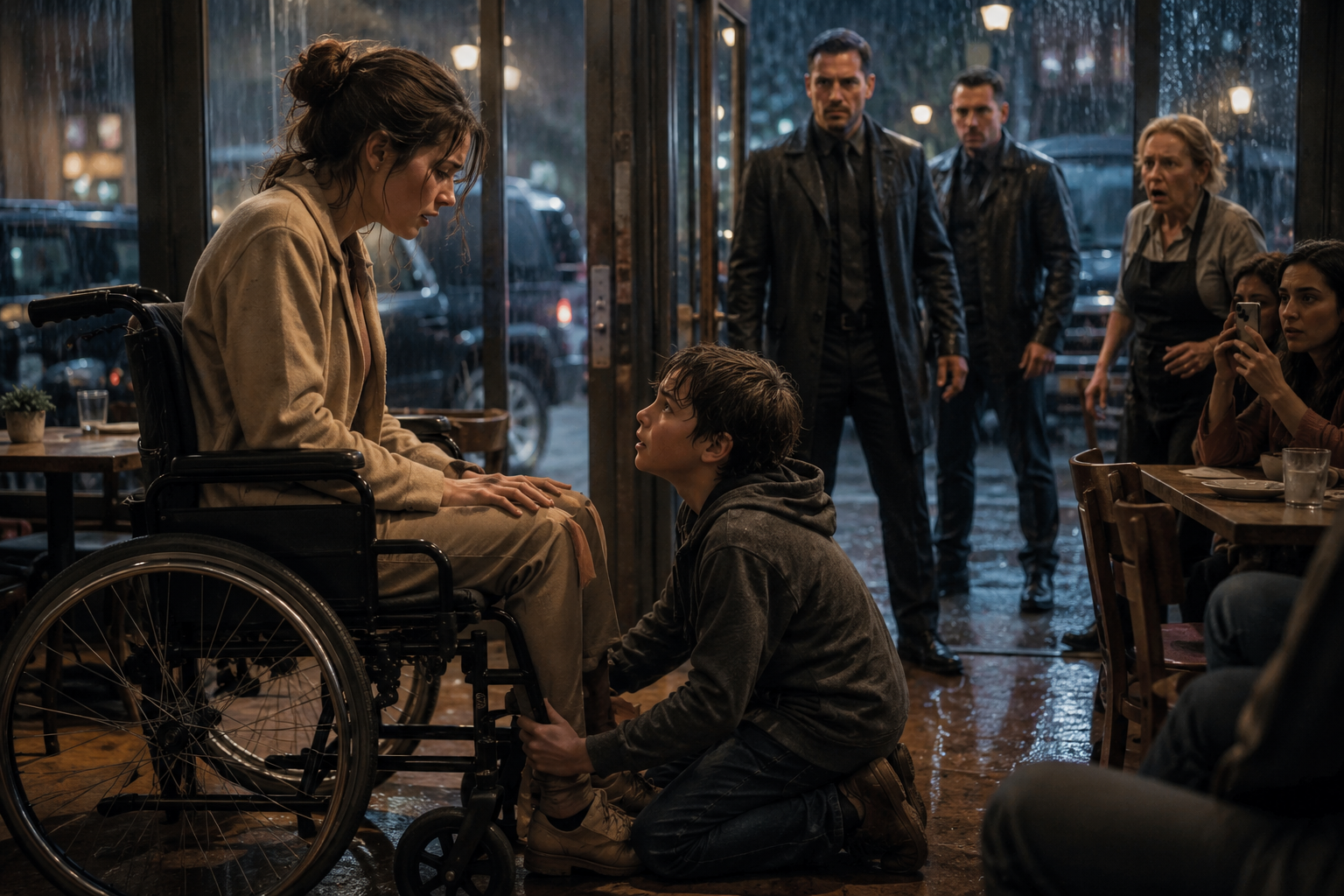
The live stream spread faster than the Institute could control.
Journalists joined.
Lawyers joined.
Doctors joined.
Parents began commenting names, dates, missing records, unanswered calls.
Neighbors came out with phones.
The men outside tried to leave, but the street had filled with witnesses.
And that was what powerful people feared most.
Not anger.
Witnesses.
By noon, the Vale Institute released a statement saying Jonah Reed was “a medically vulnerable minor unlawfully removed from supervised treatment.”
By one, Dr. Leona Hale posted photographs of his injuries with his face hidden and demanded an emergency investigation.
By two, three families had come forward claiming the Institute had taken their children into long-term programs they could no longer access.
By sunset, Clara’s father called.
She stared at his name on the screen.
Malcolm Voss.
The man who taught her how to smile for donors before he ever taught her how to tell him no.
She answered on speaker.
His voice was tight.
“Clara, what have you done?”
She almost laughed.
Not because it was funny.
Because it was exactly what he would ask.
Not are you safe.
Not can you walk.
Not who hurt that child.
What have you done?
“I told the truth,” she said.
“You exposed a respected medical institution based on the word of a disturbed boy.”
Jonah flinched.
Clara’s vision sharpened with fury.
“Do not call him that.”
“You are emotional.”
There it was.
The word people used when they wanted a woman back in her cage.
Emotional.
As if anger at cruelty were an illness.
As if compassion were hysteria.
As if her wheelchair had made her decorative and standing had made her dangerous.
“You’re on the board,” Clara said. “What did you know?”
Silence.
Too much silence.
“Dad.”
He sighed.
“You don’t understand what the Institute was trying to accomplish.”
The kitchen went still.
Even Maribel stopped breathing.
Clara’s voice became very quiet.
“What did you know?”
“They were studying rare regenerative responses. Do you understand what that means? It could have changed medicine. It could have helped people like you.”
“People like me?”
“Yes. People trapped inside bodies that—”
“Stop.”
He stopped.
Clara looked at Jonah, wrapped in a blanket on Theo’s couch, staring at her with wide, frightened eyes.
“Did you know they were using children?”
Her father said nothing.
That silence was the answer.
Something broke inside Clara.
Not her heart.
Not exactly.
It was the final collapse of the daughter who had still wanted her father to be better than the institutions he funded.
“You paid for the place that tortured him,” she said.
“Progress has costs, Clara.”
There it was.
The sentence monsters said when they wore expensive suits.
Progress has costs.
“Yes,” Clara said. “And this time, you’re going to be one of them.”
She hung up.
Then she sent the recorded call to three journalists.
The investigation began before morning.
Not a polite internal review.
Not a quiet board meeting.
A real investigation.
Because now the public had the story by the throat, and no powerful person could bury it without being seen holding the shovel.
For the next week, Theo’s house became a command center.
Lawyers came.
Reporters called.
Social workers arrived with emergency protection orders.
Families appeared with folders, photographs, medical bills, and stories that sounded too much like Jonah’s.
A girl who could calm seizures.
A boy whose touch reduced swelling.
A toddler whose blood showed impossible healing markers.
Children taken from poor families with promises of free care, housing, medicine, scholarships, hope.
Hope, Clara learned, was the easiest thing to sell to desperate parents.
Jonah barely spoke through most of it.
He stayed close to Maribel, sometimes close to Clara. At night, he woke screaming for his sister.
Lily.
Six years old.
Missing.
That was the truth that finally shattered him.
He had not run only from testing.
He had run because Lily had disappeared.
“They said she got transferred,” he sobbed one night. “But they wouldn’t tell me where. I tried to feel her. I can always feel her when she’s close. But she was gone.”
Clara made him a promise she had no right to make.
“We’ll find her.”
Maribel looked at Clara, terrified by the size of that promise.
But Jonah nodded.
Because children in pain do not need perfect odds.
They need one adult willing to stand between them and despair.
Three days later, Leona found the clue.
A billing code buried in leaked files pointed to an off-site facility in northern Michigan, officially listed as a pediatric recovery retreat.
Unofficially, according to a nurse who contacted reporters anonymously, it was where the Institute moved children whose cases had become “sensitive.”