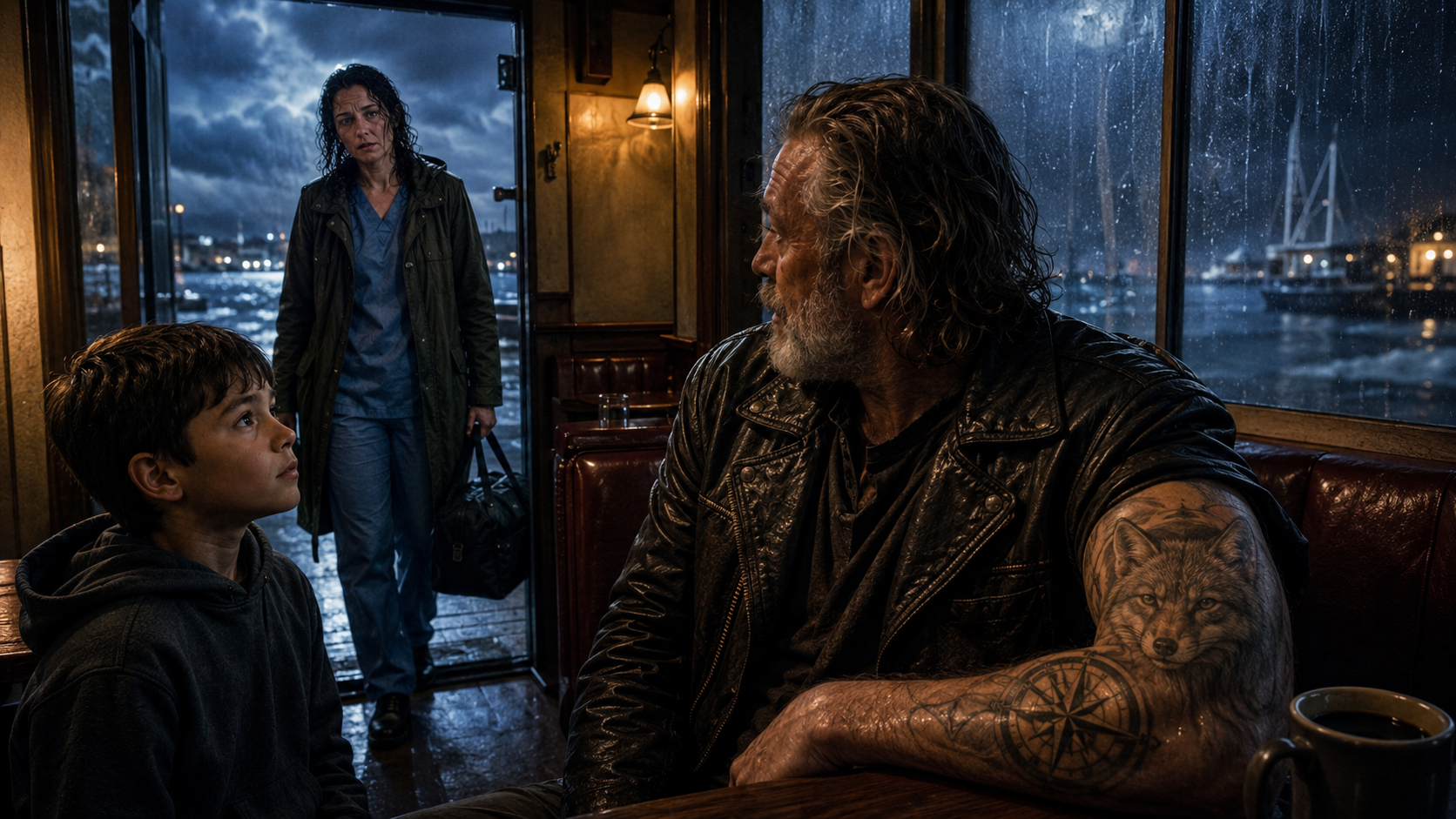
Elias and the other riders had been returning from a fundraising event for injured firefighters when they were trapped between two fire fronts.
Their motorcycles could not cross a collapsed bridge.
Their radios had failed.
Jonah’s leg was broken.
Rourke had suffered severe burns.
Mae had nearly lost consciousness from smoke inhalation.
Camille and Aaron found them while helping evacuate a rural medical station.
The official route was already burning.
Camille remembered an abandoned mining road that crossed the northern ridge. She led the group through darkness, smoke, and falling ash while Aaron remained behind to locate two missing riders.
He brought them out.
Then he collapsed.
He died in a hospital three weeks later from complications caused by his injuries.
After the fire, the surviving riders formed a volunteer emergency-response network.
They chose the silver fox as their symbol because Camille’s old jacket had carried a small fox-shaped pin. Aaron had often joked that she could find a safe road through any wilderness because she thought like a fox.
The compass star represented the route she had found.
The black line across the fox’s ear represented those who had not come home.
Every original member received the tattoo.
Camille had accepted one as well.
Then she vanished.
Theo listened without interrupting.
When the story ended, he looked at his mother.
“Dad saved them?”
Camille nodded.
“And you saved them too?”
“We helped each other.”
Elias reached into his wallet and removed a worn photograph protected by clear plastic.
In it, seven people stood beside a damaged rescue truck.
They were covered in ash.
Camille was younger, with shorter hair. Aaron stood beside her with one arm around her shoulders. Elias, Mae, Jonah, Rourke, and two other riders crowded around them.
A silver fox had been drawn on the side of the truck with white paint.
Theo touched the photograph.
“That’s Dad?”
“Yes,” Camille whispered.
“He looks happy.”
“He was.”
Theo studied the picture for a long time.
Then he pointed to Elias.
“You had more hair.”
Rourke laughed so suddenly that coffee came out of his nose.
Even Camille smiled.
The tension in the room finally cracked.
Lorna brought fresh cocoa for everyone.
The riders crowded around the booth. For the first time, they told Theo about Aaron.
They told him how his father sang terribly whenever he was nervous.
How he carried lemon candies in every pocket.
How he could repair a radio with a paperclip but could never remember where he had put his own keys.
How he had once crossed a freezing river to rescue a dog that immediately bit him.
Camille listened with tears on her cheeks.
Theo listened as though someone had opened a book he had been waiting his entire life to read.
After a while, Lorna pulled Camille aside.
“Theo told me about the apartment.”
Camille stiffened.
“He shouldn’t have.”
“He’s worried.”
“I’m handling it.”
“The notice says you have twelve days.”
Elias heard her.
Camille saw it in his face.
“No.”
He raised both hands.
“I haven’t said anything.”
“You’re about to.”
“You need a place to live.”
“I need people to stop treating me like I’m helpless.”
“No one here believes you’re helpless.”
“Then stop trying to rescue me.”
Elias’s expression sharpened.
“This isn’t rescue.”
“What is it?”
“A job.”
Camille blinked.
Mae placed a folder on the table.
Inside were plans for a mobile emergency clinic, photographs of a renovated bus, and letters from several rural communities.
Elias explained that their volunteer network had grown.
They now operated rescue vehicles, delivered medicine after storms, transported elderly patients, and supported communities cut off by floods or wildfires.
They had equipment.
They had funding.
They had drivers, mechanics, and volunteers.
What they did not have was a medical director willing to travel the back roads.
“We were coming to Port Alder to meet a retired doctor,” Mae said. “That was before a little boy recognized Elias’s arm.”
Camille stared at the plans.
“You expect me to believe this is a coincidence?”
“The meeting is real,” Elias said. “The timing may be something else.”
“I can’t accept a position because you feel guilty.”
“I don’t feel guilty.”
“You said you thought I was dead.”
“I feel grateful. There’s a difference.”
Camille closed the folder.
“I have a son.”
“The clinic schedule would keep you closer to Port Alder than your current job,” Mae said. “Regular hours, emergency rotations shared between three teams, full medical insurance.”
Camille looked at her.
“You planned all of this in the last twenty minutes?”
Mae smiled.
“We have been planning it for two years. We simply didn’t know the right person was sitting in this café.”
Elias placed a brass key beside the folder.