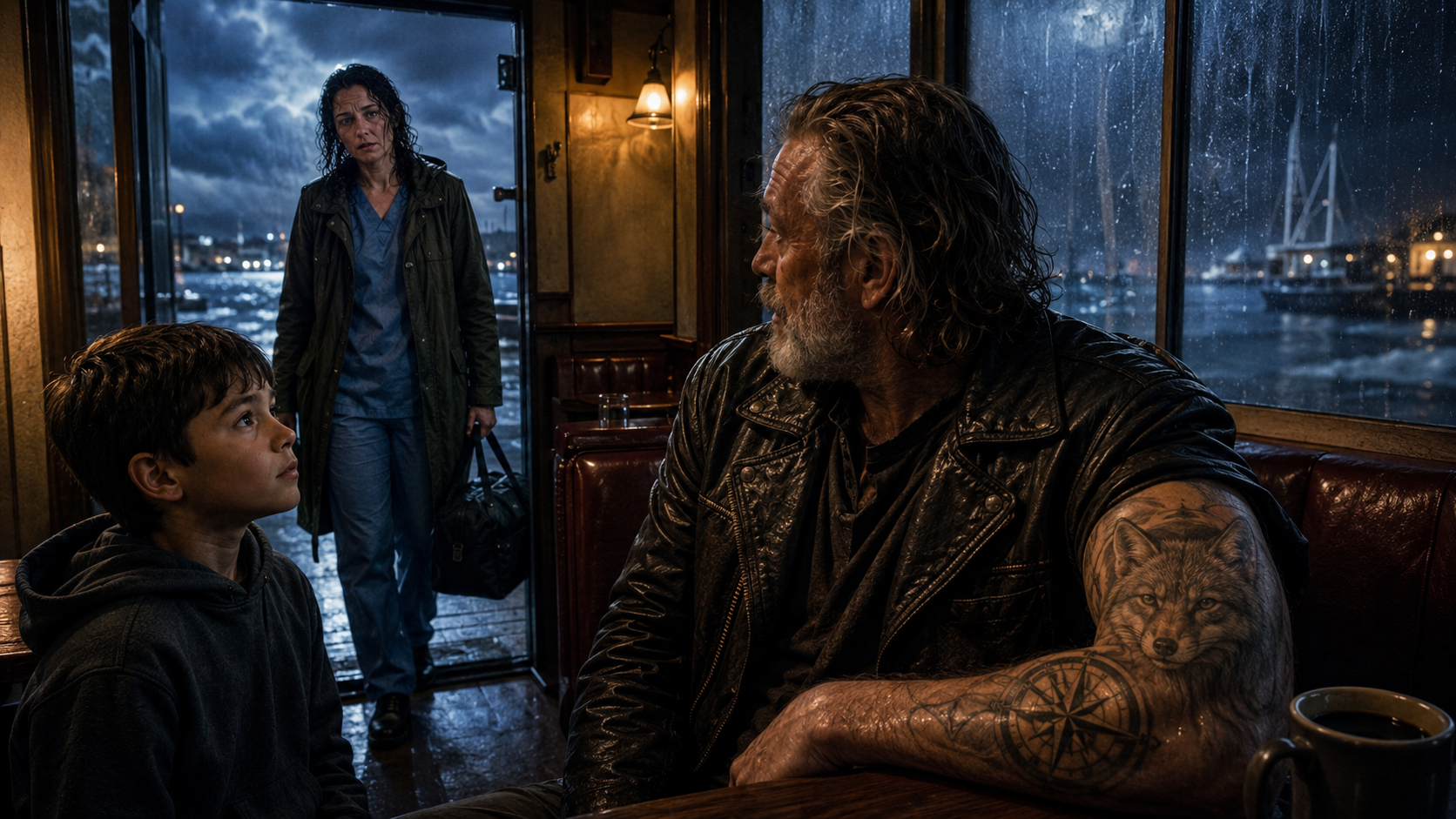
The Boy Who Recognized the Silver Fox

By the time the storm reached Port Alder, the ocean had vanished.

It was still there, somewhere beyond the black windows of the Breakwater Café, but the rain had swallowed the harbor, the fishing boats, and the row of weathered buildings along the shore. Wind hammered the glass hard enough to make the coffee cups tremble in their saucers.

Nine-year-old Theo Vale sat alone in the last booth.

His red backpack rested beside him. One strap had been repaired with silver tape, and the zipper no longer closed properly. A library book about sea monsters stuck out of the top.

In front of Theo stood a mug of cocoa that had stopped steaming nearly an hour ago.

He had drawn a maze in the condensation on the window. At the center of it, he had made a tiny house. Outside the maze, he had drawn two figures holding hands.

One was small.

The other wore a long coat and had dark curls.

Lorna Bell, the café’s owner, watched him from behind the counter as she polished the same glass for the third time.

“Your mother called again,” she said. “The highway is moving slowly, but she’s coming.”

Theo nodded.

“She always comes.”

“I know she does.”

Lorna placed a warm cinnamon roll beside his cold cocoa.

Theo looked at it but did not touch it.

His mother had told him not to accept free food when they could not pay for it. Lorna had told him that cinnamon rolls left on the counter after eight o’clock belonged to nobody.

They had been having that argument for months.

Camille Vale worked as a home-care nurse. She drove through coastal towns, mountain communities, and isolated farms to visit patients who could no longer travel to a clinic. Some nights she came home smelling of antiseptic. Other nights she smelled of woodsmoke, wet dogs, or whatever meal an elderly patient had insisted on feeding her.

Lately, she came home later than usual.

She also checked the mailbox before Theo could reach it.

When bills arrived, she folded them in half and placed them beneath a chipped blue bowl on top of the refrigerator.

Theo knew more than she believed he did.

He knew their apartment building had been sold.

He knew the new owner wanted everyone out before winter.

He knew Camille’s car made a grinding sound whenever she turned left.

He knew she sometimes skipped dinner and claimed she had eaten with a patient.

But she always came for him.

Even in rain.

Even in snow.

Even when her eyes were red with exhaustion and she had to sit in the car for a minute before pretending everything was fine.

So Theo waited.

At 8:17 p.m., six motorcycles rolled into the parking lot.

Their headlights appeared first, floating through the rain like pale moons. Then the machines emerged from the darkness, black and silver, water flying from their tires.

The riders parked beneath the broken awning.

Five men and one woman entered the café.

The room changed the moment they stepped inside.

They wore weather-darkened jackets, heavy boots, and gloves stained by years of oil and road dust. Rain gleamed on their shoulders. Their faces carried old scars, windburn, and the calm expressions of people who had spent too much time in dangerous places.

The woman removed her helmet first.

She was tall, perhaps sixty, with close-cropped white hair and a narrow scar through one eyebrow. A coil of rope hung from her pack.

Behind her came a broad man with a gray beard, a thin rider with a mechanical brace around one knee, and two younger men carrying waterproof tool cases.

The last rider through the door was the oldest.

He moved slowly, but the others unconsciously made space for him.

He had a weathered face, deep-set eyes, and silver hair tied at the back of his neck. His leather jacket bore no club name. There was only a small patch on the left shoulder: a silver fox standing beneath an eight-pointed star.

Lorna pointed toward the largest table.

“Coffee?”

“All of it,” the white-haired woman said.

A few customers smiled nervously.

The oldest rider did not.

He looked toward the windows and listened to the storm as though it were speaking a language only he understood.

The riders settled at the long table near the counter. They spoke quietly about the flooded highway, a fallen tree near Grayson Point, and whether the bridge north of town would remain open.

Theo watched them over the edge of his book.

He had seen motorcyclists before. Port Alder sat along a famous coastal road, and every summer brought riders from distant cities. These people were different.

They did not laugh loudly or try to frighten anyone.

They checked the weather radar.

They placed a battery-powered radio between the sugar jar and the napkin holder.

One of the younger men spread a paper map across the table.

The oldest rider removed his wet jacket and rolled up his sleeves.

That was when Theo saw the tattoo.

A silver fox curled around a compass star.

One of the fox’s ears was marked by a thin black line.

Theo forgot the storm.

He forgot the cinnamon roll.

He forgot that his mother had warned him not to bother strangers.

He slipped out of the booth.

Lorna noticed him crossing the café.

“Theo?”

He kept walking.

The conversation at the riders’ table faded.

The white-haired woman looked down at him.

“Can we help you, sailor?”

Theo stared at the oldest man’s forearm.

The man followed his gaze.

“You like the fox?”

Theo pointed.

“My mother has one.”

The man’s expression did not change immediately.

Then his fingers tightened around his coffee mug.

The woman beside him stopped smiling.

The rider with the knee brace slowly lowered the map.

The oldest man leaned forward.

“What kind of fox?”

“That one.”

Theo pointed again.

“Silver, with the star behind it. There’s a black mark on the ear.”

The man’s voice became very quiet.

“Where did you see it?”

“On her shoulder. She thinks I don’t know about it.”

No one at the table moved.

Lorna came out from behind the counter and rested a protective hand on Theo’s shoulder.

“He doesn’t mean any harm.”

“Neither do we,” the oldest rider said.

He looked at Theo as if the boy had opened a door that had been locked for years.

“What’s your mother’s name?”

“Camille Vale.”

The white-haired woman closed her eyes.

The broad man with the gray beard whispered a curse.

The rider wearing the knee brace pushed himself to his feet so quickly that the table shifted.

The oldest man stared at Theo.

“Camille?”

Theo stepped closer to Lorna.

“You know her?”

The man looked at the silver fox on his arm.

“I used to.”

“Was she a biker?”

A strange sound escaped the white-haired woman, halfway between a laugh and a sob.

The oldest man shook his head.

“No. Your mother was something much rarer.”

Before Theo could ask what that meant, headlights swept across the café windows.

A small blue car turned into the parking lot.

It moved slowly, one headlamp dimmer than the other.

Theo ran toward the door.

“That’s her.”

The riders rose together.

Outside, Camille Vale stepped from the car and lifted one arm against the rain.

She wore a dark green coat over blue medical scrubs. Her curls had escaped from a loose knot, and water streamed down her face. A canvas nursing bag hung from her shoulder.

She hurried across the parking lot.

When she opened the café door, wind and rain followed her inside.

“Theo, I’m so sorry. A tree came down near—”

She stopped.

The color drained from her face.

Her nursing bag slipped from her shoulder and struck the floor.

The oldest rider stood beside the table.

For several seconds, he and Camille simply stared at each other.

The storm filled the silence.

Finally, Camille whispered his name.

“Elias.”

Elias Ward gripped the back of a chair.

“I thought you were dead.”

Camille looked at the other riders.

At Mae Calder, the white-haired woman.

At Jonah Reese, whose damaged knee had never fully healed.

At Rourke Bell, the gray-bearded rider who was openly crying.

At Ben Mercer and Solomon Drake, who had been young apprentices the last time she had seen them.

“You weren’t supposed to find me,” Camille said.

Mae stepped forward.

“We spent eleven years trying.”

Theo looked from his mother to the riders.

“Mom?”

Camille seemed to remember that he was standing there.

She rushed to him and placed both hands on his shoulders.

“Are you all right?”

“I’m fine. They have your fox.”

Her eyes closed briefly.

When she opened them, Elias had moved closer.

Not threateningly.

Carefully.

As though approaching a wounded animal.

“Does he know?” Elias asked.

“No.”

“Camille, he deserves—”

“He deserves a normal childhood.”

Theo frowned.

“What don’t I know?”

Camille took his hand.

“We’re leaving.”

A burst of static came from the radio on the riders’ table.

Then a dispatcher’s voice broke through.

“Multiple reports of a vehicle off Old Quarry Road. Possible rollover near mile marker twelve. Emergency units delayed by flooding on the south access route.”

Every rider turned toward the radio.

Camille froze.

The dispatcher continued.

“Two occupants confirmed. One may be trapped. Caller reports smoke from the engine compartment.”

Elias reached for his jacket.

“Old Quarry Road is five minutes from here.”

“Not in this weather,” Lorna said. “That road is barely wide enough in daylight.”

Mae was already tightening her boots.

“We have rescue equipment.”

Camille glanced at the dark windows.

Then at Theo.

Then at the medical bag lying on the floor.

She closed her eyes, but only for a moment.

When she opened them again, the frightened woman who had entered the café was gone.

“Ben,” she said, “what’s in the red case?”

The younger rider answered instantly.

“Hydraulic spreader, cutting saw, stabilization straps.”

“Jonah, can you operate the winch with that knee?”

“I can operate it better than anyone here.”

“Mae, how much rope?”

“Two hundred feet.”

Camille picked up her medical bag.

“Lorna, keep Theo inside.”

Theo grabbed her coat.

“No.”

She knelt in front of him.

“I have to help.”

“You just got here.”

“I know.”

“You said you would come for me.”

“I did.”

“No, you came and now you’re leaving again.”

Pain crossed Camille’s face.

Elias crouched beside them.

“Your mother isn’t leaving you.”

Theo looked at him angrily.

“You don’t know that.”

Elias accepted the accusation without flinching.

“You’re right. But I know she never walks away from someone who needs her.”

Camille looked at Elias.

Something unspoken passed between them.

Theo’s fingers loosened around her coat.

“Will you come back?”

Camille pressed her forehead against his.

“Always.”

Outside, the storm struck them like a wall.

The riders moved with practiced efficiency.

Tool cases were secured to two motorcycles. Rope was strapped to Mae’s pack. Jonah climbed into a support truck parked behind the café. Elias handed Camille a spare helmet.

She stared at it.

“You still carry extras?”

“We learned to.”

Camille climbed into the passenger seat of the truck instead.

Elias joined Jonah in the front. Mae, Rourke, Ben, and Solomon rode behind them, their headlights cutting narrow tunnels through the rain.

Old Quarry Road wound above the ocean.

Mud streamed across the asphalt. Fallen branches cracked beneath the truck’s tires. On one side stood a wall of wet stone. On the other, the ground disappeared toward the rocks below.

The overturned vehicle lay beyond a sharp bend.

It was a delivery van resting against a cluster of young cedar trees. The front end had collapsed. Smoke rose from beneath the hood.

A teenage girl stood in the road, waving both arms.

“My father’s inside!”

Camille was out of the truck before it stopped moving.

“What’s your name?”

“Sadie.”

“Are you hurt?”

“My shoulder, but I can move. My dad can’t get out.”

Camille touched the girl’s neck, checked her breathing, and examined her pupils.

“Stay beside Mae. Do exactly what she says.”

She approached the van.

The driver was conscious but pinned behind the steering column. Blood covered one side of his face.

“Sir, my name is Camille. I’m a nurse. Can you tell me your name?”

“Martin.”

“Good. Keep looking at me, Martin.”

“I can’t feel my left leg.”

“We’re going to get you out.”

Smoke thickened near the engine.

Ben examined the front of the van.

“Battery cable is crushed under the frame.”

Solomon aimed a fire extinguisher toward the hood.

Jonah positioned the truck uphill and unspooled the winch.

The vehicle shifted.

A cedar trunk cracked beneath it.

Everyone heard the sound.

Mae looked over the edge.

“If that tree gives way, the van goes another forty feet.”

Camille leaned through the broken passenger window.

Martin’s face had turned gray.

“Stay awake.”

“My daughter?”

“She’s safe.”

“Promise?”

Camille looked toward Sadie, who stood wrapped in Mae’s riding jacket.

“I promise.”

Elias knelt beside Camille.

“What do you need?”

“Stabilize the van. Then open the driver’s side without twisting the frame. He may have spinal damage.”

Elias nodded.

He did not question her.

He did not hesitate.

He simply turned and began giving orders.

The riders anchored the van to the support truck. Mae secured a second line around a thick spruce tree uphill. Ben slid wooden blocks beneath the chassis. Rourke crawled into the back of the van to clear fallen cargo away from the driver’s seat.

Camille remained beside Martin.

She inserted an intravenous line by the glow of a headlamp. She covered him with a thermal blanket and monitored his pulse.

“You’re doing well,” she told him.

“I’m terrified.”

“So am I.”

Martin blinked at her.

“You don’t look terrified.”

“That’s because I’ve had practice.”

The cedar beneath the van groaned again.

The winch cable snapped tight.

Jonah shouted from the truck.

“I’ve got the weight, but not for long.”

Ben placed the hydraulic spreader against the damaged door.

“Ready.”

Camille looked at Martin.

“This is going to be loud.”

Metal screamed as the tool forced the door outward.

Martin cried out.

Camille kept one hand against his neck and the other around his wrist.

“Stay with me. Look at my face.”

The gap widened.

Rourke cut through a section of twisted dashboard.

A small flame appeared beneath the hood.

Solomon emptied the extinguisher over it.

“Fire’s down, not dead.”

Distant sirens echoed through the storm.

The sound was faint.

Too far away.

Camille examined the space around Martin’s legs.

“The steering column has him pinned. We need another six inches.”

“The frame may not take it,” Ben warned.

Camille looked at the smoke, the cracked tree, and the terrified man in front of her.

“Then we give it no choice.”

Elias placed both hands on the spreader.

“On your order.”

For one second, Camille was no longer on Old Quarry Road.

She was eleven years younger, standing beneath a sky the color of burning copper.

She heard trees exploding in the heat.

She heard motorcycles crashing through brush.

She heard Aaron shouting through smoke.

She heard Elias asking which direction led out.

She heard herself ordering everyone forward while the mountain burned behind them.

Then the memory released her.

“Now.”

The door tore free.

Rourke and Ben lifted the damaged steering assembly.

Camille guided Martin’s legs through the opening.

Together, they transferred him onto a rigid rescue board seconds before the cedar beneath the van split apart.

The winch cable shrieked.

The van slid three feet down the slope and stopped against the secondary rope.

Mae let out a breath.

“Everyone clear!”

They carried Martin uphill.

By the time the ambulance arrived, Camille had stabilized his blood pressure and dressed the wound on his head. Sadie climbed into the ambulance beside him.

Before the doors closed, Martin reached for Camille’s hand.

“My daughter said you came out of nowhere.”

Camille glanced at the six riders standing in the rain.

“No,” she said. “I didn’t come alone.”

The ambulance disappeared around the bend.

For a while, nobody spoke.

Rain ran from Elias’s hair and beard.

He looked at Camille with the same expression he had worn in the café.

“You’re still doing it.”

“Doing what?”

“Walking into the worst moment of someone’s life and convincing them there’s a way out.”

Camille began packing her medical supplies.

“You should go back to the café.”

“So should you.”

“I have my car.”

Elias looked at the road.

“You are not driving that car through this storm.”

“You don’t get to give me orders.”

A faint smile touched his face.

“You haven’t changed.”

“I’ve changed completely.”

“No. You’ve just become better at hiding.”

Camille turned away.

Mae approached and handed her a dry jacket.

“We don’t want to frighten you.”

“You don’t frighten me.”

“Then why did you disappear?”

Camille looked toward the dark ocean.

“Because every time I saw the fox, I remembered that mountain.”

Mae’s expression softened.

“We remember it too.”

“You survived.”

“Because of you.”

“Because everyone followed instructions.”

“Because you went back for us.”

Camille’s jaw tightened.

“I didn’t get everyone out.”

The riders fell silent.

Elias stepped closer.

“Aaron made his own decision.”

“He went back because I told him two riders were missing.”

“And he found us.”

“He died three weeks later.”

“He knew the risk.”

“I was his wife.”

“And we were the strangers he chose to save.”

Camille’s eyes filled with tears, but her voice remained controlled.

“I was pregnant. I found out after the funeral. Every road, every engine, every hospital corridor reminded me of what happened. I could not breathe in that town anymore.”

Elias looked down.

“We searched hospitals, clinics, and shelters. We contacted every Camille Mercer in three states.”

“Vale was my mother’s name.”

“We thought you hated us.”

“I hated myself.”

“No one blamed you.”

“I did.”

Mae touched Camille’s arm.

“The fox was never meant to chain you to that night.”

Camille pulled away.

“What was it meant to do?”

“Lead us home.”

They returned to the Breakwater Café shortly before midnight.

Theo was asleep in the booth with his head on Lorna’s folded sweater. His sea-monster book lay open beneath one hand.

Camille stopped in the doorway.

The exhaustion in her face deepened.

She removed the borrowed jacket and walked toward him.

Theo opened his eyes when she touched his hair.

“You came back.”

“I promised.”

“Did you save them?”

“The ambulance took them to the hospital.”

“So yes.”

Camille smiled tiredly.

“We all helped.”

Theo sat up and looked at the riders.

“Did my mom tell you what the fox means?”

Elias pulled out the chair across from him.

“Not yet.”

Camille shook her head.

“Elias.”

“No secrets,” Theo said.

She looked at her son.

Then she sat beside him.

Eleven years earlier, Camille explained, she and Aaron had lived in a mountain town called Calder’s Ridge. Camille worked as an emergency nurse. Aaron volunteered with a wilderness search-and-rescue team.

One August afternoon, lightning ignited the western slope.

The fire crossed three valleys in less than six hours.

Roads vanished beneath smoke. Power lines fell. Entire neighborhoods were evacuated.

Elias and the other riders had been returning from a fundraising event for injured firefighters when they were trapped between two fire fronts.

Their motorcycles could not cross a collapsed bridge.

Their radios had failed.

Jonah’s leg was broken.

Rourke had suffered severe burns.

Mae had nearly lost consciousness from smoke inhalation.

Camille and Aaron found them while helping evacuate a rural medical station.

The official route was already burning.

Camille remembered an abandoned mining road that crossed the northern ridge. She led the group through darkness, smoke, and falling ash while Aaron remained behind to locate two missing riders.

He brought them out.

Then he collapsed.

He died in a hospital three weeks later from complications caused by his injuries.

After the fire, the surviving riders formed a volunteer emergency-response network.

They chose the silver fox as their symbol because Camille’s old jacket had carried a small fox-shaped pin. Aaron had often joked that she could find a safe road through any wilderness because she thought like a fox.

The compass star represented the route she had found.

The black line across the fox’s ear represented those who had not come home.

Every original member received the tattoo.

Camille had accepted one as well.

Then she vanished.

Theo listened without interrupting.

When the story ended, he looked at his mother.

“Dad saved them?”

Camille nodded.

“And you saved them too?”

“We helped each other.”

Elias reached into his wallet and removed a worn photograph protected by clear plastic.

In it, seven people stood beside a damaged rescue truck.

They were covered in ash.

Camille was younger, with shorter hair. Aaron stood beside her with one arm around her shoulders. Elias, Mae, Jonah, Rourke, and two other riders crowded around them.

A silver fox had been drawn on the side of the truck with white paint.

Theo touched the photograph.

“That’s Dad?”

“Yes,” Camille whispered.

“He looks happy.”

“He was.”

Theo studied the picture for a long time.

Then he pointed to Elias.

“You had more hair.”

Rourke laughed so suddenly that coffee came out of his nose.

Even Camille smiled.

The tension in the room finally cracked.

Lorna brought fresh cocoa for everyone.

The riders crowded around the booth. For the first time, they told Theo about Aaron.

They told him how his father sang terribly whenever he was nervous.

How he carried lemon candies in every pocket.

How he could repair a radio with a paperclip but could never remember where he had put his own keys.

How he had once crossed a freezing river to rescue a dog that immediately bit him.

Camille listened with tears on her cheeks.

Theo listened as though someone had opened a book he had been waiting his entire life to read.

After a while, Lorna pulled Camille aside.

“Theo told me about the apartment.”

Camille stiffened.

“He shouldn’t have.”

“He’s worried.”

“I’m handling it.”

“The notice says you have twelve days.”

Elias heard her.

Camille saw it in his face.

“No.”

He raised both hands.

“I haven’t said anything.”

“You’re about to.”

“You need a place to live.”

“I need people to stop treating me like I’m helpless.”

“No one here believes you’re helpless.”

“Then stop trying to rescue me.”

Elias’s expression sharpened.

“This isn’t rescue.”

“What is it?”

“A job.”

Camille blinked.

Mae placed a folder on the table.

Inside were plans for a mobile emergency clinic, photographs of a renovated bus, and letters from several rural communities.

Elias explained that their volunteer network had grown.

They now operated rescue vehicles, delivered medicine after storms, transported elderly patients, and supported communities cut off by floods or wildfires.

They had equipment.

They had funding.

They had drivers, mechanics, and volunteers.

What they did not have was a medical director willing to travel the back roads.

“We were coming to Port Alder to meet a retired doctor,” Mae said. “That was before a little boy recognized Elias’s arm.”

Camille stared at the plans.

“You expect me to believe this is a coincidence?”

“The meeting is real,” Elias said. “The timing may be something else.”

“I can’t accept a position because you feel guilty.”

“I don’t feel guilty.”

“You said you thought I was dead.”

“I feel grateful. There’s a difference.”

Camille closed the folder.

“I have a son.”

“The clinic schedule would keep you closer to Port Alder than your current job,” Mae said. “Regular hours, emergency rotations shared between three teams, full medical insurance.”

Camille looked at her.

“You planned all of this in the last twenty minutes?”

Mae smiled.

“We have been planning it for two years. We simply didn’t know the right person was sitting in this café.”

Elias placed a brass key beside the folder.

“There’s a small house on the rescue property. It belonged to our radio operator. Two bedrooms, a garden, and a school bus stop at the main gate.”

Camille did not touch it.

“I don’t want charity.”

“Good,” Elias replied. “Because we expect you to work.”

Rourke leaned across the table.

“And you’ll have to tolerate terrible coffee.”

Jonah raised his mug.

“This café has ruined us for life.”

Theo looked at the key.

“Does the house have leaks?”

“Not anymore,” Ben said. “I repaired the roof.”

“Ghosts?”

“Only one,” Solomon answered. “But he’s polite.”

Camille gave him a warning look.

Solomon immediately corrected himself.

“No ghosts.”

Theo turned to his mother.

“We could look at it.”

Camille’s eyes filled again.

“I don’t know.”

Theo slipped his hand into hers.

“You always tell me that not knowing is different from saying no.”

Elias looked away, hiding a smile.

Camille studied the faces around the table.

They were older than the people in the photograph.

Time had taken hair, strength, perfect joints, and friends from them. Yet the same people were still there beneath the years.

They had not come to collect a debt.

They had come because they remembered a road through the fire.

Camille slowly rolled up the sleeve of her coat.

The tattoo on her shoulder had faded, but the silver fox was still visible beneath the café lights.

The compass star surrounded it.

A black line crossed one ear.

Under the fox were two names.

Aaron.

Theo.

Elias bowed his head.

Mae covered her mouth.

Theo traced the air above the tattoo without touching it.

“You added my name.”

“The day you were born.”

“Why didn’t you ever show me?”

“Because I thought the story would make you sad.”

Theo considered this.

“It does.”

Camille’s face fell.

“But it also makes me proud.”

He leaned against her.

Outside, the storm began to weaken.

The rain softened from a roar to a steady whisper. Far beyond the windows, the harbor lights reappeared one by one.

Camille picked up the brass key.

“I will look at the house.”

Elias nodded.

“And the clinic?”

“I will read the proposal.”

Mae smiled.

“That is the closest thing to yes she has ever given anyone.”

“You remember that?”

“I remember everything.”

Theo looked around the booth.

“Does this mean they’re our family?”

Camille glanced at the photograph.

Then at the six road-worn people watching her with hope they were trying unsuccessfully to hide.

“Family is a serious word.”

Rourke nodded solemnly.

“We can begin with suspicious acquaintances.”

“Very suspicious,” Jonah added.

Theo looked at Elias’s tattoo.

“I think you’re foxes.”

Elias leaned closer.

“What does that make you?”

Theo thought about it.

“A fox cub.”

The riders laughed.

Camille laughed with them.

It was not the polite laugh she used with patients or the tired laugh she gave Theo when he told the same joke for the fifth time.

It was a sound that seemed to come from a room inside her that had been locked for eleven years.

Lorna brought another cinnamon roll and placed it in front of Theo.

“This one belongs to somebody,” she said. “The silver foxes are paying.”

Theo pulled the plate to the center of the table.

“Then everybody gets some.”

They divided it into eight uneven pieces.

Dawn arrived slowly over Port Alder.

The storm moved north, leaving branches, flooded streets, and shining rooftops behind. Fishing boats emerged from the fog. Gulls returned to the harbor.

Camille and Theo stood beneath the café awning as the riders prepared to leave.

Elias fastened his helmet.

“We’re staying at the old rescue station outside town. Come tomorrow afternoon.”

“To see the house,” Camille said.

“And the clinic.”

“To read the proposal.”

“Of course.”

Theo stood beside Elias’s motorcycle.

“Will you teach me to ride?”

“When you’re older.”

“How much older?”

“Thirty.”

Theo stared at him.

Camille folded her arms.

“Forty.”

Elias nodded.

“Your mother is the medical director.”

“I haven’t accepted the job.”

“Not yet.”

The motorcycles started one after another.

The sound rolled across the waking harbor, deep but not threatening.

Before Elias pulled away, he lifted his tattooed arm.

Camille hesitated.

Then she raised her sleeve and showed him the matching fox.

For a moment, the years between them disappeared.

The riders left in a line, their red taillights fading along the wet coastal road.

Theo slipped his hand into Camille’s.

“Are we going to be okay?”

She watched the last motorcycle vanish around the bend.

For years, she had answered that question too quickly.

Of course.

Everything is fine.

Don’t worry.

This time, she gave him the truth.

“I think we’re going to need help.”

Theo squeezed her hand.

“That isn’t the same as not being okay.”

Camille looked down at him.

“No,” she said. “It isn’t.”

They walked toward the blue car.

It made the familiar grinding sound when Camille opened the driver’s door.

Theo placed his backpack on the rear seat and climbed in.

Before starting the engine, Camille looked at the brass key resting in her palm.

A small silver fox had been engraved into its head.

She had spent eleven years believing that surviving meant leaving everything behind.

The mountain.

The riders.

The tattoo.

The woman she had been before fire rearranged her life.

But perhaps survival was not a road that led only away.

Perhaps, sometimes, it curved back.

Perhaps the people we saved were allowed to return for us.

Camille closed her fingers around the key.

Then she started the car.

As they drove away from the Breakwater Café, sunlight broke through the clouds and spread across the harbor.

Theo pressed his face to the window.

For an instant, the reflection of the sky turned the wet highway silver.

Like a fox’s trail.

Like a compass needle.

Like a road pointing home.