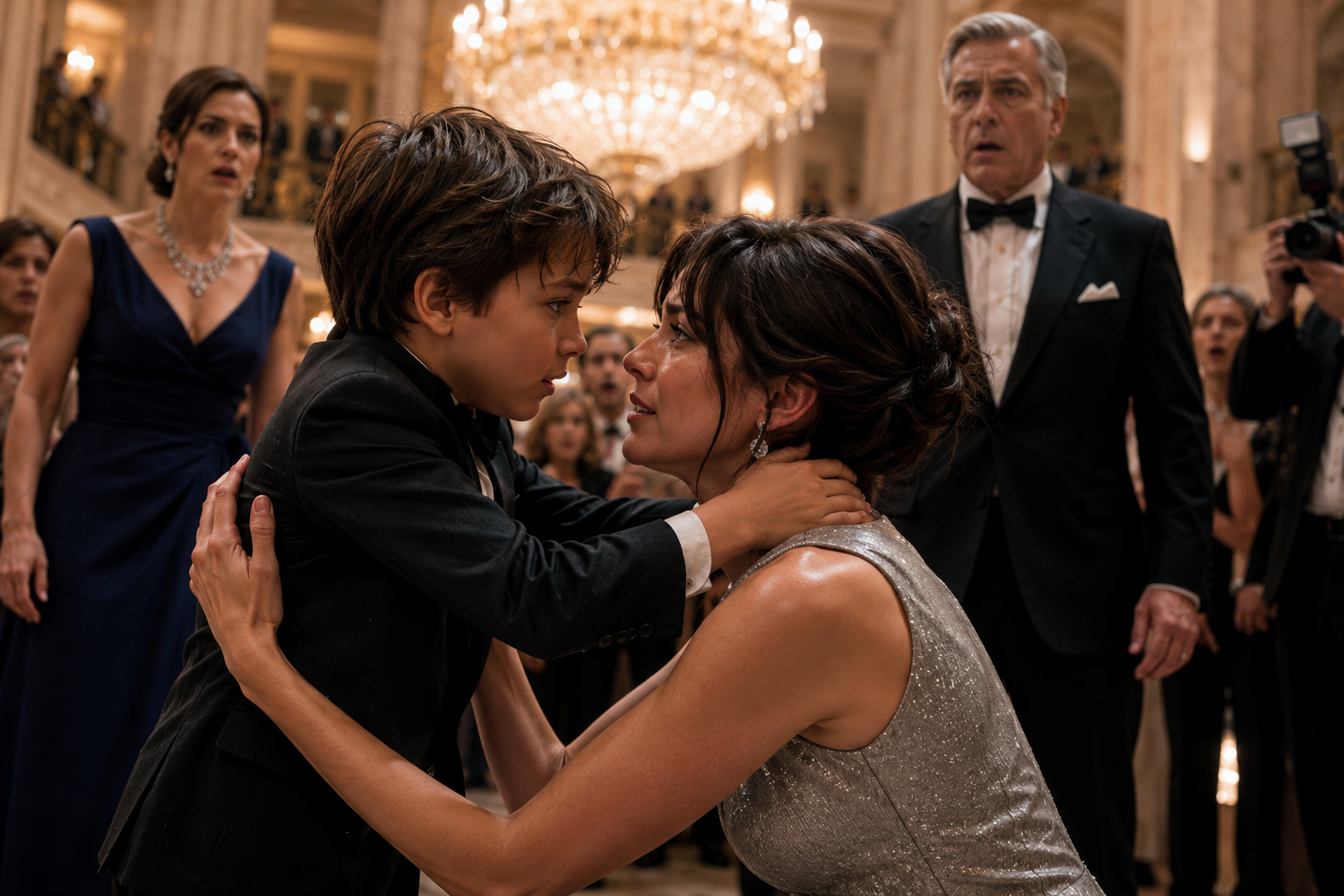
The first person to notice the boy was a waiter carrying a tray of champagne.
By then, the orchestra had reached the loudest part of the evening’s opening performance. Violins swept through the marble ballroom of the Aurelia Museum while hundreds of candles flickered inside towering glass lanterns. Beneath a ceiling painted with angels and clouds, the wealthiest families in Bellmont City celebrated the restoration of the museum’s east wing.
Bankers traded quiet jokes beside politicians.
Business leaders posed for photographers.
Women in jeweled gowns moved between tables decorated with white roses and silver branches.
At the center of it all stood Grant Mercer, the billionaire founder of Mercer Global and the evening’s guest of honor. His company had donated twenty million dollars to the museum, and his name was already carved into the stone above the new exhibition hall.
Everything had been planned perfectly.
Then the doors near the service corridor flew open.
A boy stumbled into the ballroom.
He could not have been older than nine.
His black dinner jacket hung from one shoulder, one shoe was missing, and dust covered the knees of his trousers. He looked as though he had crawled through a basement rather than attended a charity gala.
He stopped beneath the chandelier, gasping for breath.
“Please,” he shouted. “Someone help me!”
The orchestra fell silent.
A bow slipped from a violinist’s hand.
Guests turned in their chairs, irritated at first, then confused.
The boy’s name was Leo Mercer.
Everyone in Bellmont knew his face. He appeared beside his father in holiday photographs, corporate advertisements, and carefully arranged charity events. Newspapers called him the future heir to one of the largest fortunes in the country.
But the child standing in the ballroom did not look like an heir.
He looked terrified.
“Leo!”
A woman rushed through the same doorway.
Celeste Arden wore a dark blue gown and a diamond necklace that had once belonged to European royalty. She was Grant Mercer’s fiancée and had lived in the Mercer estate for nearly four years.
Her expression was calm for the cameras, but her eyes were furious.
“Come back immediately,” she ordered.
Leo backed away.
“No.”
Several guests exchanged uneasy glances.
Celeste forced a smile.
“He became frightened backstage,” she explained. “There’s no reason for anyone to be alarmed.”
“That isn’t true!” Leo cried.
“Leo,” she said through clenched teeth, “you are embarrassing your father.”
The boy glanced around the enormous room. Hundreds of adults were watching him, but no one moved closer.
Then he heard a voice.
“Let the child breathe.”
It came from the far side of the ballroom.
A woman stood beside an ancient marble staircase, partially hidden behind a column. She wore a simple silver dress without jewelry, and her dark hair was pinned loosely behind her head.
She had spent most of the evening alone.
Few guests knew who she was. Her invitation identified her as Mara Hale, a consultant working with the museum’s international restoration team.
Leo stared at her.
His fear vanished beneath an expression of complete disbelief.
The woman looked back at him, and the glass in her hand began to tremble.
Celeste followed his gaze.
The color drained from her face.
“No,” she whispered.
Leo took one uncertain step toward the stranger.
Then another.
The woman pressed a hand over her mouth.
Leo’s lips trembled.
“Mom?”
A murmur spread through the ballroom.
The woman closed her eyes as if the single word had broken something inside her.
When she opened them again, tears were running down her cheeks.
“My little lion,” she whispered.
Leo ran.
He crossed the ballroom so quickly that two security guards barely had time to step aside. He reached the woman, wrapped his arms around her waist, and buried his face against her.
She dropped to her knees and held him with both arms.
For several seconds, neither of them spoke.
Leo was crying too hard.
The woman kissed his hair again and again.
“I knew it,” he said between sobs. “I knew you didn’t leave me.”
“You were right,” she whispered. “I never left you willingly.”
The silence that followed was heavier than the music had been.
Everyone in Bellmont knew the story of Helena Mercer.
She had been Grant Mercer’s wife, a respected architect and the mother of his only child. Six years earlier, her car had been found abandoned near a mountain reservoir during a violent winter storm.
Search teams discovered part of her coat near the water.
Her body was never recovered.
After weeks of searching, Helena Mercer had been declared dead.
Yet the woman kneeling in the ballroom looked exactly like the photographs that had once appeared beside Grant Mercer’s name.
Older.
Thinner.
But alive.
Celeste moved toward them.
“Leo, get away from her.”
The woman rose slowly, keeping one hand on her son’s shoulder.
“He stays with me.”
“You are not his mother,” Celeste said.
Leo tightened his grip.
“Yes, she is.”
“You don’t understand what’s happening.”
“I understand more than you think,” the boy replied.
Celeste’s eyes narrowed.
“What did you find?”
The question escaped too quickly.
Leo reached inside his torn jacket and pulled out a small brass key attached to a faded red ribbon.
The woman in silver stared at it.
“Where did you get that?”
“In Celeste’s dressing room,” Leo said. “It opens the box from your studio.”
Celeste stepped forward.
“You went through my belongings?”
“You told me the studio had been emptied after Mom died,” Leo answered. “But the box was hidden behind your wall.”
A new voice cut across the ballroom.
“What is going on?”
Grant Mercer walked through the crowd.
He was tall, silver-haired, and dressed in a black tuxedo tailored so precisely that it seemed more like armor than clothing. Until that moment, he had been giving an interview in the adjoining gallery.
People immediately made room for him.
Grant looked at Leo first.
Then his gaze moved toward the woman holding him.
He stopped.
For the briefest instant, genuine panic appeared on his face.
“Helena?”
The woman’s expression became cold.
“Hello, Grant.”
His hand tightened around the stem of his glass.
“That’s impossible.”
“And yet here I am.”
Grant recovered quickly. He had spent decades speaking to shareholders, journalists, judges, and government ministers. He knew how to replace fear with charm before anyone could study it too closely.
He stepped toward her with tears shining in his eyes.
“My God,” he said. “We searched everywhere.”
Helena gave a humorless laugh.
“No, you paid people to search everywhere except the place where you knew I was.”
The photographers began taking pictures again.
Grant glanced toward them.
“This is a private family matter.”
“You made my death a public tragedy,” Helena replied. “You gave interviews about your grief. You created a foundation in my name. You raised millions of dollars by telling the world how much you missed me.”
“I did miss you.”
“You missed controlling me.”
Leo looked up at his father.
Grant’s expression hardened.
“You have no idea what she has been through,” he told the boy. “Your mother was unwell before she disappeared.”
Helena placed herself between Grant and Leo.
“That was the story you prepared before the car ever reached the reservoir.”
More whispers moved through the room.
Celeste tried to approach Grant, but he stopped her with a warning glance.
Helena noticed.
“So the two of you still communicate without words,” she said.
Grant lowered his voice.
“Whatever you think you know, this is not the place to discuss it.”
Helena looked around at the museum wing bearing his name.
“This is the perfect place.”
She reached into her small evening bag and removed an old wooden music box.
Its painted surface was cracked, and one brass hinge had been repaired.
Leo stared at it.
“That’s the box the key opens.”
Helena nodded.
“My father made it for me when I was sixteen. Before I disappeared, I hid copies of everything inside it.”
Grant’s jaw tightened.
“You’re confused.”
“Am I?”
Helena inserted the brass key.
The music box opened, but no music played. Beneath the velvet lining was a narrow compartment containing a memory card, several photographs, and a stack of folded bank records.
Grant stared at them.
This time, he could not hide his fear.
Helena handed the documents to an older woman seated near the front table.
The guest rose and removed a small identification wallet from her handbag.
“Special Investigator Ruth Calder,” she announced. “Financial Crimes Division.”
Several other guests stood at the same time.
They were not donors.
They were investigators.
The ballroom doors closed behind them.
Grant turned toward the security team.
“Remove these people.”
No one obeyed.
Helena remained beside Leo.
“Six years ago, I discovered that Mercer Global was moving money through the charitable trusts I managed,” she said. “Donations meant for hospitals, shelters, and schools were being transferred into companies that existed only on paper.”
“That is a lie,” Grant said.
“I confronted you in my studio. You promised to explain everything the following morning.”
Grant shook his head.
“You were under enormous stress.”
“The following morning, someone cut the brake line of my car.”
The guests fell completely silent.
Leo stared at his father.
Helena continued.
“I survived because the car struck a barrier before it reached the reservoir. A passing truck driver pulled me out. He called for help, but before the ambulance arrived, two men came looking for me.”
Grant’s face remained still, but his breathing changed.
“I ran into the forest,” Helena said. “For two days, I hid in an abandoned ranger station. When I finally contacted the authorities, they discovered the men had been hired through a company connected to Grant’s private office.”
“You cannot prove that.”
Investigator Calder lifted the bank records.
“She already has.”
Grant looked toward Celeste.
Celeste stepped backward.
Helena turned to her.
“You helped him create the false medical reports.”
“I didn’t know what he planned.”
“You signed the documents.”
“He said you were dangerous!”
Grant’s head snapped toward her.
Celeste froze.
The entire ballroom heard what she had said.
Helena’s voice softened.
“Dangerous to whom?”
Celeste’s mouth opened, but no answer came.
Grant moved closer to her.
“Stop talking.”
Celeste’s fear transformed into anger.
“You promised this would never come back to us,” she said. “You said the driver was dead and the files had been destroyed.”
Gasps swept through the room.
Grant closed his eyes.
For one second, he looked less like a billionaire and more like a man watching the walls of his life collapse around him.
Investigator Calder signaled to the officers.
Two men approached Grant.
He raised his hands.
“You are making a serious mistake.”
“No,” Helena said. “The mistake was believing I would stay hidden forever.”
Grant turned toward Leo.
“Son, don’t listen to her. Everything I did was for this family.”
Leo stared at him with tears in his eyes.
“You told me Mom chose to leave.”
Grant said nothing.
“You told me she didn’t love me.”
“I was protecting you.”
“From her?”
Grant glanced at the investigators.
“From a truth you were too young to understand.”
Leo shook his head.
“No. You were protecting yourself.”
The officers took Grant by the arms.
He did not resist, but his voice became desperate.
“Helena, think about what this will do to him. His name will be destroyed. His future will disappear.”
Helena pulled Leo close.
“A child’s future is not built from a stolen fortune.”
Grant looked around the ballroom, searching for one loyal face.
The board members avoided his eyes.
The politicians stepped away.
The investors who had laughed with him minutes earlier remained silent.
Even Celeste refused to look at him.
As the officers led Grant toward the doors, he turned once more.
“You cannot take my son.”
“He was never a possession,” Helena answered.
After Grant disappeared into the corridor, the room filled with voices. Reporters rushed forward, board members demanded explanations, and museum officials began covering the bronze plaque above the exhibition hall.
Helena heard none of it.
Leo was looking at her as if he were afraid she might vanish again.
“Why didn’t you come home?” he asked.
The question broke through every defense she had built.
She knelt in front of him.
“Because the people protecting me believed your father would use you to find me. If I contacted you too soon, he could have moved you somewhere I would never reach.”
“You watched me?”
“Whenever it was safe.”
“My school concerts?”
“Every one I could attend.”
“The winter race last year?”
“I stood behind the maintenance shed. You fell before the last turn, but you got up and finished.”
Leo began crying again.
“That woman in the gray coat.”
Helena smiled through her tears.
“That was me.”
“You sent the books on my birthday.”
“Yes.”
“And the wooden lion?”
“I carved it while I was living in a safe house near the coast.”
Leo wrapped his arms around her neck.
“I thought I imagined you.”
“You didn’t.”
They remained together until Investigator Calder approached.
“We need to leave through the private entrance,” she said. “The press has surrounded the building.”
Helena nodded.
Leo wiped his face.
“Are we going home?”
“We are going somewhere safe.”
“With you?”
“With me.”
For the first time that evening, he smiled.
Then Helena hesitated.
“There is someone else waiting for us.”
Leo looked confused.
“Who?”
Helena glanced toward the staircase.
A museum employee stepped from behind the marble column. Beside her stood a small girl wearing a yellow coat and holding a stuffed rabbit.
She had dark curls, wide brown eyes, and the same nervous habit Leo had of pressing his lips together when he was frightened.
The girl stared at him.
Leo stared back.
Helena took his hand.
“Her name is Ivy.”
The little girl lifted one hand in a shy wave.
“Hello, Leo.”
His eyes moved from Ivy to his mother.
“Who is she?”
Helena’s voice trembled.
“Your sister.”
Leo stopped breathing for a moment.
Helena knelt between the children.
“I learned I was expecting her several weeks after I disappeared. For her protection, almost no one knew she existed.”
Leo looked at Ivy again.
“You knew about me?”
Ivy nodded.
“Mom showed me your pictures.”
“All of them?”
“She has a lot.”
Helena laughed softly.
Leo approached his sister.
Ivy held out the stuffed rabbit.
“You can hold him if you’re scared.”
Leo looked at the rabbit, then at the little girl.
“I’m not scared anymore.”
He took her hand instead.
Around them, the gala had dissolved into confusion. Cameras flashed, guests argued, and investigators carried sealed boxes from Grant Mercer’s private office.
Above the crowd, workers covered the billionaire’s name with a long sheet of black fabric.
But Leo did not look back.
He walked between his mother and the sister he had never known, holding both their hands as they disappeared through the private corridor.
Outside, snow had begun to fall over Bellmont City.
For six years, Grant Mercer had used money, influence, and fear to keep the truth buried.
Yet the truth had returned without bodyguards or diamonds.
It had entered the ballroom in a simple silver dress.
And it had left with both children safely beside it.

