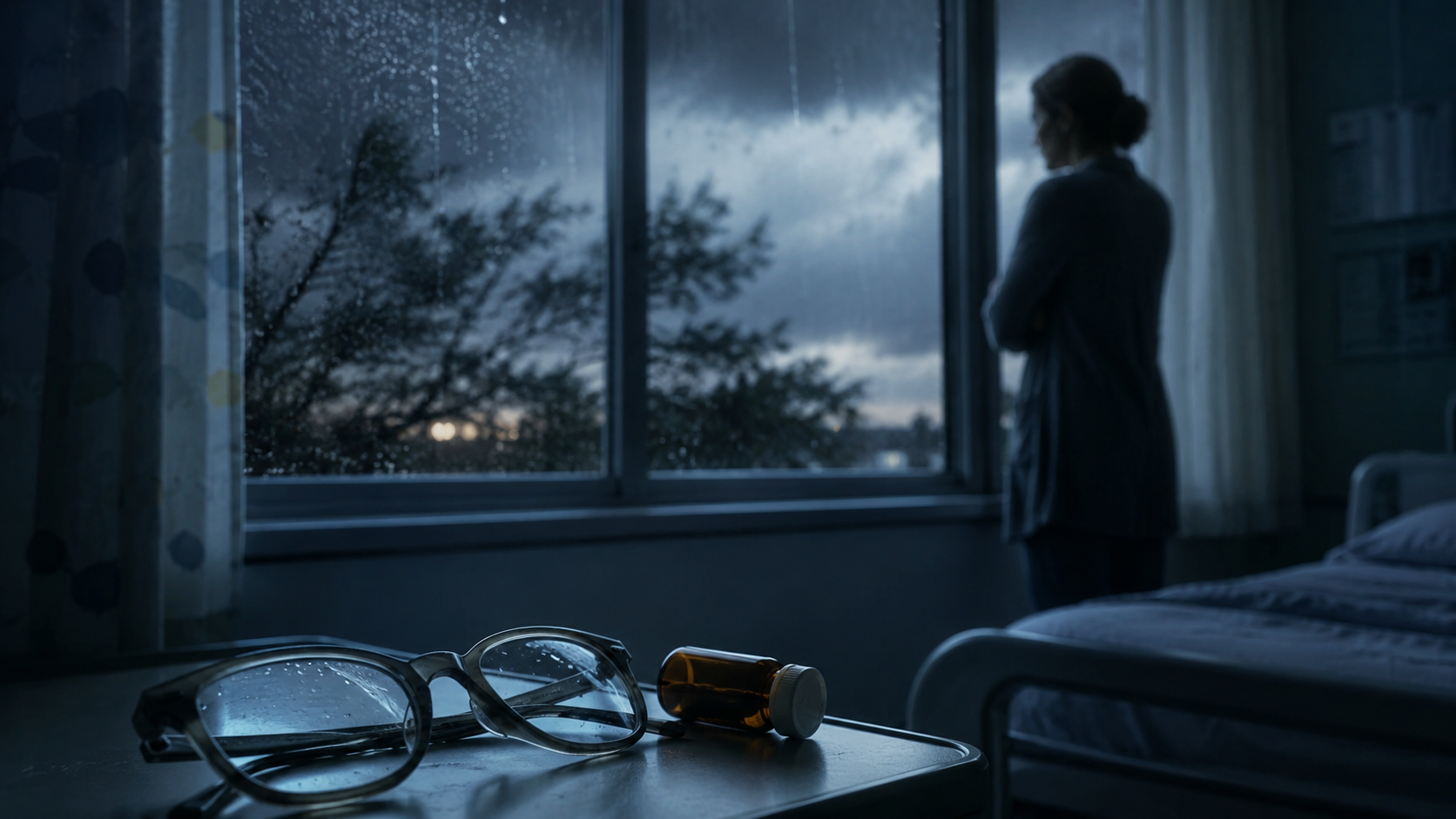
Rain had been falling over Bellmere since before sunrise.
By four in the afternoon, the streets looked polished black beneath the traffic lights, and the windows of St. Catherine’s Children’s Hospital trembled whenever the wind pushed another wave of water against the glass.
Inside Room 314, eleven-year-old Noah Bennett sat perfectly still.
A pale blue blanket covered his legs. His hands rested on top of it, fingers loosely intertwined. Thick gray glasses hid most of his eyes.
His mother, Rachel, stood beside the window watching the rain.
She hated storms now.
Before Noah became sick, he had loved them.
He would run onto the porch whenever thunder rolled over the neighborhood. He used to count the seconds between lightning and thunder and shout the distance as if he were commanding a ship through dangerous waters.
“Six seconds! The storm is moving away!”
Or—
“Two seconds! It’s right above us!”
That had been nearly a year ago.
Before headaches.
Before dizziness.
Before Noah began walking into furniture.
Before he started complaining that rooms were becoming darker.
Before the morning he woke screaming because he could no longer see his own hands.
Nine months of doctors had followed.
Neurologists.
Ophthalmologists.
Specialists from three different cities.
Blood tests.
Brain scans.
Eye examinations.
Nothing explained it.
There was no tumor.
No visible damage to the optic nerves.
No genetic disorder anyone could identify.
And yet Noah insisted he could see almost nothing.
Only vague shadows.
Sometimes light.
Sometimes nothing at all.
Rachel had stopped asking how much.
The question made him anxious.
A soft knock came from the hospital-room door.
Rachel turned.
Dr. Helen Ward entered carrying a tablet.
Behind her stood a young woman Rachel had never seen before.
She looked perhaps twenty-two. Dark hair tied carelessly behind her head. Hospital ID hanging from her neck. A red notebook tucked under one arm.
“Rachel,” Dr. Ward said, “this is Mara Quinn. She’s completing a clinical observation placement with our rehabilitation team.”
Rachel gave a tired smile.
“Another person studying my son?”
Mara immediately looked uncomfortable.
Dr. Ward sighed.
“That isn’t how I meant it.”
“No, it’s fine.”
Rachel rubbed her forehead.
“I’m sorry. I haven’t slept much.”
Noah turned his face toward the voices.
“Mom?”
“I’m here.”
Dr. Ward approached his bed.
“How are you feeling today, Noah?”
“Head hurts.”
“Same place?”
“Behind my eyes.”
Mara watched him.
Not his face.
His hands.
Then the window.
A branch outside moved violently in the wind.
Noah flinched.
It was small.
So small Rachel never noticed.
But Mara did.
Her expression changed.
She glanced toward the window again.
Another branch swept across the glass.
Noah’s head shifted slightly.
Following it.
Mara said nothing.
Dr. Ward continued asking questions while Rachel explained the new medication schedule.
Ten minutes later, the two women left.
In the hallway, Mara caught Dr. Ward’s sleeve.
“He can see.”
Dr. Ward stopped.
“What?”
“The boy.”
“Mara—”
“He can see.”
Dr. Ward lowered her voice.
“You have been inside that room for ten minutes.”
“I know.”
“And this child has been examined by some of the best specialists in the state.”
“I know that too.”
“Then choose your next words carefully.”
Mara looked through the small window in the door.
Noah was sitting exactly as before.
His mother was adjusting his pillow.
“When the branch moved outside,” Mara whispered, “his eyes followed it.”
“That could be a reflex.”
“He followed it twice.”
Dr. Ward crossed her arms.
“Children with severe visual impairment can still react to light and motion.”
Mara shook her head.
“That wasn’t light.”
“What are you suggesting?”
“I don’t know yet.”
Dr. Ward studied her.
Mara looked young.
Too young, perhaps, to sound so certain.
But she had something Dr. Ward had learned not to ignore.
Attention.
Not knowledge.
Not experience.
Attention.
“Observe,” Dr. Ward finally said. “Nothing more.”
Mara nodded.
But even then, she knew that would not be enough.
Noah Bennett lived with his mother in a narrow brick house on Hawthorne Street.
They had moved there six months earlier.
Their old house had stairs.
This one did not.
Rachel had replaced sharp furniture with rounded pieces. She placed soft markers along the walls. She bought textured labels for kitchen cabinets.
She had transformed the entire home for a child who could no longer see.
The only other person living there was Rachel’s older brother, Grant.
Uncle Grant.
To Noah, he had always been simply Grant.
He had moved in after Noah’s father died.
That had happened two years earlier.