The Boy Who Came to the Funeral With a Secret

The Boy Who Came to the Funeral With a Secret

The boy looked like he wanted to run.

Not because he was guilty.

Because he was terrified.

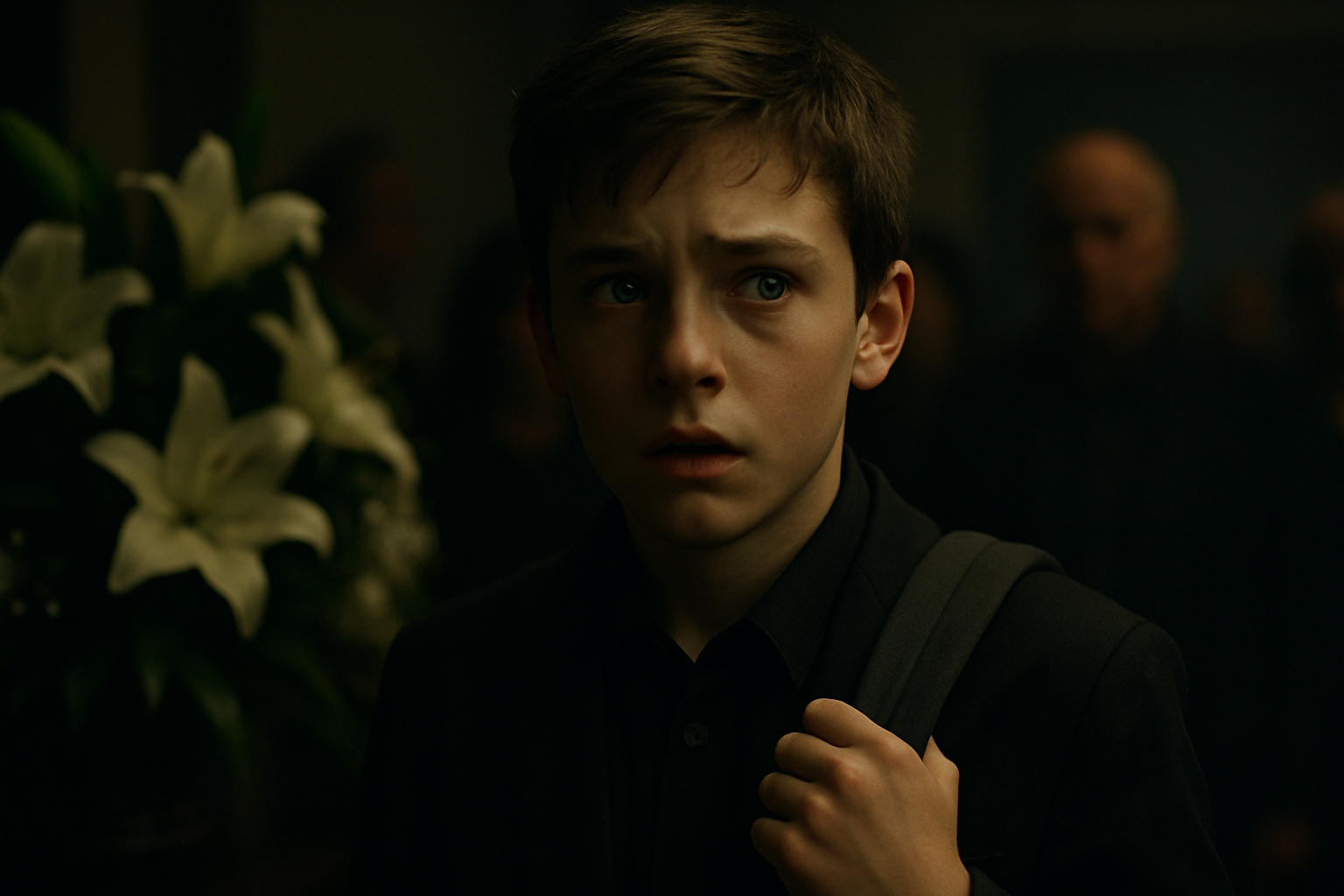
His fingers clutched the strap of his backpack while whispers moved through the funeral home like a cold draft. I stood there numb, the heavy smell of lilies pressing against my throat until I thought I might be sick.

“Who are you?” I asked again.

The boy swallowed.

“My name is Jonah.”

Nothing.

The name meant nothing to me.

In twenty-eight years of marriage, Samuel had never mentioned a Jonah. Not once. Not over coffee. Not in bed at night. Not during those quiet Sunday drives when he told me everything.

Or so I had believed.

The silence stretched until it hurt.

Then I asked the question already tearing through my chest.

“Are you saying my husband was your father?”

Gasps rose around us.

My sister Clara turned sharply from across the room. Samuel’s cousin froze beside the guest book. The boy’s face flushed deep red.

“No,” he said quickly. “No. It’s not like that.”

But he looked nervous.

Too nervous.

And grief, when it has nowhere to go, can turn cruel.

“Then what exactly is it like?” I snapped.

His shoulders stiffened. For one sad second, he looked much younger than fifteen.

“I didn’t come here to upset you.”

“Then why are you here?”

His eyes moved toward the casket.

And filled with tears.

Whatever this was, whatever secret had walked into my husband’s funeral wearing worn sneakers and carrying a backpack, one thing became clear.

This boy had loved Samuel too.

That slowed my anger.

For one breath.

Then Jonah reached into his backpack and pulled out an envelope.

My name was written on the front.

Eleanor.

Samuel’s handwriting.

My stomach dropped so hard I grabbed the back of a chair.

“He told me,” Jonah whispered, “to give you this only if something happened to him.”

My hands shook as I took it.

The envelope was soft at the corners, as if it had been carried for a long time by someone afraid to lose it. I opened it carefully.

There it was.

Samuel’s handwriting.

Steady. Familiar. Painful.

Ellie,

If you are reading this, then I did not get the extra time I kept promising you I would take.

Before anything else, breathe.

Please breathe before your imagination hurts you.

Jonah is not my son.

I never betrayed you.

But he does need help.

And I am asking you to hear his story before you decide what to do.

Please.

For me.

I stopped reading.

Relief hit me so sharply it almost felt like pain.

Not his son.

Not an affair.

But then another question rushed in.

If Jonah was not Samuel’s child, why had my husband left him to me?

I looked up slowly.

The boy stood frozen, waiting for judgment, like someone accustomed to doors closing in his face.

“Come with me,” I said quietly.

Clara caught my arm. “Eleanor, you don’t know this boy.”

“I know my husband’s handwriting.”

The room fell silent.

I led Jonah into the small family lounge beside the chapel and closed the door behind us.

For a moment, neither of us spoke.

Then I sat across from him.

“You need to explain.”

He nodded once, but his eyes stayed on his hands.

“He saved my mother’s life first,” he said.

I frowned. “What?”

“My mom worked at the diner near the train station.” His voice trembled. “One night she collapsed during her shift. Brain aneurysm.”

My chest tightened.

“Samuel was there?”

Jonah nodded. “He called the ambulance. Stayed with me at the hospital.”

Then he gave a small, shaky laugh.

“I thought he was annoying at first.”

Despite myself, I almost smiled.

That sounded like Samuel.

Helping strangers as if it were the most ordinary thing in the world.

“My mom survived the surgery,” Jonah continued, “but she couldn’t work after that.”

He looked embarrassed then, as if poverty were a shameful thing instead of a wound.

“We got evicted a few months later.”

I stared at him.

“And Samuel helped you?”

“He helped us a lot.” His voice cracked on the last word. “Groceries sometimes. School applications. He fixed things in the apartment before we lost it.”

I sat very still.

None of it sounded impossible.

Samuel had always helped people quietly. A ride here. A bill paid there. A porch step repaired for a widow who never knew who had done it. He hated applause for kindness.

But this was bigger.

“How long?” I asked.

“Three years.”

Three years.

My husband had been carrying another family’s suffering beside our own life, and I had never known.

Not because he was hiding sin.

Because he was protecting someone’s dignity.

“What happened to your mother?” I asked softly.

Jonah’s eyes filled at once.

“She died in January.”

Oh.

Oh, that poor child.

He turned his face away, ashamed of crying.

“After that, it was just me.”

My anger left completely.

Only grief remained.

Mine.

And his.

“He told me,” Jonah said, swallowing hard, “that if anything happened to him before I turned eighteen, I should come find you.”

“He said that?”

Jonah nodded.

“He said you were the kindest person he had ever known.”

Those words nearly broke me.

Samuel had always said things like that so simply. As if love were a fact. As if kindness were something you could point to, like a tree in the yard.

I looked back down at the letter.

There was more.

Ellie,

You once asked why I kept taking extra shifts when we were comfortable enough.

This is why.

I wanted to help Jonah quietly until he could stand on his own.

He is smart. Gentle. And carrying more than any boy should carry alone.

I know this is unfair to place in your hands after I am gone.

But I know the woman I married.

You do not abandon people when they are hurting.

That is one of the reasons I loved you for twenty-eight years.

There is money set aside in the blue file cabinet in my office. Enough for his schooling. Enough so he will not lose his future because life was cruel to him early.

Please do not let him think he is alone.

I could not save everyone in this world.

But maybe, together, we can save one boy.

Love always,

Samuel

By the time I finished, I was crying too hard to speak.

Jonah sat across from me, staring at the carpet as if he already regretted coming. As if he expected me to say no. As if no was the answer life had taught him to expect.

And suddenly I was furious.

At grief.

At hospitals.

At hunger.

At a world where children learn too young not to ask for help.

I wiped my face.

“Have you eaten today?”

He blinked. “What?”

“Have you eaten?”

He hesitated.

“Not really.”

Of course.

My heart cracked again.

I stood slowly.

“Well,” I whispered, my voice shaking, “Samuel would haunt me if I let a teenage boy sit hungry at his funeral.”

For the first time, Jonah laughed.

Small.

Broken.

Real.

And somehow, hearing that sound in a room full of death made something inside me keep breathing.

I took Jonah home that evening.

Not because I had answers.

Not because I knew how to carry my own grief and someone else’s at the same time.

But when we stepped outside the funeral home, I realized the terrible truth.

The boy had nowhere to go.

No relatives waiting.

No friend coming to pick him up.

No safe place.

Just one backpack and the exhausted expression of a child who had been asked to survive too much, too soon.

The drive home was quiet.

Rain tapped softly against the windshield. The sky darkened around us. Jonah sat stiffly in the passenger seat, clutching his backpack on his lap like it held everything he had left in the world.

Every few minutes, he whispered an apology.

“Sorry about this.”

“Sorry for showing up today.”

“Sorry if people talked.”

Finally, I tightened my hands around the steering wheel.

“You do not need to apologize for existing.”

The words came out sharper than I meant.

Jonah blinked.

Then he looked down.

That broke my heart in a new place.

Because it told me he was used to apologizing for taking up space.

When we pulled into the driveway, he stared at the house for a long moment.

Samuel and I had lived there for twenty-two years.

White shutters.

Blue hydrangeas.

A porch swing Samuel promised to fix every summer and never did.

Home.

Only now it felt unbearably empty.

Jonah hesitated before getting out of the car.

“You’re really sure?”

No.

I was not sure of anything anymore.

My husband was dead. A stranger had arrived at his funeral carrying secrets and letters. My entire future had changed in one afternoon.

But when I looked at that boy, soaked with rain and trying not to look frightened, there was only one answer I could live with.

“Yes,” I said softly.

Inside, the silence hit me at once.

The kind grief makes.

Too still.

Too large.

Samuel’s coat still hung by the door. His reading glasses still rested on the kitchen counter beside yesterday’s newspaper.

Jonah noticed everything, carefully, like he had stepped onto holy ground.

“I can sleep on the couch,” he said quickly.

“You are not sleeping on the couch.”

“I don’t mind.”

“I do.”

He stopped arguing.

I showed him the guest room upstairs. It was small but warm, with pale green walls and quilts my mother had sewn years ago.

Jonah stood awkwardly in the doorway.

“You can lock the door if you want,” I said.

His eyes lifted. “Why would I need to?”

The question startled me.

Then I understood.

Children who grow up safe do not think much about locks.

Children who do not grow up safe think about them all the time.

“Because sometimes new places feel scary,” I said gently.

He looked at me for a long moment, then nodded once.

“Okay.”

I turned to leave, then paused.

“There are clean towels in the bathroom. And Samuel kept extra clothes in the hall closet. Some might fit you.”

His face changed at Samuel’s name.

Not just sadness.

Something deeper.

Attachment.

Loss.

“You really loved him, didn’t you?” I asked.

Jonah looked down.

“He was the only adult who ever kept showing up.”

That sentence followed me downstairs like a ghost.

Later that night, I stood alone in Samuel’s office.

The blue file cabinet sat exactly where the letter said it would.

Third drawer.

Locked.

The key was taped underneath the desk.

Typical Samuel.

I opened the drawer slowly.

Inside were folders, each one carefully labeled.

JONAH — SCHOOL

JONAH — MEDICAL

JONAH — SAVINGS

My breath caught.

There were years of papers inside.

Report cards.

Scholarship forms.

Notes from teachers.

Grocery receipts.

Samuel had been helping this boy build a future, piece by piece.

Quietly.

Faithfully.

Then I found the notebook.

A simple black spiral notebook tucked beneath the folders.

I opened it.

The first page read:

Things Jonah pretends are okay when they are not.

My throat tightened.

Underneath, Samuel had written:

Says he already ate when food is low.

Gets headaches when stressed but hides them.

Panics if adults yell suddenly.

Loves astronomy.

Acts older when scared.

Does not trust kindness quickly.

Needs encouragement more than he admits.

I sank into Samuel’s chair.

And cried again.

Because this was love.

Not loud love.

Not dramatic love.

Patient love.

The kind that notices.

I turned the page.

Things he should hear more often:

You are not a burden.

You deserve good things too.

Resting is not weakness.

None of this was your fault.

By then I was sobbing openly.

My husband had spent years becoming someone’s safety net. And somehow, even after death, he was still trying to teach me how to care for the boy he had left behind.

A floorboard creaked.

I looked up.

Jonah stood frozen in the doorway.

He stepped back at once.

“Sorry. I didn’t mean to interrupt.”

“It’s okay.”

His eyes dropped to the notebook in my hands. Embarrassment flashed across his face.

“You found that.”

I nodded.

“He paid attention to you.”

Jonah gave a tiny shrug, but his face tightened with emotion.

“He remembered things nobody else did.”

Silence settled between us.

Then I asked the question that had been sitting in my heart since the funeral home.

“Why you, Jonah?”

He frowned. “What do you mean?”

“Samuel helped people all the time. But this…” My voice trembled. “This was different.”

Jonah stared at the floor.

Then he answered so softly I almost missed it.

“Because the first night we met, I lied to him.”

I blinked. “What?”

“At the hospital.” His hands twisted together. “The vending machines only took cash, and Mom hadn’t eaten all day. I told him I wasn’t hungry because I didn’t want him spending money on us.”

My chest ached.

“But he bought food anyway,” Jonah said.

He swallowed hard.

“And when he handed it to me, I started crying.”

A pause.

“Not because of the food.”

His voice cracked.

“Because nobody had noticed before.”

I covered my mouth.

And then I understood.

Samuel had seen him.

Not as a charity case.

Not as a project.

As a child trying too hard to survive alone.

Jonah looked toward the family photographs lining the office shelves.

“I think he understood lonely people.”

My eyes followed his to a picture of Samuel laughing on a beach years ago, wind in his hair, sun on his face.

Then I whispered the painful truth aloud.

“I don’t think I realized how many lonely people he was carrying.”

Jonah looked back at me carefully.

“He carried them because he knew what it felt like.”

I frowned.

“What do you mean?”

The boy hesitated.

Then, quietly, he said, “He told me once that before he met you, he didn’t think anyone would ever choose to stay.”