Chapter One
An Uninvited Guest
The wealthy had a remarkable talent for turning generosity into theater.
That evening, the Grand Halcyon Hotel glittered beneath thousands of crystal lights. White orchids climbed golden pillars. A string quartet played beside a fountain filled with floating candles, while waiters moved through the ballroom carrying silver trays of champagne no ordinary family could afford in a month.
The annual Vale Foundation Gala was supposed to raise money for homeless children.
At least, that was what the invitations claimed.
In reality, the event was a carefully staged celebration of the Vale family itself. Photographers crowded around the entrance. Business leaders praised one another’s compassion. Politicians shook hands beneath enormous floral arrangements. Every donation was announced loudly enough for the press to record it.
I stood near the center of the ballroom in a pale blue silk gown, smiling for cameras and pretending I belonged there.
My name was Audrey Vale.
To the public, I was the graceful youngest daughter of Conrad Vale, founder of Vale Meridian Holdings and one of the most influential men in the country. I attended charity dinners, opened children’s hospitals, and gave polished speeches about responsibility.
Behind closed doors, I had learned that responsibility meant obedience.
My father expected perfection. My older brother, Julian, expected loyalty. Neither of them had ever forgiven me for asking questions about my sister.
Lydia had disappeared eight years earlier.
According to my family, she had stolen money from the foundation and fled abroad with a dangerous man. My father had forbidden us from mentioning her name again. Her photographs vanished from the house. Her belongings were removed overnight. Even the staff behaved as though she had never existed.
But I remembered her.
I remembered how Lydia used to climb into my bed during thunderstorms. I remembered the jasmine perfume she wore and the way she hummed while reading. Most of all, I remembered our final conversation.
She had come into my bedroom after midnight, pale and frightened.
“If anything happens to me,” she had whispered, “don’t believe the first story they tell you.”
The next morning, she was gone.
A burst of applause pulled me back to the present.
My father stood at the podium, silver-haired and commanding, speaking about compassion for children living in poverty.
“We must never look away from suffering,” he declared.
The ballroom doors flew open.
The music stopped in the middle of a note.
A small boy stumbled into the room.
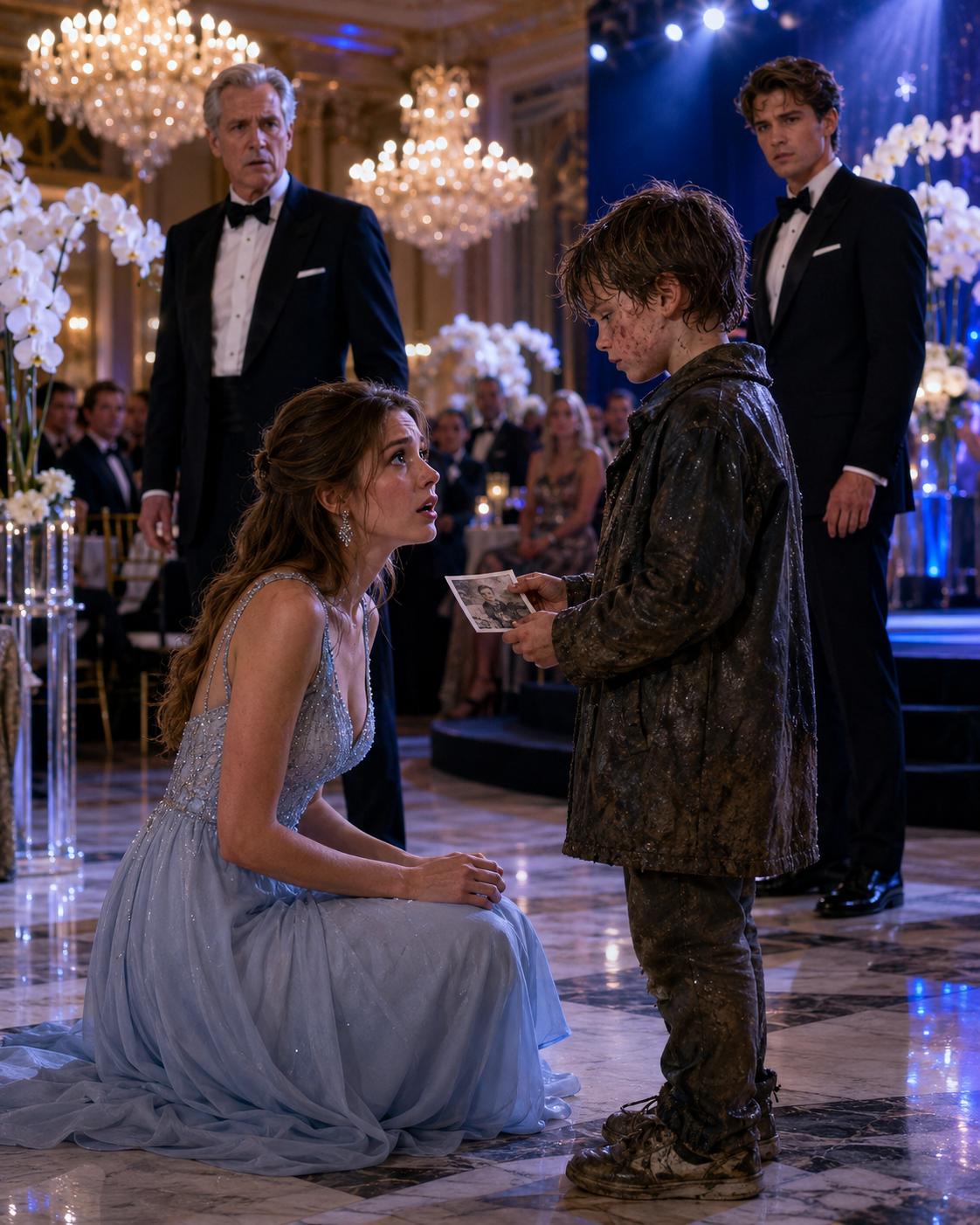
He looked no older than seven. His oversized coat was soaked with rain, and one sleeve was nearly torn away. Mud covered his trousers. His hair clung to his forehead, and his shoes were so worn that one sole had separated from the leather.
He took several frightened steps across the polished floor.
The guests reacted as if something dangerous had entered the building.
Women lifted the hems of their gowns. Men moved protectively in front of their wives. One donor covered his nose with a handkerchief.
“Where did he come from?”
“Someone call security.”
“How did a child like that get inside?”
My father’s expression changed instantly.
The compassionate benefactor disappeared. The man I knew emerged.
“Remove him,” he ordered sharply.
Four security officers approached the boy.
The child stopped.
He did not try to escape. Instead, he searched the ballroom with desperate amber-colored eyes.
Then he saw me.
His lips trembled.
“Aunt Audrey?”
The words were quiet, but in the sudden silence they carried across the entire room.
My heart seemed to stop.
The security officers reached for him.
“Don’t touch him!”
I pushed through the guests and ran across the marble floor.
Behind me, my father called my name, but I ignored him.
I reached the boy and knelt in front of him. Up close, I could see how exhausted he was. His cheeks were hollow. A small cut marked his chin, and his hands shook uncontrollably.
“How do you know my name?” I asked.
The child stared at my face as though he had spent years imagining it.
“My mother told me to find you.”
“Who is your mother?”
Instead of answering, he reached into the inner pocket of his coat.
Julian stepped down from the stage.
“Audrey, move away from him,” he said. “This could be a trick.”
The boy flinched at the sound of his voice.
That reaction told me more than Julian realized.
I positioned myself between them.
“You’re safe,” I told the child. “No one is going to take you anywhere.”
He pulled a small object from his coat. It was wrapped in cloudy plastic and tied with a piece of thread.