Eli studied the photographs.
“Mom kept copies.”
“That does not return the years.”
“No.”
Victor wiped his face.
“Can you ever forgive me?”
Eli thought before answering.
“My mother says forgiveness isn’t pretending nothing happened.”
“She is right.”
“She says it means deciding what happens next.”
Victor looked at the boy in astonishment.
Amelia’s strength was alive in him.
“What do you want to happen next?”
“I want to see my mother.”
Victor immediately stood.
“So do I.”
Julian was escorted from the mansion while investigators secured his office and electronic records. He continued insisting that the family would regret humiliating him.
Victor did not answer.
His attention had already moved elsewhere.
For the first time in twenty years, his daughter was waiting at the end of the road.
PART THREE: WHAT REMAINED AFTER THE LIE
Victor and Eli arrived at the hospital after midnight.
Amelia had been moved to a private room while specialists examined her. The years had changed her, but Victor recognized her before he reached the doorway.
Her hair was shorter.
Her face was thinner.
There were shadows beneath her eyes that had not existed when she left home.
But she was still his daughter.
Amelia noticed Eli first.
Relief softened her expression.
Then she saw the man standing behind him.
For several seconds, neither she nor Victor spoke.
Twenty years stood between them.
Twenty years of unanswered letters.
Twenty years of birthdays spent apart.
Twenty years of believing the other had chosen silence.
Victor entered the room.
“I read them,” he said.
Amelia’s eyes filled.
“All of them?”
“Every letter Mrs. Bennett saved.”
“I thought you destroyed them.”
“I never saw them.”
Her lips trembled.
“Julian said you knew everything. He told me you wanted me arrested.”
Victor lowered his head.
“I believed what he showed me. I should have known you better.”
“I tried to come home.”
“I know.”
“I called until every number was changed.”
“I know.”
“I sent photographs of Eli.”
Victor glanced at his grandson.
“I know.”
Amelia began to cry.
“I waited for you.”
Victor crossed the room.
“So did I.”
Neither of them could endure the distance any longer.
Amelia reached for him, and Victor wrapped his arms around the daughter he had believed lost forever.
Their embrace did not erase what had happened.
It did not restore the missing years.
It did not remove the anger, fear or guilt.
But it ended the silence.
Eli stood beside the bed until Amelia extended one arm toward him.
Victor reached for him at the same moment.
The boy found himself held between his mother and grandfather.
For most of his life, home had been a series of temporary rooms. A motel near a highway. A small apartment above a laundromat. A shelter where they remained for two weeks after Amelia lost her job.
Now, for the first time, home felt less like a building and more like the arms around him.
Amelia received the treatment she needed.
Her recovery took several months.
During that time, Victor visited every day.
Sometimes they spoke for hours.
Sometimes Amelia became angry and asked questions he could not answer without admitting his failures.
Victor did not defend himself.
He listened.
That was the beginning of their healing.
The investigation into Julian’s activities continued. Evidence revealed years of fraud, forged documents, obstruction and intimidation. Several former employees admitted they had been pressured into helping him conceal transactions.
Julian eventually faced trial.
The man who had spent decades controlling the family’s secrets lost his company position, his influence and his freedom.
Victor attended only one day of the proceedings.
When reporters surrounded him outside the courthouse, they asked whether he felt victorious.
“No,” he answered. “A family that loses twenty years does not win merely because the truth arrives.”
He returned home to Amelia and Eli.
That was where his real work waited.
A year later, Victor made a decision that surprised everyone.
He ordered the enormous iron gates of the Hawthorne estate removed.
The security team objected.
The architects complained.
Several board members called it unnecessary.
Victor ignored them.
Those gates had once represented success to him. Later, he understood what they had truly become.
A barrier.
A symbol of the pride that had kept him from questioning the people closest to him.
In their place, he built a smaller entrance surrounded by wild roses, Amelia’s favorite flowers as a child.
Beside the path stood a bronze plaque.
It carried the same words engraved inside the old pocket watch.
NO ROAD IS TOO LONG HOME.
The watch itself belonged to Eli now.
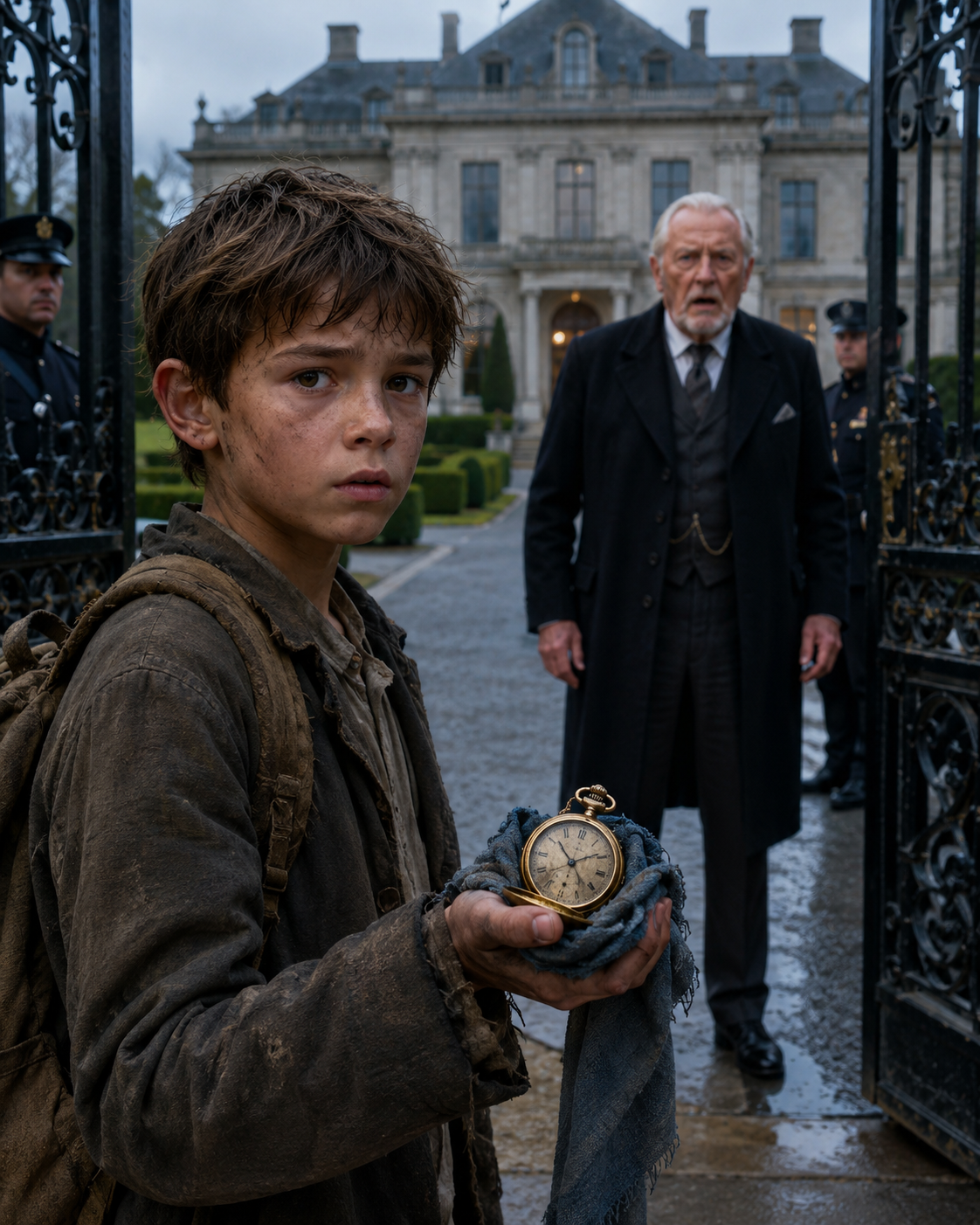
He kept it in the top drawer of his desk, wrapped in the faded blue handkerchief his grandmother Rose had once embroidered.
Victor also created a foundation to help children separated from relatives by poverty, deception or legal hardship. Amelia became its director after her health improved.
She understood those children better than any executive ever could.
Some evenings, Victor sat on the front steps while Eli returned from school.
The boy no longer approached the estate as an outsider.
He ran through the entrance with his backpack bouncing against his shoulders, calling for his mother or asking his grandfather to help with another impossible science project.
Each time Victor heard his voice, he remembered the exhausted child who had once stood outside the gates holding the truth in his small, injured hands.
The world had seen a poor boy who did not belong there.
Victor now saw the person who had brought his family back to life.
Sometimes the person everyone rejects is the one carrying the answer.
Sometimes the person pushed outside is the only one brave enough to knock again.
And sometimes the longest road home begins with a child who refuses to turn around.