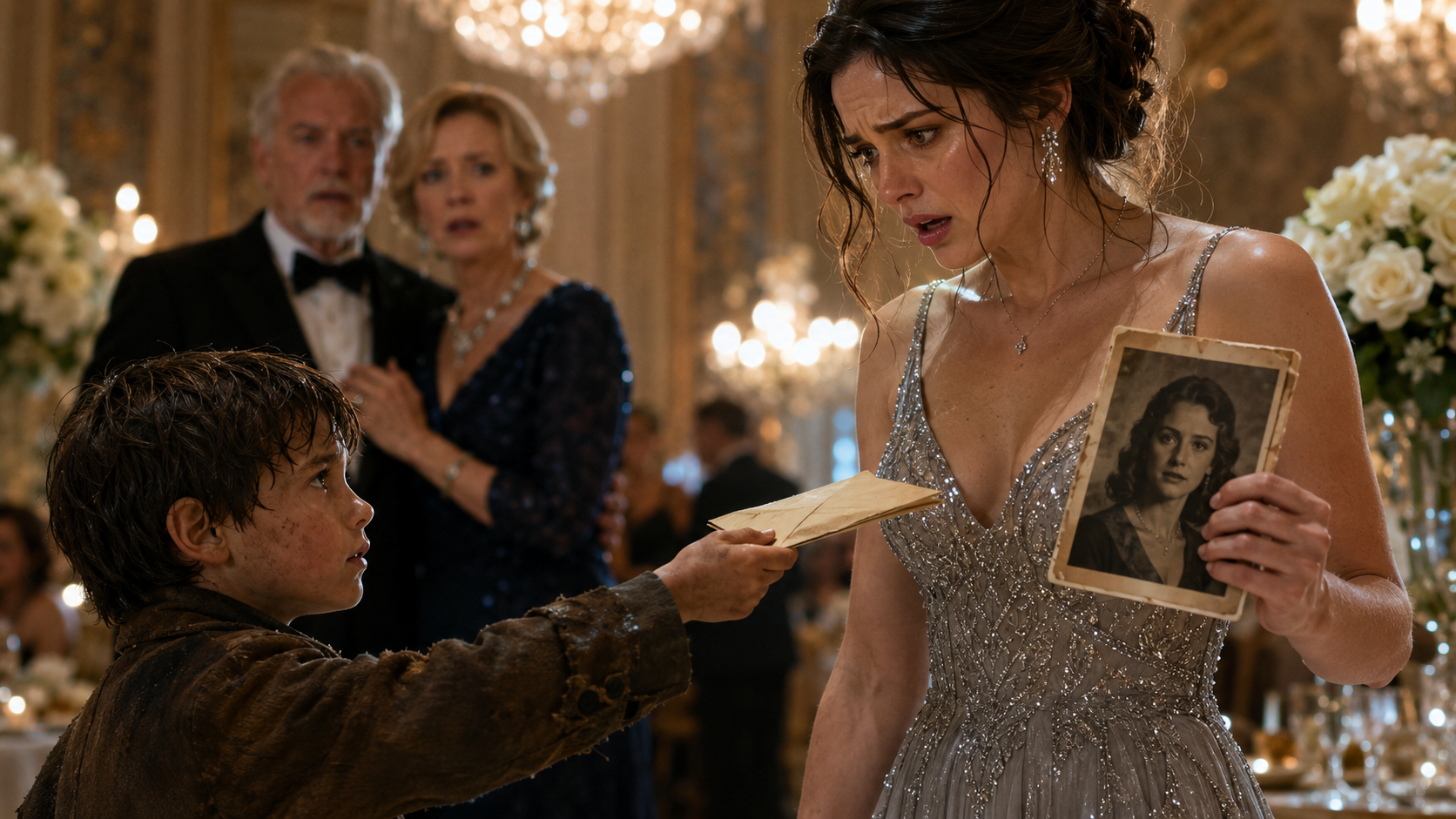
“Hannah, cancel everything on my calendar for the next week.”
“Done.”
“Call my driver.”
“He’s already outside.”
“Tell him we need to go to the church basement Milo mentioned.”
Hannah nods, then lowers her voice.
“Your father told security not to let the boy leave.”
Your blood turns hot.
“Did he?”
“Yes.”
You look toward the main entrance.
Two security guards are standing there now, pretending not to watch you.
Your father emerges from the hallway behind them.
Perfect suit. Perfect posture. Perfect monster.
The old Serena might have hesitated.
The old Serena might have chosen privacy over truth.
The old Serena might have protected the family before protecting the child.
But that woman was raised inside a lie.
And lies do not get loyalty anymore.
You take Milo’s hand.
“Come on.”
The guards move as you approach.
“Ms. Ashford,” one says carefully, “Mr. Ashford asked us to—”
You do not slow down.
“Move.”
“I’m sorry, ma’am, but—”
You stop inches from him.
“There are twelve reporters in this room,” you say quietly. “If you touch this child, I will scream that my father is holding a hungry eight-year-old hostage at his own charity gala. Then I will make sure your face is in every photograph.”
The guard steps aside.
Milo’s hand tightens in yours.
You walk out under the chandeliers while the wealthiest people in the city watch in silence.
Outside, cold rain hits your face.
Your driver, Owen, opens the car door.
Milo hesitates at the sight of the black sedan.
You recognize the hesitation.
Not because you ever feared expensive cars.
Because you suddenly understand what they represent.
A car can rescue.
A car can kidnap.
A car can carry a child from one life into another while adults call it paperwork.
“It’s okay,” you tell him. “You sit next to me.”
He climbs in.
As the car pulls away, your phone begins to ring.
Father.
You decline.
It rings again.
Mother.
You decline.
Then a message appears.
Come home before you make this worse.
You type back only one sentence.
You already made it worse thirty-two years ago.
Then you turn off the phone.
The church basement is on the east side of the city, far from the hotels with your father’s name on them.
It sits below a brick building with cracked steps and a flickering sign. A volunteer opens the door after Hannah knocks three times.
She recognizes Milo immediately.
“Oh, thank God,” she says, reaching for him. “Where did you go?”
Milo shrinks back against you.
The woman stops, eyes widening.
“I’m not here to take him from you,” she says gently. “We were worried.”
“I went to find my aunt,” Milo says.
The word aunt hits you with unexpected force.
Aunt.
Not stranger.
Not heiress.
Aunt.
The volunteer looks at you.
You can see the moment she notices your face.
Her mouth opens.
“You’re her,” she whispers.
“Lena?” you ask.
“She showed me a picture once. I thought…” The woman shakes her head. “I thought grief made her imagine things.”
“Where is she?”
The volunteer’s expression changes.
“She was sick. Very sick. She didn’t want to go to the hospital because she was afraid someone would take Milo. Yesterday morning she left to find antibiotics from a clinic. She never came back.”
“Which clinic?”
The woman gives you the name.
Hannah writes it down.
“Did she have enemies?” you ask.
The volunteer hesitates.
“Not enemies exactly.”
“What does that mean?”
“She was scared of a man.”
Your body stiffens.
“What man?”
“She never said his name. Only that he worked for the family who took her sister.”
The room seems to narrow.
“What did he look like?”
“Older. Gray hair. Expensive coat. He came here three weeks ago asking about her. She hid in the supply room until he left.”
Your father’s lawyer.
The thought comes instantly.
“What did he want?”
“To know if she had contacted you.”
Milo’s small voice cuts in.
“Mom said the man told her to stop digging.”
You turn to him.
“What digging?”
Milo reaches into his coat and pulls out a little notebook.
“My mom wrote things down so she wouldn’t forget.”
You take it carefully.
The pages are filled with names, dates, addresses, and fragments written in hurried handwriting.
Ashford Foundation.
Judge Harlan.
Cedar Row Maternity Ward.
Adoption seal.
Payment records.
Vale file destroyed?
One page has a name circled three times.
Edmund Price.
Your father’s oldest attorney.
The man who sent birthday gifts every year and once told you that your parents “fought very hard to have you.”
Now you understand what kind of fight he meant.
You photograph every page.
Then you call Dr. Ellis.
“I need you to check every hospital within twenty miles for a woman named Lena Vale,” you say. “Possible pneumonia, fever, maybe collapse. She may not have ID.”