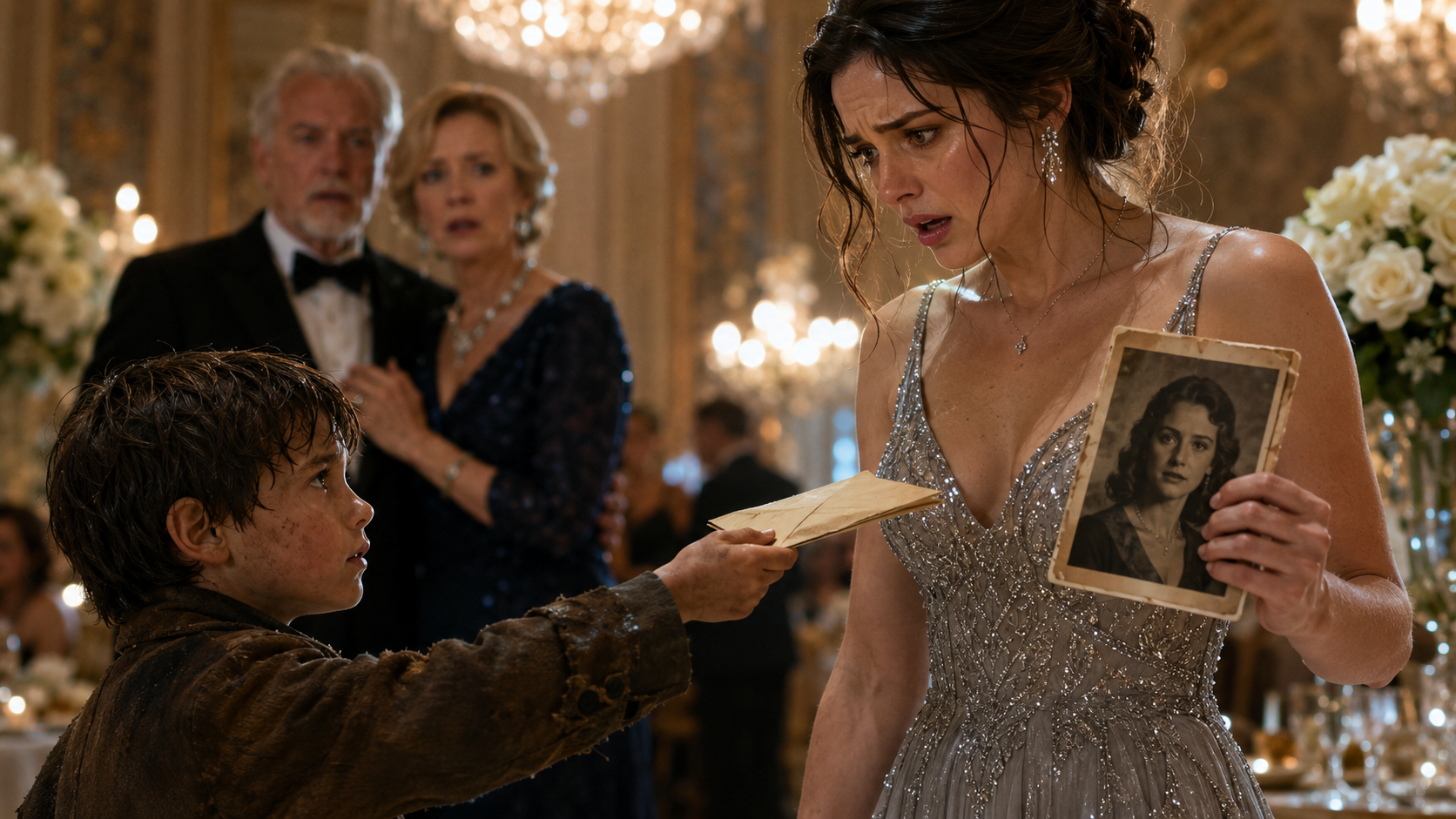
The first time the boy says it, you think you heard him wrong.
The ballroom is too loud.
Crystal glasses sing against one another. Laughter rises in polished waves. A string quartet plays near the marble staircase, soft enough to feel expensive and meaningless enough to be ignored. Everywhere you look, people are smiling the careful smiles rich people wear when cameras are nearby.
Your father is on the stage, accepting another award for generosity.
Your mother is in the front row, dabbing the corner of her eye with a silk handkerchief, as if kindness has exhausted her.
And you are standing beside a tower of white roses, wearing a silver dress that costs more than most people’s rent, when a little boy in an oversized brown coat tugs at your hand.
“Are you Serena Ashford?” he asks.
You turn.
He cannot be more than eight.
His hair is dark, cut badly, like someone did it with kitchen scissors. His shoes are wet. One sleeve of his coat is torn at the cuff. He has the hollow, watchful look of a child who has already learned not to expect help from adults.
For one second, irritation moves through you.
Not cruelty. Not hatred.
Just the cold reflex of a woman raised to believe interruptions are problems someone else should handle.
Security is only twenty feet away. Your assistant, Hannah, is searching for you with a phone pressed to her ear. Your father is halfway through a speech about “lifting the forgotten.” There are reporters in the room.
A child like this does not belong here.
Then he says it again.
“My mom said to find Serena Ashford. She said you would have her face.”
Your smile freezes.
“My face?”
The boy nods. His fingers tighten around a folded envelope so old and soft it looks like it has been opened a hundred times.
“She said if anything happened, I should bring this to you.”
The ballroom disappears around you.
Not fully. You can still see the chandeliers, the flowers, the donors, your father at the podium with one hand over his heart.
But sound pulls away from the world.
The boy holds out the envelope.
Your name is written on the front.
Not Serena Ashford.
Serena Vale.
A name you have never used.
A name no one has ever called you.
Your fingers go cold.
“Where did you get that?” you ask.
“My mom gave it to me.”
“What is your mother’s name?”
The boy looks at you with confusion, as if the answer should already be inside your bones.
“Lena,” he says. “Lena Vale.”
The name means nothing.
And somehow, it feels like something buried under your ribs has just heard itself being called from a grave.
You take the envelope.
It is thin. Soft. Stained at the edges.
Inside is a photograph.
At first, you think it is a mirror.
The woman in the picture has your eyes. Your mouth. The same small shadow beneath the left cheekbone. The same stubborn tilt of the chin your mother always told you came from the Ashford side.
But the woman is not you.
Her hair is shorter. Her face is thinner. There is exhaustion around her eyes that no spa treatment could erase. She is holding the boy when he was younger, maybe three or four, his head tucked beneath her chin.
On the back of the photo, written in blue ink, are four words:
For my sister, Serena.
Your breath stops.
Sister.
You have no sister.
You have been told this so many times it became part of your name.
Serena Ashford. Only child. Miracle baby. Born after eleven years of failed treatments and private doctors. Beloved daughter of Malcolm and Vivienne Ashford. Heiress to hotels, foundations, and lies dressed in satin.
The boy watches your face carefully.
“She said you wouldn’t know,” he whispers. “She said they made sure.”
You look toward the stage.
Your father is still speaking.
“My wife and I have always believed that every child deserves to be seen,” Malcolm Ashford says, voice warm and powerful. “No child should ever be erased by circumstance.”
Applause rolls through the ballroom.
Your mother lowers her handkerchief.
For one terrifying second, she sees you.
Then she sees the boy.
The color leaves her face.
That is when you know.
Not because of the photograph.
Not because of the envelope.
Because your mother looks at that hungry little child like he is not a stranger.
She looks at him like he is a door she locked thirty-two years ago and suddenly heard opening behind her.
“Who are you?” you ask him, though your voice barely works.
“My name is Milo,” he says. “Milo Vale.”
The surname cuts deeper the second time.
“Where is your mother, Milo?”
He looks down at the marble floor.
“She told me to wait in the church basement. She said she was going to get medicine.” His voice trembles, but he forces the words out. “She didn’t come back.”
“How long ago?”
“Yesterday morning.”
You kneel before you can think about whether the floor will ruin your dress.