Adrian looked thinner. His expensive suit had been replaced by a plain uniform. His hair had turned almost completely gray.
Mason sat across from him.
Claire waited in the hallway.
For a long time, neither spoke.
Adrian broke the silence.
“You look healthy.”
Mason’s expression hardened.
“You didn’t ask me here to talk about my health.”
“No.”
“Then say what you want.”
“I wanted to see you before the judge sends me away.”
“You’ve seen me.”
Adrian lowered his eyes.
“I have thought about you every day.”
“That doesn’t help me.”
“I know.”
“No, you keep saying that, but you don’t know anything about me.”
“You’re right.”
Mason had prepared questions with his therapist, but now that Adrian was in front of him, only one mattered.
“How much?”
Adrian looked confused.
“How much what?”
“How much did they pay you for me?”
Adrian’s face collapsed.
“Mason—”
“I want the number.”
“Two million dollars.”
The boy stared at him.
“That’s all?”
Adrian flinched.
“To you, I mean. That was enough?”
“It wasn’t about your value.”
“It was exactly about my value. You decided the company was worth more.”
“I was a coward.”
“Yes.”
“I have no excuse.”
“No.”
“I know I cannot ask you to forgive me.”
“You can ask. I’ll just say no.”
Adrian nodded.
Mason stood.
“Was there anything else?”
“I loved you.”
The boy paused at the door.
“You didn’t know me.”
“You were my son.”
“That didn’t stop you.”
Mason left without looking back.
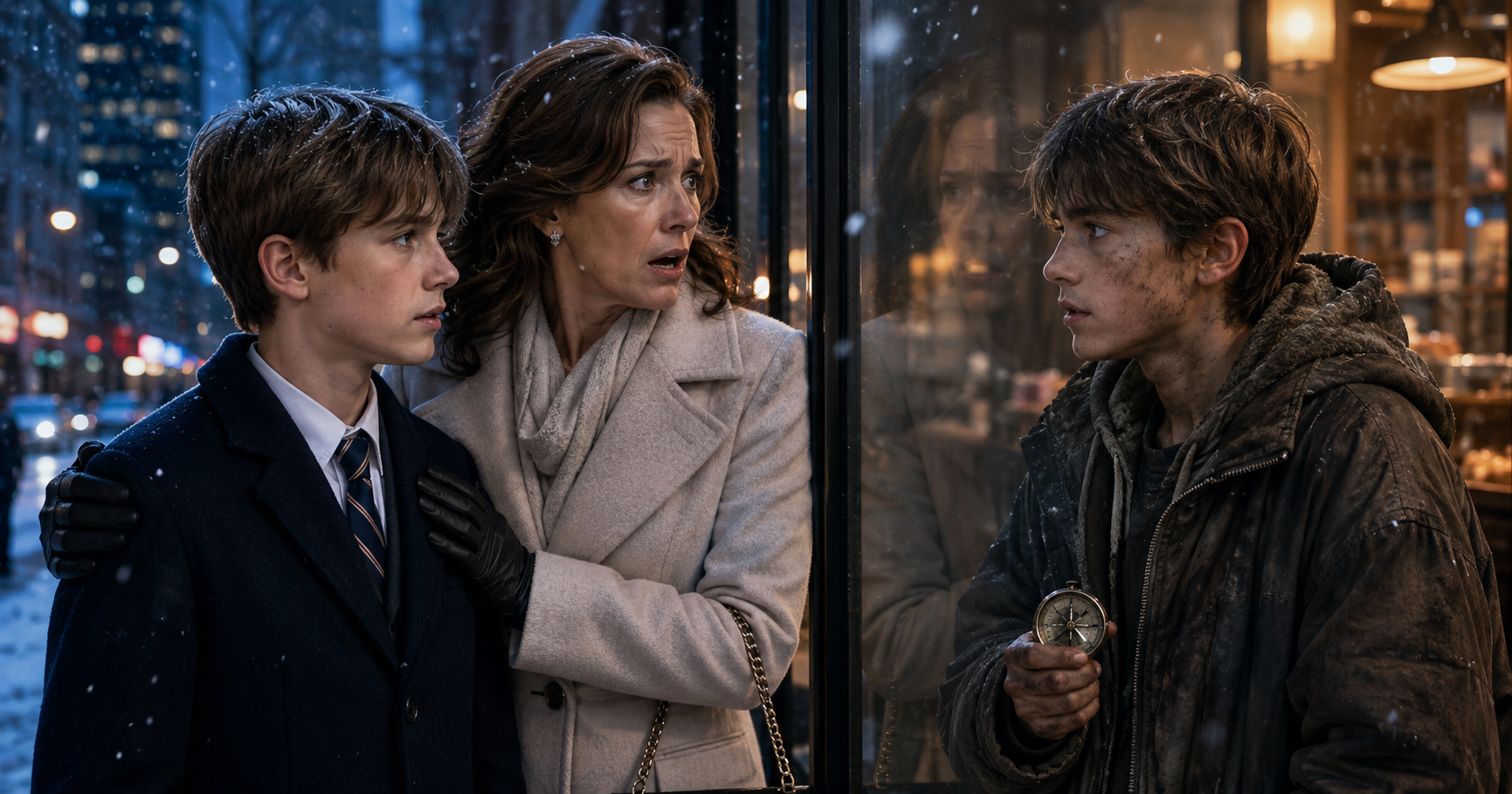
Outside, Claire waited with Lucas.
Neither asked what had happened.
Lucas simply held out Mason’s coat.
Mason put it on.
Then the brothers walked toward the exit side by side.
Chapter Five: The Second Compass
Five years passed.
The Whitmore mansion was sold.
Claire could no longer walk through its rooms without remembering secrets hidden beneath polished surfaces. She purchased a smaller home near Lincoln Park where the boys could walk to school and neighbors sometimes appeared at the door without appointments.
Lucas became interested in law.
Mason became interested in everything.
He studied photography, social work, emergency medicine, and investigative journalism. He said he had spent enough years being invisible and wanted to learn how to make invisible people seen.
On their eighteenth birthday, Claire gave the brothers two small boxes.
They opened them together.
Inside were the matching silver compasses.
Lucas’s had been kept in the family safe for years.
Mason’s had been repaired, although every scratch remained visible.
“I asked the jeweler not to polish it,” Claire explained.
“Why?” Mason asked.
“Because surviving should not have to look untouched.”
Mason ran his thumb over the damaged lid.
Lucas opened his compass.
Its needle pointed north.
Mason opened his.
A new needle had been installed.
For a moment, both needles trembled.
Then they settled in the same direction.
Two years later, the brothers established the Northlight Center in a renovated railway building.
It provided emergency beds, legal support, medical care, and family-search services for homeless teenagers and young adults leaving foster care. No one was forced to surrender personal belongings. No one was removed without being told where they were going. Every resident received a lockable room and a key of their own.
Above the entrance, there was no giant family name.
Mason had insisted on that.
“This isn’t a monument to us,” he said during the planning meeting. “It’s a door for people who need one.”
On opening night, snow began falling over Chicago.
Claire stood near the back of the hall while Mason addressed volunteers, donors, social workers, and former foster children.
He spoke without notes.
“When I was thirteen, I believed surviving meant never depending on anyone. I believed a locked door was a warning and every gift carried a hidden price.”
He glanced at Claire.
“Then I met people who taught me that a home is not the building where you are told to stay. It is the place where someone notices when you are missing.”
Lucas stood beside the stage.
Mason looked at him.
“And family is not only the people who share your blood. Family is the person who crosses the street when everyone else keeps walking.”
After the ceremony, the brothers climbed to the building’s rooftop.
Chicago stretched around them in towers of light. Trains moved across the city like glowing threads.
Lucas rested his arms on the railing.
“Do you ever think about that night?”
“Every day.”
“Do you wish it had happened differently?”
Mason considered the question.
“I wish someone had found me sooner.”
Lucas looked down.
“I’m sorry.”
“You didn’t leave me.”
“I still had everything while you had nothing.”
“That wasn’t your fault.”
“It doesn’t feel fair.”
“It wasn’t fair.”
Lucas turned toward him.