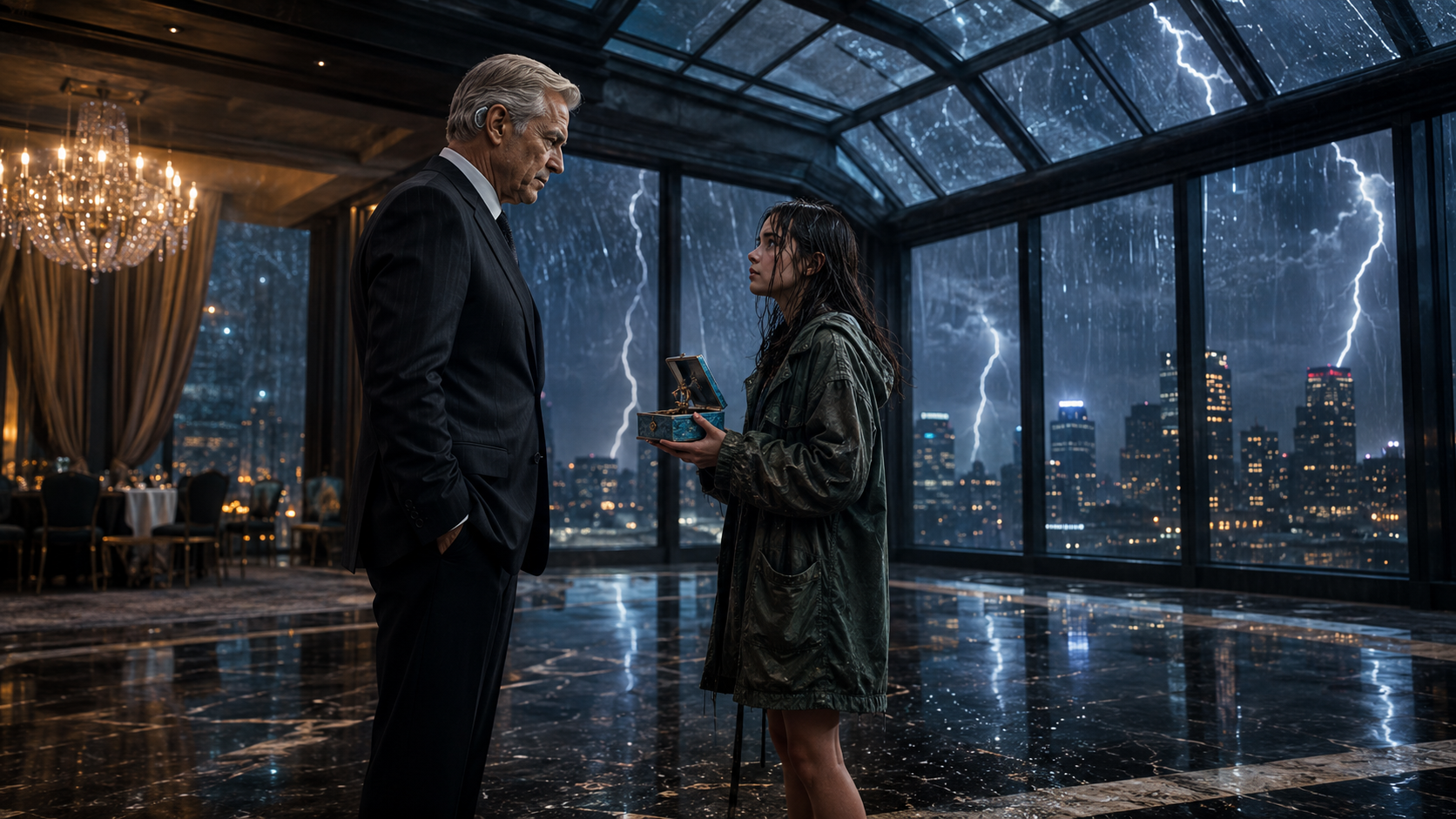
THE BILLIONAIRE WHO COULD NOT HEAR THE RAIN

The first drops of the storm struck the glass roof of the Aurelia Hotel just as Elias Crowe raised his champagne glass.

No one in the ballroom noticed the rain.

Two hundred floors above the streets of Chicago, the guests were too busy admiring themselves in mirrored walls, photographing towers of white roses, and whispering about the man standing beneath the crystal lights.

Elias Crowe owned the hotel.

He also owned six private hospitals, a chain of luxury residences, three newspapers, and enough property along the river to change the shape of the city.

That evening, he was announcing his greatest project yet: a silver tower called the Crowe Meridian, which would rise where the oldest neighborhood in the city had once stood.

People applauded before he even began speaking.

They always did.

Elias waited until the room became silent. Then he touched the small black device behind his right ear.

It was the most advanced hearing implant money could buy.

It had been designed in Zurich, assembled in Tokyo, and adjusted by specialists who charged more for an hour than most families earned in a year.

Still, Elias heard nothing.

Not the applause.

Not the orchestra.

Not the storm beating against the roof.

Three years earlier, a helicopter accident had taken his hearing. The surgeons had repaired his skull, his balance, and the damaged nerves around his ears, but sound had never returned.

He had learned to read lips with ruthless precision.

Most people forgot he was deaf after speaking to him for a few minutes.

Elias never forgot.

He remembered every morning when he opened his eyes to silence.

He remembered every night when he watched lightning flash beyond his bedroom windows but could not hear the thunder.

He had spent millions searching for a cure.

Nothing had worked.

Yet he refused pity. He preferred fear.

A tall woman in a silver dress stepped to the microphone and introduced him. Elias watched her lips carefully.

“Ladies and gentlemen, the man who transformed our skyline…”

Her voice was invisible to him, but he knew the words. He had approved them that afternoon.

Elias moved toward the stage.

Then the ballroom doors opened.

A girl stood in the entrance.

She appeared to be twelve or thirteen years old. Rainwater dripped from her dark hair. Her green coat was several sizes too large, and one of its pockets had been repaired with red thread. She wore no shoes.

A security guard hurried after her.

The guests turned.

The orchestra stopped playing, though Elias did not know it.

The girl walked across the polished floor, leaving small wet footprints behind her.

Some guests laughed.

Others raised their phones.

Elias studied the child with visible irritation.

The security guard caught her arm.

“You cannot be in here.”

The girl pulled free and pointed directly at Elias.

“I came to speak to him.”

The guard looked toward the stage.

Elias read the girl’s lips.

He handed his champagne glass to an assistant and motioned for security to bring her closer.

The girl stopped several feet away from him.

Up close, Elias noticed that she was carrying a small wooden music box. Its blue paint had faded, and a crack ran across its lid.

“What is your name?” Elias asked.

“Mara Ward.”

“How did you enter my hotel?”

“The kitchen door was open.”

Several guests smiled as though the answer were part of a comedy performance.

Elias did not.

“What do you want?”

Mara looked at the device behind his ear.

“I want to give you back the sound of rain.”

A wave of amusement passed through the ballroom.

Elias could not hear the laughter, but he saw shoulders shaking and mouths opening. He saw a man near the bar nearly spill his drink.

Mara did not look at them.

Elias tilted his head.

“Do you know who I am?”

“Yes.”

“Then you probably know that the best doctors in the world have examined me.”

“Yes.”

“They could not restore my hearing.”

“I know.”

“And you believe you can?”

Mara held up the damaged music box.

“I believe you can hear one thing tonight.”

The laughter grew stronger.

A television presenter in the front row aimed her phone at Mara and grinned.

Elias glanced around the room. Humiliating the child would entertain his guests. Allowing her to try would make him appear generous.

Either choice would benefit him.

He smiled.

“Very well. If you make me hear anything, I will give you one hundred thousand dollars.”

Mara’s expression remained unchanged.

“I don’t want your money.”

The guests stopped laughing.

Elias narrowed his eyes.

“Everyone wants money.”

“My mother wanted time.”

Something about the sentence unsettled him.

He stepped down from the stage.

“What does your mother have to do with me?”

Mara placed the music box on a nearby table.

Its tiny brass handle was shaped like a bird’s wing.

“You will understand after the second note.”

Elias looked toward his head of security.

The man immediately moved forward, but Elias lifted one hand.

“No one touches her.”

Mara opened the music box.

Inside stood a miniature dancer carved from pale wood. The figure wore a blue dress and held both arms above its head.

Mara turned the brass handle.

Once.

Twice.

Three times.

Elias watched the mechanism move.

The dancer began to spin.

Nothing happened.

He heard only the endless silence he had known for three years.

A man behind him said something sarcastic. Elias did not need to read his lips to understand.

Mara looked up.

“Close your eyes.”

“I do not take orders from children.”

“Then keep living in silence.”

Elias stared at her.

No employee, politician, journalist, or business partner would have spoken to him that way.

Mara waited.

Finally, Elias closed his eyes.

The ballroom disappeared.

For a moment there was nothing but darkness.

Then the music box played its first note.

Elias heard it.

The sound was thin and delicate, like a drop of water striking a glass.

His eyes opened.

He grabbed the edge of the table.

The guests leaned forward.

The second note came.

The ballroom vanished.

Elias was no longer standing inside his hotel.

He was sitting in the back of a black car eleven years earlier.

Rain covered the windows.

His younger face stared from the reflection in the glass. His hair was darker then. His eyes were sharper. A leather folder rested across his knees.

A nervous man sat beside him.

“The residents still haven’t left,” the man said.

Elias heard every word.

The memory was impossible.

He remembered the night, but not the sound.

Not until now.

The nervous man continued.

“There are forty-three families in the building. The city inspector says the electrical system is unsafe.”

“Then cut the power,” the younger Elias replied.

“We can’t do that while people are inside.”

“They were given notices.”

“Some of them have nowhere to go.”

“That is not my responsibility.”

“The community clinic is still operating on the first floor.”

Elias looked down at the leather folder.

He remembered the acquisition.

His company had purchased an entire block in the West Harbor district. The old buildings were supposed to be emptied and demolished. In their place, he planned to construct luxury apartments overlooking the river.

One building remained occupied.

The residents had refused to leave because the promised temporary housing had never been provided.

The clinic on the first floor treated children whose families could not afford private care.

The nervous man spoke again.

“A winter storm is coming. If we disconnect the electricity, the heating system will stop.”

The younger Elias closed the folder.

“Do it before midnight.”

The memory shifted.

Elias stood in the rain outside the old building.

Smoke poured from the upper windows.

People screamed.

Firefighters struggled with frozen hoses.

A woman leaned from a fifth-floor window, holding a little girl against her chest.

The girl wore a blue dress.

The same blue as the wooden dancer inside Mara’s music box.

Elias heard glass breaking.

He heard sirens.

He heard a firefighter shout that the emergency stairwell had been locked during the eviction process.

Then he heard the building groan.

The upper floors collapsed in a cloud of sparks and black smoke.

Elias opened his eyes.

He was back in the ballroom.

His hands were shaking.

The guests stared at him.

The music box had stopped.

Once again, the world was silent.

Elias seized Mara by the shoulders.

“What did you do to me?”

The security guards stepped forward.

Mara did not resist.

“I made you listen.”

“To what?”

“To the night you buried.”

Elias released her.

His face had turned pale.

“That fire was an accident.”

Mara reached into her coat and removed a photograph protected by a plastic sleeve.

The picture showed a smiling woman kneeling beside two children. One was Mara, much younger. The other was a small boy holding a toy airplane.

“My mother was Dr. Lena Ward,” Mara said. “She ran the clinic.”

Elias stared at the photograph.

He remembered the name.

It had appeared in the newspaper reports.

“The fire department blamed faulty wiring,” Elias said.

“Because your lawyers paid an engineer to change his statement.”

The television presenter slowly lowered her phone.

Mara placed another object on the table: a small metal key covered in rust.

“This opened the emergency stairwell. A maintenance worker found it in your company office after the fire. The doors had been locked so families couldn’t return to their apartments.”

Elias looked around the ballroom.

Every guest was watching.

His public relations director stood near the stage, desperately signaling for the orchestra to resume and for security to remove the girl.

Elias ignored her.

“How many people died?” Mara asked.

He knew the number.

He had always known.

“Seventeen.”

“Say it louder.”

“Seventeen.”

Mara’s eyes glistened.

“My mother was one of them. My little brother was another.”

Elias lowered his gaze.

For years, he had described the disaster as an unfortunate consequence of an electrical failure. He had repeated the statement in interviews until the words became smooth and harmless.

He had donated money to the city.

He had attended a memorial service.

He had even shaken hands with several survivors while cameras flashed around him.

But he had never returned to the ruins after that night.

He had never spoken the victims’ names.

And he had never admitted that his order had placed them in darkness during the coldest storm of the year.

Mara touched the music box.

“My mother used this to calm children during treatments. When the lights went out, she played it in the clinic so no one would be afraid.”

Elias watched her lips.

“Why bring it to me?”

“Because silence protected you.”

The words struck harder than an accusation shouted across the room.

Mara pointed toward the enormous windows.

Beyond the glass, lightning split the sky above the city.

“You built this hotel where our homes used to be.”

Elias turned slowly.

The Aurelia Hotel stood on the exact site of the West Harbor buildings.

The marble ballroom covered the ground where the clinic had once welcomed families through a green wooden door.

“What do you want from me?” he asked.

“I want you to stop pretending you can buy forgiveness.”

“I offered you money.”

“That is not forgiveness.”

“Then tell me what is.”

Mara closed the music box.

“You must tell the truth while everyone is still watching.”

Elias looked toward the cameras.

Several guests were streaming the confrontation live. His assistants whispered frantically into their phones.

Within minutes, the company’s lawyers would arrive.

They would deny everything.

They would question Mara’s story, challenge the evidence, and describe her as a confused child seeking attention.

That was how Elias Crowe’s world worked.

Every truth had a price.

Every witness could be discredited.

Every tragedy could be converted into a public relations problem.

He could still stop this.

He could have Mara removed.

He could destroy the photograph and the key.

He could issue a statement before sunrise.

Instead, he walked back onto the stage.

His public relations director approached him.

“Mr. Crowe, we should end the event.”

Elias looked at her lips.

Then he took the microphone.

He could not hear whether it was working.

He could not hear the storm.

He could not hear his own voice.

But for the first time in years, the silence did not protect him.

“My name is Elias Crowe,” he began. “Eleven years ago, I ordered electricity and heating disconnected from an occupied building in West Harbor.”

Several guests gasped.

“I knew families were still inside. I knew a clinic was operating there. I chose to believe that forcing them into the cold would make them leave.”

His lawyers appeared at the back of the ballroom.

One of them shook his head violently.

Elias continued.

“When the fire began, the emergency stairwell was locked because my company wanted to prevent residents from returning. Seventeen people died. I allowed investigators, journalists, and the public to believe the disaster was only an electrical accident.”

He looked at Mara.

“I was responsible.”

The room remained motionless.

Elias placed the microphone on its stand.

He removed the black implant from behind his ear and set it beside the music box.

“What happens now?” he asked.

Mara answered quietly.

“Now you decide whether the truth changes anything.”

Elias called his chief financial officer to the stage.

“Cancel the Meridian Tower.”

The man stared at him.

“The contracts have already been signed.”

“Cancel them.”

“We will lose hundreds of millions.”

“Then we lose hundreds of millions.”

Elias pointed toward the floor.

“This hotel will close at the end of the month. The building will be transferred to an independent public trust.”

His lawyer hurried forward.

“You cannot announce that without consulting the board.”

“I just did.”

“What will the trust do with it?”

Elias looked at Mara.

She did not answer for him.

He had to choose the words himself.

“The lower floors will become free medical clinics. The residential floors will become temporary housing for families whose children are receiving treatment. The ballroom will become a community school for music and art.”

Mara studied his face.

“And the people who survived the fire?”

“They will control the trust.”

“Not you?”

“Not me.”

“And your name?”

“It will not appear on the building.”

For the first time, Mara’s expression softened.

Elias touched the music box.

“Will I hear again?”

“I don’t know.”

“You said you could give me back the sound of rain.”

“I said I could give it back tonight.”

“Then the two notes were all I get?”

Mara placed the music box in his hands.

“The first note opened the door. The second showed you why it was closed.”

“And the third?”

“There is no third note.”

Elias looked down at the dancer.

“Why not?”

“Because some endings must be made by people, not miracles.”

Mara turned and walked toward the ballroom doors.

Elias followed her.

The guests moved aside.

At the entrance, she stopped.

“Wait,” Elias said.

Mara looked back.

“Your shoes.”

He glanced at her bare feet.

“Where are they?”

“I left them at the shelter. Another girl needed them more.”

Elias almost offered money again.

He stopped himself.

“What do you need tonight?”

“A ride home.”

Elias nodded.

“I will drive you.”

“You have a driver.”

“Then he can sit in the front.”

They descended through the hotel together.

By the time they reached the lobby, reporters surrounded the entrance. Camera flashes illuminated the rain outside.

Elias removed his coat and placed it around Mara’s shoulders.

When they stepped onto the street, water ran over the pavement and soaked through his expensive shoes.

He opened the car door for her.

Mara climbed inside.

Before Elias followed, he paused beneath the hotel canopy.

Lightning flashed above the river.

A second later, something touched the edge of his awareness.

It was faint.

Uneven.

Almost impossible to recognize.

A soft tapping against the metal roof of the car.

Elias stopped breathing.

Rain.

He could hear the rain.

Not clearly.

Not through both ears.

But enough.

One drop.

Then another.

Then hundreds.

He turned toward Mara.

She watched him through the open door.

“Can you hear it?” she asked.

Elias nodded.

Tears mixed with the rain on his face.

“Yes.”

Mara smiled.

“Then remember what it sounds like when the world refuses to stay silent.”


Fourteen months later, the Aurelia Community House opened its doors.

The marble reception desk was removed. The gold elevators remained, but children covered their walls with paintings of birds, stars, and impossible cities.

The old presidential suites became apartments where parents could stay while their children received medical treatment.

The ballroom became the Lena Ward School of Music.

There were no statues of Elias Crowe.

No photographs.

No engraved speeches praising his generosity.

Near the entrance stood a simple wall containing the names of the seventeen people who had died in the West Harbor fire.

Elias visited every Thursday.

He no longer arrived with assistants.

He no longer wore black suits that cost more than a family’s yearly rent.

He had sold most of his private properties, resigned from the boards of his companies, and placed the remaining shares into the community trust.

The investigation into the fire was reopened.

Elias testified without demanding immunity.

He paid every settlement ordered by the court.

He also accepted the possibility that forgiveness might never come.

Some survivors refused to speak to him.

Others shouted when they saw him.

He listened to all of them.

His hearing returned slowly, though no doctor could explain why.

First came the rain.

Then footsteps.

Then the low notes of a piano.

Human voices were the last sounds to return.

The first voice he clearly recognized belonged to Mara.

She was standing in the music school, tuning a violin.

Elias entered quietly.

Mara looked up.

“You’re late.”

He froze.

Her voice was softer than he had imagined.

“I heard you.”

She smiled.

“That is usually how conversations work.”

Elias laughed.

The sound surprised him.

Mara lifted the violin to her shoulder.

“Do you want to hear the song my mother used to play?”

He sat in the front row.

“Yes.”

Mara drew the bow across the strings.

The melody began with two delicate notes.

Elias closed his eyes.

This time, no terrible memory pulled him into the past.

He heard children talking in the hallway.

He heard a nurse pushing a cart across the floor.

He heard construction workers finishing apartments on the upper levels.

He heard the city beyond the windows.

And underneath everything, he heard the rain.

It fell gently against the glass roof, no longer hidden by wealth, fear, or silence.

Elias listened until the final note disappeared.

When he opened his eyes, Mara was watching him.

“What did you hear?” she asked.

He looked around the building that had once been a monument to his power.

“Tomorrow,” he said.

Mara lowered the violin.

Outside, the storm moved east across the city.

Inside, the music began again.

SEEDANCE VIDEO TRAILER PROMPTS

1

Create a cinematic 15-second supernatural drama trailer in 16:9 with synchronized spoken dialogue and realistic ambient sound. Maintain consistent appearances: Elias Crowe is a stern silver-haired billionaire in a black formal suit with a small hearing implant; Mara Ward is a rain-soaked thirteen-year-old girl with dark hair, an oversized green coat, bare feet, and a cracked blue music box.

0–4 seconds: Wide tracking shot through a luxurious glass-roof ballroom during a thunderstorm. Wealthy guests turn and laugh as barefoot Mara walks toward Elias, leaving wet footprints on the marble. Elias coldly asks, “What do you want?” Mara answers, “To give you back the sound of rain.”

4–9 seconds: Extreme close-up of Mara winding the cracked music box. The room falls unnaturally silent. She whispers, “Listen for the second note.” The wooden dancer spins as lightning flashes through the glass roof.

9–15 seconds: Rapid cinematic flashes of a burning apartment building, frightened families, Elias staring in horror, and Mara placing an old photograph on the table. Mara says, “Silence protected you.” Elias whispers, “What have I done?” End on his tearful face as the sound of rain suddenly becomes loud and clear.

Dark emotional realism, dramatic contrast, natural facial movement, precise lip synchronization, subtle supernatural atmosphere. No subtitles, no captions, no titles, no logos, no written words anywhere in the video.

2

Generate a tense 15-second mystery trailer with synchronized dialogue, cinematic sound design, and realistic character continuity. Use a sophisticated modern thriller style, 16:9 aspect ratio.

0–3 seconds: Close-up of rain striking the glass roof of a luxury hotel while the audio is completely silent. Cut to deaf billionaire Elias Crowe touching his hearing implant. A security guard pulls a barefoot girl away, but she calls out, “Ask him what happened in West Harbor.”

3–7 seconds: Elias raises his hand and stops security. Slow push-in as he asks, “Who are you?” Mara holds up a broken blue music box and replies, “Someone your lawyers forgot.”

7–11 seconds: Mara opens the box. Two sharp musical notes ring out. Fast fragmented visions: locked stairwell doors, a clinic losing power, smoke filling a corridor, Elias signing an order.

11–15 seconds: Back in the ballroom, Elias staggers against a table. Mara says, “Seventeen people died in your silence.” Elias faces the watching guests and says, “Turn on every camera.”

Realistic storm lighting, elegant camera movement, restrained acting, powerful low-frequency sound, clear English dialogue, accurate lip synchronization. No subtitles, no on-screen text, no signs, no captions, no logos, no title cards.

3

Create an emotional 15-second redemption trailer with natural synchronized dialogue, orchestral sound, and cinematic photorealism. Use consistent characters: Elias Crowe, a wealthy silver-haired businessman who cannot hear; Mara Ward, a barefoot teenage girl carrying her late mother’s music box.

0–4 seconds: In a glittering ballroom, Elias offers Mara a check while guests watch. He says, “Name your price.” Mara pushes the check away and answers, “My mother needed time, not money.”

4–8 seconds: Mara plays two notes on the music box. Elias suddenly hears the roar of fire and children crying. He drops to his knees as the ballroom transforms briefly into the ruined clinic from his memory.

8–12 seconds: Mara places a rusted key in his hand and says, “You locked the door.” Elias looks toward the cameras and replies, “Then everyone will hear the truth.”

12–15 seconds: Match cut to the same building transformed into a bright children’s clinic. Elias hears rain against the window and whispers, “I remember.” Mara answers, “Good.”

Warm but dramatic ending, emotionally expressive faces, seamless match cut, realistic rain and music-box audio, clear English speech, precise lip synchronization. No subtitles, no captions, no visible writing, no brand marks, no logos, no title text.

4

Produce a fast, high-impact 15-second cinematic trailer combining luxury drama, supernatural mystery, and emotional confrontation. Use 16:9 framing, synchronized English dialogue, realistic sound, and consistent faces and clothing.

0–3 seconds: Aerial night shot descending through lightning toward a glass skyscraper. Inside the ballroom, Mara walks barefoot through a crowd of laughing millionaires. A guest says, “Someone remove that child.” Elias commands, “Let her speak.”

3–6 seconds: Mara faces Elias and says, “You have been deaf for three years.” Elias replies, “Every doctor failed.” Mara raises the cracked music box. “They were treating your ears.”

6–10 seconds: The box plays two notes. The camera rapidly circles Elias as the ballroom lights flicker and ghostly images of a burning clinic appear in the mirrored walls. Elias shouts, “Make it stop!” Mara answers, “Tell them what you ordered.”

10–15 seconds: Elias steps onto the stage before hundreds of raised phones. He says, “I caused the West Harbor fire.” Smash cut to rain on his face as he hears it for the first time. Mara’s voice says, “Now decide what the truth is worth.”

Intense pacing, photorealistic fire reflections, controlled camera motion, deep thunder, music-box melody, accurate lips and voices. No subtitles, no captions, no written words, no interface elements, no logos, and no title cards.

THE BILLIONAIRE WHO COULD NOT HEAR THE RAIN
The Crime Lord’s Baby Cried at 2:13 Every Night—Until the H Question