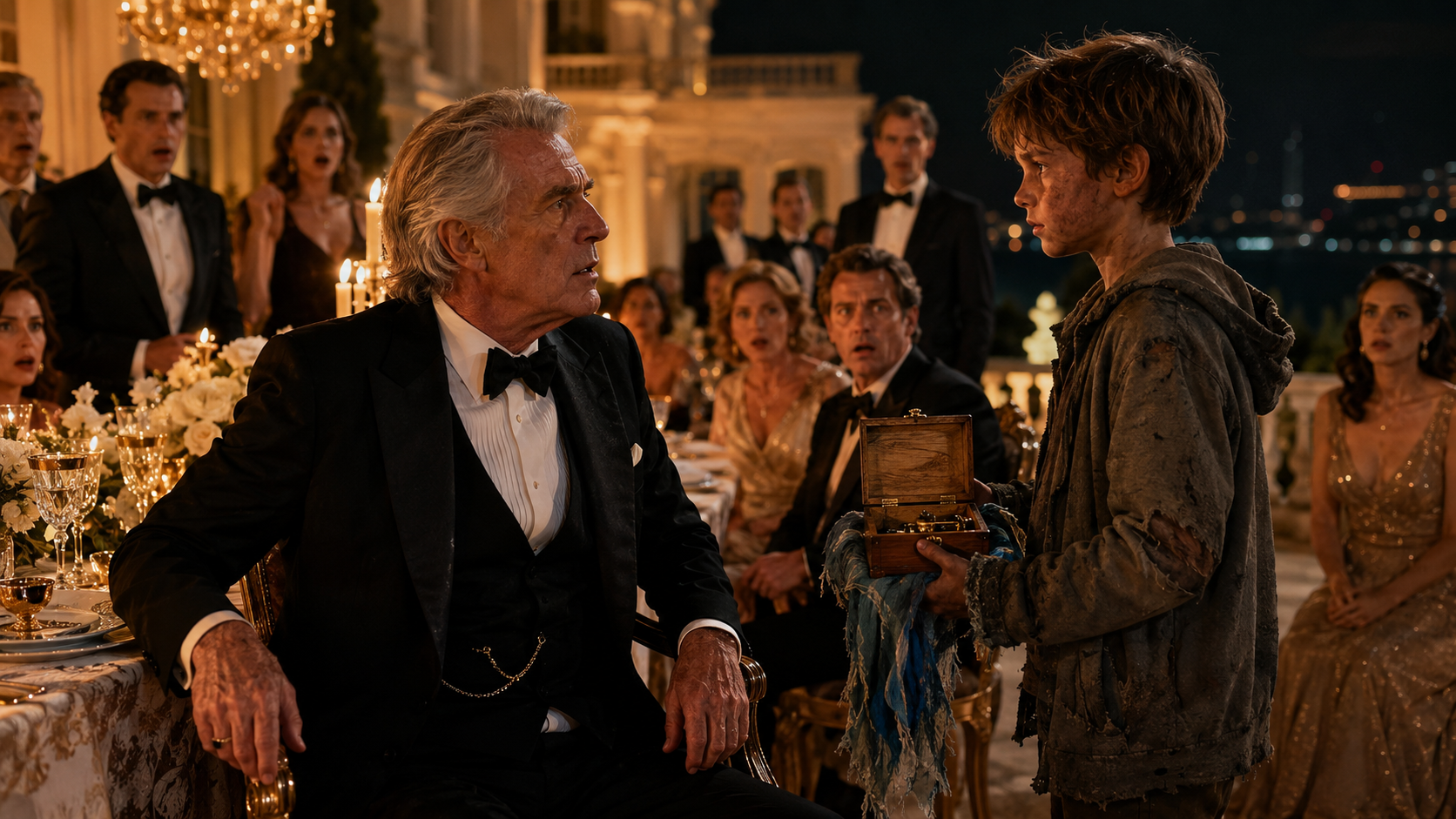
“You didn’t come when he died.”
Victor went still.
Eli looked down.
The room seemed to shrink.
Victor’s voice faded.
“Mateo is dead?”
Isabel’s expression trembled.
“Three years ago. Construction accident. He was working nights because the music jobs weren’t enough.”
Victor sat down slowly in the chair beside the wall.
He did not ask why no one told him.
He knew why.
He had built a wall high enough that even death could not climb it.
“I’m sorry,” he said.
Isabel looked away.
“You’re sorry now because you saw Eli.”
“Yes.”
The honesty landed between them.
Victor nodded.
“Yes. Because I saw him. Because I humiliated him. Because I looked at my own blood and treated him like a nuisance.”
Eli whispered, “Grandpa…”
The word startled everyone.
Especially Eli.
He looked embarrassed, as if it had slipped out before he could stop it.
Victor covered his mouth with one hand.
For a moment, he could not speak.
Isabel watched him carefully.
Maybe she wanted to see if the word meant anything to him.
It did.
It meant too much.
Victor lowered his hand.
“I don’t deserve that name,” he said.
Eli looked at him.
“But you are.”
Victor’s eyes filled.
He had not cried when reporters accused him of corruption.
He had not cried when his competitors tried to ruin him.
He had not cried at Clara’s funeral, because he had believed tears would make grief real.
But in that small hospital room, with fluorescent light on the walls and his grandson wearing his tuxedo jacket like a blanket, Victor Langley began to cry.
Not dramatically.
Not loudly.
Just enough that Isabel saw it.
And maybe that was worse.
Because for the first time in her adult life, her father looked old.
Not powerful.
Old.
The surgery happened before dawn.
Victor waited in the hallway with Eli asleep against his side.
At first, the boy had tried to sit apart from him. But exhaustion finally won. His head slowly dropped against Victor’s arm, and when Victor carefully shifted to make him more comfortable, Eli did not wake.
Victor stayed perfectly still for two hours.
Afraid to disturb the trust he had not earned.
Adrian arrived at the hospital around six in the morning.
He wore the same suit from dinner, though his tie was loosened and his eyes were sharp with panic.
Victor saw him coming down the hallway and gently eased Eli’s head onto a folded coat.
“What are you doing here?” Victor asked.
Adrian stopped a few feet away.
“I’m worried about you.”
“No,” Victor said. “You’re worried about yourself.”
Adrian’s face hardened.
“That boy appeared out of nowhere, and suddenly everything changes?”
“Yes.”
“You can’t be serious.”
“I have never been more serious.”
Adrian took a breath, lowering his voice.
“I have protected your legacy for years. I stood by you when everyone else whispered about Isabel. I defended you. I learned the business. I prepared to carry the family name.”
Victor looked at him.
“The family name was never yours to carry.”
Adrian’s mask slipped.
“And his?” he asked, pointing toward Eli. “A poor child whose father was nobody?”
Victor stood.
Slowly.
The hallway seemed to grow colder.
“His father was a man my daughter loved,” Victor said. “That already makes him more worthy than you.”
Adrian’s face twisted.
“You’ll regret this.”
Victor almost smiled.
Not with amusement.
With clarity.
“I already regret everything that led to this.”
The surgeon came out before Adrian could respond.
Victor turned immediately.
“She made it,” the doctor said.
Eli woke to the sound of Victor exhaling like a man being pulled from underwater.
Isabel survived.
Recovery was slow.
Forgiveness was slower.
Victor learned this quickly.
Money could buy specialists, private rooms, better medicine, physical therapy, meals delivered at any hour, a safe apartment, new clothes for Eli, tutors, transportation, comfort.
But it could not buy the right to sit at Isabel’s bedside without silence.
It could not buy back birthdays.
It could not buy the sound of Mateo’s laugh.
It could not buy the years Eli spent thinking his grandfather did not want him.
So Victor did something he had almost never done in his life.
He waited.
He came to the hospital every day.
Not with cameras.
Not with gifts meant to impress.
Sometimes he brought soup.
Sometimes he brought books.
Sometimes he brought nothing at all and simply sat in the chair by the wall while Isabel slept.
Eli was easier.
Children often are.
Not because they forget, but because they are brave enough to hope before adults are.
He asked Victor questions.
“Do you live in that big house alone?”
“Yes.”
“Isn’t it scary?”
“Sometimes.”
“Do you know how to make pancakes?”
“No.”
“That’s sad.”
“It is.”
“Mom makes them shaped like bears.”