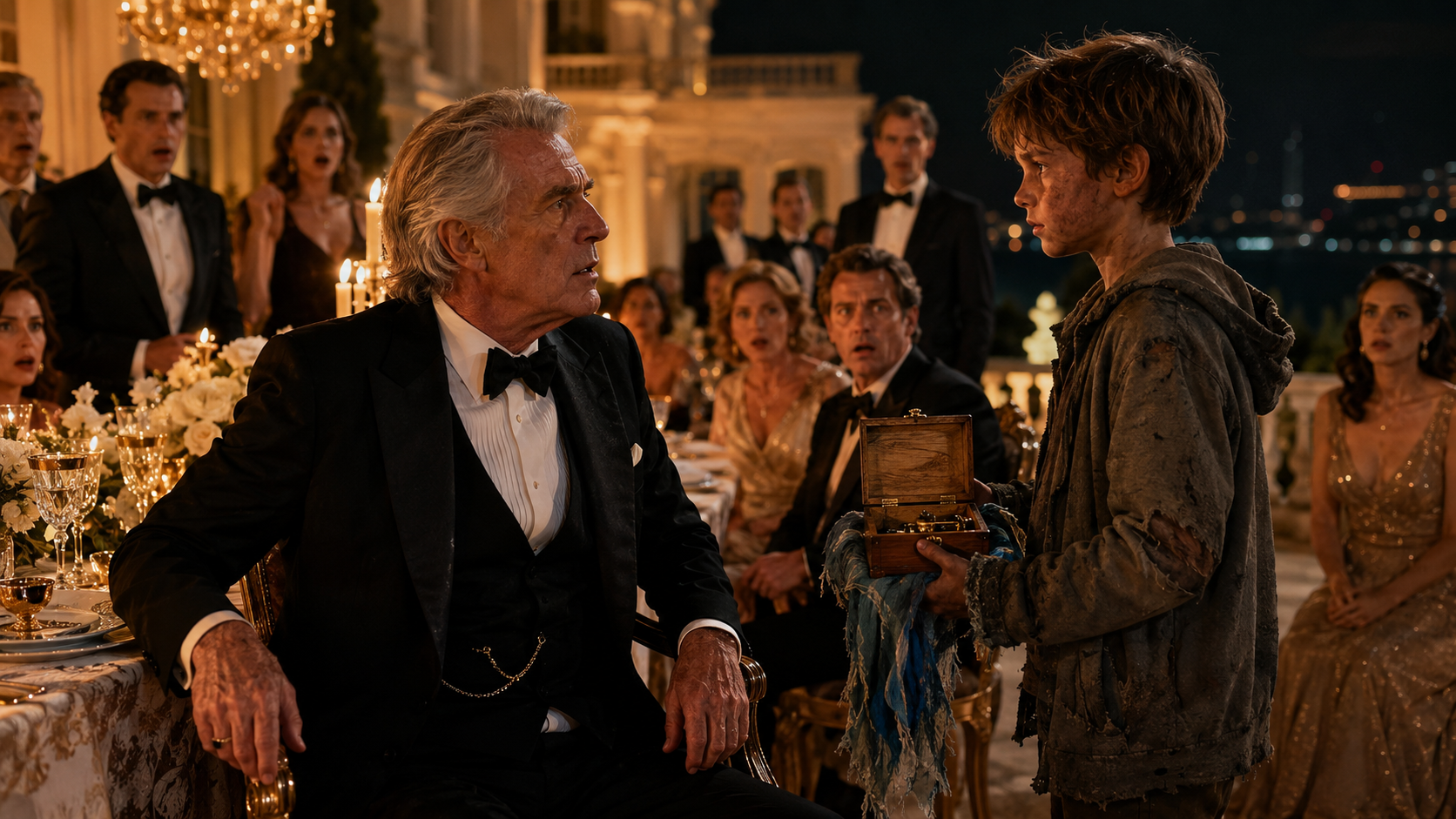
The name meant nothing to Victor.
At least, not yet.
“Mr. Langley,” Eli said, moving one step closer, “my mother said you knew my grandmother once. She said maybe you would—”
Adrian cut him off. “This is not the place.”
“I’m sorry,” Eli said quickly. “I’m really sorry. I tried the front gate, but the man told me to leave. I waited outside for a long time. Then I saw people coming through the garden entrance and I—”
“You sneaked in,” Victor said.
Eli’s face flushed with shame. “Yes, sir.”
A few guests chuckled.
It was quiet at first, almost nervous. Then someone at the table gave a sharper laugh, and the sound gave permission to the others.
The mayor looked down at his plate.
Adrian smiled.
Victor leaned back in his chair.
“You entered my property illegally,” he said. “You interrupted a formal dinner. You came dirty, uninvited, and dramatic. And now you expect help because you have a sad story?”
Eli stared at him.
The boy’s lips parted, but no words came.
Victor did not stop.
He had spent his life being ruthless in rooms where people were old enough to defend themselves. Now, somehow, that same cold skill turned toward a child.
“Do you know how many people come to gates like mine every week?” Victor continued. “How many claim to be desperate? How many invent mothers, illnesses, tragedies?”
Eli’s eyes shone.
“I’m not lying.”
“Of course you say that.”
“I’m not.”
Adrian stepped beside Victor’s chair, lowering his voice just enough to sound concerned while still letting the table hear him.
“Uncle, I’ll have someone handle this.”
Victor raised a hand.
“No. Let him answer.”
Eli clutched the scarf-wrapped object closer to his chest.
Victor looked at him with cold impatience. “If your mother needs help, there are hospitals. Charities. Shelters. The very foundation we are raising money for tonight exists because children like you require structure, not emotional manipulation.”
The words landed across the terrace.
Some guests looked uncomfortable.
Others looked entertained.
Eli’s chin trembled, but he held his ground.
“My mother is at Mercy General,” he said. “They said she needs a surgery. They said the money—”
“Money,” Victor interrupted. “There it is.”
The boy flinched.
Victor reached into the inside pocket of his jacket, took out several folded bills, and placed them on the table.
“Here,” he said. “Since this is what you came for.”
Eli looked at the money.
Then back at Victor.
“I didn’t come to beg.”
Victor laughed once, without warmth.
“No? Then what do you call this?”
The boy’s small shoulders rose as he took a breath.
“I came because she told me your name when she was crying.”
The terrace went still again.
Victor’s eyes narrowed.
“What did you say?”
Eli slowly unwrapped the blue scarf.
Inside was a small wooden music box.
It was old. Scratched. Carefully repaired more than once. On the lid, carved into the wood, was a tiny bird with one wing raised.
Victor stared at it.
Something shifted in his face.
Not enough for the guests to understand.
But enough for Adrian to notice.
The music box had belonged to Victor’s wife.
Clara.
Clara had carved that little bird herself during the first year of their marriage, back when they were still poor enough to share one winter coat and happy enough not to care. She used to say the bird looked unfinished because all beautiful things were. She had given the box to their daughter, Isabel, when Isabel was seven.
Victor had not seen it in twenty-four years.
Not since Isabel walked out of his house with tears on her face and a suitcase in her hand.
The laughter around the table died.
Eli held the music box out with both hands.
“My mom said if I ever had nowhere else to go, I should bring this to you.”
Victor did not move.
The garden lights blurred at the edges of his vision.
For one strange moment, he was no longer an old billionaire at a dinner party. He was a younger man standing in the doorway of his study while his daughter begged him to accept the man she loved.
Isabel had been twenty-two.
Beautiful. Stubborn. Bright with the kind of life Victor could never control.
She had fallen in love with Mateo Rivera, a musician who worked two jobs and owned nothing but a guitar, a used car, and the audacity to look Victor in the eye.
Victor had called him unsuitable.
Isabel had called him honest.
Victor had threatened to cut her off.
Isabel had said love was not a business contract.
That was the last conversation they had before she left.
The next morning, Victor ordered his staff to remove every photograph of her from the public rooms of the house.
He told himself she would come back.
She didn’t.
Months became years.
Pride became habit.
Habit became punishment.
And punishment, over time, became a story Victor told himself: that his daughter had chosen poverty over family, and therefore whatever happened next was not his fault.