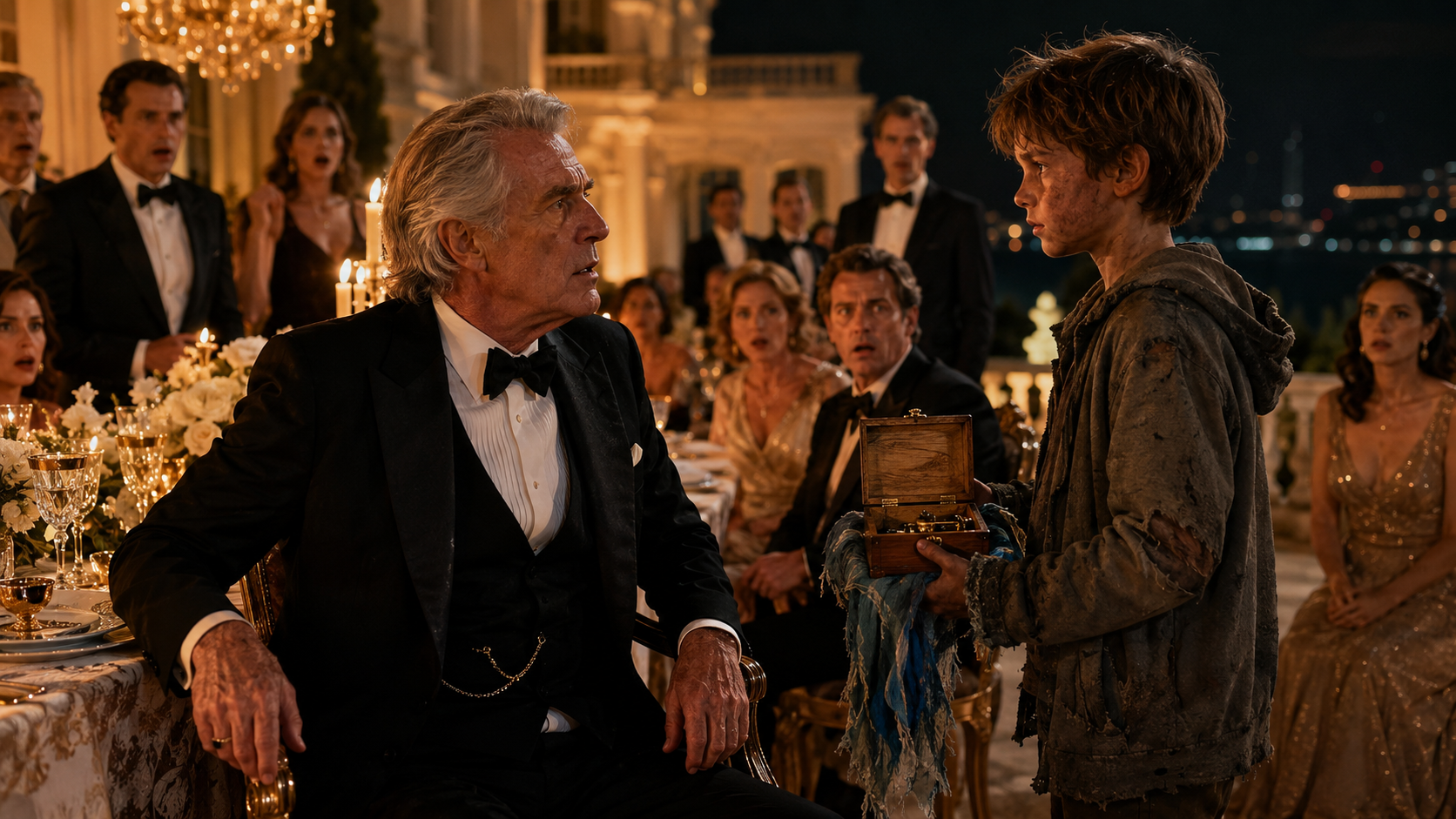
The Billionaire Laughed at the Poor Boy at His Dinner Party — Then Discovered the Child Was His Grandson

The first mistake Victor Langley made that evening was believing he owned the room.

The second was believing he owned the people inside it.

And the third — the one that would break him open in front of everyone — was believing that a child in torn shoes could not possibly matter.

The dinner party had been planned for months.

Every flower had been flown in fresh that morning. Every candle had been placed by hand. Every silver fork had been polished until it reflected the golden light of the chandeliers above. The long glass table stretched across the terrace of Victor Langley’s estate like a river of wealth, surrounded by politicians, investors, bankers, old family friends, and people who smiled at him because his name could open doors their own never could.

Beyond the terrace, the gardens rolled into darkness.

Fountains whispered under the moonlight. Violin music floated through the warm evening air. Waiters in white gloves moved silently between guests, pouring wine that cost more than most people earned in a month.

Victor sat at the head of the table, exactly where everyone expected him to sit.

He was seventy-two, tall even in age, with silver hair combed back and a face built out of discipline. His tuxedo had been tailored in London. His watch had been gifted to him by a European prince. His company’s name was printed on hospitals, schools, airports, and museums across the country.

People called him generous.

People called him powerful.

People called him a legend.

But no one at that table would have called him kind.

Not if they knew him well.

Victor lifted his glass while the mayor beside him laughed too loudly at something one of the guests had said. He did not laugh with them. He rarely did. Laughter, to him, was something people used when they had nothing more valuable to offer.

He was waiting for the evening to reach the part that mattered: the announcement.

Tonight, he would publicly name his nephew, Adrian Langley, as the next chairman of the Langley Foundation. Adrian had spent years positioning himself beside Victor — appearing at charity galas, shaking the right hands, wearing humble expressions for cameras. He was handsome, polished, obedient, and empty in exactly the way Victor found useful.

Victor had no son.

No daughter anymore.

At least, that was what he told people.

At the far end of the terrace, Adrian rose from his seat and gently tapped his champagne glass with a knife.

“Ladies and gentlemen,” he began, smiling as all heads turned toward him, “before my uncle makes tonight’s announcement, I want to thank each of you for supporting the Langley Children’s Fund. Because of your donations, children across this city will receive food, shelter, and opportunities they never thought possible.”

A soft wave of applause moved around the table.

Victor gave a small nod.

It sounded noble.

It sounded clean.

It sounded perfect.

And then a voice from the darkness said, “Please, sir… can someone help my mother?”

The music faltered.

Not stopped.

Faltered.

The violinist’s bow slipped for half a second, just long enough for everyone to turn.

At the edge of the terrace stood a boy.

He could not have been more than ten.

His clothes were too thin for the night air, his gray hoodie torn at the sleeve, his pants muddy at the knees. One shoe had a broken sole that hung loose like a tired mouth. His hair was dark and messy, sticking to his forehead. His small hands clutched something wrapped in a faded blue scarf.

For a moment, no one spoke.

It was not pity that filled the silence.

It was offense.

This was not the kind of child these people donated to. The children they helped existed in brochures, in carefully edited videos, in speeches spoken over dessert. They had names only when useful. Faces only when moving. Stories only when profitable.

But this boy was real.

He was standing on expensive stone with mud on his shoes.

A woman near the center of the table leaned away from him as if poverty were contagious.

Adrian stepped forward quickly, his smile tightening.

“Security,” he said under his breath.

The boy heard him and took one step back.

“Please,” he said again. “I don’t want food. I don’t want money for me. My mom is sick. She told me not to come here, but I didn’t know where else to go.”

Victor slowly lowered his glass.

The interruption irritated him.

The timing irritated him.

The boy’s desperation irritated him most of all, because desperation always demanded something from those who had carefully trained themselves not to feel.

“This is a private event,” Victor said.

His voice was not loud, but it carried.

The boy looked toward him. “Are you Mr. Langley?”

Several guests exchanged glances.

Victor’s expression hardened. “Who are you?”

“My name is Eli.”

“Eli what?”

The boy swallowed. “Eli Rivera.”

The name meant nothing to Victor.

At least, not yet.

“Mr. Langley,” Eli said, moving one step closer, “my mother said you knew my grandmother once. She said maybe you would—”

Adrian cut him off. “This is not the place.”

“I’m sorry,” Eli said quickly. “I’m really sorry. I tried the front gate, but the man told me to leave. I waited outside for a long time. Then I saw people coming through the garden entrance and I—”

“You sneaked in,” Victor said.

Eli’s face flushed with shame. “Yes, sir.”

A few guests chuckled.

It was quiet at first, almost nervous. Then someone at the table gave a sharper laugh, and the sound gave permission to the others.

The mayor looked down at his plate.

Adrian smiled.

Victor leaned back in his chair.

“You entered my property illegally,” he said. “You interrupted a formal dinner. You came dirty, uninvited, and dramatic. And now you expect help because you have a sad story?”

Eli stared at him.

The boy’s lips parted, but no words came.

Victor did not stop.

He had spent his life being ruthless in rooms where people were old enough to defend themselves. Now, somehow, that same cold skill turned toward a child.

“Do you know how many people come to gates like mine every week?” Victor continued. “How many claim to be desperate? How many invent mothers, illnesses, tragedies?”

Eli’s eyes shone.

“I’m not lying.”

“Of course you say that.”

“I’m not.”

Adrian stepped beside Victor’s chair, lowering his voice just enough to sound concerned while still letting the table hear him.

“Uncle, I’ll have someone handle this.”

Victor raised a hand.

“No. Let him answer.”

Eli clutched the scarf-wrapped object closer to his chest.

Victor looked at him with cold impatience. “If your mother needs help, there are hospitals. Charities. Shelters. The very foundation we are raising money for tonight exists because children like you require structure, not emotional manipulation.”

The words landed across the terrace.

Some guests looked uncomfortable.

Others looked entertained.

Eli’s chin trembled, but he held his ground.

“My mother is at Mercy General,” he said. “They said she needs a surgery. They said the money—”

“Money,” Victor interrupted. “There it is.”

The boy flinched.

Victor reached into the inside pocket of his jacket, took out several folded bills, and placed them on the table.

“Here,” he said. “Since this is what you came for.”

Eli looked at the money.

Then back at Victor.

“I didn’t come to beg.”

Victor laughed once, without warmth.

“No? Then what do you call this?”

The boy’s small shoulders rose as he took a breath.

“I came because she told me your name when she was crying.”

The terrace went still again.

Victor’s eyes narrowed.

“What did you say?”

Eli slowly unwrapped the blue scarf.

Inside was a small wooden music box.

It was old. Scratched. Carefully repaired more than once. On the lid, carved into the wood, was a tiny bird with one wing raised.

Victor stared at it.

Something shifted in his face.

Not enough for the guests to understand.

But enough for Adrian to notice.

The music box had belonged to Victor’s wife.

Clara.

Clara had carved that little bird herself during the first year of their marriage, back when they were still poor enough to share one winter coat and happy enough not to care. She used to say the bird looked unfinished because all beautiful things were. She had given the box to their daughter, Isabel, when Isabel was seven.

Victor had not seen it in twenty-four years.

Not since Isabel walked out of his house with tears on her face and a suitcase in her hand.

The laughter around the table died.

Eli held the music box out with both hands.

“My mom said if I ever had nowhere else to go, I should bring this to you.”

Victor did not move.

The garden lights blurred at the edges of his vision.

For one strange moment, he was no longer an old billionaire at a dinner party. He was a younger man standing in the doorway of his study while his daughter begged him to accept the man she loved.

Isabel had been twenty-two.

Beautiful. Stubborn. Bright with the kind of life Victor could never control.

She had fallen in love with Mateo Rivera, a musician who worked two jobs and owned nothing but a guitar, a used car, and the audacity to look Victor in the eye.

Victor had called him unsuitable.

Isabel had called him honest.

Victor had threatened to cut her off.

Isabel had said love was not a business contract.

That was the last conversation they had before she left.

The next morning, Victor ordered his staff to remove every photograph of her from the public rooms of the house.

He told himself she would come back.

She didn’t.

Months became years.

Pride became habit.

Habit became punishment.

And punishment, over time, became a story Victor told himself: that his daughter had chosen poverty over family, and therefore whatever happened next was not his fault.

Now a child stood before him with Clara’s music box in his hands.

“Where did you get that?” Victor asked.

“My mom gave it to me.”

“What is your mother’s name?”

Eli hesitated.

The entire table seemed to lean forward.

“Isabel,” he said.

Victor’s hand tightened around the arm of his chair.

“Isabel Rivera?”

The boy nodded.

Something inside Victor cracked so sharply he almost heard it.

Adrian’s expression changed first.

Not shock.

Fear.

Because in one sentence, this dirty, trembling child had become more dangerous to him than any rival investor, any lawsuit, any scandal.

Victor stood slowly.

His chair scraped against the stone.

“Your mother is alive?”

Eli blinked, confused by the question.

“Yes.”

Victor’s voice dropped.

“Where is she?”

“Mercy General. Room 412. She told me not to leave, but I heard the nurse say they were moving her surgery because we couldn’t pay. She was asleep, and I took the bus. Then I walked.”

“You walked here from Mercy General?”

Eli nodded.

Victor looked down at the boy’s broken shoe.

The torn sole.

The mud.

The small feet that had crossed half the city because adults had failed him.

A sound moved through the guests.

Not laughter this time.

Whispers.

Adrian stepped forward. “Uncle, we should verify this privately. Anyone could know Isabel’s name. Anyone could have stolen an old family object.”

Victor turned toward him.

Very slowly.

The look on Victor’s face silenced him.

“Stolen?” Victor said.

Adrian’s jaw tightened. “I’m only saying we should be careful.”

“You think a ten-year-old child limped through my garden with my dead wife’s music box as part of a plan?”

“I think people see opportunity when money is involved.”

Victor stared at him.

For the first time that evening, he saw Adrian clearly.

Not the loyal nephew.

Not the polished heir.

Not the young man who had stood patiently at his side.

He saw hunger.

Thinly dressed as concern.

Victor looked back at Eli.

The boy was trembling now, not from cold alone. He had come prepared to plead. He had not come prepared to be laughed at. There was a difference, and Victor had made him learn it in front of strangers.

Victor stepped toward him.

Eli instinctively backed away.

That tiny movement did something to Victor that no boardroom defeat, no market crash, no public accusation had ever done.

It ashamed him.

The boy was afraid of him.

His own grandson — because there was no longer any real doubt in Victor’s mind — was afraid of him.

Victor stopped.

Then, in front of the mayor, the donors, the photographers, the board members, the staff, and every person who had spent the evening treating him like a king, Victor Langley lowered himself to one knee.

A gasp moved through the terrace.

Eli stared at him.

Victor’s knee pressed into the cold stone.

His old body protested.

He ignored it.

“Eli,” he said, and his voice sounded different now. Rougher. Smaller. Human. “I spoke to you cruelly.”

The boy said nothing.

Victor swallowed.

“I should not have done that.”

Eli’s fingers curled around the music box.

Victor looked at the money he had thrown onto the table.

It suddenly looked obscene.

Not because it was money.

Because of what he had meant by it.

“I am sorry,” Victor said.

The guests were silent.

No one knew where to look.

Eli studied him with the careful suspicion of a child who had learned that adults could change their faces faster than their hearts.

“Can you help my mom?” he asked.

The question was simple.

It left no room for speeches.

Victor nodded once.

“Yes.”

“Tonight?”

“Yes.”

“Not tomorrow?”

Victor closed his eyes briefly.

“Tonight.”

Eli’s lips pressed together, fighting tears.

Victor rose and turned toward the house.

“Call Dr. Henley. Call Mercy General. Tell them Victor Langley is coming. Tell them no procedure is to be delayed because of payment. Tell them I will cover every cost.”

Several staff members moved at once.

Adrian grabbed his arm.

“Uncle, think about what you’re doing.”

Victor looked down at Adrian’s hand.

Adrian immediately released him.

“This dinner,” Adrian said carefully, “this announcement — the foundation board is here. The press is here. You can’t just leave because a boy appeared with a story.”

Victor’s voice became cold again, but it was no longer aimed at the weak.

It was aimed at the deserving.

“My daughter is in a hospital.”

Adrian lowered his voice. “Your daughter made her choice.”

Victor’s expression darkened.

“Say that again.”

Adrian went pale.

Behind him, the guests watched as the future he had imagined for himself began to collapse.

Victor stepped closer.

“She was my child,” he said. “And I punished her for loving a poor man because I thought money made me wise.”

No one moved.

“Tonight, I nearly punished her son for being poor because I thought money made me better.”

Eli looked up at him.

Victor removed his tuxedo jacket and gently draped it over the boy’s shoulders. It swallowed Eli’s small frame, but the boy pulled it tight around himself.

Then Victor turned to the table.

“Dinner is over.”

No one argued.

The ride to Mercy General was quiet.

Eli sat across from Victor in the back of the black car, holding the music box on his lap. The city moved past the tinted windows in streaks of white and red light. For a long time, neither of them spoke.

Victor had conducted billion-dollar negotiations with less fear than he felt sitting across from that child.

There were so many questions he wanted to ask.

Did Isabel ever speak of him?

Had she been happy?

Where was Mateo?

Had Eli gone hungry?

Had he celebrated birthdays?

Had he ever stood outside toy stores and pretended not to want anything because his mother could not afford it?

But every question felt like theft.

He had no right to demand memories from a life he had chosen not to enter.

Finally, Eli opened the music box.

A fragile melody filled the car.

Victor’s breath caught.

Clara’s song.

She had hummed it when Isabel was a baby. She had played it when storms frightened their daughter. After Clara died, Victor had forbidden the song from being played in the house because grief made him angry, and anger was easier than sorrow.

“Mom plays it when she can’t sleep,” Eli said softly.

Victor looked out the window.

“She remembered it,” he whispered.

“She remembers everything,” Eli said.

The words struck harder than accusation.

At Mercy General, Victor moved through the hospital doors with Eli beside him and a small army of staff behind them. Nurses looked up. Administrators appeared. Phones rang. Suddenly, paperwork that had taken days began taking minutes.

Money had always opened doors for Victor.

But that night, for the first time, he hated how quickly doors opened when his name was spoken.

Room 412 was at the end of a pale hallway.

Eli stopped outside the door.

Victor stopped too.

The boy’s hand hovered over the handle.

“She doesn’t know I left,” Eli said.

Victor nodded. “Then I will take the blame.”

Eli looked at him.

“You?”

“Yes.”

The boy seemed to consider whether billionaires were allowed to take blame.

Then he opened the door.

The room was dim.

Machines beeped softly beside the bed.

And there she was.

Isabel.

Older now. Thinner. Her dark hair pulled back carelessly. Her face pale from illness. But even before she opened her eyes, Victor knew her.

A father knows.

Even when he has spent half a lifetime pretending not to.

Eli ran to the bed.

“Mom.”

Isabel stirred.

Her eyes opened slowly.

For one second, she saw only her son.

Then her gaze moved past him.

And found Victor.

The room changed.

Her face went still.

Not angry.

Not happy.

Still.

As if her heart had protected itself so completely that even shock had to knock before entering.

Victor stood near the doorway.

He had commanded rooms full of senators and CEOs.

Now he could not take three steps toward his own daughter.

“Isabel,” he said.

Her eyes filled with something too complicated to name.

Pain.

Memory.

Exhaustion.

Love buried so deep it looked like hatred.

“You shouldn’t be here,” she whispered.

Eli grabbed her hand. “I went to him. I’m sorry. I know you said not to, but the nurse said—”

Isabel looked at her son.

Fear crossed her face.

“You walked there?”

“I took the bus some of the way.”

“Eli—”

“I had Grandma’s music box. You said if we ever had nowhere else—”

Isabel closed her eyes.

A tear slipped down the side of her face.

Victor stepped forward once.

Then stopped.

“I’m paying for the surgery,” he said.

Isabel opened her eyes.

“No.”

Victor flinched.

He had expected anger.

He had not expected refusal.

“I’m not asking for permission,” he said, then immediately heard the old arrogance in his own voice.

Isabel heard it too.

Her mouth tightened.

Victor lowered his head.

“I’m sorry,” he said. “That came out wrong.”

For the first time, Isabel looked truly surprised.

Victor forced himself to continue.

“I would like to pay for the surgery. And for the hospital stay. And for anything else you need.”

“I needed a father twenty-four years ago.”

The sentence was quiet.

It destroyed him anyway.

Victor’s face tightened.

“Yes,” he said. “You did.”

Isabel stared at him.

No defense.

No excuse.

No speech about intentions.

Just agreement.

It made her angrier somehow.

“You told me if I walked out that door, I was no longer your daughter.”

Victor’s eyes burned.

“I remember.”

“You returned my letters.”

“I know.”

“You never met my husband.”

“No.”

“You didn’t come when he died.”

Victor went still.

Eli looked down.

The room seemed to shrink.

Victor’s voice faded.

“Mateo is dead?”

Isabel’s expression trembled.

“Three years ago. Construction accident. He was working nights because the music jobs weren’t enough.”

Victor sat down slowly in the chair beside the wall.

He did not ask why no one told him.

He knew why.

He had built a wall high enough that even death could not climb it.

“I’m sorry,” he said.

Isabel looked away.

“You’re sorry now because you saw Eli.”

“Yes.”

The honesty landed between them.

Victor nodded.

“Yes. Because I saw him. Because I humiliated him. Because I looked at my own blood and treated him like a nuisance.”

Eli whispered, “Grandpa…”

The word startled everyone.

Especially Eli.

He looked embarrassed, as if it had slipped out before he could stop it.

Victor covered his mouth with one hand.

For a moment, he could not speak.

Isabel watched him carefully.

Maybe she wanted to see if the word meant anything to him.

It did.

It meant too much.

Victor lowered his hand.

“I don’t deserve that name,” he said.

Eli looked at him.

“But you are.”

Victor’s eyes filled.

He had not cried when reporters accused him of corruption.

He had not cried when his competitors tried to ruin him.

He had not cried at Clara’s funeral, because he had believed tears would make grief real.

But in that small hospital room, with fluorescent light on the walls and his grandson wearing his tuxedo jacket like a blanket, Victor Langley began to cry.

Not dramatically.

Not loudly.

Just enough that Isabel saw it.

And maybe that was worse.

Because for the first time in her adult life, her father looked old.

Not powerful.

Old.

The surgery happened before dawn.

Victor waited in the hallway with Eli asleep against his side.

At first, the boy had tried to sit apart from him. But exhaustion finally won. His head slowly dropped against Victor’s arm, and when Victor carefully shifted to make him more comfortable, Eli did not wake.

Victor stayed perfectly still for two hours.

Afraid to disturb the trust he had not earned.

Adrian arrived at the hospital around six in the morning.

He wore the same suit from dinner, though his tie was loosened and his eyes were sharp with panic.

Victor saw him coming down the hallway and gently eased Eli’s head onto a folded coat.

“What are you doing here?” Victor asked.

Adrian stopped a few feet away.

“I’m worried about you.”

“No,” Victor said. “You’re worried about yourself.”

Adrian’s face hardened.

“That boy appeared out of nowhere, and suddenly everything changes?”

“Yes.”

“You can’t be serious.”

“I have never been more serious.”

Adrian took a breath, lowering his voice.

“I have protected your legacy for years. I stood by you when everyone else whispered about Isabel. I defended you. I learned the business. I prepared to carry the family name.”

Victor looked at him.

“The family name was never yours to carry.”

Adrian’s mask slipped.

“And his?” he asked, pointing toward Eli. “A poor child whose father was nobody?”

Victor stood.

Slowly.

The hallway seemed to grow colder.

“His father was a man my daughter loved,” Victor said. “That already makes him more worthy than you.”

Adrian’s face twisted.

“You’ll regret this.”

Victor almost smiled.

Not with amusement.

With clarity.

“I already regret everything that led to this.”

The surgeon came out before Adrian could respond.

Victor turned immediately.

“She made it,” the doctor said.

Eli woke to the sound of Victor exhaling like a man being pulled from underwater.

Isabel survived.

Recovery was slow.

Forgiveness was slower.

Victor learned this quickly.

Money could buy specialists, private rooms, better medicine, physical therapy, meals delivered at any hour, a safe apartment, new clothes for Eli, tutors, transportation, comfort.

But it could not buy the right to sit at Isabel’s bedside without silence.

It could not buy back birthdays.

It could not buy the sound of Mateo’s laugh.

It could not buy the years Eli spent thinking his grandfather did not want him.

So Victor did something he had almost never done in his life.

He waited.

He came to the hospital every day.

Not with cameras.

Not with gifts meant to impress.

Sometimes he brought soup.

Sometimes he brought books.

Sometimes he brought nothing at all and simply sat in the chair by the wall while Isabel slept.

Eli was easier.

Children often are.

Not because they forget, but because they are brave enough to hope before adults are.

He asked Victor questions.

“Do you live in that big house alone?”

“Yes.”

“Isn’t it scary?”

“Sometimes.”

“Do you know how to make pancakes?”

“No.”

“That’s sad.”

“It is.”

“Mom makes them shaped like bears.”

“I would like to learn.”

“You’d probably make them square.”

“I probably would.”

The first time Isabel laughed at something Victor said, she covered her mouth as if the sound had betrayed her.

Victor pretended not to notice.

But he carried that laugh with him for the rest of the day like a treasure.

Three weeks later, Isabel was strong enough to leave the hospital.

Victor offered his house.

She refused immediately.

He did not argue.

Instead, he arranged a quiet apartment near Eli’s school and placed the lease in Isabel’s name. When she found out, she was furious.

“You don’t get to control my life again,” she said.

Victor nodded.

“You’re right.”

“Then why did you do it?”

“Because I wanted you safe.”

“I needed you to want that twenty-four years ago.”

“Yes,” he said. “You did.”

She stared at him.

That answer again.

No defense.

No counterattack.

It left her with nowhere to throw the anger except at the truth.

And the truth was that he was trying.

Not perfectly.

Not gracefully.

But trying.

One month after the dinner party, Victor held another event.

Smaller.

No mayor.

No cameras.

No Adrian.

The long glass table was removed from the terrace. In its place were round wooden tables, simple food, warm lights, and music from a small local band. Staff members were invited as guests. So were nurses from Mercy General. So were children from shelters supported by the foundation — not for photographs, not for speeches, but because Victor had finally understood that charity without humility was just pride wearing a generous mask.

At sunset, Victor stood before the gathering with Eli beside him and Isabel seated in the front row.

He looked older than he had a month before.

But softer too.

“I have spent much of my life giving money to causes,” Victor said. “And for many years, I mistook giving for goodness.”

The terrace was quiet.

“I believed wealth made me important. Then a child came to my home asking for help, and I treated him as though his pain had interrupted my evening.”

His voice shook slightly.

He did not hide it.

“That child was my grandson.”

A murmur moved through the guests, though most already knew.

Victor looked down at Eli.

Eli looked back up at him.

Not afraid this time.

Victor continued.

“I cannot undo what I did to my daughter. I cannot recover the years I lost with her. I cannot meet the man she loved and offer him the respect I should have given him. But I can tell the truth.”

He looked at Isabel.

“I was wrong.”

Her eyes filled, but she did not look away.

Victor turned back to the crowd.

“The Langley Foundation will no longer be run as a monument to my name. Its leadership will change. Its mission will change. Its doors will open not only to donors, but to the families we claim to serve. And every decision will begin with one question: are we protecting people, or are we protecting our pride?”

No one applauded at first.

The words were too honest for immediate applause.

Then Eli started clapping.

Small hands.

Clear sound.

Isabel joined him.

Then the nurses.

Then the staff.

Then everyone.

Victor looked down, overwhelmed by a kind of approval he had never chased and therefore had never received.

Later that evening, after the guests had eaten and the music softened, Eli found Victor standing near the garden fountain.

The boy held the old music box.

“Mom said I can keep it,” Eli said. “But she said I should let you hear it sometimes.”

Victor smiled faintly.

“That sounds like your mother.”

Eli opened the lid.

The melody began.

Victor closed his eyes.

For years, that song had reminded him only of loss.

Now it sounded different.

Still sad.

But alive.

Eli leaned against the fountain beside him.

“Were you really mean to my mom?”

Victor looked at the boy.

“Yes.”

“Why?”

Victor took a long breath.

“Because I was afraid she would choose a life I couldn’t control.”

“That’s dumb.”

Victor nodded. “Very.”

Eli thought about that.

Then he said, “Are you still dumb?”

Victor laughed.

A real laugh this time.

“I hope less than before.”

Eli smiled.

Then, after a quiet moment, he slipped his small hand into Victor’s.

Victor froze.

Not because he did not want it.

Because he knew exactly how fragile it was.

Trust.

Given by a child who had every reason to withhold it.

Victor closed his fingers gently around Eli’s hand.

Across the terrace, Isabel watched them.

She did not smile fully.

Not yet.

But something in her face softened.

And for Victor Langley, who had spent decades building towers, companies, and monuments to his own importance, that small softening was greater than any empire he had ever made.

Because pride had cost him a daughter.

Cruelty had almost cost him a grandson.

But love — late, humbled, imperfect love — had finally found its way back to the table.

And this time, Victor did not send it away.

The Billionaire Laughed at the Poor Boy at His Dinner Party — Then Discovered the Child Was His Grandson
My winter boots were worn out, but my husband refused to buy me new ones and said, ‘I decide how to spend my money.’