A small account Mara should have received from Celeste’s estate, quietly folded into foundation reserves through legal language Bennett had recommended and Victor had signed without reading closely enough.
That last discovery nearly broke him.
He brought the documents to Mara himself.
“I signed it,” he said.
Mara read every page.
Eli sat at the kitchen table doing math homework, pretending not to listen.
When Mara finished, she folded the papers carefully.
“Did you know?”
“No.”
“Should you have known?”
“Yes.”
She nodded.
“That’s the answer I needed.”
Victor waited.
Mara looked toward the window.
“I spent years thinking you were the monster in the story.”
Victor did not defend himself.
She looked back at him.
“You were. Just not the only one.”
He accepted that too.
Months passed.
Not all wounds closed.
Some became scars.
Some stayed tender.
Mara improved slowly. She gained weight. Color returned to her face. She began teaching music part-time from the apartment, then more often. Eli started at a better school but refused to let Victor’s driver drop him at the front gate because “that’s embarrassing.”
Victor learned to text.
Badly.
His first message to Mara read: Are you alive.
She responded: Is that your version of good morning?
His second message read: Good morning. Are you alive.
She sent back a laughing face.
Victor stared at it for several minutes, unsure whether it counted as progress.
On Eli’s eleventh birthday, Mara agreed to come to Harrow House.
Not for a gala.
Not for donors.
Just dinner.
The long outdoor table was gone. In its place, a smaller table sat beneath the old chestnut tree, set for three. No crystal towers. No violinists. No mayor. No people laughing because they wanted money.
Harris served roast chicken, potatoes, green beans, and chocolate cake because Eli had requested “normal food.”
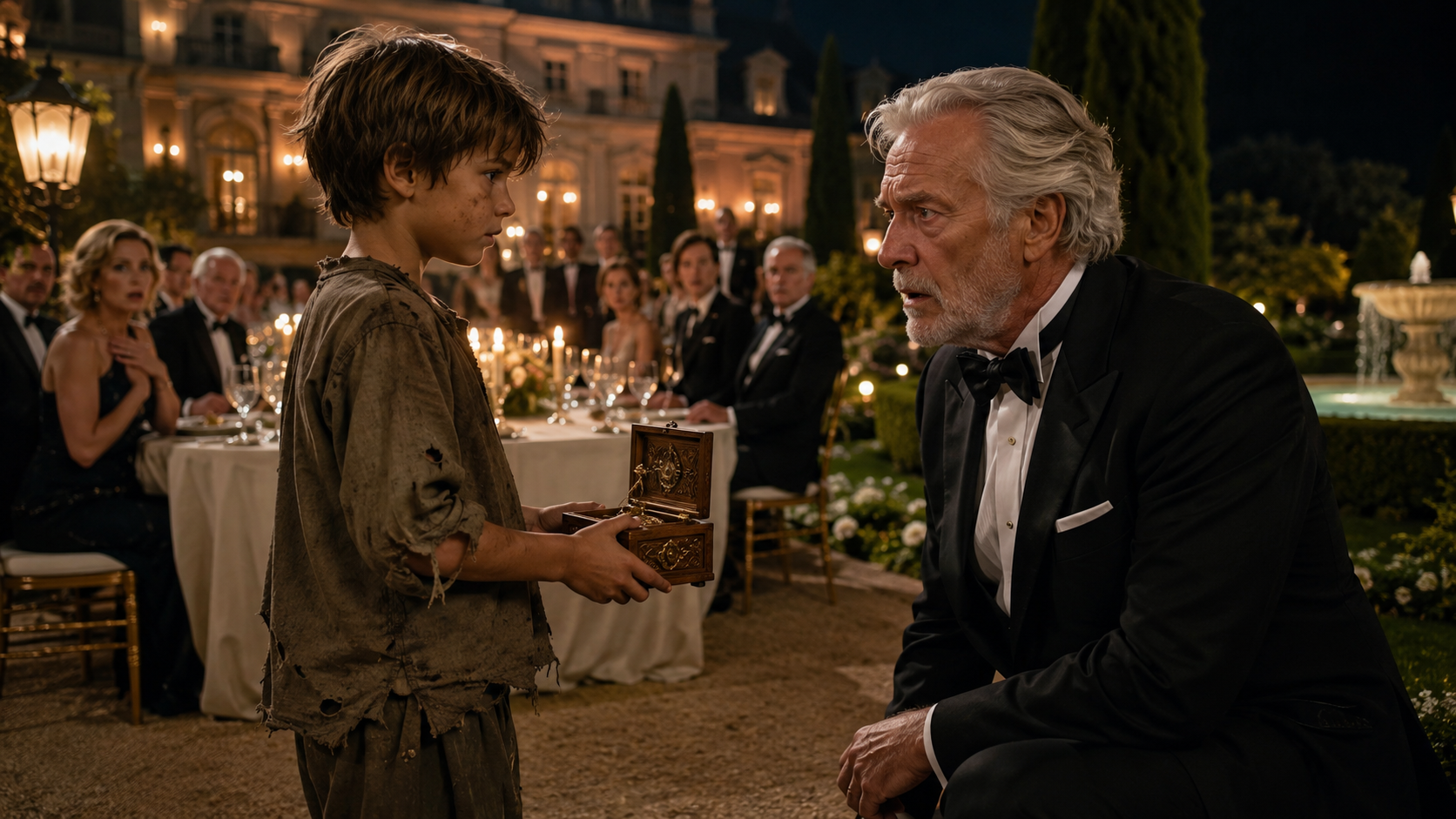
The music box sat in the center of the table.
After dinner, Eli ran through the garden with the kind of energy that made Victor worry about every stone edge and fountain step. Mara watched him from her chair, wrapped in a shawl that had once belonged to Celeste.
“You kept it,” she said.
Victor followed her gaze to the shawl.
“Yes.”
“I thought you threw everything away.”
“No,” he said. “Only the living parts.”
Mara looked at him.
Victor regretted the sentence as soon as he said it.
But Mara did not turn away.
Instead, she reached across the table and touched the music box.
“I used to play this when I missed Mom.”
“So did I.”
Mara’s eyes lifted.
“You did?”
Victor nodded.
“At night. After the staff went to bed.”
“I never knew.”
“I made sure no one did.”
She smiled sadly.
“You were very committed to being miserable.”
“I excelled at it.”
Eli ran back then, breathless.
“Can we open presents?”
Mara looked at Victor. “One present.”
Victor handed Eli a wrapped box.
The boy tore into it carefully at first, then with increasing excitement.
Inside was a small wooden bird, hand-carved, unfinished in places, imperfect.
Eli turned it over in his hands.
“You made this?”
Victor looked uncomfortable.
“I attempted it.”
Mara stared at him. “You carved?”
“Badly.”
Eli grinned. “It looks kind of angry.”
“It does not.”
“It does.”
Mara took it and laughed. “It really does.”
Victor frowned at the bird.
“I’ll make another.”
“No,” Eli said quickly, taking it back. “I like this one.”
Victor looked at him.
The boy held the crooked bird against his chest.
“I like that you made it.”
Victor could not speak for a moment.
Mara saw.
She looked away kindly.
Later, after Eli fell asleep on the sofa in the library, Mara stood beside Victor near the fireplace.
“You know this doesn’t erase it,” she said.
“I know.”
“Some days I still hate you.”
“I know.”
“Some days I don’t.”
Victor turned to her.
That was more mercy than he had expected in this lifetime.
Mara crossed her arms.
“I don’t know what we become from here.”
Victor looked toward Eli, asleep beneath a blanket, one hand curled near his face.
“Neither do I.”
“You always hated not knowing.”
“I’m learning to tolerate it.”
She leaned her shoulder lightly against his arm.
Not an embrace.
Not forgiveness.
But contact.
Victor stared straight ahead because if he looked at her, he might weep again, and Eli had already informed him that crying was acceptable but “dramatic when overdone.”
After a while, Mara said, “Mom would be furious with you.”
Victor closed his eyes.
“Yes.”
“She would also be glad you finally came.”
He breathed out slowly.
“I was late.”
Mara nodded.
“Yes.”
Then she added, “But you’re here.”
Outside, the garden lights glowed softly against the dark.
Years ago, Victor had believed a house was proven by its gates, its guards, its stone walls, its polished rooms, its distance from ordinary suffering.
Now he looked at the sleeping boy on the sofa, the daughter beside him, the music box on the table, and understood the truth far too late.
A house was not protected by keeping people out.
It became a home only when the right people were finally allowed back in.
And for the first time in twenty-two years, Harrow House was not silent.
It was listening.