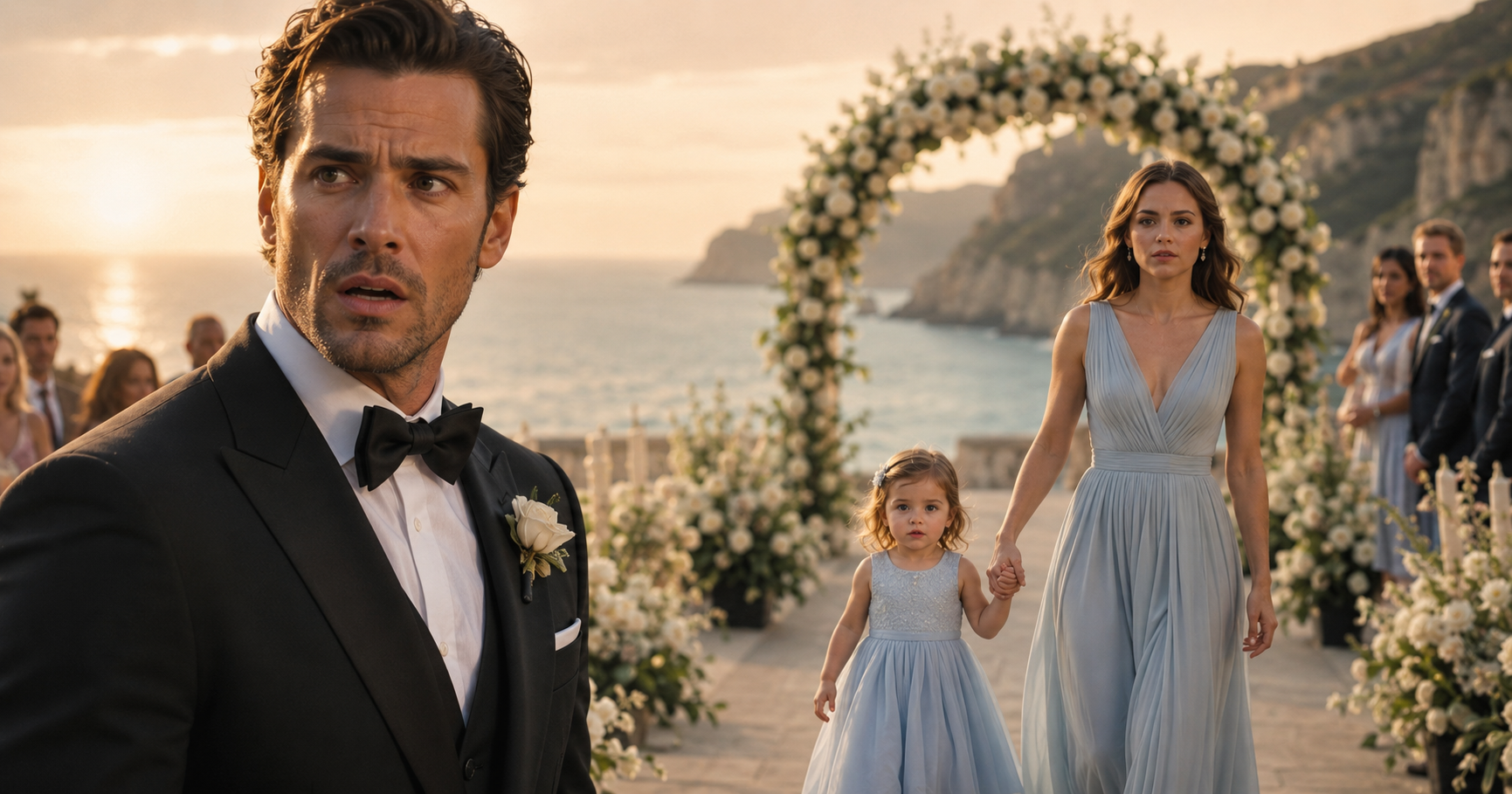
Adrian Vale had never feared a boardroom.
He had walked into rooms where men twice his age waited to tear him apart. He had sat across from ministers, rivals, prosecutors, investors, and enemies who smiled with polished teeth while hiding knives beneath contracts. He had built Vale Meridian from a half-ruined inheritance into a global empire with his name engraved across glass towers, private terminals, hospital wings, and charity foundations.
But one cream-colored envelope on his desk had managed to unsettle him more than any hostile takeover ever had.
The invitation lay beside his untouched coffee.
Vivienne Hart and Thomas Bell request the honor of your presence…
Adrian had known Vivienne since college. She had been one of the rare people who could enter his office without trembling, insult his tie, steal his espresso, and leave with a donation check for whatever charity had captured her heart that month. She had also been one of the few people who had refused to choose sides when Adrian’s marriage collapsed.
At the bottom of the invitation, written in Vivienne’s looping handwriting, was one extra sentence.
I invited Mara too. Be civil, or I’ll seat you with my grandmother and her bridge club.
Adrian stared at the name for a long time.
Mara.
Three years had passed since he had last seen Mara Ellis Vale standing in the doorway of their Pacific Heights house, one hand around the handle of a small suitcase, her wedding ring sitting on the marble console behind her like something already dead.
He still remembered what she had said.
“I’m tired of begging you to come home to a life you never wanted.”
He had told himself she was being dramatic. He had told himself she would cool down. He had told himself love could wait until after the merger, after the lawsuit, after the Singapore expansion, after every fire he believed only he could put out.
By the time he understood that she was gone, she had already changed her number, moved out of the city, and signed the divorce papers without asking for a single share of his fortune.
That had hurt him more than he admitted.
Not because of the money.
Because Mara had refused to profit from losing him.
Now, three years later, he was holding an invitation to a wedding where she would be standing under spring trees in a pretty dress, perhaps laughing with some man who knew how to answer messages, keep promises, and eat dinner before midnight.
Adrian told himself not to go.
Then he ordered his tuxedo pressed.
The wedding was held on the coast, at a white estate above the ocean where the grass rolled toward cliffs and the wind smelled like roses, salt, and money old enough to pretend it was modest. Guests drifted across the lawn in silk and linen. Champagne caught the sun in tall glasses. A string quartet played something delicate beneath a floral arch.
Adrian arrived late enough to avoid small talk and early enough to prove he was not hiding.
That was the first lie of the day.
He was absolutely hiding.
He stood near the stone terrace with a glass he had no intention of drinking, watching the guests gather for the ceremony. Several people greeted him. He nodded. He smiled when required. He endured congratulations for a hospital acquisition, a magazine cover, a speech at some summit he barely remembered giving.
All the while, his eyes kept searching the crowd.
He saw Vivienne first.
She looked radiant, nervous, and dangerous in the way brides became dangerous when they had planned an event for fourteen months and suspected someone might ruin it.
She spotted him and pointed two fingers at her eyes, then at him.
Behave.
Adrian almost smiled.
Then the smile died.
Mara had arrived.
For one suspended second, the entire wedding seemed to blur around her.
She was standing at the edge of the lawn in a pale blue dress that moved softly in the wind. Her dark hair was shorter than he remembered, pinned loosely at the back of her neck, with a few strands escaping around her face. She looked older. Not in a cruel way. In a real way. As if life had asked something of her and she had answered without applause.
Adrian’s hand tightened around his glass.
She was not alone.
A little girl stood beside her, one small hand wrapped in Mara’s fingers.
She could not have been more than two.
She wore a white cardigan over a yellow dress, with tiny shoes and a ribbon slipping loose from her curls. She was looking around the lawn with serious gray eyes, the kind of eyes that studied before they trusted.
Adrian forgot to breathe.
The child turned her head.
Sunlight touched her face.
And Adrian saw himself.
Not vaguely. Not in the flattering way strangers said babies looked like everyone.
He saw the sharp little line of concentration between her brows. He saw the dark lashes. He saw the same gray eyes that looked back at him from every mirror before dawn.