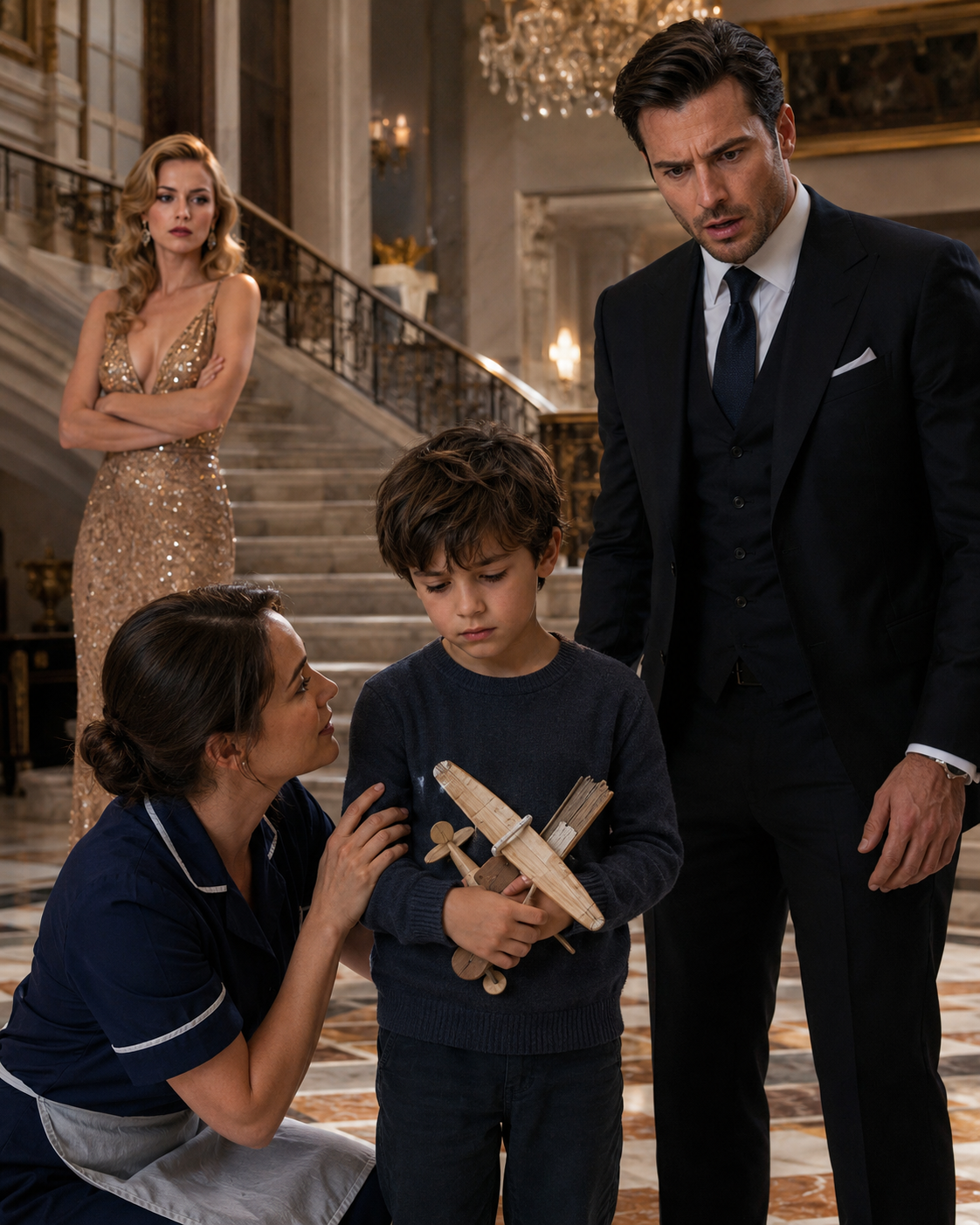
The Billionaire Hired a Housekeeper for His Silent Son — But When His Fiancée Threw Her Out, the Boy Finally Spoke

For almost three years, no one in the Whitmore mansion had heard little Oliver Whitmore say a single word.

Not “good morning.”

Not “father.”

Not even “help.”

The doctors called it selective mutism. The therapists called it trauma. The expensive specialists, flown in from Boston, Geneva, and London, used longer words that sounded impressive and changed nothing. They all left the mansion with polished briefcases, generous checks, and the same helpless look in their eyes.

But Adrian Whitmore refused to accept that his son was broken.

Oliver had not always been silent. Before his mother died, the boy had been full of questions. He used to run through the corridors with toy airplanes in his hands, shouting facts about clouds, engines, stars, and birds. He used to wake his father before sunrise just to tell him he had dreamed of the ocean.

Then his mother’s car went off an icy road one December evening.

After the funeral, Oliver stopped speaking.

At first, Adrian thought it was grief. Then months passed. Then a year. Then two. The mansion grew quieter than a museum, and Oliver moved through it like a little ghost in clean clothes.

Adrian built business towers, bought failing companies, negotiated billion-dollar deals, and frightened men twice his age into silence. But at home, he could not make one seven-year-old child look him in the eye.

He tried everything money could buy.

Private tutors.

Child psychologists.

Music therapy.

Art therapy.

A small therapy pony named Biscuit, who lasted three days before Oliver refused to come outside.

Nothing worked.

And then, on a rainy Tuesday morning, a woman named Clara Bennett arrived at the mansion to interview for the housekeeper position.

She was not what Adrian expected.

She wore a simple navy coat, old but carefully brushed. Her hair was tied at the back of her neck. She carried no designer bag, no printed résumé in a leather folder, no rehearsed smile. She was not young enough to be nervous or old enough to seem tired. She had the calm face of someone who had survived difficult things without letting them turn her cruel.

Mrs. Vale, the mansion’s head of staff, introduced her in the front hall.

“Mr. Whitmore, this is Clara Bennett. She worked for the Harrington family for six years before they moved to Paris.”

Adrian glanced at the file in his hand. “You left that position voluntarily?”

“Yes, sir.”

“Why?”

Clara did not hesitate. “Because Mrs. Harrington wanted me to lie about something I had seen.”

Mrs. Vale stiffened. Most applicants knew better than to begin an interview by admitting trouble with a previous employer.

Adrian looked up. “And what had you seen?”

“A child being blamed for something an adult did.”

For the first time that morning, Adrian closed the file.

The answer was too direct to be polished. Too dangerous to be rehearsed. And for reasons he did not understand, it made him listen.

Before he could ask another question, a small sound came from the staircase.

Oliver stood halfway down, barefoot despite the cold marble floor, clutching the wooden airplane his mother had bought him years ago. His dark hair fell over his eyes. His gaze was fixed on Clara.

Everyone in the hall froze.

Oliver never came downstairs when strangers were present.

Never.

Clara did not smile too quickly. She did not rush toward him. She simply turned her head and looked at the toy airplane in his hands.

“That is a beautiful plane,” she said gently. “It looks like it has flown through many storms.”

Oliver’s fingers tightened around it.

Adrian waited, his breath caught somewhere in his chest.

Oliver said nothing.

But he did not run away.

That was enough.

Clara was hired before lunch.

For the first few days, she performed her duties quietly. She polished the breakfast room, arranged fresh towels, checked the pantry, and learned the rhythm of the mansion without asking unnecessary questions. The other staff liked her because she did not gossip. Mrs. Vale respected her because she worked without complaint. Adrian noticed her because Oliver began appearing wherever she was.

If Clara dusted the library, Oliver sat behind the armchair with his plane.

If she folded linens, he stood near the doorway.

If she carried soup to the kitchen, he followed at a distance, silent but watchful.

Most people made the mistake of trying to pull words out of him. Clara never did.

She spoke around him, not at him.

“The rain is loud today.”

“This hallway is too proud of itself. It echoes everything.”

“I once knew a boy who believed airplanes needed stories to fly properly.”

Oliver listened.

One afternoon, Clara found him sitting beneath the grand piano, knees pulled to his chest, his wooden airplane resting beside him.

She lowered herself to the floor several feet away, not close enough to frighten him.

“My brother used to hide under tables,” she said, as if speaking to the room. “He said the world sounded softer from there.”

Oliver stared at the piano leg.

Clara opened a small sewing kit and began repairing a tear in the edge of a dust cloth.

“People always told him to come out. That never worked. So I brought him biscuits and talked about clouds until he decided the table was boring.”

Oliver did not smile.

But the next day, when Clara cleaned the music room, she found a small plate under the piano.

On it was one untouched biscuit.

Beside it lay a folded paper airplane.

Clara kept it.

By the end of the second week, the mansion had changed in ways Adrian could not explain.

Oliver began eating more.

He stopped waking from nightmares every night.

He let Clara open the curtains in his bedroom.

He even sat at the breakfast table for twelve full minutes while Adrian pretended not to stare.

Hope is a dangerous thing when it returns to a house that has forgotten how to hold it.

Adrian knew that better than anyone.

He also knew that his fiancée, Vanessa Crowe, did not like Clara.

Vanessa was beautiful in a way that seemed expensive before one even saw the jewelry. She had perfect hair, perfect posture, perfect instincts for being photographed beside powerful men. She had entered Adrian’s life two years after his wife’s death, at a charity auction where she spoke softly about children’s hospitals and smiled at Oliver as if he were an accessory she hoped would behave.

Adrian had proposed because it made sense.

The board liked her.

The newspapers liked her.

His social circle approved of her.

And most importantly, she seemed willing to tolerate the silence inside his house.

But tolerate was not the same as love.

Clara understood that almost immediately.

Vanessa visited the mansion three or four times a week, usually arriving in perfume, diamonds, and impatience. Whenever Oliver entered the room, she softened her voice dramatically.

“Sweetheart,” she would say, “come give Vanessa a hug.”

Oliver always stepped back.

Vanessa’s smile never changed, but her eyes did.

One morning, Clara entered the breakfast room carrying fresh orange juice and found Vanessa leaning over Oliver’s chair.

“You know,” Vanessa whispered, not realizing Clara was behind her, “your father cannot keep living like this forever. People will start to think there is something wrong with this family.”

Oliver stared at his plate.

Vanessa touched his shoulder.

“If you loved him, you would try harder.”

The glass pitcher in Clara’s hand almost slipped.

“Miss Crowe,” she said.

Vanessa turned sharply.

Clara placed the pitcher on the sideboard. Her voice remained polite, but something in it had gone cold.

“Mr. Whitmore asked that Oliver not be pressured at meals.”

Vanessa straightened. “I do not take instructions from the help.”

“No,” Clara said. “But you should take them from kindness.”

The silence that followed was sharp enough to cut crystal.

Vanessa smiled.

Not warmly.

Not kindly.

Like a woman choosing where to place a knife.

That evening, Vanessa told Adrian that Clara had become disrespectful.

Adrian listened from behind his desk, one hand resting against his temple. It had been a brutal day. A merger collapsing in Singapore. A lawsuit in Chicago. A board member threatening to resign. And now Vanessa stood before him in a cream silk dress, saying the new housekeeper was becoming too attached to Oliver.

“She is not family,” Vanessa said. “You cannot let a servant confuse your son.”

Adrian looked up. “Oliver is improving.”

“Is he?” Vanessa asked softly. “Or is he becoming dependent on a woman you barely know?”

That question stayed with him longer than it should have.

Because Adrian Whitmore trusted numbers, contracts, and evidence. He did not trust miracles. And Clara Bennett had walked into his house like one.

A week later, he left for a two-day business trip to Manhattan.

Before leaving, he stopped outside Oliver’s bedroom. The door was open. Clara was sitting near the window, reading aloud from a book about migrating birds while Oliver sat on the rug with his airplane.

Adrian watched unseen.

Clara read, “Some birds know the way home because they remember the stars.”

Oliver looked up at her.

His lips parted slightly.

Adrian’s heart slammed against his ribs.

But no sound came.

Clara did not push him. She simply turned the page.

Adrian left for Manhattan carrying that almost-word with him.

He did not know it would be the last peaceful moment in his house for a long time.

The next afternoon, Vanessa arrived at the mansion with two suitcases and a decision.

Mrs. Vale met her in the hall. “Miss Crowe, Mr. Whitmore is not expected until tomorrow evening.”

“I know,” Vanessa said, removing her gloves. “That is why I came today.”

By sunset, Clara had been accused of overstepping boundaries, manipulating Oliver, stealing family trust, and trying to secure a permanent place in the household.

She denied nothing angrily. She explained calmly. That only made Vanessa more furious.

“You think because the boy follows you around, you matter?” Vanessa said in the sitting room, where Oliver stood hidden behind the half-open door. “You are a housekeeper. You clean floors. You do not heal children.”

Clara’s face tightened, but her voice stayed steady. “Oliver should not hear this.”

“Oliver hears too little already.”

“Please lower your voice.”

Vanessa stepped closer. “Pack your things.”

Mrs. Vale protested. The cook protested. Even the driver, who rarely spoke, said Mr. Whitmore should be called first.

Vanessa lifted her chin. “I will be his wife in six weeks. This is my home too.”

Clara looked toward the door.

She saw a glimpse of Oliver’s sleeve.

Her expression changed.

Not fear.

Not anger.

Sorrow.

She understood that if she fought, the child would believe love always ended in shouting.

So she packed one small suitcase.

Before leaving, she walked to the bottom of the staircase. Oliver stood at the top, pale and trembling, both hands gripping the railing.

Clara wanted to run up to him.

She did not.

“Storm planes still fly,” she said gently.

Oliver’s eyes filled with tears.

Vanessa crossed her arms. “How touching.”

Clara turned and left the mansion in the rain.

The front door closed.

Oliver made no sound.

Then he dropped the wooden airplane.

It struck the marble floor and broke one wing clean off.

When Adrian returned the next evening, the mansion felt wrong before he reached the front steps.

No one met his eyes.

Mrs. Vale looked as if she had not slept.

Oliver was not in the breakfast room, not in the library, not under the piano.

Adrian found him in his bedroom, sitting on the floor beside the broken airplane.

“Where is Clara?” Adrian asked.

Oliver did not look up.

Mrs. Vale stood in the doorway behind him. “Mr. Whitmore…”

He turned slowly. “Where is Clara?”

Vanessa appeared at the end of the hall, dressed in pale blue, calm as a winter lake.

“I let her go,” she said.

Adrian stared at her. “You what?”

“She had become inappropriate.”

His voice dropped. “You fired the one person my son trusted while I was away?”

“She was confusing him.”

Adrian walked toward her. “No. You were jealous of her.”

Vanessa’s face hardened for half a second before the practiced sadness returned. “I am trying to protect this family.”

Behind them, a small sound came from Oliver’s room.

At first, Adrian thought it was a sob.

Then he heard it again.

A cracked whisper.

“No.”

Everyone froze.

Adrian turned.

Oliver stood in the doorway, clutching the broken airplane against his chest. His face was wet with tears, but his eyes were fixed on Vanessa.

He had spoken.

For the first time in almost three years, Oliver Whitmore had spoken.

Vanessa put a hand over her mouth. “Oliver…”

The boy stepped back from her.

His voice was small, rough, unused.

“No. Not her.”

Adrian could not breathe.

Mrs. Vale began crying silently.

Oliver looked at his father.

“She didn’t hurt me,” he whispered. “She heard me.”

Adrian dropped to one knee in front of his son, afraid that if he moved too quickly the moment would disappear.

“Oliver,” he said, his voice breaking. “Tell me what happened.”

The boy’s lower lip trembled.

“She told me Mommy left because I was too much.”

Adrian went still.

The hallway seemed to tilt.

Vanessa’s face emptied.

“That is not true,” she said quickly.

Oliver flinched.

Adrian rose to his feet.

“What did you say to my son?”

Vanessa stepped backward. “He misunderstood. Children misunderstand everything.”

But Oliver shook his head.

Words came slowly now, each one dragged from a place where he had buried them to survive.

“She said if I stayed quiet, you would still love me. She said if I talked about Mommy, you would send me away.”

Adrian felt something inside him turn colder than rage.

He looked at Vanessa, and for the first time he saw not the elegant woman the world admired, but the patient cruelty behind the diamonds.

“How long?” he asked.

Vanessa’s mouth opened.

“How long have you been saying things to him?”

“I was trying to help him move on.”

“No,” Adrian said. “You were trying to erase my wife from my son’s heart.”

Vanessa’s eyes flashed. “Your wife is dead, Adrian. And this house has been worshiping a ghost for years.”

Oliver began to shake.

Adrian turned away from Vanessa immediately and lifted his son into his arms. Oliver did not resist. He buried his face against his father’s shoulder and cried with sound for the first time since the funeral.

That sound broke Adrian more completely than silence ever had.

Vanessa left the mansion that night, not with drama, not with a scandal, but with the quiet finality of a door closing on a lie.

The engagement was ended before morning.

The newspapers would later call it a private family matter. The board would ask no questions. People like Adrian Whitmore could make entire storms disappear when necessary.

But he could not undo what had been done to his child.

And he could not find Clara.

Mrs. Vale had only one address, a small apartment on the east side of town. By the time Adrian arrived there, Clara was gone. The landlord said she had paid two weeks early, returned her key, and left no forwarding information.

For three days, Oliver spoke only one sentence.

“Find Clara.”

Adrian used every resource he had.

Private investigators.

Employment records.

Old references.

Hospital records.

Train stations.

Bus terminals.

But Clara Bennett had lived most of her life quietly, and quiet people can disappear in ways rich men do not understand.

On the fourth night, Adrian found Oliver sitting at his mother’s old writing desk.

The broken wooden airplane lay before him.

Beside it was a folded paper airplane.

“Clara made that?” Adrian asked.

Oliver nodded.

Adrian unfolded it carefully.

Inside, in neat handwriting, were seven words.

Storm planes still fly toward the light.

Below the words was a small drawing of a lighthouse.

Adrian stared at it.

A memory stirred.

During her interview, Clara had mentioned that before working for the Harringtons, she had cared for her younger brother in a coastal town after their parents died. A town with a lighthouse. He remembered because she had said it without asking for pity.

“Harbor Point,” Adrian whispered.

Oliver looked up.

The next morning, father and son drove three hours through gray rain toward the coast.

They found Harbor Point just before sunset, a small town of wet streets, old boats, salt wind, and gulls crying over the harbor. Adrian had never been anywhere that looked less like his world.

At the diner near the pier, a waitress recognized Clara’s photograph.

“She came back two days ago,” the woman said. “She’s staying above the old bookshop.”

Adrian thanked her and left a tip large enough to make her stare.

The bookshop was closed when they arrived.

A warm light glowed in the upstairs window.

Adrian stood on the sidewalk holding Oliver’s hand. For the first time in years, he was afraid of asking for something money could not command.

“Do you want me to go first?” he asked.

Oliver shook his head.

Together, they climbed the narrow stairs beside the shop.

Adrian knocked.

Footsteps approached.

The door opened.

Clara stood there in a gray sweater, her hair loose around her face. She looked tired. Sad. Still gentle.

Then she saw Oliver.

Her hand flew to her chest.

Oliver stared up at her, trembling.

For a moment, no one spoke.

Then Oliver took one step forward.

“Clara,” he whispered.

Clara covered her mouth as tears filled her eyes.

Adrian looked away because the tenderness of that moment felt too private, even for a father.

Clara knelt.

Oliver ran into her arms.

She held him carefully, as if he were both fragile and brave.

“You flew through the storm,” she whispered.

Oliver nodded against her shoulder.

Adrian stood in the doorway, a billionaire with nothing useful to offer except the truth.

“I failed him,” he said.

Clara looked up.

“I trusted the wrong person,” he continued. “I mistook quiet for healing. I mistook appearances for love. And I let you be thrown out of my home when you were the only person brave enough to protect my son without asking for anything.”

Clara wiped her tears. “I never wanted anything from you, Mr. Whitmore.”

“I know,” Adrian said. “That is why I am asking, not ordering.”

Clara waited.

“Come back,” he said. “Not as a housekeeper if you do not want that. Come back as someone Oliver trusts. As someone this house should have protected. I will arrange any role, any salary, any conditions you choose.”

Clara looked down at Oliver.

The boy pulled back just enough to look at her face.

“Please,” he said.

One word.

Small.

Unsteady.

Powerful enough to change everything.

Clara closed her eyes.

“I will come back,” she said softly. “But not for your money.”

Adrian nodded. “I understand.”

“And not to replace anyone.”

His throat tightened. “No one could.”

Clara looked at Oliver. “I will come back because some planes still need help remembering the sky.”

Six months later, the Whitmore mansion no longer felt like a museum.

The curtains were open more often. The piano was played badly but enthusiastically. Oliver spoke in fragments at first, then sentences, then questions that spilled out faster than Adrian could answer.

He asked about birds.

He asked about engines.

He asked about his mother.

And Adrian answered every time.

Clara remained in the house, not as a servant hidden below stairs, but as the director of a new family foundation for children recovering from grief. It had been Adrian’s idea, but Clara’s condition was simple: no charity galas built for headlines. Real help first. Photographs never.

Adrian agreed.

People in society whispered, of course.

They whispered that the billionaire had lost his fiancée because of a housekeeper.

They whispered that the housekeeper had somehow captured his son’s heart.

They whispered that Adrian Whitmore had changed.

They were right about the last part.

One spring morning, Adrian found Clara in the garden helping Oliver repair the wooden airplane. Its broken wing had been sanded smooth and reattached with careful hands. It would never look new again.

That made it more beautiful.

Oliver lifted it into the air.

“Ready?” Clara asked.

Oliver nodded.

Adrian stood behind them, watching his son smile toward the open sky.

“Storm planes still fly,” Oliver said.

Then he turned to his father.

“Right, Dad?”

Adrian could not speak for a moment.

He had spent years trying to bring his son back.

In the end, it had taken a woman he almost failed to protect, a truth he had been too blind to see, and a broken airplane that still remembered how to fly.

“Yes,” Adrian said at last. “They do.”

Oliver threw the plane.

It rose on the wind, dipped once, and then carried forward into the sunlight.

The Billionaire Hired a Housekeeper for His Silent Son — But When His Fiancée Threw Her Out, the Boy Finally Spoke
14 times when they wanted to take a normal photo, but ended up with a masterpiece