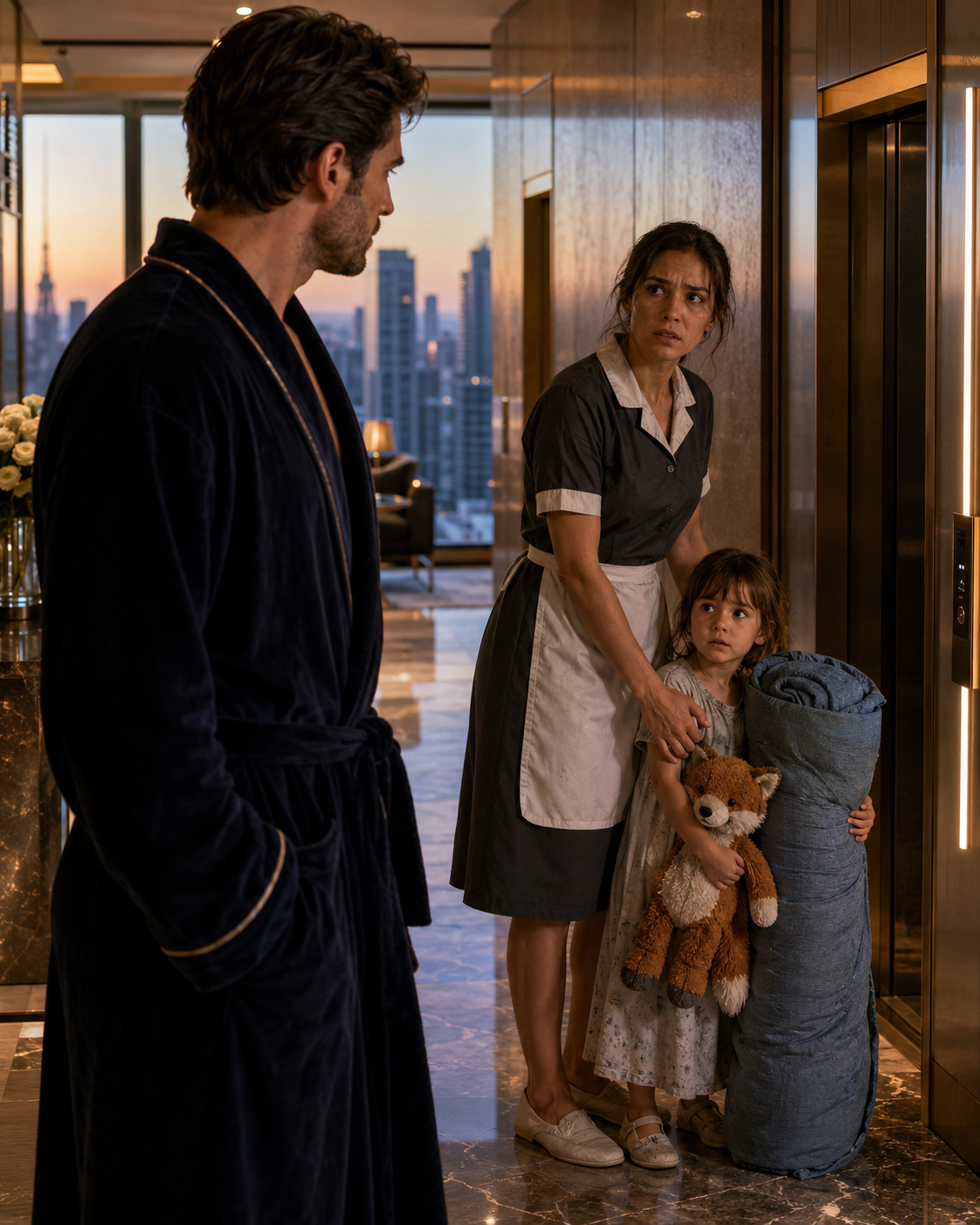
Julian understood the difference because his mother had taught him.
Somewhere between private equity meetings and glass elevators, he had forgotten.
At seven, Mara rolled the mattress, folded the blanket, and hid their tiny secret behind a utility cabinet with painful efficiency. Luna woke enough to take her mother’s hand.
As they left, she turned and waved.
“Bye, hallway man.”
Mara closed her eyes. “Luna.”
Julian smiled for the first time that morning. “I’ve been called worse.”
Luna considered this seriously. “Bye, Mr. Hallway.”
Then she vanished down the service stairs.
By noon, Julian had canceled two investor calls.
By one, he had requested the Clearline contract.
By two, his assistant, Nora Bell, had a list of every emergency overnight childcare resource in Chicago.
By three, Julian had learned that Clearline employees assigned to Solstice Tower had no childcare stipend, no emergency family assistance, no paid sick leave for the first eighteen months, and a disciplinary system strict enough to make poverty look like misconduct.
Mara had already received two warnings.
One for missing a shift when Luna had a fever.
One for leaving early after her mother fell in the bathroom back in Ohio.
By four, Julian was furious.
Not loudly.
Not dramatically.
His anger went still, the way deep water looks calm before it breaks something.
That evening, his fiancée arrived.
Vivienne Ashcroft stepped out of the elevator in a white wool coat, pearl earrings, and the effortless certainty of a woman born into rooms where people lowered their voices when she entered.
She was beautiful in a polished, expensive way. Golden hair. Perfect posture. A smile trained by generations of social power.
Her family name appeared on museum walls, hospital wings, university buildings, and political donation lists.
Julian had once admired her command of a room.
Lately, he had begun to wonder what it cost everyone else.
They were supposed to discuss the wedding.
Vivienne wanted a June ceremony at her family estate by the lake, followed by a glass-tent reception so elaborate it required climate planning, custom flooring, and a floral budget larger than most yearly salaries.
Halfway through dinner, while she described peonies like military assets, Julian interrupted.
“There’s a woman who cleans this building at night.”
Vivienne lifted her wineglass. “All right.”
“Her name is Mara Ortiz. She has a little girl named Luna.”
Vivienne waited.
“She has been bringing Luna here because she has no overnight childcare.”
The glass paused halfway to Vivienne’s mouth.
“The child sleeps in the service stairwell,” Julian said.
Vivienne lowered the glass. “Here?”
“Yes.”
“In Solstice Tower?”
“Yes.”
Her eyes sharpened.
Not with horror.
With calculation.
“That is a serious liability.”
Julian leaned back. “That was your first thought?”
“It should be yours too.”
“My first thought was that the child was cold.”
Vivienne sighed in the gentle way she used when she wanted to sound reasonable and superior at the same time.
“Darling, of course it’s sad. But buildings have policies. Restricted areas exist for a reason. If every employee brought children into workspaces, there would be chaos.”
“She isn’t every employee. She’s one woman with no options.”
“Everyone has options.”
The sentence sat between them like something spoiled beneath silk.
Julian looked at the woman he was supposed to marry and felt distance open inside him.
“My mother used to take me to work,” he said. “When she couldn’t find anyone to watch me.”
Vivienne’s expression softened immediately.
But it softened for him.
Not for Mara.
“That was different,” she said.
“Why?”
“You were her son.”
“Luna is Mara’s daughter.”
Vivienne set down her fork. “You know what I mean.”
“I’m trying to.”
Her jaw tightened. “You are generous, Julian. It’s one of the things people admire about you. But sometimes you let your childhood turn every unfortunate situation into a personal crusade. You cannot rescue everyone from the consequences of poor choices.”
He stared at her.
A second too late, she seemed to hear herself.
“I didn’t mean that cruelly.”
“That may be the problem.”
The dinner ended politely because Vivienne Ashcroft did not make scenes. She kissed his cheek, reminded him that the florist needed a final answer, and left in a cloud of winter perfume.
Julian stood alone after the elevator doors closed.
Then he went to the refrigerator.
A magnet held a photograph of him and his mother at the opening of the Rose Vale Family Center in Detroit. His mother had died before she could see it completed, but he had built it in her name. The center offered emergency childcare for parents attending night classes, medical appointments, interviews, and court hearings.
He had built a place like that in another city.