Not because custody hearings usually drew crowds.
Because everyone in Millstone had heard.
The feared biker.
The stolen daughter.
The granddaughter in the wheelchair.
The woman who had built a life on a lie.
Vivian Cross appeared in a wheelchair of her own, pushed by a private nurse. She was eighty-four, thin, powdered, and dressed in pale lavender. Age had softened her body but not her eyes.
When she saw Iron, she looked away.
When she saw Noelle, she smiled.
Noelle moved closer to Ruth.
Iron saw it.
So did the judge.
Vivian’s lawyer spoke first.
He painted Iron as a dangerous relic. A man with violent associations. A man whose life was unsuitable for a medically fragile child. He described Vivian as a grieving elder who had already lost one granddaughter and now wished only to protect her great-grandchild.
Then Daniel stood.
He did not shout.
He did not dramatize.
He simply laid out the paper trail.
The fake death certificate.
The payment to Ellen Price.
The hidden note.
The recording.
Lily’s guardianship request.
Ruth’s testimony.
Sheriff Mercer’s testimony.
The retired nurse’s testimony.
By the time Daniel finished, the courtroom felt less like a legal proceeding and more like a room full of people standing around a wound.
Finally, Vivian asked to speak.
The judge allowed it.
Her nurse pushed her chair forward.
Vivian’s hands rested neatly in her lap.
“I did what I believed was necessary,” she said.
Iron’s face did not move.
Noelle watched from beside Ruth.
Vivian looked at the judge.
“My daughter married a violent man. A criminal. A biker. I knew what kind of life that child would have. Noise. Filth. Danger. Men coming and going. I had the means to place her somewhere respectable.”
The judge’s expression hardened.
“You allowed two parents to believe their newborn child was dead.”
Vivian’s mouth tightened.
“I allowed my daughter to survive.”
Iron stood so quickly his chair scraped the floor.
Daniel caught his arm.
The judge looked sharply at him.
“Mr. Vale.”
Iron breathed hard once.
Then sat.
Vivian finally looked at him.
Her eyes were cold.
“You would have ruined her.”
Iron’s voice was low.
“You never met the father I would have been.”
Something flickered across Vivian’s face.
Not remorse.
Irritation.
As if his grief was an inconvenience.
Noelle suddenly spoke.
“Can I say something?”
The courtroom turned.
Daniel whispered, “Only if the judge allows it.”
The judge studied her kindly.
“You may, Noelle.”
Ruth wheeled her forward.
Noelle’s heart hammered.
She hated everyone looking at her. She hated courtrooms. She hated adults deciding where children belonged as if children were furniture being moved from one house to another.
But she thought of her mother.
Of the hospital bed.
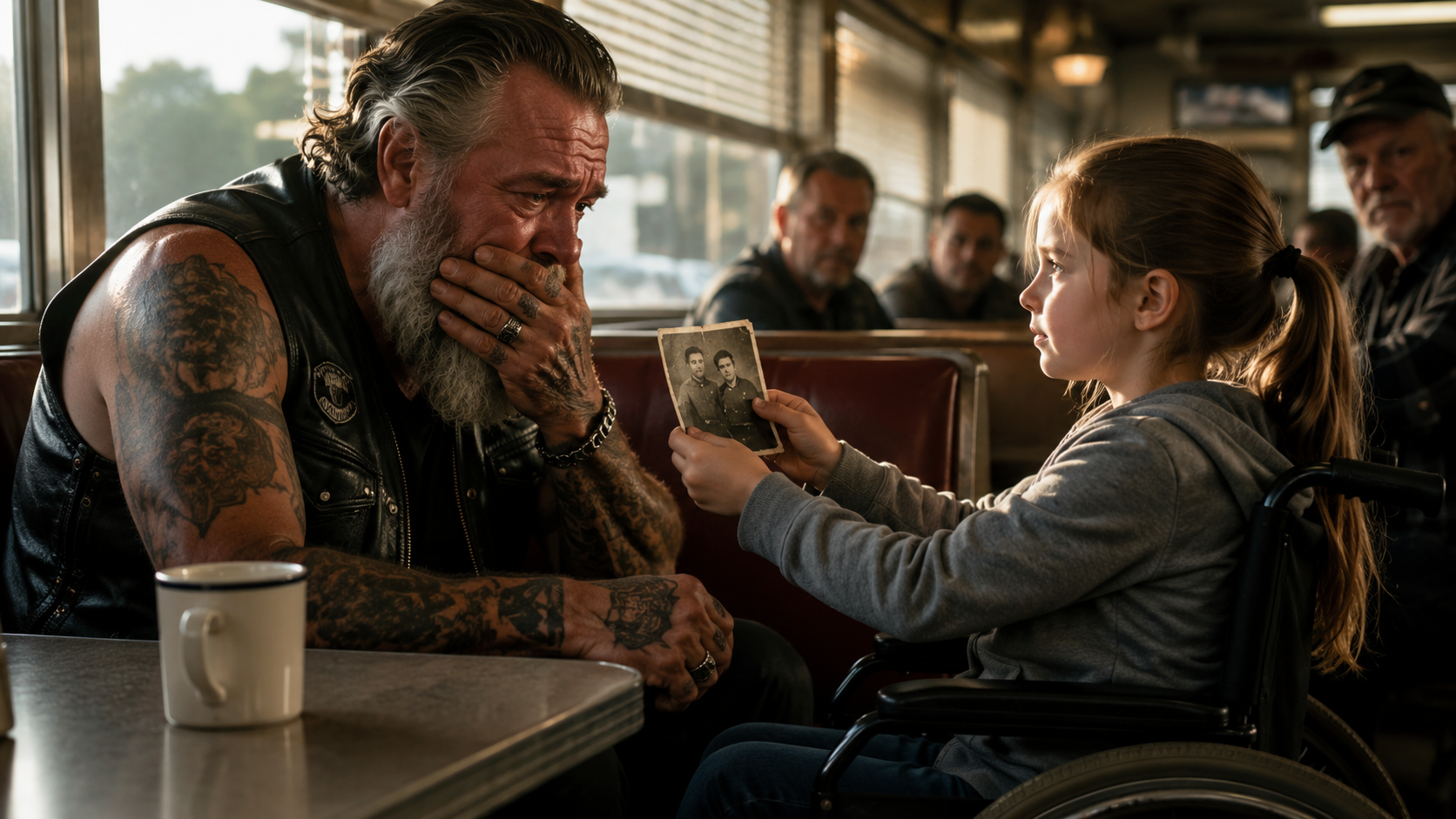
Of the photograph.
Of the sign.
We found you, Grandpa.
She looked at Vivian first.
“You said you saved my mom.”
Vivian’s face softened into something fake.
“I did, sweetheart.”
Noelle shook her head.
“No. You gave her a nice house maybe. Maybe pretty clothes. Maybe good schools. But you made her think her father threw her away.”
Vivian’s smile faded.
Noelle’s voice trembled, but she kept going.
“My mom spent her whole life thinking she wasn’t wanted. That does something to a person. It makes them say sorry when they’re hurt. It makes them afraid to ask for too much. It makes them keep pictures hidden under floorboards because they don’t know if love is allowed.”
Iron closed his eyes.
Noelle looked at him next.
“I don’t know Grandpa very well yet.”
Iron opened his eyes.
“But when he found out about me, he didn’t ask what I cost. He didn’t ask how hard my chair would make things. He didn’t ask if I was too much trouble.”
Her eyes filled.
“He asked if I was safe.”
The courtroom was silent.
“That’s where I want to be,” Noelle said. “With someone who asks that first.”
The judge made her decision that afternoon.
Temporary guardianship was granted to Harlan Vale, under supervision, pending final review.
Vivian Cross was denied unsupervised contact.
A criminal investigation was recommended.
When the gavel came down, Noelle did not cheer.
Iron did not smile.
Not at first.
They simply looked at each other across the table, both stunned by the same impossible thing.
They had not won back the years.
They had not brought Lily home.
They had not undone the coffin, the lies, the lonely birthdays, the hospital room, or the final breath of a daughter who died before hearing her father say her name.
But they had saved what remained.
Iron walked to Noelle and crouched in front of her.
“Ready to go home?” he asked.
Noelle studied him.
Then she nodded.
“Home sounds okay.”
Outside the courthouse, the parking lot was full of motorcycles.
Not roaring.