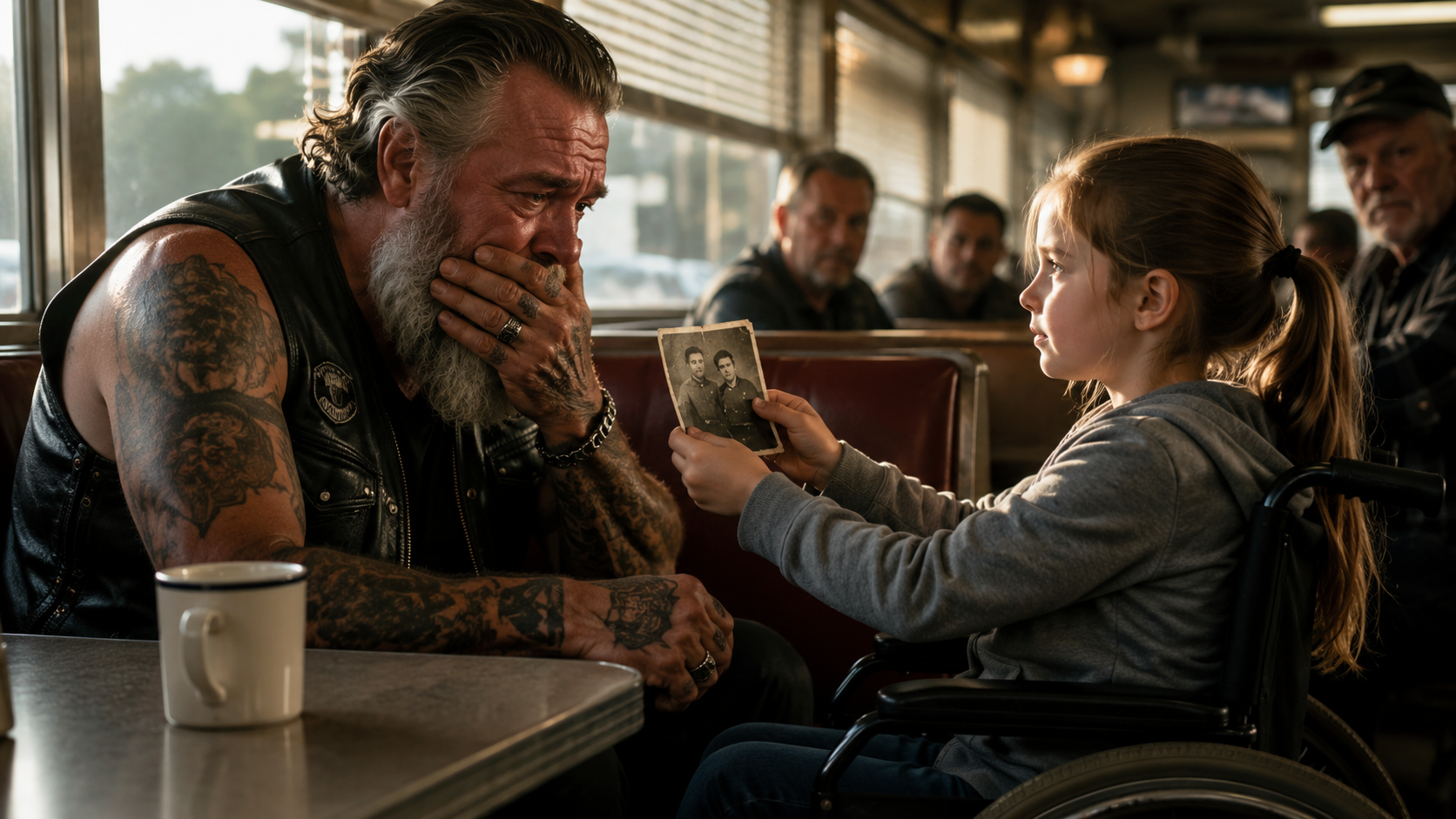
The Biker Everyone Feared Had Buried His Daughter 28 Years Ago — Then a Little Girl Rolled Into the Diner Holding Her Photo

Nobody in Millstone County spoke the name Harlan Vale unless they had to.

Most people called him Iron.

Not because he was strong, though he was. Not because he rode a black Harley that sounded like thunder rolling through a graveyard, though he did that too. They called him Iron because everyone believed there was nothing soft left inside him.

He had the kind of face that made strangers lower their voices. A wide jaw covered in gray stubble. A crooked nose that had been broken more than once. A scar that cut through his left eyebrow and disappeared into the weathered lines beside his eye. His hands were enormous, rough, and tattooed, the hands of a man who had fixed engines, thrown punches, buried friends, and carried grief so long it had become part of his bones.

Every morning at six, Iron walked into Maggie’s Diner and sat in the last booth by the window.

Every morning, Maggie poured his coffee before he asked.

Every morning, no one sat too close.

The booth had become his by silent law. Truckers avoided it. Teenagers whispered when they passed it. Even the sheriff, who had known Iron since they were boys, never sat across from him unless invited.

And Iron almost never invited anyone.

For twenty-eight years, he came to that booth alone.

He drank black coffee.

He stared out at the highway.

And on the date that nobody else remembered anymore, he placed a folded white napkin beside his cup and touched it with two fingers like a prayer.

That date was September 14th.

The day his baby girl had died.

Or so he had been told.

Her name had been Lily Grace Vale.

She had lived three days.

Three days of hospital lights. Three days of tiny breaths. Three days of Iron standing beside a glass nursery window, looking at a baby wrapped in a yellow blanket, terrified to touch her because his hands were too big and his world was too dangerous.

Then the doctors said there had been complications.

His wife, Mara, had screamed until her voice broke.

Iron had not screamed.

He had stood still.

That was what everyone remembered.

The big biker standing beside a tiny white coffin with rain dripping from his beard and no expression on his face.

People thought he felt nothing.

They were wrong.

Iron had felt everything.

He had simply learned that if he let the pain out, it might burn down the whole town.

So he buried it.

He buried it under miles of road.

Under engine noise.

Under whiskey.

Under fights.

Under silence.

Under twenty-eight years of pretending a man could survive losing his only child if he just refused to say her name out loud.

Then, on a cold Tuesday morning, the bell above Maggie’s Diner door rang at 6:17.

Iron did not turn around.

He heard everything, though.

The soft squeak of wheels.

The careful steps of someone walking behind them.

The sudden quiet that moved through the diner like a hand passing over a candle flame.

Forks stopped scraping plates.

Maggie stopped pouring coffee.

Someone whispered, “Lord have mercy.”

Only then did Iron look up.

A little girl had rolled into the diner in a wheelchair.

She was small, maybe eight or nine, with dark hair braided over one shoulder and a face too serious for a child. A faded blue blanket lay across her lap. One wheel of her chair had a strip of silver tape around the rim. On the back hung a cloth backpack covered with tiny embroidered suns.

Behind her stood an elderly Black woman in a green coat, gripping the handles of the wheelchair like she was ready to turn it around and run.

The girl looked around the diner until her eyes found Iron.

She did not flinch.

That was the first thing he noticed.

Grown men flinched when they met his eyes.

This child did not.

She rolled forward.

The diner seemed to hold its breath.

Iron watched her approach his booth, his expression unreadable. He saw Maggie take one small step out from behind the counter. He saw Sheriff Dale Mercer lower his newspaper. He saw two young mechanics near the door suddenly become very interested in their plates.

The child stopped beside Iron’s table.

Her hands rested on the wheels.

Her knuckles were pale.

“Are you Harlan Vale?” she asked.

Iron’s fingers tightened around his coffee cup.

Nobody called him Harlan.

Not anymore.

“Who’s asking?”

Her chin lifted slightly.

“My name is Noelle Hart.”

The old woman behind her whispered, “Noelle, honey…”

But the girl ignored her.

She reached into the pocket of her backpack and pulled out a photograph.

It was old.

Bent at the corners.

Protected in a clear plastic sleeve.

Noelle placed it on the table and pushed it toward him.

Iron did not touch it at first.

He looked down.

And the world stopped.

The photograph showed a young woman standing beside an old red motorcycle.

She had long brown hair, bright eyes, and a smile that looked like sunrise breaking through storm clouds. She was holding a baby wrapped in a yellow blanket. On the back of the photo, written in blue ink, were three words.

For my father.

Iron stopped breathing.

The coffee cup slipped from his hand.

It hit the table, tipped sideways, and spilled black coffee across the chrome edge. Maggie gasped. Someone stood up too fast and knocked a chair backward.

Iron did not move.

His eyes stayed locked on the photograph.

On the woman’s face.

On the baby blanket.

On the handwriting.

His dead wife’s handwriting had looked almost exactly like that.

But not quite.

This handwriting was younger.

Softer.

Alive.

Iron’s voice came out like gravel dragged across stone.

“Where did you get this?”

Noelle swallowed.

“My mother gave it to me.”

Iron’s eyes rose slowly to her face.

The diner disappeared.

The highway outside disappeared.

The years disappeared.

There was only the photograph and the child in front of him.

“What was your mother’s name?”

Noelle’s fingers curled around the edge of her blanket.

“Lily.”

A sound moved through the diner.

Not a gasp exactly.

Something worse.

The sound people make when a secret grave opens in the middle of the room.

Iron’s face changed.

Not much.

Just enough.

The hard mask cracked at the mouth first. Then around the eyes. Then somewhere deeper, in a place no one could see but everyone could feel.

“No,” he whispered.

Noelle looked down.

“She said you might say that.”

Iron’s hand moved toward the photo, then stopped an inch above it.

He looked almost afraid to touch it.

“Lily died,” he said.

The words were not spoken to Noelle.

They were spoken to the past.

To the hospital.

To the tiny coffin.

To the rain.

To twenty-eight years of pain.

“She died when she was three days old.”

Noelle shook her head.

“No, sir.”

The old woman behind her closed her eyes.

Noelle reached into her backpack again.

This time she pulled out an envelope.

It was cream-colored, soft from being held too many times. Across the front was written one name.

Harlan.

Iron stared at it.

His hands had not shaken in years.

They shook now.

Noelle held the envelope out.

“My mom told me to give you this if she couldn’t.”

Iron did not take it.

For a long second, he looked like a man standing at the edge of a bridge, unsure whether the thing below him was water or fire.

Then he reached out.

His fingers closed around the envelope.

The diner was silent enough to hear the old paper tear as he opened it.

Inside was a letter.

Iron unfolded it.

His eyes moved over the first line.

Then his shoulders dropped.

Not dramatically.

Not like in movies.

Just a small collapse, barely visible.

But everyone in that diner saw it.

And everyone understood.

Whatever was written on that paper had reached inside the most feared man in Millstone County and broken something open.

He read silently at first.

Then his mouth trembled.

Then he whispered the first words aloud.

“Daddy…”

Maggie covered her mouth.

Sheriff Mercer stood slowly.

Iron read on, his voice low and uneven.

“If you are reading this, then Noelle found you. That means I was either too sick to come myself, or I ran out of time before I could fix what was stolen from us.”

He stopped.

His eyes squeezed shut.

The letter rattled in his hands.

Noelle watched him carefully.

She had imagined this moment a hundred times during the bus ride to Millstone. Her mother had described him as tall, frightening, stubborn, and sad. She had said he might shout. He might deny everything. He might refuse to listen because grief can turn truth into an enemy.

But her mother had also said one more thing.

“If he looks at you like he already lost you,” Lily had whispered from the hospital bed, “don’t be afraid of him.”

Noelle was not afraid.

Not yet.

Iron forced himself to keep reading.

“I was told my whole life that you abandoned me. I was told you were cruel. I was told you gave me away because you didn’t want a child. I believed it because children believe what adults repeat often enough.”

His jaw tightened.

“But three months ago, I found the hospital file. Not the fake one. The real one. I found the nurse’s statement. I found the adoption papers that were never supposed to exist. I found out you were told I died.”

Iron’s fist came down on the table.

The silverware jumped.

Noelle flinched then.

Only a little.

Iron saw it immediately.

His anger vanished from his face as quickly as it had appeared.

“I’m sorry,” he said.

Those two words shocked the diner almost as much as the letter.

Iron Vale did not apologize.

Not to strangers.

Not to cops.

Not to God.

But he had just apologized to a little girl in a taped wheelchair.

Noelle nodded once.

“It’s okay.”

“No,” Iron said quietly. “It isn’t.”

He looked back at the letter.

His lips moved, but no sound came out for several lines.

Then he read again.

“Her name is Noelle. She is my daughter. She is brave, bossy when she is hungry, terrible at hiding when she is scared, and she likes pancakes with strawberries. She pretends she doesn’t care when people stare at her chair, but she does. Please don’t let her pretend with you.”

Noelle looked away quickly.

The diner blurred.

Her mother had written that during one of the bad nights.

One of the nights when the machines beeped too slowly and the nurses spoke too softly.

Iron kept reading.

“I know I have no right to ask you for anything. I know I am arriving in your life as a ghost and leaving you with a child who deserves more than grief. But if there is any part of you that ever loved the baby you thought you buried, please look at my daughter and know this: she is your blood too.”

Iron stopped again.

His eyes lifted to Noelle.

For the first time, she saw tears in them.

Not falling.

Just waiting.

“My mother died last Thursday,” Noelle said.

The words were small, but they landed hard.

Iron looked like someone had struck him.

The old woman behind Noelle stepped forward.

“She fought a long time,” she said softly. “Heart failure. It got worse this year. She wanted to come herself, Mr. Vale. She tried. But by the end…”

Her voice broke.

“I promised her I would bring Noelle.”

Iron looked at the woman.

“Who are you?”

“Ruth Bell. I lived across the hall from Lily for eleven years.”

“You knew about me?”

Ruth’s face tightened with guilt.

“Not at first. Lily didn’t know the truth herself until near the end. When she found the files, she started searching. Your old address was gone. Your club had moved. People told her not to look for you. They said you were dangerous.”

A bitter smile crossed Iron’s face.

“They weren’t wrong.”

Noelle spoke before Ruth could.

“My mom said dangerous people aren’t always bad people.”

Iron looked at her.

Noelle held his gaze.

“She said sometimes they’re only dangerous because they had to survive something.”

The old biker’s face turned away.

For a moment, he stared out the window at his motorcycle parked near the curb. Black paint. Chrome pipes. A machine built for leaving.

He had spent his life leaving.

Leaving towns.

Leaving fights.

Leaving women before they could ask why he never stayed.

Leaving birthdays, weddings, funerals, anything that smelled like family.

Because family was a room in a hospital.

Family was Mara screaming.

Family was a white coffin so small he could carry it under one arm.

Family was something life had taken from him before he had learned how to hold it properly.

And now family was sitting beside his booth with silver tape on her wheelchair and his daughter’s eyes.

Iron looked back down at the letter.

The last page was folded around something small.

He opened it.

A hospital bracelet fell into his palm.

The plastic had yellowed with age.

The printed name was nearly faded, but still readable.

Baby Girl Vale.

Iron made a sound then.

It was not a sob.

Not exactly.

It was the sound of a man being crushed by proof.

Sheriff Mercer took one step closer.

“Iron.”

The old biker did not look at him.

“You knew?” Iron asked.

Mercer’s face paled.

The diner went even quieter.

“I was twenty-three,” the sheriff said. “A deputy. I didn’t know everything.”

Iron turned his head slowly.

“But you knew something.”

Mercer swallowed.

“There were rumors.”

Iron rose from the booth.

Every person in the diner stiffened.

He was still a big man, even at sixty-two. Broad shoulders. Heavy boots. Leather vest over a dark shirt. Gray hair pulled back at the nape of his neck. When he stood, the room seemed smaller.

Noelle’s hands tightened on her wheels.

Iron noticed.

He sat back down.

Not because he was weak.

Because the child had looked nervous.

That was the second thing that changed the diner forever.

The most feared man in town sat down because a little girl needed him to.

“What rumors?” Iron asked.

Mercer took off his hat.

It made him look older.

“There was a nurse at County General. Ellen Price. She disappeared two days after the funeral. People said she had gambling debts. People said she’d been paid.”

Iron’s eyes darkened.

“By who?”

Mercer hesitated.

Noelle felt Ruth’s hand settle on her shoulder.

“By your mother-in-law,” Mercer said.

Iron went still.

The name did not need to be spoken.

But he spoke it anyway.

“Vivian.”

Maggie whispered, “Oh God.”

Everyone in Millstone knew the old story.

Iron’s wife, Mara, had come from money. Not fortune-level money, but enough to make her family believe they were better than men who wore leather and fixed motorcycles. Her mother, Vivian Cross, had hated Iron from the beginning.

She hated his club.

His tattoos.

His lack of manners.

His last name.

Most of all, she hated that Mara loved him anyway.

When Mara died seven years after the baby, people said grief had killed her.

Iron knew better.

It was not grief alone.

It was the way grief had been sharpened by Vivian’s voice.

You should never have married him.

You should have listened.

That child was doomed the moment she had his blood.

Iron had thrown Vivian out of the house the night after Mara’s funeral.

He had not seen her since.

He had assumed she died alone somewhere, surrounded by furniture too expensive to love her back.

“She’s alive,” Noelle said.

Iron looked at her.

“My mom found her.”

The diner seemed to tilt.

“She lives in a private care home outside Tulsa,” Ruth added. “Lily went to see her before she got too sick. Vivian admitted some of it, but not all. She said she ‘saved’ Lily from being raised around bikers.”

Iron’s face drained of color.

Noelle pulled another item from her backpack.

A small digital recorder.

“My mom recorded her.”

Ruth’s hand tightened.

“Noelle, honey, maybe not here.”

But Noelle had carried too much too far to stop now.

She placed the recorder on the table.

“My mom said truth shouldn’t have to whisper.”

Iron stared at the device.

Then he pressed play.

At first there was static.

Then a weak old woman’s voice filled the diner.

“You have his eyes. I always hated that.”

A younger woman answered.

Lily.

Iron’s daughter.

His living, breathing, grown daughter, whose voice he had never heard until after her death.

“Did he know?”

The old voice laughed softly.

“He knew what he needed to know.”

“Did my father know I was alive?”

A pause.

Then Vivian said, “Your father was a violent man.”

“That isn’t an answer.”

“He would have ruined you.”

“That isn’t an answer either.”

Another pause.

Then the old woman snapped, “No. He did not know.”

Iron closed his eyes.

The recording continued.

Lily’s voice shook.

“You let him bury an empty coffin.”

“I gave you a better life.”

“You gave me a lie.”

“I gave you safety.”

“You stole my father.”

Vivian’s reply came cold and thin.

“I stole you from his world before his world could destroy you.”

The recorder clicked off.

Nobody moved.

Nobody breathed loudly.

Even the grill seemed to hiss more quietly.

Iron stared at the recorder.

Then at the photograph.

Then at Noelle.

“She sounded like Mara,” he whispered.

Noelle nodded.

“People said that.”

Iron’s mouth tightened with pain.

“I never heard her voice.”

“I know.”

“I never saw her take a step.”

“I know.”

“I never taught her to ride.”

“I know.”

His face folded for half a second before he pulled it back together.

“I never got to tell her I wanted her.”

Noelle’s eyes filled then.

Because that was the sentence her mother had needed more than medicine.

More than answers.

More than revenge.

She had needed to know she had been wanted.

Noelle reached into her backpack one last time.

She pulled out a second photograph.

This one was newer.

It showed Lily in a hospital bed, thin and tired, but smiling. Noelle sat beside her, pressed close, holding up a hand-drawn sign.

We found you, Grandpa.

Iron stared.

The first tear finally fell.

It moved slowly down the scar on his cheek.

No one pretended not to see it.

No one dared comment.

Noelle pushed the photo closer.

“She made me take that before she died. She said if I got scared, I should show you.”

Iron’s voice broke.

“Why would you be scared?”

Noelle glanced around the diner.

At the bikers’ photos on the wall.

At Iron’s skull ring.

At his scarred hands.

At the people watching like they expected him to explode.

“Because everybody said you were a monster.”

Iron gave a short, humorless laugh.

“They weren’t always wrong about that either.”

Noelle studied him.

Then she shook her head.

“My mom said monsters don’t keep grief for twenty-eight years. They throw it away.”

That did it.

Iron covered his face with both hands.

His shoulders shook once.

Only once.

But once was enough.

Maggie began to cry behind the counter.

Sheriff Mercer looked down at his boots.

Ruth wiped her eyes with a tissue.

And Noelle waited.

She had learned in hospitals that adults needed time when pain came back. Nurses needed time before giving bad news. Doctors needed time before saying there was nothing more to do. Her mother needed time before admitting she was afraid.

So Noelle gave Iron time.

When he finally lowered his hands, his eyes were red.

He looked older.

And somehow less frightening.

“What happens to you now?” he asked.

Ruth answered carefully.

“Lily named you in her guardianship request. But Vivian’s attorney filed a competing claim two days ago. They’re saying Noelle has no living family fit to care for her.”

Iron’s gaze sharpened.

“No living family?”

Ruth nodded.

“They’re claiming you’re unstable. Criminal history. Motorcycle club connections. Violence. No proper home environment.”

Iron leaned back slowly.

For the first time that morning, something like the old danger returned to his face.

Not wild.

Focused.

Controlled.

The kind of danger that did not shout because it had already decided what to do.

Sheriff Mercer spoke carefully.

“Iron, listen to me. You can’t handle this the way you used to handle things.”

Iron looked at him.

“I’m not stupid.”

“I know you’re not.”

“No,” Iron said. “You don’t. Because if you did, you wouldn’t be warning me in front of my granddaughter like I’m some animal on a chain.”

Mercer’s face flushed.

Noelle looked between them.

Granddaughter.

He had said it.

Not “the girl.”

Not “the child.”

Not “Lily’s daughter.”

My granddaughter.

The word sat inside Noelle’s chest like a match struck in a dark room.

Iron turned back to her.

“Do you have somewhere safe tonight?”

Ruth answered, “She’s with me for now.”

“For now isn’t good enough.”

“I agree.”

Iron nodded once.

Then he stood slowly.

This time Noelle did not flinch.

He noticed that too.

He reached into his vest pocket, pulled out a worn leather wallet, and removed a business card. It was not fancy. Just thick white paper with black letters.

Vale Custom Motorworks
Restoration. Fabrication. Repairs.
Harlan Vale, Owner.

He wrote an address on the back and handed it to Ruth.

“My place is behind the shop. It’s not pretty. But it’s clean. There’s a spare room. I’ll make it better.”

Ruth looked uncertain.

Iron saw that.

“I’m not asking you to hand her over in a diner,” he said. “I’m saying I want to be checked. By the court. By social services. By whoever needs to check. But nobody is sending her to Vivian Cross.”

Noelle’s voice was quiet.

“She scares me.”

Iron’s eyes moved to her.

“Did you meet her?”

Noelle nodded.

“At the hospital. She came once. Mom made the nurse take me outside. But I heard her yelling.”

“What did she say?”

Noelle’s hands tightened on the blanket.

“She said my mom should have stayed dead.”

The sound that went through Iron then was almost inhuman.

Sheriff Mercer stepped forward fast.

“Iron.”

Iron did not look at him.

His eyes stayed on Noelle.

Slowly, deliberately, he lowered himself until he was kneeling beside her wheelchair.

The entire diner watched in disbelief.

Iron Vale kneeled for no one.

But there he was, one knee on the cracked tile floor, bringing his scarred face level with a little girl’s.

“I need you to hear me,” he said.

Noelle nodded.

“That woman took my child from me. She took your mother’s father from her. She took twenty-eight years from this family. But she does not get you.”

Noelle’s lips trembled.

“She has lawyers.”

“I’ll get better ones.”

“She has money.”

“I have a shop, land, and sixty bikers who owe me favors.”

Ruth coughed softly.

“I’m not sure that last part helps in court.”

Iron glanced up.

A tiny smile pulled at one corner of his mouth.

“Then I’ll leave that part out.”

Noelle almost smiled.

Almost.

Iron saw it and looked like someone had handed him a piece of the sun.

Then the bell above the diner door rang again.

Three men entered.

They wore suits.

Not local suits.

City suits.

Dark, expensive, too clean for a highway diner.

The man in front had silver hair and a briefcase. His eyes swept across the room and landed on Noelle.

“There you are,” he said.

Ruth stiffened.

Noelle went pale.

Iron stood.

The man’s gaze moved to him.

“Mr. Vale, I presume.”

Iron said nothing.

The man smiled as if silence amused him.

“My name is Richard Bellamy. I represent Mrs. Vivian Cross. We were informed that Miss Noelle Hart had been removed from her temporary residence without proper authorization.”

Ruth’s voice shook.

“She is with me by her mother’s request.”

Bellamy ignored her.

“Noelle, your great-grandmother is very worried about you.”

Noelle’s hands moved to her wheels.

“She’s not worried.”

Bellamy’s smile tightened.

“You’re a child. You don’t understand these matters.”

Iron stepped between them.

“She understands enough.”

Bellamy looked him over.

Leather vest.

Tattooed hands.

Scarred face.

Grease under one fingernail.

The lawyer’s expression sharpened with satisfaction, as if Iron had just become evidence.

“Mr. Vale, I strongly suggest you avoid interfering. Given your history, any attempt to influence this child could be viewed unfavorably by the court.”

Iron leaned slightly forward.

The diner temperature seemed to drop.

“My history?”

Bellamy opened his briefcase.

“Assault charges. Disorderly conduct. Association with known criminal motorcycle groups. Multiple arrests.”

“No convictions on most of those,” Sheriff Mercer said.

Bellamy turned.

“And you are?”

“Sheriff Mercer.”

“Then I trust you’ll ensure this doesn’t become unpleasant.”

Mercer’s eyes narrowed.

“This is already unpleasant.”

Bellamy’s smile disappeared.

He looked back at Noelle.

“Come along.”

Noelle did not move.

Ruth stepped closer.

“She isn’t going anywhere with you.”

Bellamy pulled out a document.

“I have an emergency petition prepared. Mrs. Cross is the only financially stable family member available. This child requires medical care, accessible housing, and proper supervision. Not…” He glanced around the diner. “This.”

Iron’s hand curled.

Noelle noticed.

So did Sheriff Mercer.

But Iron did not move.

Instead, he said, “Maggie.”

Maggie wiped her eyes.

“Yes?”

“Your nephew still a family attorney?”

She blinked.

“Daniel? Yes.”

“Call him.”

Bellamy gave a small laugh.

“That won’t be necessary.”

Iron looked at him.

“It wasn’t a request to you.”

Maggie grabbed the phone.

Bellamy’s face hardened.

“You’re making a mistake.”

“No,” Iron said. “I made my mistake twenty-eight years ago when I trusted a hospital, a death certificate, and a woman who hated me.”

He picked up the old photograph from the table.

Then the hospital bracelet.

Then Lily’s letter.

“This time I’m reading every word.”

Bellamy reached for the letter.

“I’ll need to review those documents.”

Iron’s hand closed around his wrist.

Not violently.

Not yet.

Just firmly enough to stop him.

The lawyer froze.

The two men behind him shifted.

Sheriff Mercer said, “Careful.”

Iron did not look away from Bellamy.

“These belong to my granddaughter.”

Bellamy’s nostrils flared.

“You have not established any legal relationship to the child.”

Iron’s grip tightened slightly.

“I buried her mother.”

“No,” Noelle said.

Every head turned.

Her voice was small, but steady.

“You buried an empty box.”

Iron released Bellamy’s wrist.

The lawyer pulled his hand back, shaken.

Noelle wheeled forward until she was beside Iron.

“My mom said grown-ups lied because they thought they could make truth tired. But truth doesn’t get tired. People do.”

She lifted her chin.

“I’m tired. But I’m not going with you.”

Bellamy’s face turned red.

“You don’t get to decide that.”

“No,” Sheriff Mercer said, stepping into the aisle. “But until a judge signs an order, you don’t get to drag a child out of a diner either.”

Bellamy looked at him coldly.

“You’re taking responsibility for that?”

Mercer put his hat back on.

“Yes.”

The word was simple.

Final.

Bellamy stared at the sheriff, then at Iron, then at Noelle.

“This will be reported.”

Iron nodded.

“Good.”

Bellamy snapped his briefcase shut.

Before leaving, he leaned slightly toward Noelle.

“Your great-grandmother only wants what’s best for you.”

Noelle’s voice did not shake this time.

“My mother was what was best for me.”

Bellamy had no answer for that.

The bell rang again as he and his men left.

Only after their car pulled away did the diner breathe.

Maggie came around the counter with a plate of pancakes she had not been asked to make.

Strawberries on top.

Extra whipped cream.

Noelle stared at them.

“How did you know?”

Maggie smiled through tears.

“Your grandpa read it out loud.”

Your grandpa.

Again.

Noelle looked at Iron.

He looked back at her like he was still learning how to stand in the same room as hope.

“I don’t know how to do this,” he admitted.

Noelle picked up her fork.

“Do what?”

“Be someone’s grandfather.”

She cut a small piece of pancake.

“My mom said nobody knows how to be family at first. You just keep showing up.”

Iron looked out the window at the highway.

At all the roads he had used to escape.

Then he looked back at Noelle.

“I can show up.”

She believed him.

Not completely.

Not yet.

But enough to take the first bite.

For the next three days, Millstone County changed around Noelle Hart.

People who had spent years crossing the street to avoid Iron Vale suddenly appeared at his motorcycle shop with excuses.

Maggie brought curtains for the spare room.

Sheriff Mercer brought old case files and guilt he had carried too long.

A retired nurse named Paula drove six hours after hearing the story and admitted she had seen Vivian Cross at the hospital the night Lily disappeared.

Iron’s motorcycle club arrived in waves.

They did not roar into town like an army.

Iron told them not to.

They came quietly, one by one, parking their bikes behind the shop, removing their sunglasses before meeting Noelle.

A giant man called Moose built a wheelchair ramp before anyone asked.

A woman named Cricket painted Noelle’s room pale blue.

A tattooed mechanic installed grab bars in the bathroom and cried when Noelle thanked him.

Iron watched all of it with a strange ache in his chest.

For years, he had believed his club was the only family left to him.

Now he saw them becoming a wall around a child they had known for less than a week.

Not a prison wall.

A shelter.

On the fourth day, Daniel Bell, Maggie’s nephew and the best family lawyer within two counties, arrived at the shop with a stack of papers and an expression that said he had not slept.

“We have a problem,” he told Iron.

Iron was sanding a wooden handrail for the ramp.

He stopped.

“What?”

“Vivian Cross is claiming Lily was mentally unstable at the time she wrote the guardianship request.”

Iron’s face went flat.

Daniel continued, “They’re also claiming Noelle was manipulated into coming here. They’re going after Ruth too.”

Iron set the sandpaper down carefully.

“Can they win?”

Daniel exhaled.

“They have money. They have polished witnesses. They have your record. And they have a narrative.”

“What narrative?”

“That Lily was raised away from you for a reason. That Vivian made a difficult choice to protect her. That whatever happened twenty-eight years ago doesn’t change the fact that you’re not suitable now.”

Iron laughed once.

Coldly.

“She stole a baby and gets to call it protection.”

“In court, stories matter,” Daniel said. “Evidence matters more. We need something undeniable.”

Iron looked through the shop window.

Noelle was outside with Cricket, painting small yellow stars along the new ramp. She was laughing at something Cricket said.

The sound hit him in a place he thought had died with Mara.

“What about the recording?” he asked.

“Helpful. But Vivian’s team may argue Lily pressured a confused elderly woman.”

“She confessed.”

“She implied. It may not be enough.”

Iron’s jaw worked.

“What would be enough?”

Daniel hesitated.

“The original hospital records. Payment records. Adoption transfer documents. Something tying Vivian directly to the nurse or the fake death certificate.”

Iron looked toward the back wall of the shop.

There, above his workbench, hung a framed photograph of Mara.

She was twenty-two in the picture, sitting on his motorcycle, laughing at the camera. Before the hospital. Before the coffin. Before grief had made ghosts of them both.

“I kept everything,” Iron said quietly.

Daniel turned.

“What?”

“After Lily died, I kept every paper they gave me. Bills. Certificates. Funeral receipts. Mara couldn’t look at them, so I locked them away.”

Daniel’s eyes sharpened.

“Where?”

Iron wiped his hands on a rag.

“In my house.”

The box was in the bedroom closet.

Iron had not opened it in nineteen years.

It was metal, dented, and heavier than it looked. Dust covered the lid. His fingers paused on the latch.

Noelle sat in the doorway, watching.

“You don’t have to do it now,” she said.

Iron looked at her.

“I do.”

“Why?”

“Because I should have done it before.”

Noelle shook her head.

“You thought she was dead.”

“That doesn’t mean I stopped being her father.”

The words came out rough.

Noelle did not answer.

Iron opened the box.

The smell of old paper rose immediately.

Hospital forms.

Insurance letters.

A tiny knitted cap.

Mara’s bracelet from the maternity ward.

A sympathy card from Vivian Cross, still unopened.

Iron stared at that envelope.

His name and Mara’s were written across the front in Vivian’s elegant handwriting.

For twenty-eight years, he had refused to open it because he could not bear one more false word from that woman.

Now he picked it up.

The seal was still intact.

Daniel leaned closer.

Iron opened it.

Inside was a card with lilies printed on the front.

A folded check slipped out.

Daniel grabbed it before it hit the floor.

His eyes widened.

“Iron.”

“What?”

Daniel turned the check around.

It was made out to Ellen Price.

The nurse.

The memo line was blank.

The amount was $40,000.

The date was two days before Lily’s supposed death.

Iron’s vision went dark around the edges.

Daniel looked inside the envelope again.

There was a note.

Not a sympathy note.

A mistake.

Maybe Vivian had placed the wrong paper in the wrong envelope during the confusion after the funeral. Maybe she had meant to destroy it. Maybe arrogance had made her careless.

Daniel unfolded it and read silently.

His face changed.

“What does it say?” Iron asked.

Daniel looked at Noelle, then back at Iron.

“It says: ‘Once the transfer is complete, there must be no connection to me. The father is not to know. The death certificate must be filed before discharge.’”

Iron gripped the edge of the dresser.

Noelle whispered, “She wrote that?”

Daniel nodded.

“This is enough?”

Daniel’s voice was quiet.

“This is more than enough.”

The hearing took place nine days later.

The courtroom was packed.

Not because custody hearings usually drew crowds.

Because everyone in Millstone had heard.

The feared biker.

The stolen daughter.

The granddaughter in the wheelchair.

The woman who had built a life on a lie.

Vivian Cross appeared in a wheelchair of her own, pushed by a private nurse. She was eighty-four, thin, powdered, and dressed in pale lavender. Age had softened her body but not her eyes.

When she saw Iron, she looked away.

When she saw Noelle, she smiled.

Noelle moved closer to Ruth.

Iron saw it.

So did the judge.

Vivian’s lawyer spoke first.

He painted Iron as a dangerous relic. A man with violent associations. A man whose life was unsuitable for a medically fragile child. He described Vivian as a grieving elder who had already lost one granddaughter and now wished only to protect her great-grandchild.

Then Daniel stood.

He did not shout.

He did not dramatize.

He simply laid out the paper trail.

The fake death certificate.

The payment to Ellen Price.

The hidden note.

The recording.

Lily’s guardianship request.

Ruth’s testimony.

Sheriff Mercer’s testimony.

The retired nurse’s testimony.

By the time Daniel finished, the courtroom felt less like a legal proceeding and more like a room full of people standing around a wound.

Finally, Vivian asked to speak.

The judge allowed it.

Her nurse pushed her chair forward.

Vivian’s hands rested neatly in her lap.

“I did what I believed was necessary,” she said.

Iron’s face did not move.

Noelle watched from beside Ruth.

Vivian looked at the judge.

“My daughter married a violent man. A criminal. A biker. I knew what kind of life that child would have. Noise. Filth. Danger. Men coming and going. I had the means to place her somewhere respectable.”

The judge’s expression hardened.

“You allowed two parents to believe their newborn child was dead.”

Vivian’s mouth tightened.

“I allowed my daughter to survive.”

Iron stood so quickly his chair scraped the floor.

Daniel caught his arm.

The judge looked sharply at him.

“Mr. Vale.”

Iron breathed hard once.

Then sat.

Vivian finally looked at him.

Her eyes were cold.

“You would have ruined her.”

Iron’s voice was low.

“You never met the father I would have been.”

Something flickered across Vivian’s face.

Not remorse.

Irritation.

As if his grief was an inconvenience.

Noelle suddenly spoke.

“Can I say something?”

The courtroom turned.

Daniel whispered, “Only if the judge allows it.”

The judge studied her kindly.

“You may, Noelle.”

Ruth wheeled her forward.

Noelle’s heart hammered.

She hated everyone looking at her. She hated courtrooms. She hated adults deciding where children belonged as if children were furniture being moved from one house to another.

But she thought of her mother.

Of the hospital bed.

Of the photograph.

Of the sign.

We found you, Grandpa.

She looked at Vivian first.

“You said you saved my mom.”

Vivian’s face softened into something fake.

“I did, sweetheart.”

Noelle shook her head.

“No. You gave her a nice house maybe. Maybe pretty clothes. Maybe good schools. But you made her think her father threw her away.”

Vivian’s smile faded.

Noelle’s voice trembled, but she kept going.

“My mom spent her whole life thinking she wasn’t wanted. That does something to a person. It makes them say sorry when they’re hurt. It makes them afraid to ask for too much. It makes them keep pictures hidden under floorboards because they don’t know if love is allowed.”

Iron closed his eyes.

Noelle looked at him next.

“I don’t know Grandpa very well yet.”

Iron opened his eyes.

“But when he found out about me, he didn’t ask what I cost. He didn’t ask how hard my chair would make things. He didn’t ask if I was too much trouble.”

Her eyes filled.

“He asked if I was safe.”

The courtroom was silent.

“That’s where I want to be,” Noelle said. “With someone who asks that first.”

The judge made her decision that afternoon.

Temporary guardianship was granted to Harlan Vale, under supervision, pending final review.

Vivian Cross was denied unsupervised contact.

A criminal investigation was recommended.

When the gavel came down, Noelle did not cheer.

Iron did not smile.

Not at first.

They simply looked at each other across the table, both stunned by the same impossible thing.

They had not won back the years.

They had not brought Lily home.

They had not undone the coffin, the lies, the lonely birthdays, the hospital room, or the final breath of a daughter who died before hearing her father say her name.

But they had saved what remained.

Iron walked to Noelle and crouched in front of her.

“Ready to go home?” he asked.

Noelle studied him.

Then she nodded.

“Home sounds okay.”

Outside the courthouse, the parking lot was full of motorcycles.

Not roaring.

Not blocking traffic.

Just waiting.

Men and women in leather stood beside their bikes, quiet as church bells before a funeral.

Maggie was there.

Ruth was there.

Sheriff Mercer was there.

Cricket had painted a small wooden sign and tied it to Iron’s Harley.

Welcome home, Little Star.

Noelle touched the sign.

“My mom called me that.”

Iron’s voice softened.

“So did mine.”

Noelle looked up.

“Your mom?”

He nodded.

“Long time ago.”

She thought about that.

Then she reached for his hand.

Iron froze.

Noelle’s fingers were small around his.

The old biker looked down as if he had been handed something breakable and holy.

“Don’t squeeze too hard,” she said.

A faint smile moved across his face.

“I won’t.”

“And don’t cry again. People are watching.”

His smile grew.

“Bossy when hungry, huh?”

“I’m not hungry.”

“You sure?”

She looked toward Maggie.

“Maybe a little.”

Iron laughed.

It was rusty.

Awkward.

Almost painful.

But it was real.

And for the first time in twenty-eight years, the people of Millstone heard Harlan “Iron” Vale laugh without bitterness in it.

That evening, Noelle sat in the last booth by the window at Maggie’s Diner.

Iron sat across from her.

Not alone.

Not anymore.

Her wheelchair was parked beside the table. Her blue blanket was folded over the seat. In front of her was a plate of pancakes with strawberries. In front of Iron was black coffee gone cold because he kept forgetting to drink it.

On the table between them lay two photographs.

One old.

One new.

In the old one, Lily smiled beside a motorcycle with a baby in her arms.

In the new one, taken outside the courthouse, Noelle held Iron’s hand under the wooden sign that said Welcome home.

Maggie came by with the coffee pot.

“Warm that up for you?”

Iron looked at his cup.

Then at Noelle.

Then at the photos.

“No,” he said. “I’m good.”

And for once, he meant it.

The Biker Everyone Feared Had Buried His Daughter 28 Years Ago — Then a Little Girl Rolled Into the Diner Holding Her Photo
Jamie Lee Curtis shocked everyone in a black feather dress, fans compare her to a raven!