Bianca began to cry, though Elise could not tell whether it was grief, fear, or fury at being placed in a scene where tears would not help.
When the meeting ended, Sterling remained seated.
The directors left quietly.
Bianca swept out after them without looking at Elise.
Adrian paused by the door. “I’ll be outside.”
Then Elise and her father were alone in the boardroom.
For a long moment, Sterling said nothing.
The city stretched behind him through the glass, bright and indifferent.
Finally, he spoke.
“You planned this.”
“Yes.”
“For how long?”
“Long enough.”
“You used another name.”
“I used my mother’s maiden name.”
He looked up sharply. “Merrick.”
“Yes.”
His mouth twisted. “Your mother knew?”
“No.”
Something like relief crossed his face.
Elise found it ugly.
Sterling stood, slowly. “You enjoyed it. Sitting at my table, knowing.”
“No,” Elise said. “I hated it.”
“You expect me to believe that?”
“I don’t expect anything from you anymore.”
That stopped him more effectively than anger would have.
He walked to the window and looked out.
“You have no idea what I gave up for this company.”
“I know exactly what you gave up,” Elise said. “Kindness. Honesty. Your marriage. Your daughters. Your grandson. You gave up everything that couldn’t be valued on a balance sheet.”
He turned. “I gave you everything.”
“You gave me rooms, clothes, schools, tutors, drivers. You gave me things. And then you called those things love so you would never have to give me respect.”
His face hardened again. “Respect is earned.”
“Yes,” she said. “That was the first lesson you taught me.”
Sterling’s eyes moved over her face, searching for the girl who used to bend under his disappointment.
She was not there.
“What do you want?” he asked.
The question was so typical that Elise almost smiled. Sterling believed all conflict ended in a transaction.
“I want you out of the CEO office by Monday.”
His expression darkened.
“I want full cooperation with the audit. I want no destruction of records, no calls to political friends, no pressure on staff. I want Bianca removed from any informal access to company strategy. She does not get to play executive because she chose the right fiancé.”
He gave a humorless laugh. “And personally?”
Elise stood.
“Personally, I want you to understand that last night was the final time you will ever speak to my son that way.”
“He is my grandson.”
The words came too late.
Elise looked at him.
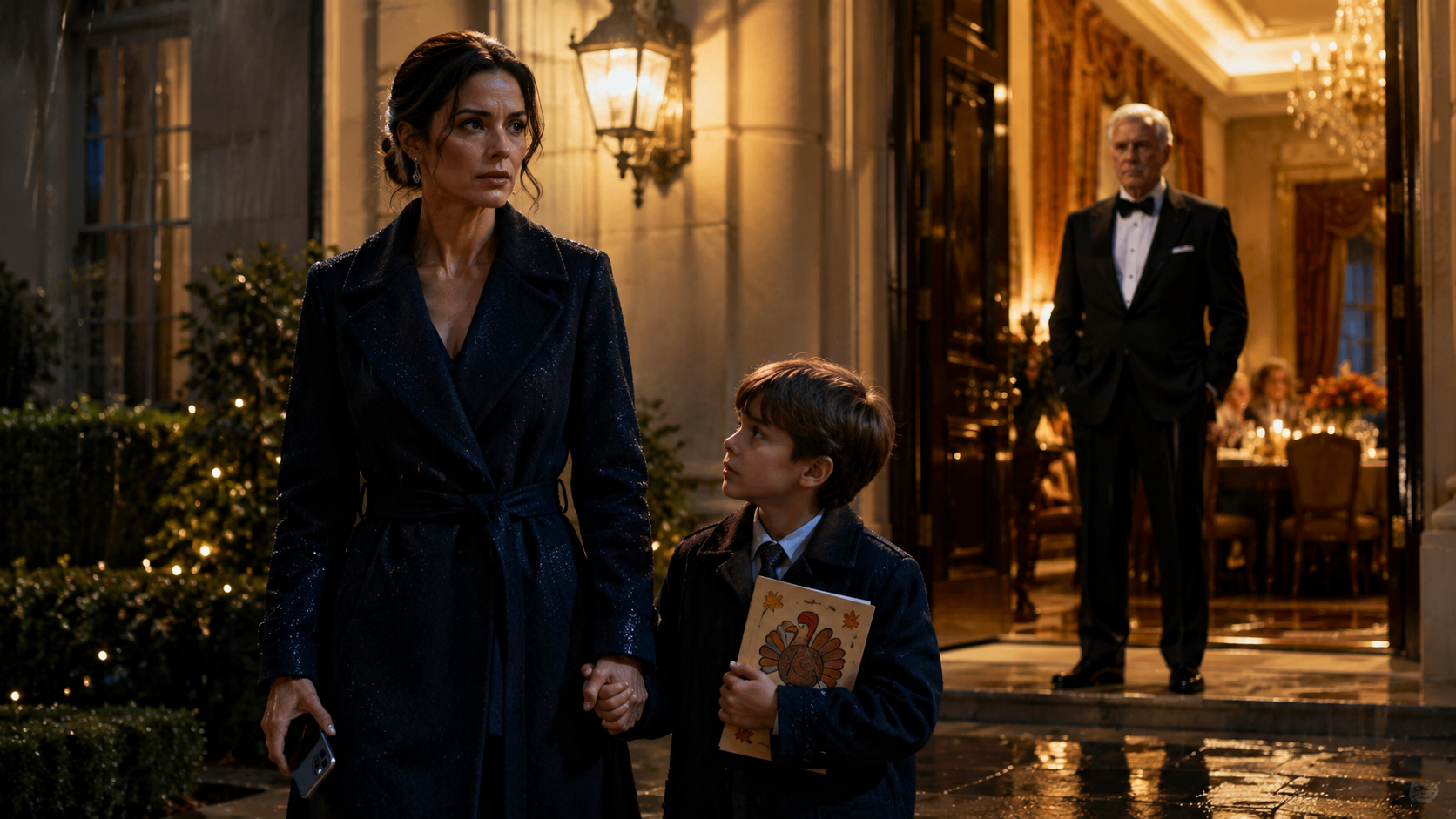
“No,” she said. “He was your grandson last night when he stood in your house holding a card he made for you. He was your grandson when you called him ‘the boy.’ He was your grandson when you watched his face fall and chose pride anyway. Today, he is a child you are not allowed to hurt again.”
Sterling looked away first.
That, more than the vote, felt impossible.
Elise gathered her folder.
At the door, he said, “Your mother wants to see you.”
Elise paused.
“She can call me.”
“She’s upset.”
“So was Milo.”
Sterling flinched. Not much. Enough.
Elise left him standing beneath the city he no longer controlled.
The news broke that afternoon.
At first, it appeared in financial terminals. Then business sites. Then gossip accounts, which stripped away details and sharpened the family drama into something easy to consume.
By evening, everyone knew that Sterling Vale had lost control of Vale Meridian Group to a private capital firm led by his estranged younger daughter.
By night, people who had ignored Elise for years began discovering they had always believed in her.
Cousins texted congratulations.
An aunt sent a heart emoji and wrote, Family is complicated.
Preston’s mother requested lunch.
Bianca sent nothing.
Marianne called at eight.
Elise let it ring twice before answering.
“Elise,” her mother said.
“Hello, Mom.”
A silence.
Then Marianne began to cry.
Not delicately. Not for effect. The sound was raw enough that Elise sat down.
“I’m sorry,” Marianne said. “I am so sorry.”
Elise closed her eyes.
She had imagined this apology in many forms over the years. In some versions, she was cold. In some, she wept. In some, she forgave everything because she wanted peace more than justice.
Reality was quieter.
“For what part?” Elise asked.
Marianne inhaled shakily. “For all of it.”
Elise looked toward the living room, where Milo was building a tower from plastic bricks while wearing pajamas. He had recovered in the way children sometimes did, quickly on the surface, carefully underneath.
“I needed you to say something last night,” Elise said. “Not after. Not once it cost him nothing. Then.”
“I know.”
“You always knew.”
“Yes.”
“And you let me stand alone anyway.”
Marianne cried harder.
Elise did not soften the truth for her.
Not anymore.
After a while, Marianne said, “May I see Milo?”
“Not yet.”