No one corrected him.
Because the rich did not call things impossible when they were impossible.
They called them impossible when they had failed to see them coming.
Preston’s father pushed back from the table. “Sterling, we need to talk privately.”
Sterling rounded on him. “Did you know?”
“Of course not.”
“You said the lender issue was contained.”
“I said it was manageable if the bridge financing closed.”
“And why didn’t it?”
Preston’s father’s silence answered.
Bianca stood. “Daddy, what does this mean?”
Sterling ignored her. He was scrolling, opening attachments, searching for a loophole in legal language written specifically to deny him one.
Marianne looked toward the foyer.
“Elise knew,” she whispered.
Sterling heard.
He turned slowly. “What?”
“She knew before she left.”
Something inside him changed.
He saw, with violent clarity, the moment she had looked at her phone. The calm afterward. The way she had not defended herself. The way she had simply walked out.
Sterling gripped the back of his chair.
“Get her back here,” he said.
No one moved.
“I said get her back here!”
The houseman at the door flinched.
Marianne rose fully now. For once, her voice did not tremble. “No.”
Sterling stared at her.
“What did you say?”
“I said no.” Marianne’s face was pale, but her eyes were clear. “You sent her out. In front of everyone. You sent your grandson out. You do not get to summon them back because you discovered she matters.”
A stunned silence followed.
Bianca looked at her mother as if she had never seen her before.
Sterling’s jaw tightened. “This is not the time for sentimental nonsense.”
“No,” Marianne said. “It is exactly the time.”
Sterling slammed his fist onto the table. Crystal jumped. Wine spilled across white linen like blood in a painting.
“This is my company.”
Preston’s father looked at the phone again and spoke carefully. “Not anymore.”
The words struck the room harder than the fist.
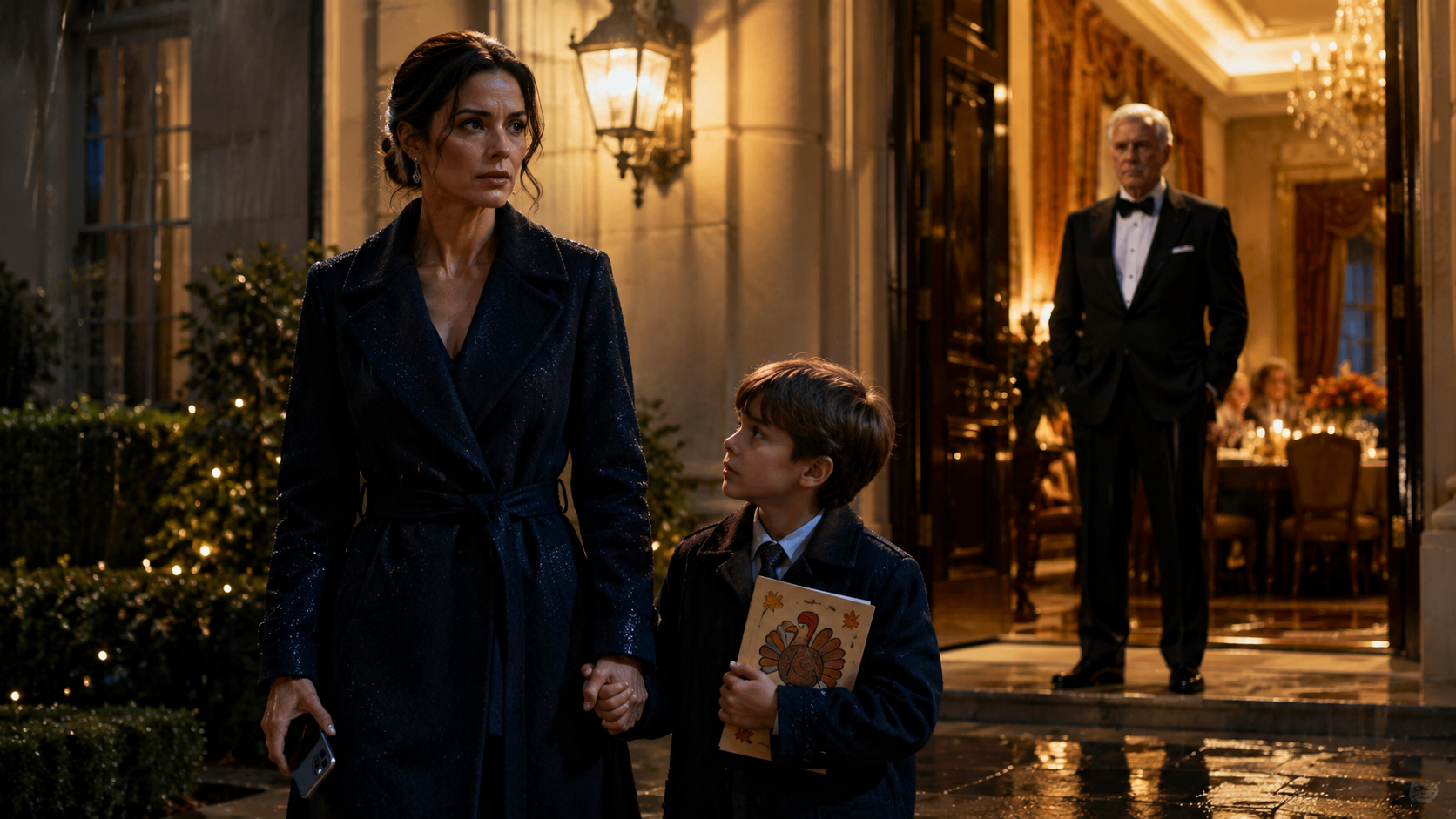
Outside, Elise was driving away.
She did not speed. She did not cry. She kept both hands on the wheel, the wipers moving steadily across the windshield.
Milo watched the mansion disappear behind the trees.
“Are we going home?” he asked.
“Yes.”
“Can we stop for fries?”
Elise glanced at him in the mirror.
His eyes were still red, but his voice was steadier.
“On Thanksgiving?”
“You said we could make new traditions.”
She smiled then, small but real. “Fries after emotional disasters?”
“And milkshakes.”
“Very well. A sacred tradition.”
They stopped at a twenty-four-hour diner near the highway, the kind of place with fogged windows, vinyl booths, and pies rotating in a glass case. Elise and Milo sat across from each other under fluorescent lights while rain tapped the glass.
A waitress named Trudy brought fries, milkshakes, and two slices of pumpkin pie “because nobody should look that sad on Thanksgiving.”
Milo dipped a fry into his milkshake.
Elise pretended not to judge him.
For a while, they ate in quiet.
Then Milo said, “Grandpa’s house didn’t feel like Thanksgiving.”
“No,” Elise said. “It didn’t.”
“This does more.”
She looked around at the chipped table, the humming refrigerator, the old man drinking coffee at the counter, the waitress laughing in the kitchen.
Her throat tightened.
“Yes,” she said. “It does.”
Her phone buzzed repeatedly. Calls from numbers she recognized and numbers she did not. Board members. Counsel. A private banker. Bianca. Her mother.
Sterling called seven times.
Elise turned the phone face down.
Milo noticed. “Aren’t you going to answer?”
“Not yet.”
“Is it Grandpa?”
“Yes.”
Milo considered this. “Good.”
Elise laughed despite herself.
At midnight, after Milo had fallen asleep in the back seat with a takeout box on his lap, Elise finally listened to Sterling’s voicemails.
The first was fury.
“Elise, call me immediately. Whatever game you think you are playing, you are out of your depth.”
The second was command.
“You will not embarrass this family with a public stunt. You will call me back and explain who is behind this.”
The third was calculation.
“There are ways to resolve this privately. Do not make a mistake you cannot undo.”
The fourth came after someone had clearly explained the situation to him.
His voice was lower.
“Elise. We should talk. You owe me that much.”
She deleted them all.
The emergency board session convened the next morning at ten.
Elise arrived at Vale Meridian headquarters at nine forty-five in a charcoal suit, her hair pinned low, her face calm. The tower lobby was all black marble, brushed steel, and enormous floral arrangements. She had visited only twice before. Both times, she had waited more than an hour because Sterling had chosen to make her wait.
This time, the security director met her at the door.
“Ms. Mercer,” he said. “Welcome.”