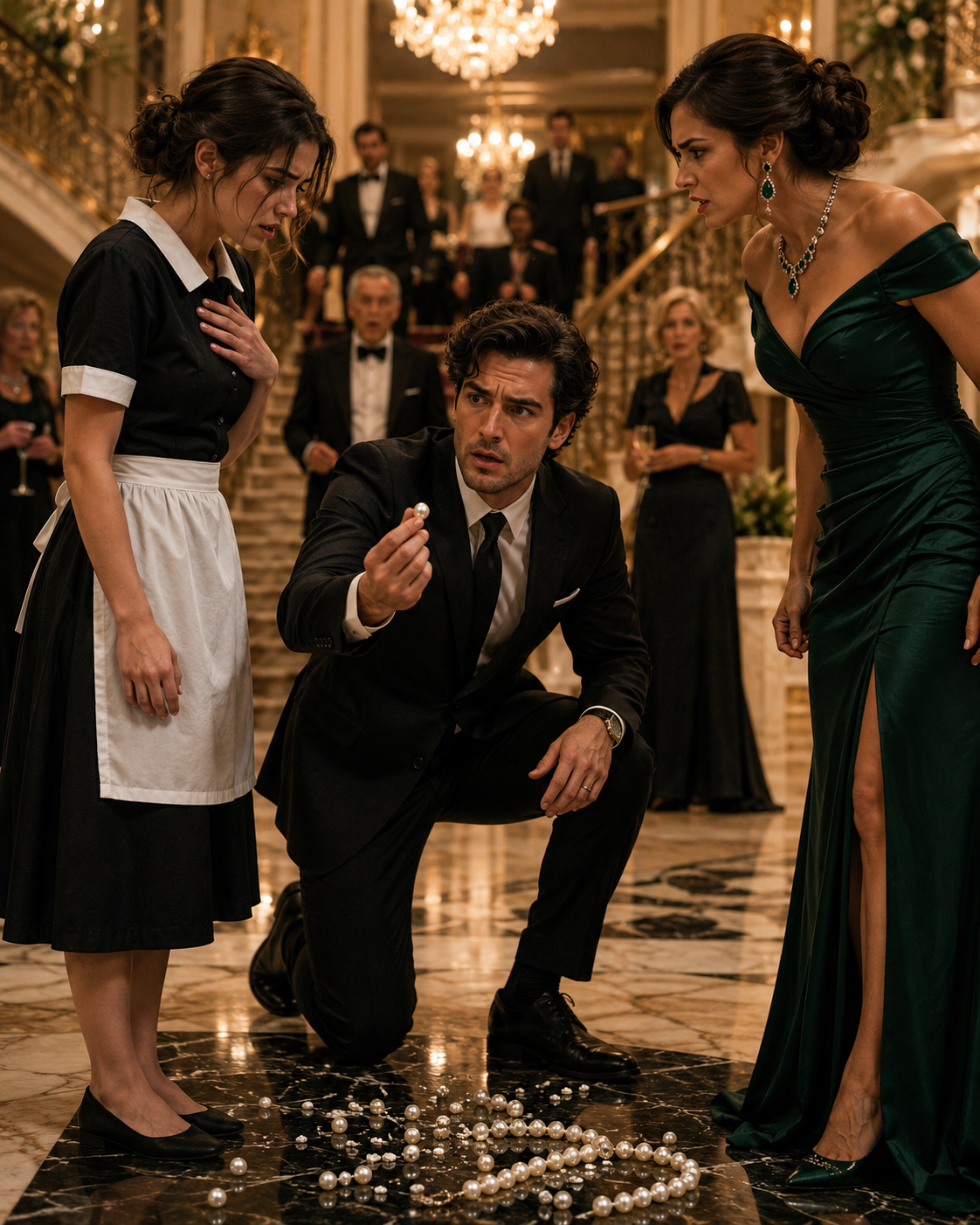
Selina stared at the window behind him. “I saw it before anyone said it. Something about her always bothered me. Not because she was incompetent. Because she wasn’t. Because she moved through that house as if she had a right to be unnoticed, and somehow that felt like a threat.”
“And your response was to break her necklace.”
Selina’s mouth tightened.
“Yes.”
Leonard made a note.
“That was unfortunate.”
“That was catastrophic.”
“Yes,” he said. “That too.”
Selina built her case anyway.
For three weeks she moved through legal strategy, old correspondence, social leverage, and quiet phone calls. She contacted Adrian’s aunt, Beatrice Blackthorne, who had lived abroad for decades and had her own unresolved history with the family. Selina believed Beatrice might join her challenge if the revised inheritance threatened old trust arrangements.
But Beatrice did not come for Selina.
She came for Clara.
When Beatrice arrived at the estate, she stepped into the sitting room, looked at Clara for three seconds, and began to cry.
“You have Marianne’s face,” she said.
Clara did not know what to do with that.
Beatrice took her hands. “I tried to find you after your mother died. I sent a letter. It came back. I should have done more.”
Clara had heard many apologies in the weeks since the necklace broke. Some were polite. Some were defensive. Some were really requests for absolution wearing the clothing of regret.
Beatrice’s was different.
It asked for nothing.
So Clara held her hands back.
Together, Beatrice, Thomas, Adrian, and Clara built the truth piece by piece.
A former housekeeper named Mrs. Greer arrived with copies of old records she had preserved for years. There were documents showing Malcolm had tried to send money after Marianne left, and that Marianne had refused it. There were notes proving the leather box had existed long before Selina’s challenge. There were dated photographs, private journals, legal references, and finally two independent DNA results.
Selina’s challenge collapsed before it truly began.
The judge confirmed Clara Vale Blackthorne as a direct heir.
For the first time in her life, Clara had more than a name.
She had a place.
But place did not feel simple.
After the hearing, she left the estate for eight days.
Not forever. Not like her mother.
She drove north to a cold coastal town where the wind was sharp enough to make thoughts honest. She walked along the beach in a heavy coat and thought about her mother as a nineteen-year-old girl leaving a mansion with one bag, a pearl necklace, and a child no one had been brave enough to claim properly.
She thought about Malcolm’s letter.
She thought about Adrian’s guilt.
She thought about Thomas waiting for the right moment.
She thought about the east bedroom, the breakfast table, the repaired pearls, and the strange pain of discovering that something had always belonged to you after you had already learned how to live without it.
On the eighth day, she returned.
Adrian met her at the door.
He tried to hide his relief and failed.
At dinner that night, Clara said, “I don’t want to just inherit money.”
Adrian looked at her across the table. “What do you want?”
“I want to build something for girls like me.”
“Girls with secret inheritances?”
“No.” Clara smiled faintly. “Girls standing outside doors they don’t know are theirs.”
That became the beginning.
With Adrian’s support, Beatrice’s foundation, Thomas’s memory, Mrs. Greer’s network, and Clara’s stubborn clarity, they created The Open Door Trust — an organization for young women cut off from family histories, legal claims, guardianship rights, or inheritances they did not know how to access. It was not glamorous work. It did not make fashionable headlines. But Clara understood the gap it filled because she had lived inside that gap.
Months later, Selina asked to meet.
Adrian was cautious. His attorney was more cautious. But Clara agreed.
They met in a neutral hotel room with pale walls, a round table, and no history.
Selina arrived without jewelry.
For once, she looked less arranged.
“I owe you an apology,” she said.
Clara waited.
“I knew something about you frightened me,” Selina continued. “I didn’t know what it was. I only knew that you threatened a future I had spent years building. And instead of asking why, I tried to make you small.” She swallowed. “The necklace was not strategy. It was cruelty. That is worse, in some ways. I am sorry for what I did to your dignity before I knew what your name meant.”
Clara studied her for a long time.
Then she said, “You loved Adrian.”
Selina blinked.
“That was real,” Clara said. “Not all of it. But some of it.”
Selina’s eyes shone before she looked away.
“Yes.”
“I watched you for six months,” Clara said. “From the side people don’t look at. You were ambitious. You were cruel. You were also sometimes genuine. I think truth is more useful than making you a simple villain.”