“Yes.”
“I should have stopped Bianca.”
“Yes.”
“I can learn from this.”
Celeste studied him.
Perhaps he could.
People sometimes changed.
But change was not a receipt they handed over to cancel consequences.
“I hope you do,” she said.
Relief flickered across his face.
“But not from the president’s office.”
The relief vanished.
Damon nodded once because there was nothing profitable left to say.
After he left, Malcolm came to stand beside Celeste.
“You know some directors will say you went too far.”
Celeste untied the apron and folded it carefully.
“They’ll call me by Monday.”
“To complain?”
“To confess what they ignored.”
Malcolm chuckled. “You always preferred earthquakes to renovations.”
“No,” Celeste said, looking at the empty chairs. “I prefer foundations that don’t lie.”
By 3:00, everyone in Meridian Tower knew.
Office towers were terrible at keeping secrets, especially righteous ones.
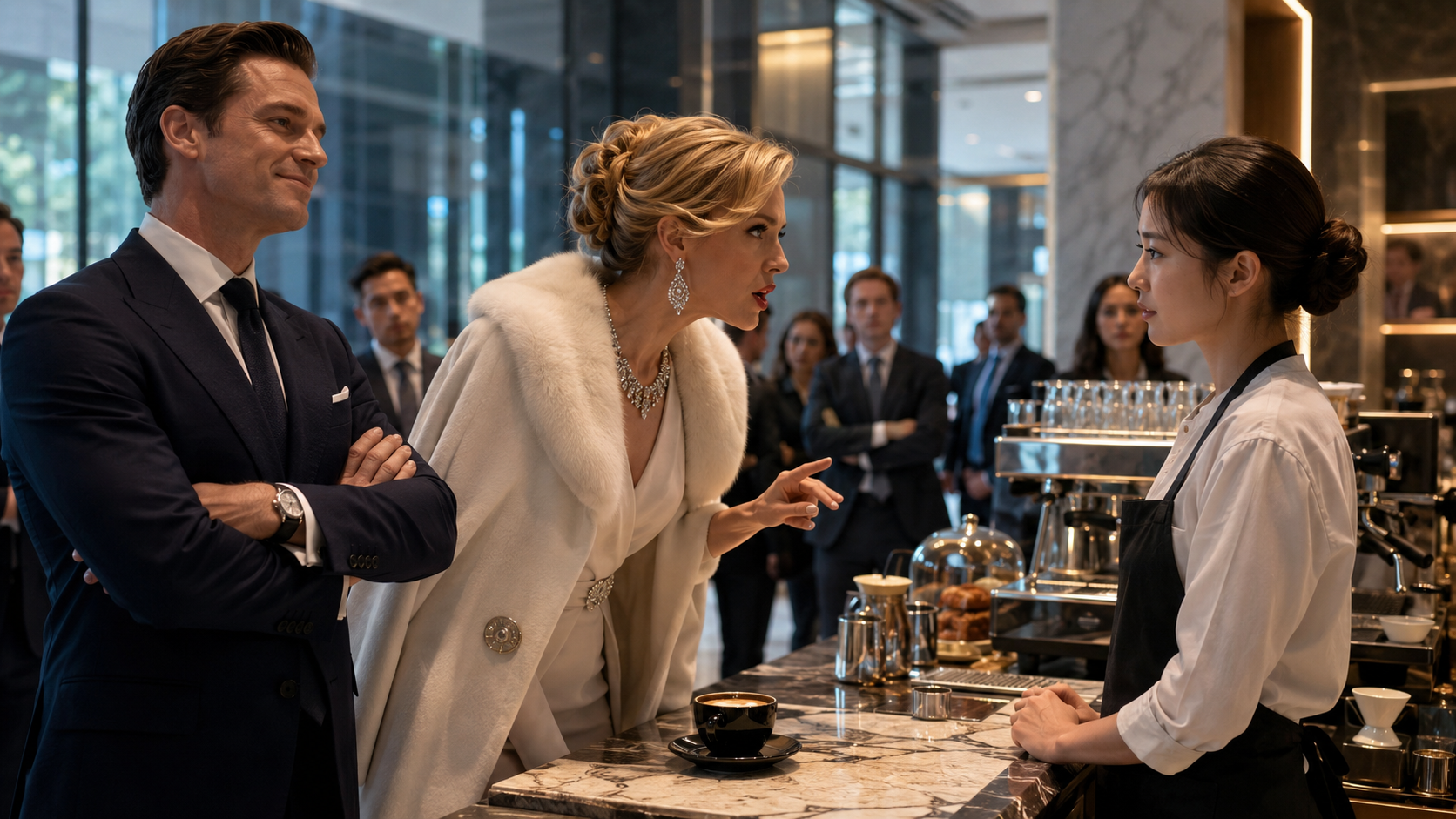
When Celeste walked into the lobby café that afternoon without the apron, conversations stopped. The silence was different from the silence after Bianca’s cruelty.
Not fear.
Not worship.
Recognition.
Miles stood behind the counter, trying to make a cappuccino while three analysts stared at him as if he had survived a public trial.
Arthur spoke with the café manager near the pickup station. Nora sat by the window with a coffee she had forgotten to drink.
Celeste walked to the counter.
Miles froze. “Ms. Arden.”
“Celeste is fine when I’m ordering coffee.”
He blinked. “You’re ordering?”
“I still drink coffee.”
That broke the tension.
A few people laughed.
Miles smiled, shaky but real. “What can I get you?”
“Flat white. Oat milk. One pump vanilla. Not too hot.”
He winced. “That feels like a test.”
“It is coffee, Miles.”
“Right. Coffee.”
He made it perfectly.
When he set the cup down, Celeste took a sip.
“Excellent,” she said.
Miles exhaled as though released from a locked room.
Arthur came beside her.
“Back where it started,” he said.
Celeste looked around the lobby.
A director picked up a napkin he had dropped instead of leaving it on the floor. A vice president thanked the security guard by name. A young analyst held the elevator for a cleaner pushing a cart. Small things. Almost nothing.
But culture rarely changed in lightning.
It changed in the moment someone noticed what they had trained themselves to ignore.
“It hasn’t started yet,” Celeste said.
Arthur nodded. “Fair.”
Three weeks later, Damon resigned before the review concluded. The official statement said he was leaving to pursue new opportunities. Celeste did not object. Public humiliation was not justice. Accountability was enough.
Bianca posted a long complaint online about jealous corporate women and the death of elegance. It was discussed for one afternoon, mocked by strangers for one evening, and forgotten by breakfast.
Nora became one of the sharpest voices in the Client Integrity team. Her first major proposal created a reporting structure that made it harder for managers to bury complaints by calling them personality conflicts.
Miles entered the mentorship program and eventually became café operations coordinator. Six months later, when a vendor mocked a delivery driver’s accent, Miles spoke up. His voice shook, but he spoke.
Arthur Bell became Deputy Director of Workplace Operations, then Director two years later. On his first week in the role, he removed the phrase executive communication style from every internal promotion rubric.
In its place, he wrote three lines.
Notices what others ignore.
Protects dignity when it costs something.
Leaves people larger than he found them.
Celeste kept the black apron in her office.
Not framed.
Not spotlighted.
Folded neatly inside a glass case beneath no plaque and no explanation.
Visitors often assumed it was an artifact from the company’s early days, some charming symbol of entrepreneurial humility.
Celeste rarely corrected them.
Most people did not ask.
But sometimes, late at night, when Meridian Tower quieted and the river reflected the city lights like broken gold, she would look at the apron and remember Bianca’s voice.
Smile while you serve me.
She would remember Damon laughing.
She would remember the room that watched.
She would remember Arthur stepping forward with a mop in his hand and more leadership than anyone in a tailored suit.
And she would remind herself of the lesson that no quarterly report, no leadership retreat, and no polished speech could replace.
Respect that depends on status is not respect.
It is strategy.
And sooner or later, when the apron comes off and the name tag changes, strategy stops protecting what character has already revealed.