The first thing Celeste Arden learned behind the café counter was that people showed their real faces when they believed no one important was watching.
Not when cameras were pointed at them.
Not when executives sat across from them in glass conference rooms.
Not when human resources passed out glossy cards with words like respect, integrity, excellence printed in tasteful gray lettering.
People were easiest to read when they ordered coffee.
At 7:18 on a rainy Tuesday morning, Celeste stood beneath the warm lights of the Meridian Tower café wearing a black apron, a name tag that said CLAIRE, and a cap pulled low enough to hide the sharp cheekbones that had once appeared on the cover of Fortune & Empire.
No one looked closely at a barista.
That was the point.
“Double espresso, no sugar,” said a man in a charcoal coat, already turning away before he finished speaking.
“Good morning,” Celeste said.
He did not hear her. Or he decided not to.
A junior analyst with wet hair apologized three times for asking whether the almond croissants were fresh. A marketing director snapped her fingers for napkins without looking up from her phone. One of the security guards called every café employee by name and waited patiently while Celeste learned the register.
By 9:00, Celeste had written eleven notes in the small black notebook she kept beside the extra stir sticks.
She had spent three weeks doing this.
Three weeks arriving before dawn through the service entrance of the tower she owned.
Three weeks steaming milk, wiping counters, emptying trash, taking orders, cleaning tables, remaking drinks, and watching the people of Arden Meridian Holdings behave as though the lobby café were not part of the company at all, but some invisible machine that produced caffeine and politeness on demand.
The board thought she was in Zurich.
Her senior executives thought she was reviewing expansion contracts remotely.
Only three people knew the truth: her assistant, her security chief, and Malcolm Wren, the seventy-two-year-old board chairman who had warned her this experiment would either save the company or ruin her faith in it.
Celeste had replied, “Those are not opposite outcomes.”
Now she locked the portafilter into place and listened to the hiss of the espresso machine. The café smelled of roasted beans, butter, rain-soaked coats, and expensive perfume.
At 10:42, the air changed.
Celeste noticed because the young cashier beside her, Miles, straightened too quickly and knocked over a stack of lids.
“Oh no,” he whispered.
Celeste followed his gaze.
Damon Voss had entered the café.
Even in a building filled with people who wanted to look powerful, Damon stood out. He was tall, polished, beautifully dressed, and moved with the relaxed confidence of a man who had never once wondered whether a room would make space for him.
He was Arden Meridian’s Chief Strategy Officer.
He was also the board’s favorite candidate to become company president.
Celeste had hired him six years ago.
Back then, Damon had seemed brilliant, hungry, disciplined, and just humble enough to be trusted. He had rescued two failing divisions, negotiated a brutal merger without losing a major client, and charmed investors who usually needed three martinis to become cheerful.
Numbers loved him.
People, Celeste was beginning to suspect, survived him.
A woman walked beside him, one hand looped through his arm.
She was not an employee. Celeste knew because she had personally reviewed the badge scans every morning since beginning her undercover inspection.
Her name was Bianca Rowe.
Influencer, private-events consultant, charity gala regular, and, according to the company rumor mill, Damon’s girlfriend, though Damon was still technically married to a woman named Elise who lived in London and avoided newspapers with impressive skill.
Bianca wore white wool, diamond studs, and the expression of someone permanently disappointed by the world’s failure to become a mirror.
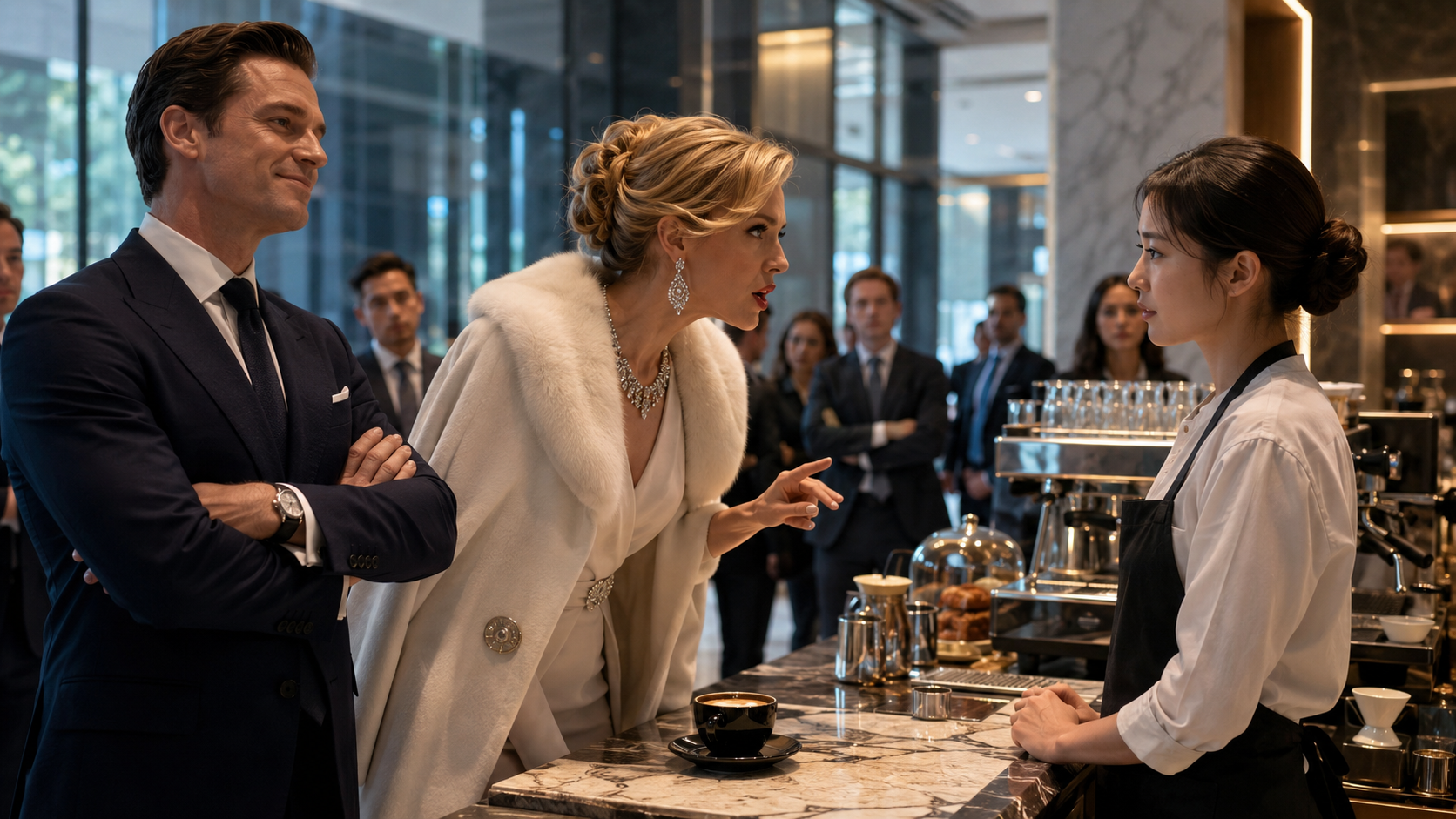
She stopped in front of the counter and looked at Celeste.
Not at her face.
At her apron.
Then her mouth curved.
“How sweet,” Bianca said. “You people have matching uniforms.”
Miles’s face turned pink.
Celeste smiled professionally. “Good morning. What can I get started for you?”
Bianca glanced at Damon. “Does she always sound rehearsed?”
Damon looked amused, not embarrassed.
“Bianca likes precision,” he said.
“I like competence,” Bianca corrected. Then she looked back at Celeste. “Cappuccino. Dry. Extra hot. No foam touching the lid. Cinnamon, but not from one of those dusty little shakers. And smile while you serve me. It makes the experience feel less depressing.”
The café quieted.
Not completely. People in corporate towers were experts at pretending they had not heard things. But the sound changed. Keyboards softened. Cups paused. Conversations lowered into careful murmurs.