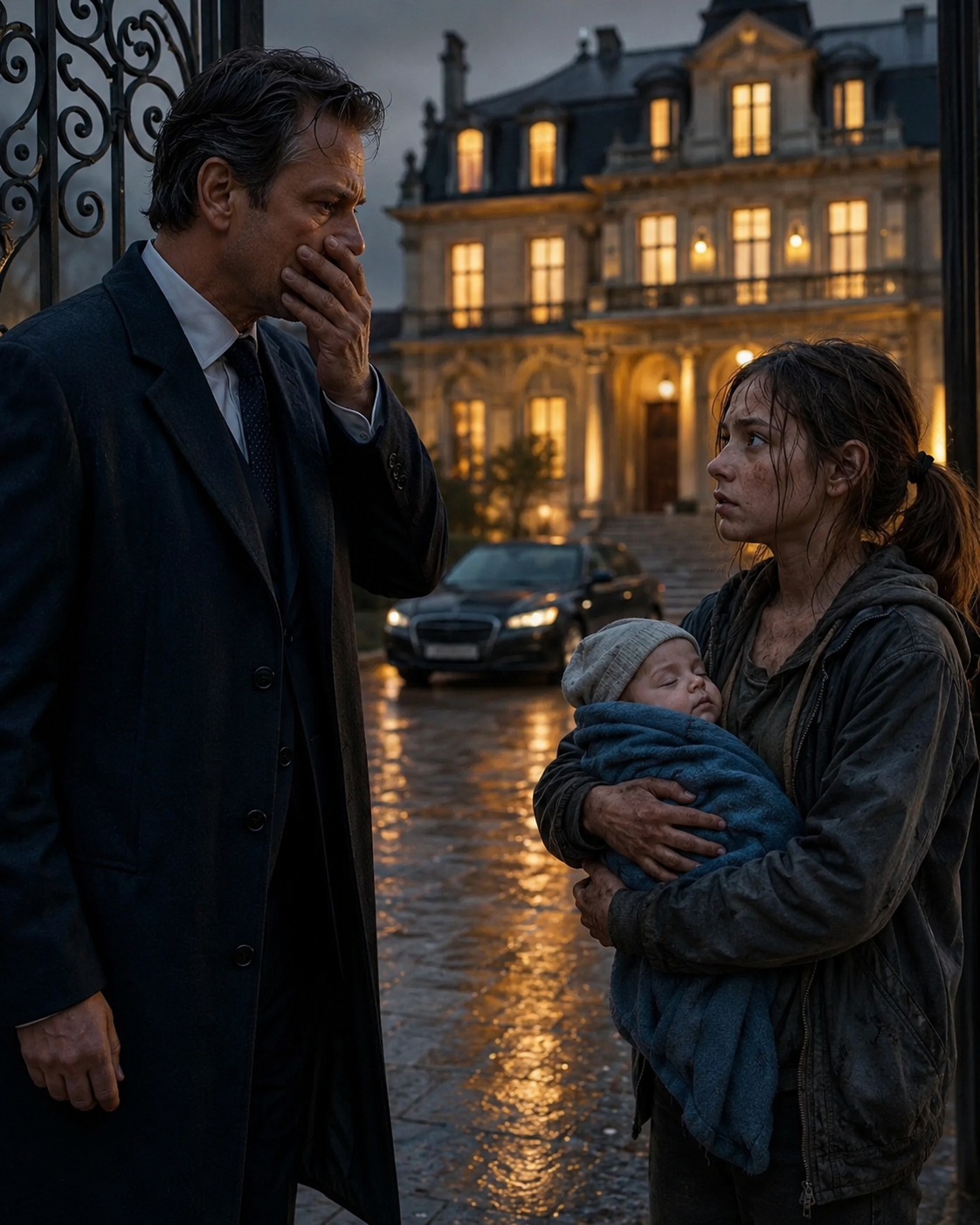
The voice was so small that at first Victor Ashbourne thought it had come from the wind.
He had just stepped out of his black car in front of the tall iron gates of his Kensington estate, one hand already reaching for the polished brass handle, when the words stopped him cold.
“Sir… please.”
Victor turned.
A girl stood near the edge of the pavement, half hidden by the shadow of the stone wall. She could not have been more than seventeen. Her coat was too thin for the sharp London evening, her shoes were split at the sides, and her dark hair hung in tangled waves around a face that looked older than it should have. Across her chest, wrapped carefully in a faded blue blanket, a baby slept with one tiny fist pressed against her cheek.
The girl swallowed hard, forcing herself not to cry.
“Do you need a maid?” she asked. “A cleaner? A kitchen girl? I can scrub floors, wash windows, cook simple meals, anything. I won’t steal. I won’t complain. Just… please give us food. My little sister is hungry.”
Victor Ashbourne had been asked for many things in his life. Money. Favors. Investments. Influence. Mercy, sometimes, by men who had made the mistake of crossing him in business.
But never this.
Not like this.
His first instinct was caution. Wealth had taught him to distrust sudden need, sudden tears, sudden stories told at the gates of a mansion. He had security for a reason. He had lawyers for a reason. He had spent forty-eight years building walls high enough to keep strangers and trouble outside.
But then the girl shifted the baby higher against her chest, and the collar of her worn coat slipped.
Victor saw the mark.
A small, pale crescent just below the left side of her jaw.
The world seemed to narrow around it.
He took one step closer, then stopped as if the ground had turned fragile beneath his shoes.
That birthmark was impossible.
His younger sister, Rosalie, had carried the same mark in the same place. A soft crescent, almost silver in certain light. Their mother used to call it “the moon’s thumbprint.” Rosalie had hated it as a child and hidden it beneath ribbons. Later, when she ran from the family after one final, bitter argument, Victor had remembered that mark more vividly than her last words.
She had disappeared nineteen years ago.
Victor had spent years telling himself she had chosen freedom. That she wanted nothing from him. That searching for her would only reopen old wounds.
Now a starving girl stood at his gate with Rosalie’s moon on her neck.
“What is your name?” he asked.
His voice came out colder than he intended, and the girl flinched.
“Mara,” she whispered. “Mara Bell. And this is my sister, Elsie.”
The baby stirred at the sound of her name, her small mouth trembling in sleep.
“Mara Bell,” Victor repeated slowly. “Where are your parents?”
The girl lowered her eyes.
“My father was never around. My mother died in February.” She tried to keep speaking, but grief caught in her throat. “She was sick for a long time. I did what I could. I worked in a laundry, then in a café, but when she died, the landlord said I couldn’t stay. I had no papers for the flat. No money. No one.”
Victor glanced toward the baby.
“And the child?”
“My sister,” Mara said quickly, as if afraid he might accuse her of something. “My mother had her late. She said Elsie was a miracle. I promised I’d keep her safe.”
The words were simple, but there was iron beneath them.
Victor looked again at the crescent mark.
“Your mother’s name,” he said. “Tell me.”
Mara hesitated. Her hands tightened around the baby’s blanket.
“Rose Bell.”
Victor felt the name strike him in the chest.
Rose.
Rosalie had always hated being called by her full name. As a girl, she had said it sounded like a porcelain doll trapped behind glass. She preferred Rose. After their father died and the family business passed to Victor, she had begged him to let her live quietly, to stop using the Ashbourne name as a cage. Victor had called her ungrateful. She had called him heartless.
The next morning, she was gone.
“Did your mother ever mention a family?” Victor asked carefully.
Mara gave a faint, sad laugh.
“Only once or twice. She said she used to have a brother.” Her eyes lifted to the mansion behind him, then quickly dropped again. “A very rich brother. She said he loved money more than people.”
The words were soft, but they cut with perfect aim.
Victor’s jaw tightened. Behind him, the mansion windows glowed gold against the evening, every room warm, polished, and useless. He owned hotels, shipping contracts, private estates, and enough art to fill a museum wing. Yet his own sister’s child had stood hungry in the street.
He looked at Mara’s face more closely now. The shape of her eyes, the stubborn line of her mouth, the way she held fear down with pride. He saw Rosalie everywhere.
“Wait here,” he said.