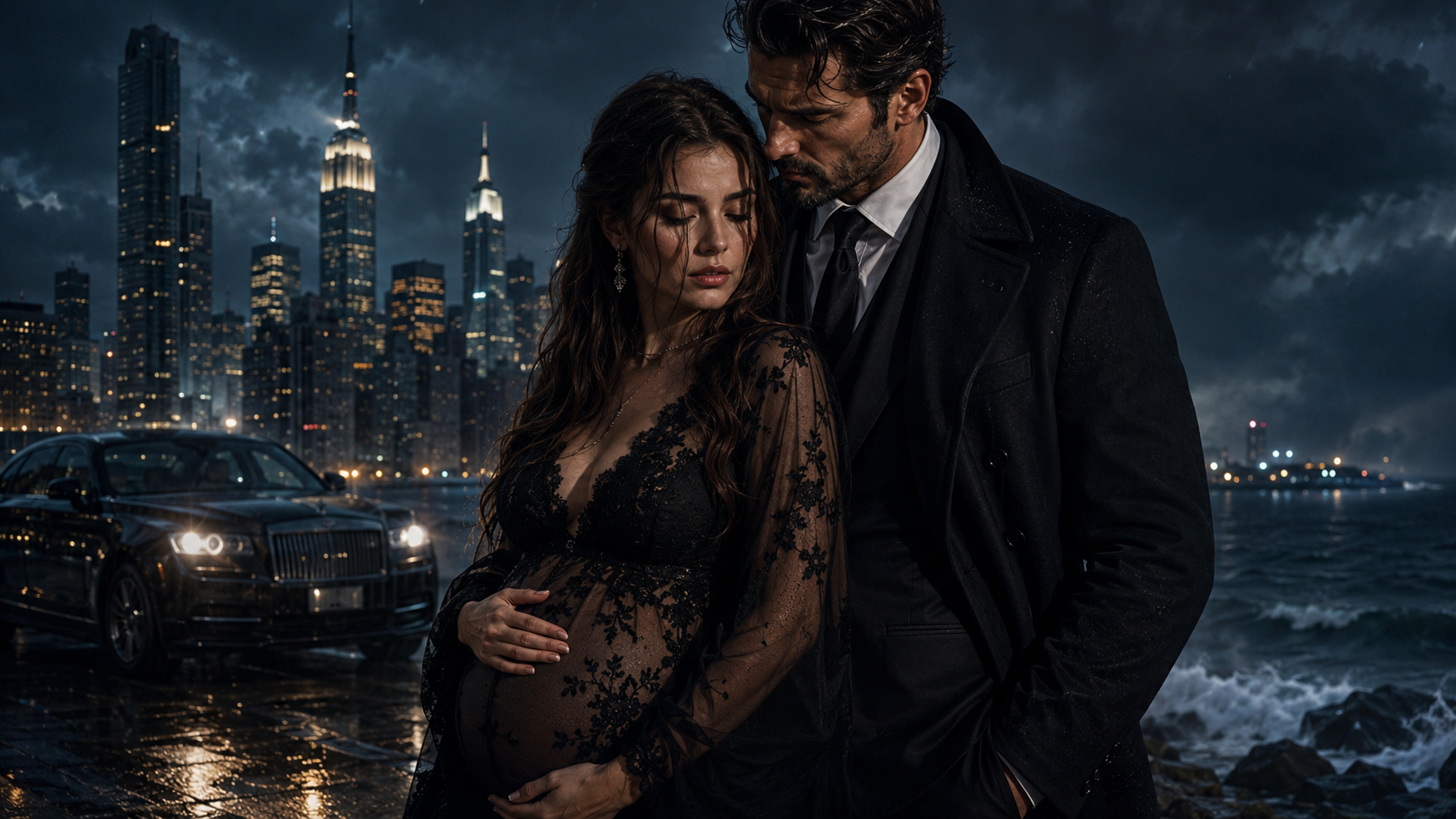
But she thought of strangers watching her father’s garage.
She thought of her sister laughing on a campus where she would never know men were paid to follow her.
She thought of her mother sleeping peacefully after surgery because a monster had paid the bill.
And she realized the most dangerous cages were not built from force.
They were built from gratitude.
The wedding happened forty-eight hours later.
No church.
No music.
No guests who loved her.
A judge with nervous eyes pronounced them husband and wife in a private library that smelled of cedar, old paper, and secrets.
Mara wore a pearl silk dress she had not chosen. Her hair was pinned by a stylist who never asked what she wanted. A diamond ring heavy enough to feel like a shackle slid onto her finger.
Luca did not touch her until the judge said he could kiss the bride.
Then he turned to her.
He waited.
It took Mara a moment to understand.
He was asking.
Not with words. Not where anyone could hear.
But his eyes asked clearly enough.
May I?
The question almost broke her.
She gave the smallest nod.
His kiss was brief. Warm. Careful. Not possessive. Not hungry.
Careful.
That was the first thing about Luca Bellarosa that frightened her more than his reputation.
A cruel man was easy to hate.
A careful one was dangerous.
After the ceremony, he led her through the halls of his penthouse, a glass palace above the city.
“This is your room,” he said, opening a door.
Mara stopped.
“My room?”
“Yes.”
Not ours.
The word hung between them, unspoken.
Inside was a bedroom with pale walls, fresh flowers, a balcony, and books stacked on the nightstand. Books she loved. Books she had once mentioned in an interview years ago when she worked at a small publishing house and believed literary taste was the most intimate thing a person could reveal.
Her stomach tightened.
“You researched me.”
“Yes.”
“You don’t see how disturbing that is?”
“I see exactly how disturbing it is.”
“Then why admit it?”
“Because lying would be worse.”
Mara turned away before he could see how close she was to crying.
Luca remained at the door.
“You are not expected in my bed,” he said.
She looked back at him.
His face was unreadable.
“Is that supposed to make me grateful?”
“No. It is supposed to make you informed.”
“And if I lock the door?”
“Then no one enters.”
“Not even you?”
“Especially not me.”
She searched his face for mockery.
There was none.
“I don’t understand you,” she said.
His mouth curved without warmth.
“That may be safest for both of us.”
For the first month, Mara lived as if the penthouse were a museum where she was the stolen artifact.
She attended dinners beside Luca. She stood at charity galas while photographers shouted his name. She learned the geography of power: which men kissed Luca’s ring without a ring being offered, which women watched him with old regret, which businessmen laughed too loudly because they were terrified.
In public, Luca’s hand sometimes rested at her back.
Never too low.
Never too long.
Always just enough to announce ownership to the room.
Mara told herself she hated it.
Then, one night, a man with silver hair and snake-thin eyes approached her while Luca was speaking to a senator across the room.
“Mrs. Bellarosa,” the man said. “You are prettier than expected.”
Mara had grown up poor. She knew an insult when it wore perfume.
“And you are exactly as expected,” she replied.
His smile widened.
“Does Luca know you have teeth?”
“He seems to appreciate them.”
The man leaned closer.
“Be careful, little bride. Men like your husband don’t keep pretty things forever.”
Before Mara could answer, Luca appeared at her side.
He did not touch the man.
He did not threaten him.
He simply said his name.
“Orsini.”
One word.
The man went pale.
Mara had never seen power move so quietly.
Orsini bowed his head and left.
Luca watched him go, then turned to her.
“Did he touch you?”
“No.”
“Did he frighten you?”
Mara wanted to say no.
Pride rose first.
Then honesty.
“A little.”
Something hard passed over Luca’s face.
“I’ll have him removed from the guest list permanently.”
“From the charity?”
“From the city, if necessary.”
She stared at him.
“You can’t just exile people because they made me uncomfortable.”
“I can.”
“That wasn’t permission.”
“I didn’t ask for permission to protect you.”
“No,” Mara said, stepping closer. “You asked for permission to kiss me at our wedding, but not for this?”
The words struck him.
For one second, Luca Bellarosa looked almost human.
Then he said, “You’re right.”
Mara blinked.
“I am?”
“Yes.”
He looked back toward the crowd.
“I will not act against him unless you ask me to.”
That should have pleased her.
Instead, it unsettled her.