“You could have mentioned there were thirty people here.”
“You might have invented an emergency.”
“I never invent emergencies.”
“You once told me your printer was on fire to avoid your cousin’s birthday.”
“It was making a dangerous noise.”
“It needed paper.”
Gideon picked up a box.
Then he noticed someone at the other side of the room.
Livia.
She wore jeans, an old sweater, and her hair was tied behind her head.
She was crouched beside an elderly man, listening as he explained that he could not carry a heavy package home.
“I’ll separate it into two bags,” she told him. “Or I can drive you.”
“You don’t have to do that.”
“I know.”
The answer made Gideon stop.
Livia stood and turned.
She saw him.
For one second, surprise crossed her face.
Then she simply nodded.
“Hi.”
“Hi.”
No dramatic reunion followed.
Helen walked between them carrying a box.
“You two can stare at each other later. Potatoes first.”
Livia laughed.
Gideon stared at his mother.
“You planned this.”
Helen looked offended.
“I plan many things. This is merely something that happened exactly the way I expected.”
For the next three hours, they worked.
Gideon watched Livia when she did not know he was watching.
That mattered to him.
She was patient with a confused elderly woman who asked the same question three times.
She cleaned a spilled container without calling someone else.
She listened more than she spoke.
Nobody photographed her.
Nobody thanked her publicly.
Nobody knew who she was.
When the work was finished, Gideon found her outside.
The afternoon was cold but clear.
“You’ve been volunteering here long?”
“About eight months.”
“Why didn’t you tell me?”
She shrugged.
“You told me not to do it for you.”
He looked at her.
“So you listened?”
“Eventually.”
They stood in silence.
Then Livia smiled.
“Your mother still doesn’t like expensive flowers.”
“You tried?”
“Once.”
“What happened?”
“She made me return them.”
Gideon laughed.
“She did not.”
“She absolutely did.”
“And you came back?”
“The next week.”
“With supermarket flowers?”
“With potatoes.”
He laughed harder.
Livia watched him.
There was sadness in her expression, but it no longer carried expectation.
“I am sorry,” she said.
“I know.”
“I mean for everything. Not because of what it cost me.”
He nodded.
“I know that too.”
She looked toward the community center.
“Helen taught me something.”
“That sounds dangerous.”
“She said the easiest kindness in the world is kindness toward people who can reward you.”
Gideon smiled.
“That sounds like Mom.”
“She also said your kitchen table cost too much.”
“That definitely sounds like Mom.”
Livia laughed.
Then she pulled on her coat.
“Well, I should go.”
“Livia.”
She turned.
He hesitated.
A year earlier, he might have imagined that this moment required a grand declaration.
Now he understood that some things were better rebuilt slowly.
“Would you like coffee?”
She studied him.
“As friends?”
“For today.”
A small smile appeared.
“For today sounds honest.”
They began walking toward a café at the end of the block.
Behind them, Helen watched through the community center window.
One of the volunteers noticed.
“Is that your son?”
Helen nodded.
“And the woman with him?”
Helen smiled.
“A woman learning something important.”
“Do you think they’ll get back together?”
Helen lifted another box onto the table.
“That’s their business.”
The volunteer laughed.
“You don’t sound curious.”
“Oh, I’m extremely curious.”
She looked through the window again.
“But forgiveness isn’t a door you open so everything can return to the way it was.”
“What is it, then?”
Helen thought for a moment.
“A light.”
The volunteer waited.
“It lets you see clearly enough to decide where to go next.”
Outside, Gideon and Livia disappeared around the corner.
Helen smiled and returned to work.
She had spent much of her life watching people confuse wealth with worth, confidence with character, and appearances with truth.
Age had taught her something simpler.
You could learn almost everything you needed to know about a person by watching how they treated someone who had nothing they wanted.
Not their employer.
Not their lover.
Not someone famous.
Not someone wealthy.
A tired cashier.
A nervous waiter.
A cleaner emptying an office trash can after everyone else had gone home.
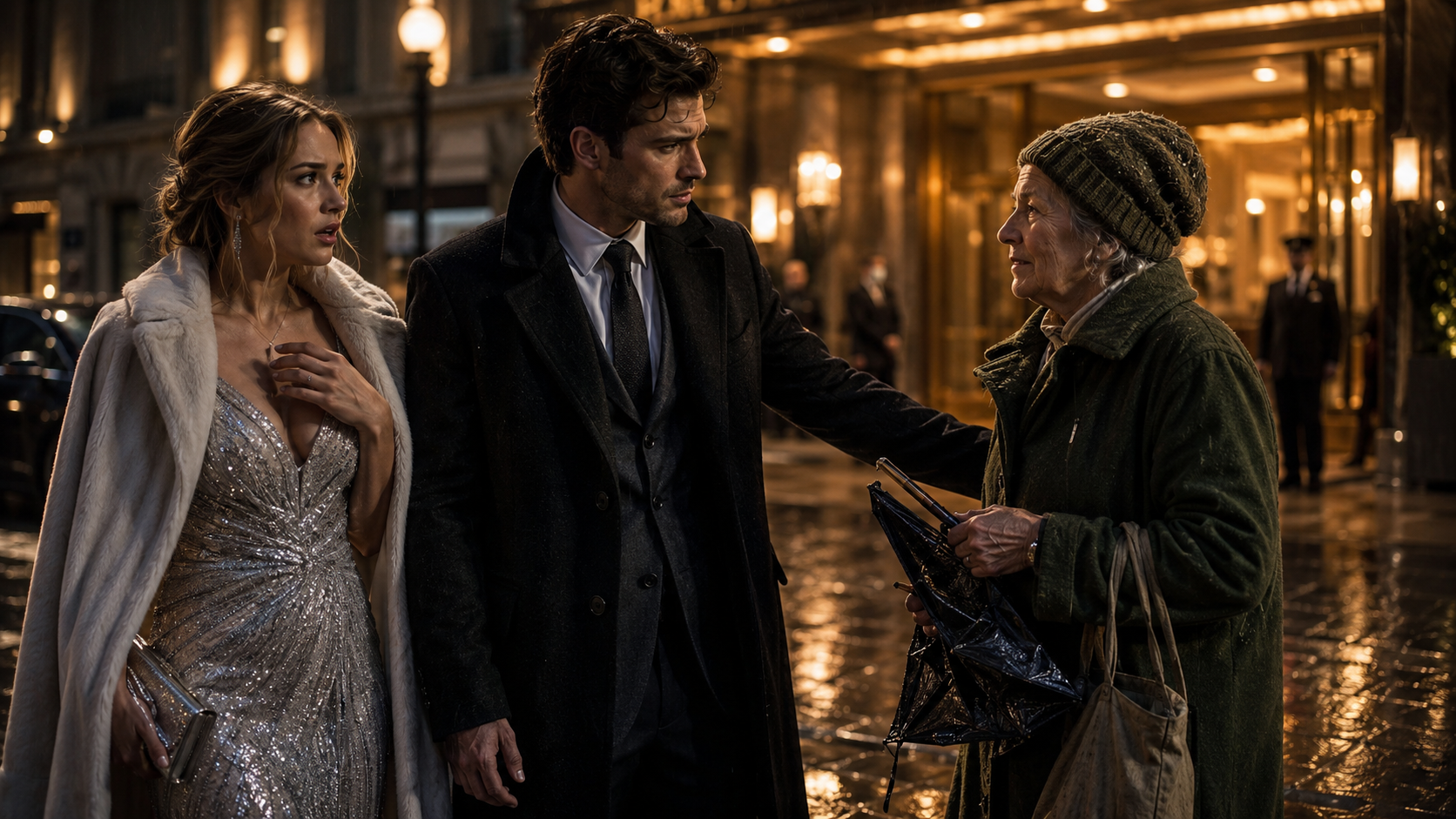
An elderly stranger standing alone in the rain with a broken umbrella.
Those moments rarely appeared in photographs.
Nobody applauded them.
No one gave awards for them.
And perhaps that was exactly why they mattered.
Because character was not the person you performed when the room was watching.
Character was the person who remained when you believed nobody important was there.