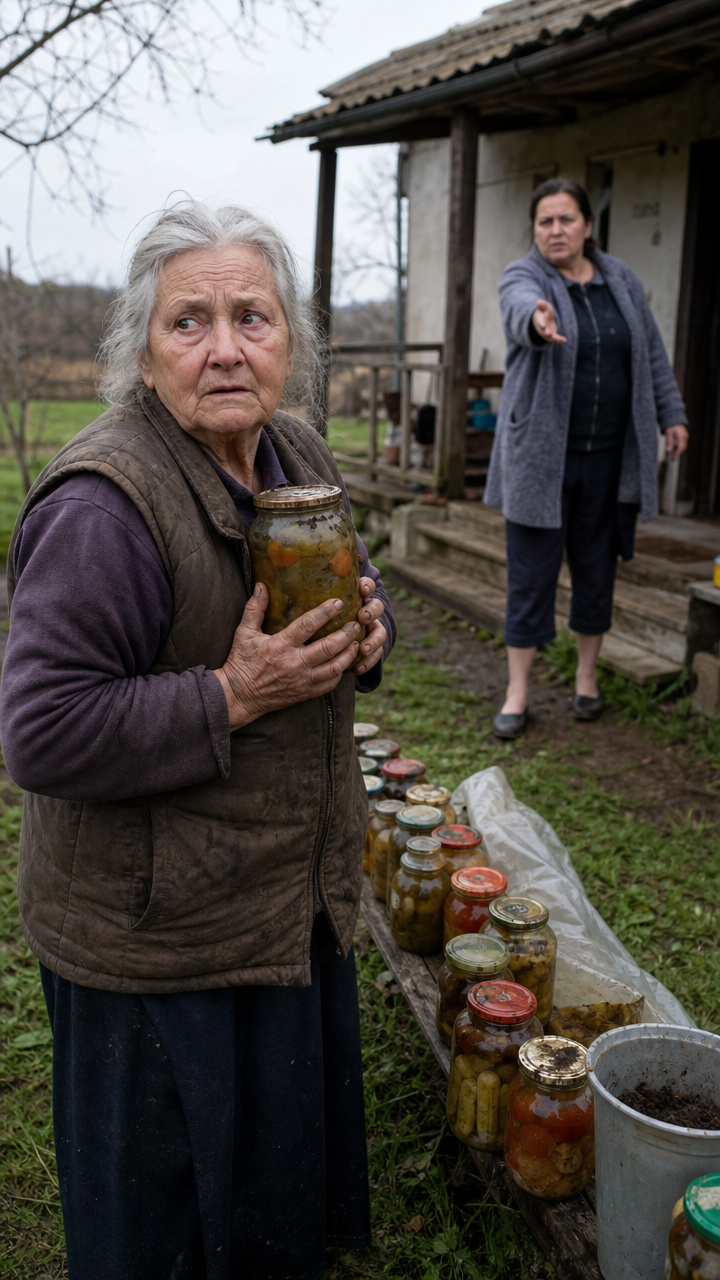
“You’re living like it’s a hundred years ago, Margaret. The smell from all those jars has taken over the whole house, so I put them outside. Let them air out.”
Margaret froze on the porch and stared silently at the ground beside the gate. On the wet grass, beneath a heavy gray September sky, her jars stood in a neat row.
Pickles. Tomatoes. Pepper relish. Plum jam. Cherry preserves. The hot sauce she had started cooking before sunrise so the kitchen would not turn into a furnace.
She had sealed every jar herself. She checked each lid carefully, turned the jars upside down on a towel, wrapped them in an old quilt, and smiled whenever the center of the lid sank perfectly without the slightest bulge.
Now everything stood outside in the open air, as if it were useless clutter nobody wanted.
“Claire,” Margaret said quietly. “Why did you do this?”
Claire stood on the porch in a pale tracksuit, her phone in one hand and her perfectly styled hair untouched by the damp country air. She looked as though she had spent the night in a boutique hotel and had just stepped out of a salon, not woken up in a farmhouse.
“Because it’s impossible to breathe in there,” she replied with a grimace. “First the goat is screaming, then there are jars everywhere, and the whole house smells like garlic. We’re not living in a museum of country life.”
Margaret curled her fingers into her palms until her nails pressed painfully into the skin.
She could have stayed silent. She had done that for years. She had stayed silent when Claire first visited the farm and announced that the place was “nothing but mud, mosquitoes, and nowhere to go.”
She had remained quiet when Claire pushed away a bowl of homemade cottage cheese, then secretly asked her husband to pack the same cheese in a container because “the baby needs healthy food.” She had said nothing when Claire never called her “Mom” or even “Mrs. Carter,” but referred to her simply as:
“She sent more of those jars again.”
Or:
“Tell her to use less dill next time.”
Margaret swallowed every insult. For her son. For her grandson. For the sake of peace in the family.
They had not come merely to visit the day before. Her grandson Ethan had graduated from the university in Chicago and had brought his diploma home to show them. Margaret had been at the stove since early morning, frying potato pastries, roasting chicken, making spiced apple cider, and slicing a salad from tomatoes grown in her own garden.
She had waited for that diploma almost as if it were her own. Ethan had been the first to enter the kitchen—tall, smiling, and dressed in a new shirt.
“Grandma, look,” he said, placing a red folder on the table. “You always said you wouldn’t believe it until you saw it yourself.”
Margaret brushed her fingers carefully over the gold lettering and, to her own surprise, began to cry.
“Oh, my darling boy… I lived to see it. Your father never managed to finish school. Those were difficult years. But you did it.”
Claire let out a weary sigh.
“Mom, please don’t start. It’s only a diploma.”
Only a diploma.
To Margaret, those papers represented far more than printed letters. They carried the years when she sent Ethan money and care packages to Chicago—potatoes, homemade cheese, preserves, and whatever she could spare from her pension. They carried the cracks in her hands from working the soil, the mornings that began before dawn, and the endless hours she spent bent over the garden.
Then came the incident that finally pushed Claire past her limit.
Daisy, the white goat—stubborn, restless, and endlessly curious—slipped into the house while everyone was distracted. She spotted the red folder on the table, stretched her neck toward it, and managed to bite the corner of the cover.
“Oh, Daisy!” Margaret cried. “What are you doing, you foolish girl?”
Claire sprang to her feet as if the house had caught fire.
“This is ridiculous! You let an animal walk through the house! Right beside the table! Next to important documents! Do you even understand what that is? It’s an official diploma!”
Ethan sat pale and silent, staring at the damaged folder. Margaret led the goat outside, came back in, and said only:
“You drink her milk. You take the cheese. You take the butter, too. So the food is good enough for you, but the goat herself is disgusting?”
Claire gave no answer, but her expression turned cold. The next morning, Margaret found the jars lined up outside the gate.
Their neighbor Helen had stepped out to fetch water and heard everything. She looked at Margaret, then at Claire, then at the jars. For a moment, it seemed she might say something. Instead, she adjusted her scarf and walked back into her own yard.
For some reason, that hurt Margaret more than Claire’s words.
Every year, Margaret gave Helen jars of jam. When Helen’s husband had suffered a stroke, Margaret brought them milk, hot soup, and fresh bread. Yet now Helen had simply looked away and left.